Riding a Rented Quad on Wyoming Public Land
A rental agreement does not automatically make a quad legal to ride on every public route in Wyoming. Before you leave the rental lot, check whether the machine has a current Wyoming ORV permit, confirm where it may be ridden, and understand the land manager’s rules. A few questions up front can prevent a frustrating trip—or a citation.
Check the quad’s permit before you leave
Wyoming’s off-road vehicle permit applies to the machine, not simply to the person who rented it. That means your home-state registration or permit does not necessarily satisfy Wyoming’s requirements. Visitors should not assume a rental is exempt because it belongs to a business, or that a permit from another state will be accepted. Wyoming does not generally offer reciprocity for out-of-state ORV registrations; see Wyoming ORV Reciprocity Rules.
Look for the Wyoming decal on the quad and ask the rental company to confirm that it is current and belongs to that machine. A receipt, a verbal assurance, or a decal on another vehicle in the rental fleet is not a good substitute for checking the actual quad. If the decal is missing, damaged, hard to read, or appears to be for a different machine, get the issue resolved before you ride.
The rental provider may include the permit as part of its fleet preparation, but do not treat that as guaranteed. Ask directly: “Does this specific quad have its Wyoming ORV permit, and is it valid for the public routes I plan to use?” A clear answer is more useful than assuming that the rental company has handled every requirement. For more on this distinction, see Does a Rental Carry Its Own Permit?.
| Before riding | What to check | Why it matters |
|---|---|---|
| Wyoming permit | Find the decal on the rented quad and ask the provider to confirm it is current | Your out-of-state registration may not replace Wyoming’s permit |
| Route access | Confirm that the intended road or trail is open to this type of machine | Public land is not the same as unrestricted access |
| Machine fit | Check route width limits and the rental company’s restrictions | A route may exclude a quad that is too wide or otherwise unsuitable |
| Equipment | Ask about the required spark arrester and any local equipment rules | Requirements can vary by land manager and route |
| Rental terms | Confirm permitted riding areas, return conditions, and breakdown procedures | The provider may limit where its machine can go |
The permit is only one part of the check. It does not make a closed route open, grant permission to cross private land, or override a rental company’s limits. It also does not mean that every quad in the fleet is approved for every kind of public route. If the rental provider cannot confirm the decal or the places you plan to ride, pause and ask for clarification before loading up.
If you are arranging a rental rather than picking one up, include permit status in your questions when comparing providers. [Renting an ATV in Wyoming] can help you think through the booking side, but the essential point at pickup is simple: verify the actual machine, not just the company’s general policy.
Confirm that the route is open to your quad
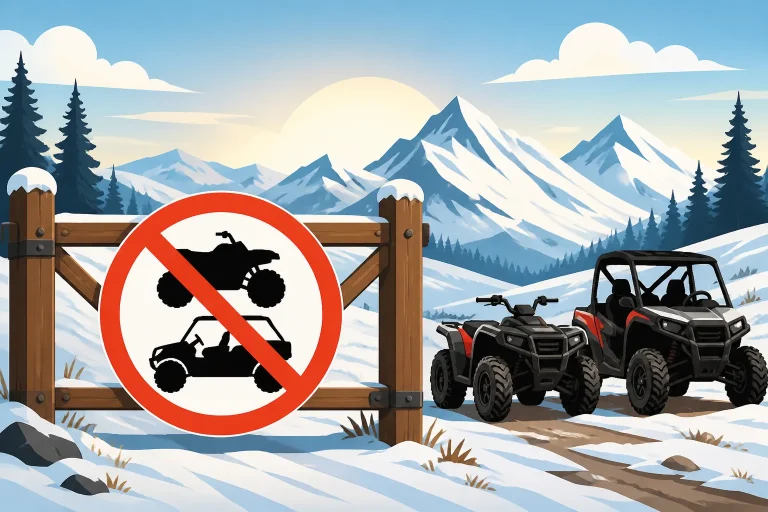
“Public land” describes who manages the land; it does not mean every road, trail, or open area is available to ATVs. A public route may be closed seasonally, limited to certain vehicle types, or subject to a width restriction. Some areas allow motorized travel only on designated routes. Riding beyond those routes can cause environmental damage and may result in enforcement action.
Start by asking the rental provider for the names of routes that are currently open and suitable for the machine you have rented. Then check the relevant land manager’s current map or travel-management information. Federal land can include areas managed by different agencies, and rules on one part of a trip may not carry over to the next. For background, review [Wyoming Rules for Riding a National Forest] and [Wyoming Rules for Riding BLM Land].
A route’s appearance can be misleading. A two-track, an old mining road, or a track visible on a phone map is not automatically an authorized ORV route. Look for a route shown as open to motorized use on the applicable official map, and pay attention to signs and gates on the ground. If the map and a sign appear to disagree, do not assume the more permissive interpretation is correct. Stop and seek direction from the land manager or the rental company before proceeding.
Also make sure the route is open to the kind of machine you are driving. Some trails have width limits, and a side-by-side or wide quad may not fit the same routes as a narrower ATV. Ask the provider for the machine’s width and compare it with the route information rather than judging by sight. [Wyoming Rules for Riding a Designated Route] explains why staying on an authorized route matters; Which Travel Map You Must Carry in Wyoming is useful when planning how to check route status.
Before setting out, have a realistic plan for the whole ride. A route may lead to a junction where the next segment is closed or not open to your vehicle. Note where authorized travel ends and choose a turnaround point in advance. If you are unsure whether a connecting road is enrolled or open, do not use it just because it looks like the easiest way back.
Understand which rules apply on public land
The permit, route designation, and land manager’s rules address different issues. A valid Wyoming decal does not replace rules about closures, equipment, land access, or safe operation. The rules can also differ between public-land jurisdictions, so a rental company’s suggested route is a starting point—not a reason to ignore signs or current restrictions.
Ask whether the quad has the required spark arrester for the area where you plan to ride. Wyoming’s public-land requirements can depend on the machine and the applicable rules, and fire restrictions may add further limits. The rental shop should be able to tell you what equipment is fitted and whether it is appropriate for the intended route. You can also review Wyoming Spark Arrester Requirement. Do not remove, bypass, or modify required equipment.
Pay attention to temporary closures and restrictions. Fire conditions, wildlife protections, weather, and seasonal access can affect where motorized travel is allowed. A route that was open when a rental company made its general trip recommendations may have changed by the day you ride. Check current notices close to departure, then follow any closure signs you encounter. Do not ride around a gate, closure barrier, or sign to reach a route that appears passable.
Public land may be next to private property or land with separate access rules. Stay on the authorized route and do not cross private ground unless you have permission. A public road or trail does not give you permission to leave it and roam across neighboring land. Keep gates as you find them and avoid disturbing livestock, wildlife, or other trail users.
Your rental contract may impose tighter limits than the land manager. For example, the provider may prohibit riding in certain areas, require you to stay within a defined zone, or make you responsible for recovery costs if the machine becomes stuck or breaks down far from an approved route. Those terms do not determine what public land is open, but they can affect what you are allowed to do with the rented quad. Ask for the limits before you sign and make sure the route you want to ride fits both the public rules and the contract.
Use a pickup checklist and know when to stop
A short check at the rental counter can settle most questions before they become problems in the field. Ask the provider to point out the decal and identify the machine it applies to. Ask for a current map or route recommendation, and have the provider explain any limits on where the quad may go. If the answer is vague, request a specific route name or ask the land manager.
Before you leave, use this sequence:
- Match the machine to the paperwork. Confirm the rented quad’s make or identifying details with the rental agreement and ask the provider to confirm the decal is for that machine.
- Inspect the decal. Make sure it is present and legible. If there is a problem, ask the provider to fix it or provide a properly permitted machine before you ride.
- Choose a designated route. Check a current land-manager map or official route information. Confirm that the route is open and allows the type and width of your quad.
- Review restrictions. Ask about closures, seasonal rules, spark-arrester requirements, fire restrictions, and any area-specific conditions.
- Read the rental terms. Confirm where the machine may be ridden, what to do after a breakdown, and how to report damage or an unexpected closure.
- Carry useful information. Keep the route map and the rental company’s contact details accessible. A map on a phone can be useful, but do not rely on a signal being available throughout the ride.
If the quad has no visible decal, the route is not clearly open, or the provider cannot explain whether the machine is allowed there, do not set out and hope it works out. Ask for a different machine, a confirmed route, or a clear answer from the relevant land manager. If you discover a closure after you have started, turn back where it is safe and do not continue past the restriction.
A little preparation protects more than your rental deposit. Staying on an authorized route helps prevent damage to public land, reduces conflict with other users, and makes it easier to handle a change in weather or trail conditions. The best plan is one that works for the quad’s permit, the route’s rules, and the rental agreement at the same time.
Disclaimer
This article is for general informational purposes only and does not constitute professional advice. Laws, prices and regulations vary by location and change over time. Consult a qualified professional for guidance on your specific situation.