Wyoming Rules for an Electric Machine on Trails
An electric ATV, UTV, or dirt bike may be quiet and emission-free, but that does not automatically make every Wyoming trail open to it. The key questions are what kind of machine you have, whether the route allows that vehicle type, and whether a Wyoming ORV decal is required. Sort those out before you haul the machine to a trailhead.
Start by identifying the machine
“Electric machine” describes how it is powered, not its legal category. A battery-powered four-wheeler built for off-road use, an electric dirt bike, an electric side-by-side, and a pedal-assist e-bike can be treated differently. Do not assume the rules for one apply to the others.
A useful first step is to look at the machine’s design and documentation. Does it have pedals that are intended for riding, or is it a motor vehicle with foot pegs? Is it built for one rider or several? Does it have a manufacturer’s vehicle classification, identification number, or off-road use information? Those details may help a permit agent or land manager determine which rules apply.
| Machine type | What to check first | Why it matters |
|---|---|---|
| Electric ATV or quad | Whether it qualifies as an off-road vehicle and needs a Wyoming decal | Its battery power alone does not establish an exemption |
| Electric UTV or side-by-side | Permit status, vehicle dimensions, and the route’s allowed vehicle types | Some trails have width or other vehicle restrictions |
| Electric dirt bike or e-moto | Whether it is treated as an off-road motorcycle and whether the route allows motorcycles | A motorized single-track route may have different access rules from an ATV trail |
| Pedal-assist e-bike | The bike’s legal category and the managing agency’s access rules | A route open to bicycles is not necessarily open to every motorized machine |
If you have a conventional off-road ATV or UTV with an electric motor, start with the Wyoming permit rules rather than assuming the machine is exempt because it has no gasoline engine. The state’s permit system is based on the vehicle and where it is used, not simply on whether it burns fuel. For an overview, see Wyoming ORV Permits Explained and the specific discussion of Wyoming ORV Permit for an Electric Machine.
If your machine is an e-bike or an electric motorcycle that does not fit an ordinary ATV or UTV category, ask the route manager or a Wyoming permit agent how it is classified. A retailer’s description such as “electric trail bike” is not, by itself, a determination that the machine can use every motorized trail.
A permit and trail access are separate requirements
A Wyoming ORV decal does not give a rider blanket permission to travel anywhere on public land. It addresses the permit requirement for eligible machines where that permit applies. Whether the machine may use a particular road or trail is a separate question controlled by the route designation and the land manager.
That distinction is especially important for electric machines. A route may be open to some motorized vehicles but closed to others, or it may have a width restriction that rules out a UTV. A route marked for bicycles or nonmotorized use should not be treated as open to an electric machine just because it is quiet. Noise level and emissions do not replace the posted designation.
Before riding, identify the specific route and the agency that manages it. National forests, Bureau of Land Management lands, state-managed areas, and other properties can have different travel rules. Use the applicable official travel map and check for current closures, seasonal limits, and signs at the trailhead. The general rules for Wyoming Rules for Riding a National Forest and Wyoming Rules for Riding BLM Land are useful starting points, but the route-level designation still matters.
A practical check before a trip:
- Find the official map for the area and locate the exact road or trail you plan to use.
- Confirm that the route is open to motorized use and to your kind of machine.
- Check any width, seasonal, or other restrictions that apply to that segment.
- Look for current closure notices from the land manager.
- Confirm whether your machine needs a Wyoming ORV decal and where the decal must be displayed.
- Recheck the route at the trailhead. A sign or temporary closure may provide information that an older map does not.
For a closer look at route designations, see Wyoming Rules for Riding a Designated Route. If you are considering a UTV, check Wyoming Width Limits on an Enrolled Trail as well. The machine may be electric and still be too wide for a particular trail.
Out-of-state stickers do not settle the question
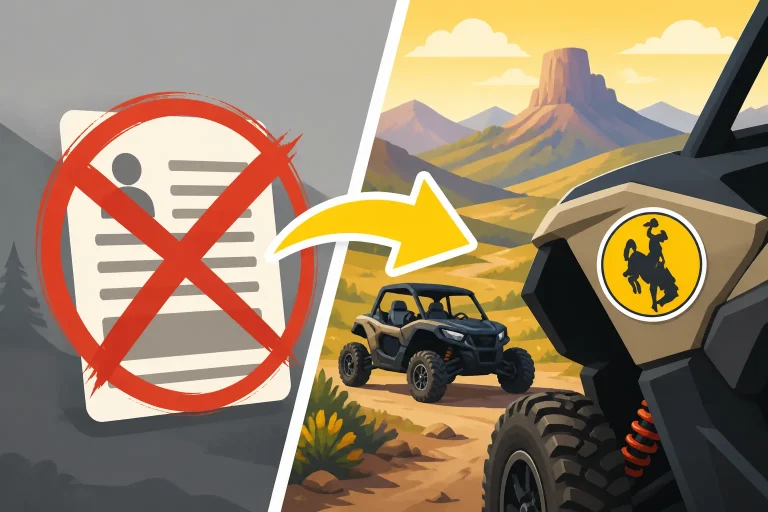
A decal, registration, or permit from another state should not be assumed to satisfy Wyoming’s permit requirement. Wyoming does not generally treat another state’s ORV registration as a substitute for its own permit. That matters for visitors bringing an electric quad or side-by-side across the border, even if the machine is fully permitted at home. See Why Wyoming Honors No Other State’s Registration for the reciprocity issue.
A visitor should settle the permit question before unloading at the trailhead. If the machine falls outside the usual ATV or UTV categories, ask a Wyoming permit agent or the responsible agency to clarify how it is treated. Keep the answer tied to the exact machine and planned use; a general statement about “electric bikes” may not cover an electric motorcycle or side-by-side.
What to verify before you ride
Electric machines can make some usual trail assumptions less reliable. They may be quieter than gas-powered machines, but they still travel under motor power, can encounter the same access restrictions, and may be difficult to recover if the battery runs low far from a road. Check the administrative requirements and plan for the practical ones.
Confirm classification and permit status
Gather the machine’s make, model, year, vehicle identification number if it has one, and any documentation describing its intended use. When asking whether a decal is needed, describe the actual vehicle rather than asking only about “an electric bike.” Include whether it has pedals, a seat, handlebars or a steering wheel, and whether it is built for off-road travel.
If the machine is treated as an ORV and the planned use requires a Wyoming permit, buy the correct permit before riding. Check current instructions for purchasing, displaying, and replacing the decal at Where to Buy a Wyoming ORV Permit. Do not assume that a phone receipt or proof of purchase is a substitute for the required decal; verify the current display rule.
Check dimensions and the exact route
A side-by-side can be too wide for a trail even when it meets permit requirements. Measure the machine as the route authority instructs, rather than relying on a brochure’s general width figure. Accessories, tires, or other modifications may affect the overall measurement. A route that is open to a smaller ATV may not be suitable for a wider UTV.
Also distinguish between a trail and a road. A public road that permits motor vehicles is not automatically an open ORV route, and an ORV trail does not automatically allow every class of vehicle. The map legend, route notes, and signs are more useful than broad assumptions about a whole forest or district.
Plan around battery range
Range figures from a manufacturer are not a guarantee of how far a machine will travel on a Wyoming route. Actual use can vary with terrain, elevation, temperature, payload, riding speed, tire choice, and how often the rider accelerates or climbs. A route with steep grades, soft ground, or repeated elevation changes may use energy faster than a relatively flat route.
Plan a conservative turnaround point and retain enough charge for the return trip. If the trail system has branches, do not count on finding a compatible charging point along the way. Check with the land manager or facility operator before relying on charging at a campground, visitor area, or trailhead. A standard outlet or charger may not be available, permitted, or compatible with your machine.
For a group ride, plan around the machine with the least usable range, not the highest range estimate in the group. Carry the charging equipment specified for the vehicle, but do not assume a portable charger can restore enough range during a short stop. If a machine loses power in a remote area, recovery may require a trailer or another vehicle, so have a basic plan before leaving the staging area.
Respect shared-trail conditions
Quiet operation can make it harder for hikers, horseback riders, or other trail users to hear an approaching machine. Slow down where sight lines are limited, give other users space, and yield as required by posted rules. Avoid using reduced noise as a reason to approach people or wildlife unexpectedly.
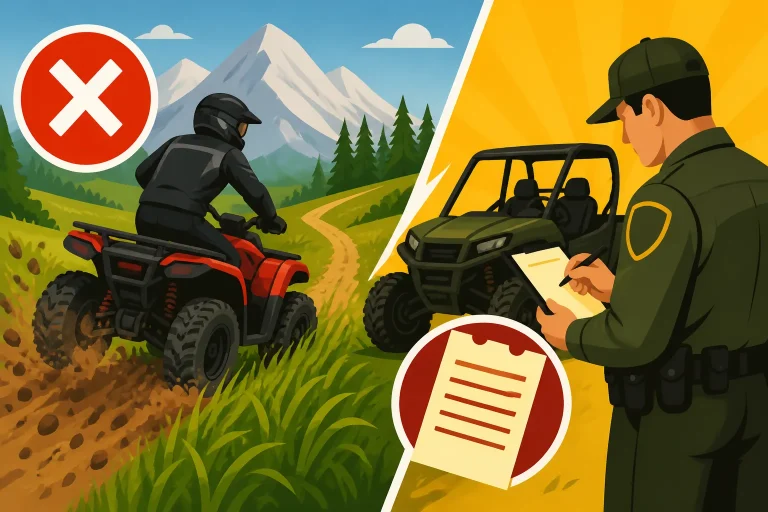
Stay on the designated route. Riding around a wet, rough, or blocked section can widen damage and create a new track that is not open to motorized travel. If a route is closed, choose another confirmed open segment rather than attempting to bypass the closure.
A simple decision process for electric riders
When the rules are unclear, work through the questions in order instead of relying on a broad label such as “electric off-road vehicle.”
- Is the machine a pedal-assist bicycle, an electric motorcycle, an ATV, or a UTV? Use the manufacturer’s documentation and vehicle features to describe it accurately.
- Does the Wyoming ORV permit program apply to this machine and planned use? If the category is unclear, ask an authorized permit agent or the Wyoming program responsible for ORV permits before riding.
- Does the specific route allow that type of motorized vehicle? Verify the official map, route designation, current closure notices, and signs.
- Does the route have a width or other vehicle limitation? This is particularly important for side-by-sides and modified machines.
- Can the battery reliably support the full trip and a safe return? Plan conservatively and do not count on charging being available on the route.
- Are you carrying the required permit and displaying it as directed? Confirm the current instructions before departing.
The most common mistake is treating these as one question: “Can I ride my electric machine in Wyoming?” There is no single yes-or-no answer for every electric vehicle and every trail. The answer depends on the machine’s classification, the permit rules that apply to it, and the designation of the particular route.
For a typical electric ATV or UTV, start by checking whether it needs the Wyoming ORV decal, then confirm that the specific route is open to that vehicle type and size. For a pedal-assist e-bike or electric dirt bike, get the machine’s category clarified rather than assuming that the ATV rules or bicycle rules automatically apply. That extra check can prevent a wasted trip and, more importantly, keep the ride on routes where the machine is actually allowed.
Disclaimer
This article is for general informational purposes only and does not constitute professional advice. Laws, prices and regulations vary by location and change over time. Consult a qualified professional for guidance on your specific situation.