Wyoming Trail Etiquette With Ranchers
Wyoming’s open country can make an ATV or UTV ride feel wonderfully remote, but many routes cross working ranch landscapes where a quiet two-track may also be a stock route, a grazing lease, or access to a ranch operation. This guide explains how to ride respectfully around ranchers, livestock, gates, and private land—and how to avoid turning a good day on the trail into a conflict.
Know who manages the ground beneath the route
A visible track is not always an open route
A tire track can look like an invitation, especially when it runs across a broad stretch of sagebrush or follows a fence line. But a route’s appearance does not tell you whether it is public, private, or open to motorized travel. In Wyoming, riders may encounter public land beside private ranch property, or a public road that crosses a working allotment. Access can change over short distances, so do not assume that a path remains open just because it was open a mile ago.
Before unloading, check the land manager’s current travel information and the specific route you plan to ride. Forest Service maps, BLM travel maps, posted signs, and agency information can help establish where motorized travel is allowed. An app such as onX Offroad can help you examine land boundaries and plan a route, but treat digital maps as one tool rather than permission to ride. If signs on the ground say a route is closed, stop and follow them.
For a wider overview of access on federal ground, read [Wyoming Rules for Riding a National Forest] and [Wyoming Rules for Riding BLM Land]. Those topics help clarify why a road or trail may be open in one section and restricted in another. If you are unsure about a specific route, contact the land manager or landowner before riding rather than trying to resolve the uncertainty from the driver’s seat.
Public access does not erase private boundaries
Wyoming’s patchwork of ownership can be confusing. A route may pass through public land and then approach private property, state trust land, or a ranch inholding. A county road, forest road, or established public route may provide lawful passage in one place without granting access to nearby fields, two-tracks, or ranch roads. Staying on the designated route is part of respecting boundaries.
Do not treat a gate, fence opening, or existing tire marks as proof that you are allowed to go through. A route that appears to connect two public areas may cross private land where permission is required. Avoid riding around a gate, cutting across a corner, or following a parallel track to get around a muddy stretch. Those small detours can take you onto land where you have no right to ride.
If a route’s status is unclear, turn around or ask before continuing. The article [Wyoming Rules for Crossing Private Ground] explains why a public ride does not automatically grant permission to cross private property. For state trust land, check the separate access rules rather than assuming that public ownership means unrestricted recreation; [Wyoming Riding on State Trust Land] offers a useful starting point.
Treat ranch operations as part of the trail
Slow down around livestock
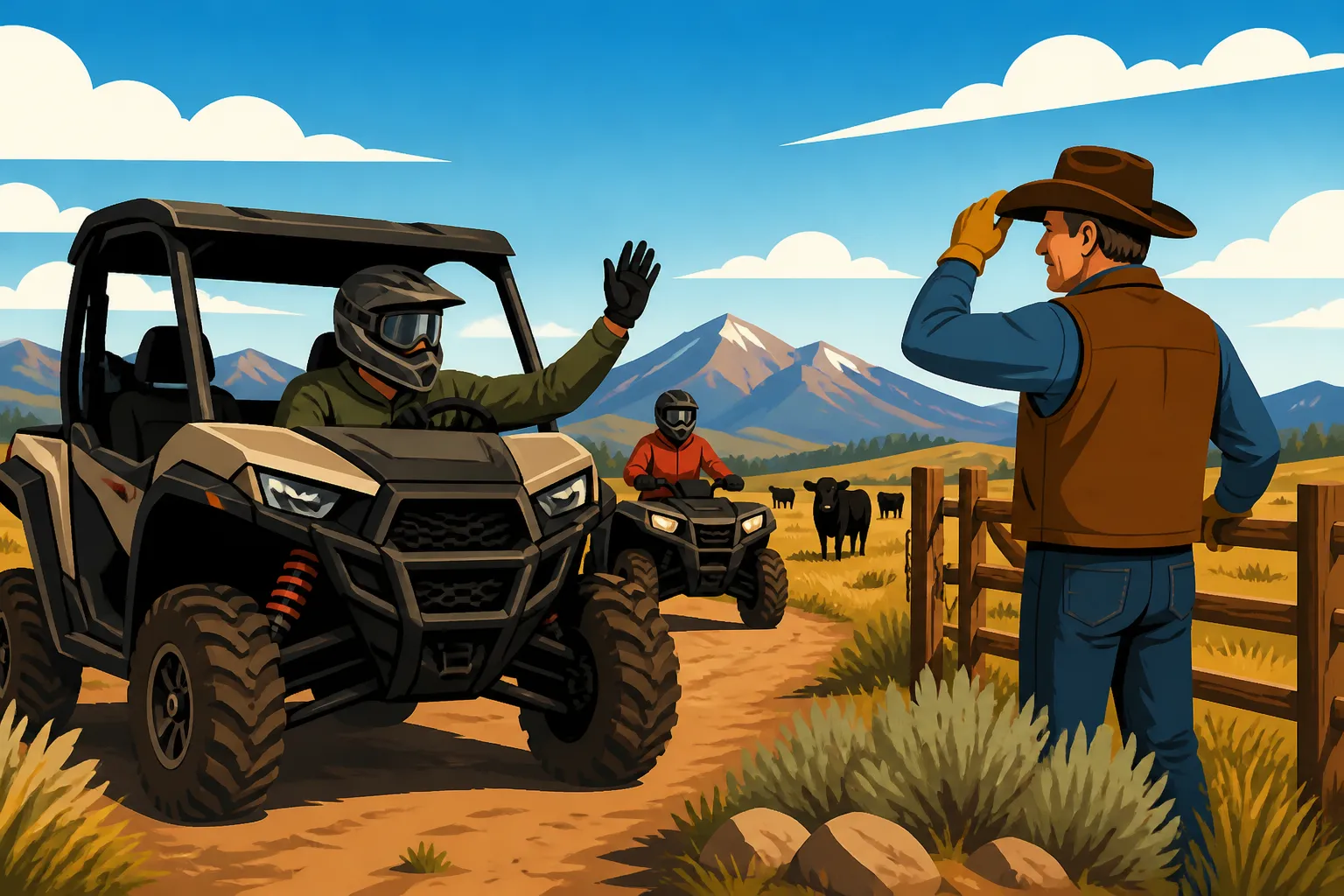
Cattle and horses may be standing near a route, moving along it, or grazing just out of sight around a bend. Slow well before you reach them, keep your machine under control, and give the animals room to move away without being crowded against a fence, ditch, or vehicle. A sudden engine rev or quick approach can startle livestock and make a manageable situation harder.
If animals are on the route, stop at a distance and wait. Keep your engine quiet, avoid honking or shouting, and give the rancher or animals time to direct what happens next. Do not try to push a group forward with your machine or squeeze through a narrow gap between animals. If the herd is moving, let it clear the route when possible. If you cannot pass safely without disturbing the animals, wait or turn around.
This matters even when you are riding a capable side-by-side. A machine that feels stable and predictable to you can still be noisy and intimidating to livestock. Riders can review [Wyoming Rules for Riding Near Cattle] for more on the practical and legal context. In the moment, patience is the simplest tool: stop early, avoid sudden movement, and let the person managing the herd make the call.
Be especially careful during livestock moves
Ranchers may move livestock between pastures, gather animals, check water, or work around young animals. These activities can be time-sensitive, and a group of ATVs arriving at the wrong moment may scatter cattle or disrupt a move. If you see a rancher on horseback, a stock trailer, working dogs, or a group of animals being directed along a road, pull well off the route where it is safe and wait for instructions.
Do not ride through a herd simply because there seems to be space. Animals can change direction quickly, and a machine may split the group or separate a calf from its mother. Keep dogs secured and under control; a loose dog can create a serious problem around livestock even if it is usually calm at home. Riders should also avoid chasing, circling, or filming animals at close range.
A courteous question can prevent confusion: “Would you like us to wait here, or is there another route you want us to use?” Then follow the rancher’s direction if it is safe and consistent with posted access restrictions. If you are planning a club outing, brief the group before departure so everyone knows to stop, stay together, and avoid crowding animals. More detail on access and livestock is available in [Wyoming Rules for Riding a Grazing Lease].
Handle gates, fences, and ranch roads carefully
Leave every gate as you found it
A gate is not a trail marker telling you to keep going; it is part of how a rancher controls livestock. If you find a gate closed, open it only if you are authorized to pass, then close it behind you. If it is open, the safest default is to leave it open unless a sign, landowner instruction, or other clear information says otherwise. Closing an open gate can trap animals away from water or pasture, while leaving a closed gate open can allow livestock to wander.
When riding in a group, assign one person to manage the gate and make sure the last rider confirms its position. It is easy for the first machine to pass through and assume someone behind will take care of it. In a long line of vehicles, the last rider may not realize the gate was left open several machines earlier. A simple call over the intercom or a hand signal can prevent that mistake.
Never climb over, drive around, or force a locked gate to continue a ride. A locked gate can indicate private access, a closure, or a management need. The guidance in [Which Gates You Are Required to Close] and [Wyoming Rules for Opening a Gate] can help riders understand why the gate’s original position matters. When in doubt, do not enter; contact the landowner or land manager for clarification.
Do not use ranch roads as shortcuts
A ranch road may exist to reach a home, water tank, hayfield, livestock pen, or equipment shed. Even when the road looks convenient, it may not be a public riding route. Avoid using private ranch roads as shortcuts between trail segments unless you have permission. A route shown on a map or encountered in the field is not automatically open to recreational vehicles.
If you have permission to cross a ranch road or property, follow the conditions you were given. Those conditions may include staying on a particular track, riding only during certain periods, limiting group size, or avoiding an area while livestock are being moved. Do not treat permission for one trip as permission for future visits, and do not invite others to use the route unless the landowner has agreed.
Riding slowly near ranch buildings, corrals, and equipment is also common courtesy. Keep dust down where you can, avoid unnecessary engine noise, and do not stop in a way that blocks a driveway or work area. If someone is operating machinery or moving a trailer, pull safely aside and let them work. For more background on route access, see [Wyoming Rules for Riding a Ranch Road] and [Wyoming Trespass Law and Off-Road Riders].
Communicate respectfully when access is unclear
Ask before entering private land
If a route appears to cross private property and there is no clear indication that public access is allowed, ask for permission before riding. When possible, make contact before the day of your trip rather than approaching a ranch house unexpectedly with a group of machines. Be specific about where you want to go, how many people are riding, what type of machines you have, and when you expect to be there.
A clear request gives the landowner a chance to say yes, no, or set conditions. For instance, a rancher might allow access on a particular road but ask you to avoid a pasture where livestock are calving. They may also ask you to close a gate, keep the group small, or stay away during a busy work period. Respect the answer even if it means revising your route. Permission is a courtesy, not something to negotiate through pressure.
If access is granted, say thank you and follow through exactly as agreed. Do not bring extra riders, stray from the authorized route, or assume that a friendly conversation means unrestricted access. If you notice a problem such as a damaged fence or an open gate, let the landowner know rather than trying to repair something you do not understand. [Asking a Wyoming Rancher for Access] covers the basics of approaching a landowner courteously.
Keep interactions calm and low-pressure
Ranchers may be busy, handling animals, or dealing with equipment when you encounter them. Give them room to work. Do not crowd a vehicle, block a gate, or stop in the middle of a narrow road to start a long conversation. If they signal for you to stop or move, do so promptly and calmly.
A respectful exchange is usually simple: greet the person, explain where you are headed, and ask whether the route is open to your group. Avoid arguing about what an app, map, or another rider told you. If the person says the route is private or closed, thank them and leave the area by the way you entered if that is safe and allowed. A disagreement on the trail rarely improves access for anyone.
If you are riding with a group, choose one person to speak for everyone. Several riders talking over one another can make a brief interaction feel confrontational. Keep the rest of the group back, turn down engines, and avoid recording the conversation without permission. Good trail manners are not only about following rules; they also shape whether landowners feel comfortable with recreational riders using nearby routes in the future.
Plan rides to reduce conflict and damage
Choose routes with clear access information
A little planning can prevent most awkward trail encounters. Before you leave, identify the routes you intend to ride, confirm the land manager’s guidance, and note where the route meets private property or a closure. Carry an offline map or other navigation option in case cell coverage drops. onX Offroad can be useful for reviewing route lines and land boundaries before a ride, but verify important access details with official maps, signs, or the appropriate land manager.
Build flexibility into the plan. If you find a closed gate, livestock move, washed-out track, or confusing boundary, a preplanned alternate route makes it easier to turn around without frustration. Do not let a tight schedule pressure the group into taking an unverified shortcut. On remote rides around places such as the Bighorn National Forest, the Medicine Bow National Forest, or public-land routes near Rock Springs, a small detour can take you into a very different ownership or management area.
| Situation | Better choice | Avoid |
|---|---|---|
| Livestock are on the route | Stop well back and wait for direction | Revving, honking, or riding through the herd |
| A gate is closed | Pass only if authorized, then close it | Leaving it open or going around it |
| A route approaches private land | Confirm access before entering | Assuming tire tracks mean public access |
| A rancher is working nearby | Give space and follow instructions | Blocking the road or crowding the work area |
| A map and a trail sign disagree | Follow the on-the-ground closure and verify later | Continuing because the app shows a route |
Ride in a way that protects the working landscape
Stay on established, authorized routes. Cutting a new line across grassland can damage vegetation, widen erosion channels, and create a route that other riders may mistakenly follow. Avoid spinning tires, sliding around turns, or leaving the track to pass another machine. These habits can also disturb livestock and create dust that settles on nearby roads, water, or buildings.
Keep noise under control and maintain equipment appropriately. A loud machine can carry a long way across open country, especially when riders accelerate repeatedly or gather near a ranch home. Follow applicable muffler and spark-arrester requirements, and avoid unnecessary idling near people or animals. If a route is muddy, consider turning around rather than creating deep ruts that may worsen after rain or damage a road used for ranch work.
Pack out what you bring in, including food wrappers, broken straps, and other small items that can be easy to miss. Do not leave a machine parked where it blocks livestock access, a gate, or a ranch vehicle. These everyday choices make a noticeable difference to people who live and work near riding areas. For a broader look at responsible riding on public routes, see [Wyoming Trail Etiquette With Ranchers] alongside the land-access guidance in [Wyoming Landowner Permission Rules].
Set expectations before riding with a group
Group leaders can prevent problems by explaining etiquette before engines start. Ask every rider to stay behind the lead machine, keep a safe distance, stop when the group stops, and avoid passing livestock or ranch vehicles without direction. Make sure new riders know that a route’s openness can change and that nobody should take a side trail simply because it looks interesting.
Before departure, identify a person who will handle questions about access and a rider who will sweep the group. The sweep rider can confirm that gates are left as they were found and that no one has been left behind. Agree on a signal for stopping and regrouping, especially if helmets and engines make conversation difficult. A large group should be prepared to split into smaller groups if the route or landowner instructions make that more appropriate.
If a rancher asks the group to wait, move, or leave, communicate the instruction to everyone without turning it into a debate. A calm, organized response shows respect and helps prevent a minor delay from becoming a larger conflict. Keep the route flexible, carry enough supplies to handle a reroute, and make sure every rider understands that access and courtesy matter as much as the destination.
Disclaimer
This article is for general informational purposes only and does not constitute professional advice. Laws, prices and regulations vary by location and change over time. Consult a qualified professional for guidance on your specific situation.