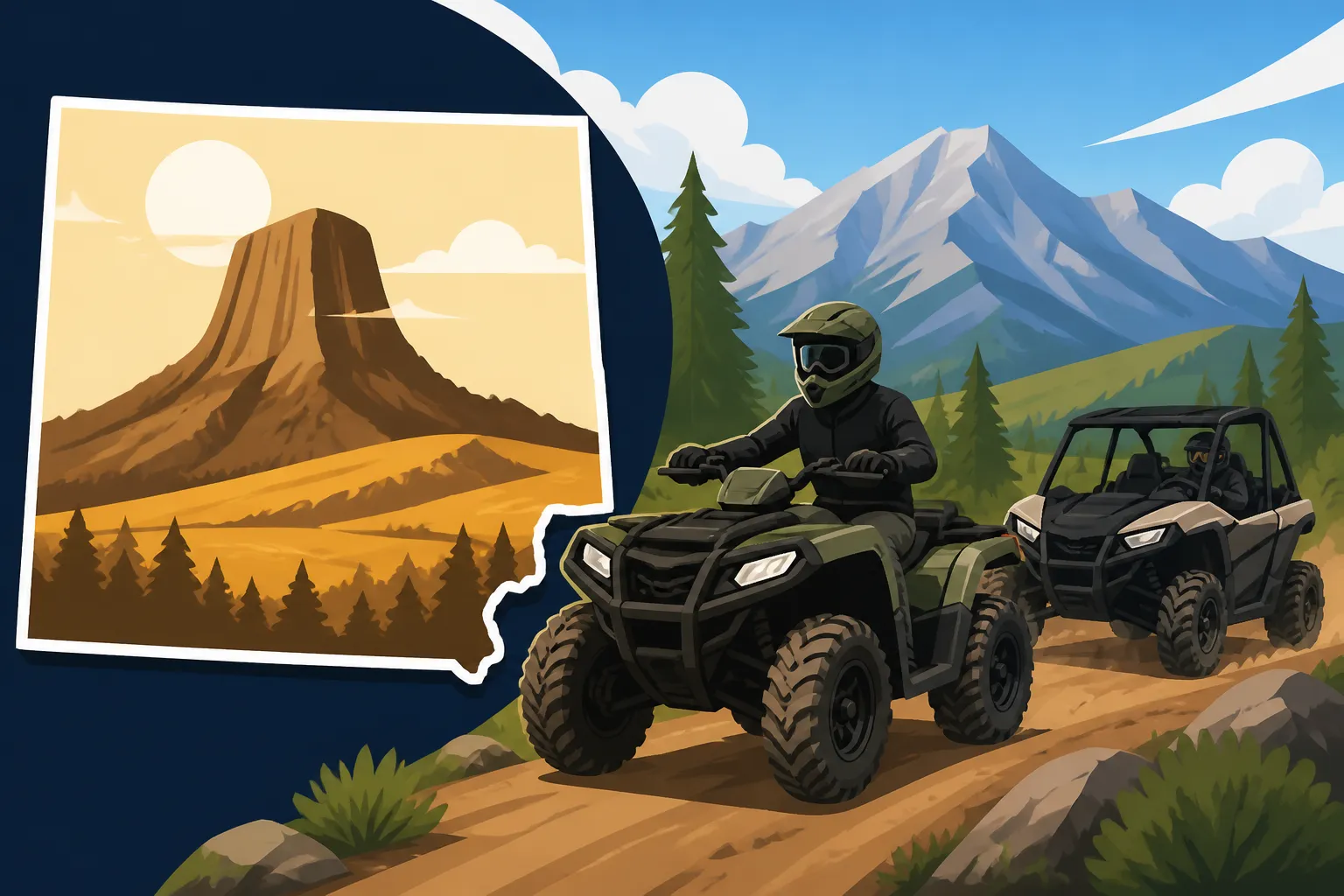
Wyoming Riding Areas Reachable Without a Trailer
If your ATV or UTV is already in Wyoming but you do not have a trailer, the key question is whether you can legally ride it from where it is parked to an open route. A trailhead being reachable by car does not automatically make the road there legal for an off-road machine. This guide explains the difference and helps you plan practical options.
What “reachable without a trailer” really means
Reaching the trailhead by car is not the same as riding there
Many Wyoming riding areas are accessible by ordinary vehicle, but that only solves the trip to the trailhead. If your ATV or UTV is not street-legal, you generally cannot assume you may ride it along public roads from town, a campground, or a rental office to the riding area. A road can look like a convenient connector and still be closed to your machine.
The distinction matters most when a trail system sits near a city. Poison Spider OHV Park, for example, is outside Casper, so it can be convenient to reach by car. That does not mean every road between a hotel and the park is open to off-road machines. Before you ride, check the route itself—not just the destination. [Poison Spider OHV Park Outside Casper] and [Wyoming ATV Trails Near Casper] are useful starting points for understanding the area.
If you are bringing your own machine, “no trailer” usually means you need another way to get it to the trailhead: a street-legal machine on a route where it is allowed, a rental with delivery or staging, or help from someone who can transport it. If you are renting, ask whether the machine is supplied at the riding area or whether you must transport it yourself.
Four practical ways to ride without towing
Your options depend on the machine, your lodging, and the route rules. A street-legal side-by-side may be able to travel on certain designated roads if it meets the applicable requirements and the road is open to it. That is different from having a permit that allows trail riding: an ORV permit is not, by itself, permission to use public roads. Read [Wyoming's MPV Path to the Road] and [Wyoming Rules for Riding a Designated Route] before planning to ride from town.
Renting locally can remove the transport problem, but do not assume every rental includes delivery, a permit, or access to every nearby route. Confirm where pickup happens, which routes the company allows, and whether the machine can be driven on the public road between pickup and the trail. Some tours avoid the issue by transporting riders or machines to a starting point; others begin where the riding is permitted.
A third option is to arrange a shuttle or ride with someone who has a trailer. That may sound less spontaneous than loading up and heading out, but it can save a frustrating day spent discovering that the last few miles to a trailhead are not legal for your machine. When you call a rental provider, outfitter, campground, or local shop, ask specifically: “Can I ride from this location to the open route, or do I need the machine transported?”
Wyoming areas to consider without your own trailer
Casper and Poison Spider
Poison Spider is a practical area to investigate if you are staying in or near Casper. The park is close enough to town to make a car trip to the area manageable, and the riding network offers a different experience from Wyoming’s larger forest and dune landscapes. Still, plan around the exact access road, parking situation, and route status rather than treating proximity to Casper as permission to ride from town.
If you do not have a trailer, start by asking a local rental provider whether it can stage a machine near the riding area or arrange transport. If you already have a street-legal machine, verify every public-road segment between your lodging and the route. Do not rely only on a phone map’s suggested path: navigation apps may show a road without showing whether your vehicle class is permitted there.
The surface and conditions can also affect whether a passenger vehicle can reach a staging point comfortably. After rain, some routes can become muddy or difficult; in dry conditions, dust and loose surfaces can still make a drive slower than expected. Check local conditions and closures before you leave, and keep a backup plan if the access road or riding area is not suitable that day.
Rock Springs and Killpecker Sand Dunes
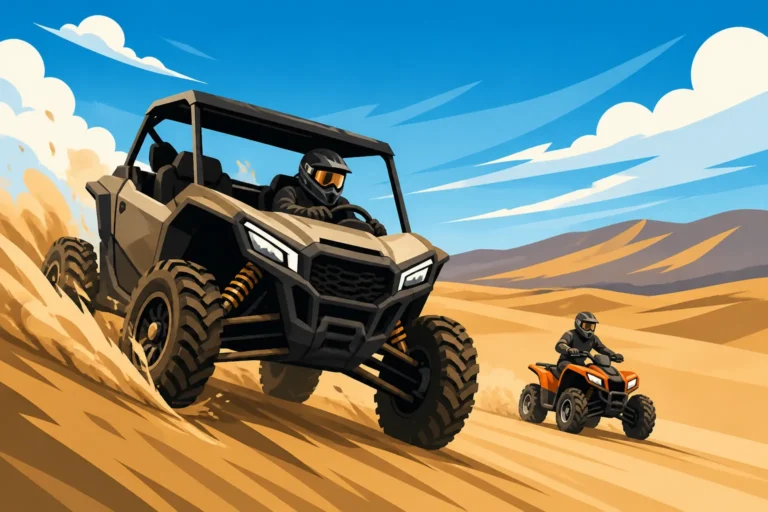
Killpecker Sand Dunes are another area to consider if you are based near Rock Springs. A regular vehicle can take you toward the dunes, but that does not solve the last-mile question for an ATV or UTV you are bringing yourself. Confirm where the riding area begins, where you may park, and whether your machine must be unloaded at a designated access point. [Riding the Dunes at Killpecker] offers more detail on the riding environment.
Dunes also call for more preparation than a quick spin around a nearby trail. Sand can affect traction, fuel use, and how far you can comfortably travel. Bring water, check your fuel range, and agree on a meeting point if your group separates. If you are renting, ask whether the machine is suitable for sand and whether the rental provider allows dune riding. A machine intended for a different route may not be a good fit.
If a standard car is your only vehicle, ask whether you can reach the planned parking or staging area without driving on soft sand. Do not follow another vehicle into an area unless you know it is an appropriate place to drive and park. Sand conditions shift, and a passenger vehicle can get stuck where a machine would be fine.
Laramie, the Snowy Range, and nearby forest routes
Laramie can be a useful base for exploring forest riding, but access is seasonal and route-specific. Snow, spring conditions, and management closures can affect when roads and trails open. A road that appears on a map is not necessarily open to motorized travel, and a route open to one type of vehicle may not be suitable for a wider side-by-side. Start with [Wyoming ATV Trails Near Laramie] and check the current land-manager map before setting out.
Without a trailer, the most workable arrangement may be to stay close to a permitted route, use a street-legal machine only where allowed, or arrange machine transport. Do not plan on connecting a hotel or campground to a trail by riding a public road unless you have verified the road’s designation and your machine’s eligibility. Forest-road access can be especially confusing because some routes are open to motor vehicles while nearby routes are restricted.
A map app such as onX Offroad can help you review route networks and plan where to look for access points, but treat it as a planning aid rather than final authority. Compare what you see in the app with the relevant travel management map and any signs at the trailhead. For broader background, see [Wyoming Trail Maps and MVUMs] and [Wyoming Rules for Riding a National Forest].
Sheridan and the Bighorn Mountains
Sheridan provides access to the Bighorn area, but the mountain setting makes “no trailer” planning more sensitive to weather, elevation, and seasonal closures. A paved approach to a forest road does not guarantee that the road is open to your machine, or that the route continues to an open trail. Look at the specific route and its restrictions before you leave town. [Riding the Bighorns From Sheridan] is a useful place to begin.
If you are relying on a rental, ask whether pickup is in Sheridan, whether the provider transports machines, and which forest routes are permitted. If you are considering riding a street-legal machine from town, check each road segment and the machine requirements—not just the destination. Mountain weather can also change quickly, so leave room to turn around if snow, mud, or a closure makes your planned route unsafe or unavailable.
In any forest area, carry the relevant map and obey signs on the ground. If the map and a posted closure seem to conflict, stop and confirm before continuing. [Wyoming Rules for Riding a National Forest] explains why route designation matters.
How to choose the right no-trailer option
Compare your transport choices
| Option | Best fit | What to confirm first |
|---|---|---|
| Street-legal machine | Riders whose machine and route both qualify for road use | Road designation, equipment, license and insurance requirements |
| Local rental | Visitors or riders without a tow vehicle | Pickup location, delivery, permitted routes, permit status and return arrangements |
| Rental tour | Riders who want a guided outing without handling transport | Meeting point, what the tour includes, passenger and driver requirements |
| Shuttle or borrowed trailer | Owners bringing a non-street-legal machine | Drop-off point, parking, trailhead access and return pickup |
| Riding from nearby lodging | Only where the entire route is legally open to the machine | Each road segment, private-property permission and current closures |
The simplest option is not always the one with the shortest distance. A rental located near town may still require a trailer to reach a trail. A trailhead that is easy to drive to may have limited parking or no suitable place to unload. Ask questions before booking or setting off, especially if you are traveling with a group and several machines.
For a street-legal route, review the requirements before you assume your machine qualifies. Wyoming’s rules for road use are distinct from trail permit rules. Learn about road requirements through [Wyoming MPV Street Legal Requirements] and [Wyoming ORV Permit for a Visiting Rider]. A permit for riding public off-road routes should not be mistaken for a road license.
Use maps, signs, and local confirmation together
A useful plan combines three things: a map, current information from the land manager, and signs at the location. onX Offroad can help you visualize roads and nearby riding areas, especially when you are comparing a town, campground, and trailhead. But app lines do not replace official route designations. Confirm whether the specific road is open to your machine, and whether its status changes by season or vehicle width.
Before leaving, write down the name of the access road, the legal parking or staging point, and the route you intend to ride. Save the map for offline use if service may be unreliable. If you are unfamiliar with the area, call a local rental shop or land-management office and describe the exact vehicle you have. “Can I ride there?” is less useful than “Is this road open to a non-street-legal ATV between this parking area and the designated route?”
At the trailhead, follow posted restrictions even if your planning map suggests a route is open. Closures can be seasonal, temporary, or related to weather and land-management needs. If you encounter an unexpected closure, turn around rather than trying an unmarked two-track as a shortcut.
A simple plan for your first ride without a trailer
Confirm the machine and route before you travel
First, identify exactly what you are riding: ATV or side-by-side, street-legal or off-road-only, and, for a UTV, its width. Those details can determine which roads and trails are appropriate. A wide side-by-side may be excluded from some trails even when nearby roads are open. Check the route rules and the machine’s requirements before you build your day around a particular trailhead.
Second, choose the transport arrangement. If you own a non-street-legal ATV, decide how it will reach the designated riding area. If you are renting, ask where the machine will be handed over and whether you can ride it from that point. If the answer is unclear, request a specific pickup or staging location rather than relying on a general statement that the rental is “near the trails.”
Third, verify permits and land access. Wyoming’s permit requirements and route rules are separate questions: you may need the appropriate permit and still be required to stay on designated routes. Start with [Wyoming ORV Permits Explained] and [Wyoming Rules for Riding a Designated Route]. If you are visiting from another state, check the visitor-specific guidance instead of assuming your home-state registration covers Wyoming riding.
Pack for delays and leave room to change plans
A no-trailer day can be less flexible because you may depend on a rental appointment, shuttle, or limited staging location. Bring water, suitable clothing, basic tools, and a charged phone. In remote areas, cell service can be limited, so tell someone where you plan to ride and when you expect to return. On dunes or mountain routes, allow extra time for conditions that slow travel.
Have a second choice in mind in case the access road is closed, the weather turns, or the rental provider cannot deliver the machine where expected. That backup might be another permitted route, a guided outing, or a shorter ride near your confirmed staging point. A little flexibility is much better than trying to force a plan through an unsigned or uncertain road.
The most reliable rule is simple: confirm how the machine reaches the riding area before you focus on the ride itself. A nearby town, a visible trail on an app, or an easy drive to a parking area does not establish that an ATV or UTV may travel the connecting road. Check the route, confirm the transport plan, and let the conditions on the ground guide the final decision.
Disclaimer
This article is for general informational purposes only and does not constitute professional advice. Laws, prices and regulations vary by location and change over time. Consult a qualified professional for guidance on your specific situation.