Spark Arresters on Wyoming Trails
A spark arrester can look like a small exhaust part, but on some Wyoming routes it can determine whether your ATV or UTV is properly equipped to ride. The tricky part is that rules depend on who manages the land and whether fire restrictions are in effect. Here’s how to check your machine, understand the difference between an arrester and a quiet muffler, and avoid relying on assumptions at the trailhead.
What a spark arrester does and why it matters
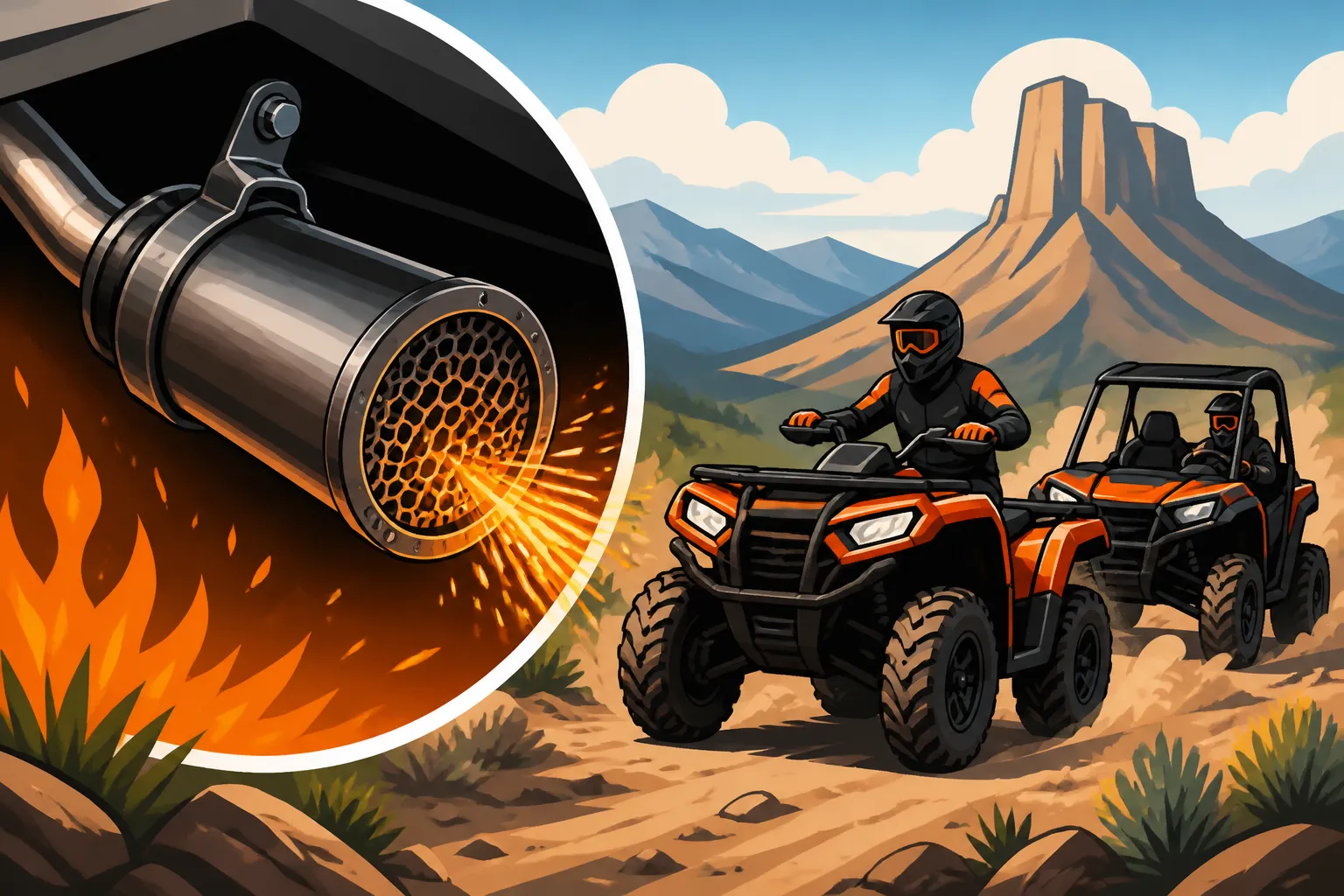
A spark arrester is a device in an engine’s exhaust system designed to prevent hot carbon particles from escaping. Those particles can ignite dry grass, brush or other fuels. The device helps reduce fire risk; it does not make a machine fireproof or remove the need to follow closures and fire restrictions.
ATVs and UTVs typically have an exhaust system designed for the machine’s original configuration. Depending on the make, model, year and exhaust parts fitted, that system may include a spark arrester. But the appearance of the muffler alone does not establish that an arrester is present, approved where required, or working properly.
This distinction matters because a machine can have a muffler and still lack an effective spark arrester. A muffler mainly reduces exhaust noise. A spark arrester is intended to stop sparks or hot particles from leaving the exhaust. Some components serve both functions, but one should not be treated as proof of the other.
On National Forest System lands, a federal rule prohibits using an internal-combustion engine without a spark arrester that is approved by the USDA Forest Service, properly installed, maintained and in effective working order. That requirement is a key reason riders should check their exhaust system before using a national forest route. For more about the surrounding riding rules, see [Wyoming Rules for Riding a National Forest].
A spark arrester requirement is separate from an ORV permit or decal. A decal does not certify that a machine’s exhaust system meets land-manager requirements. Likewise, an arrester does not give permission to ride a route that is closed or not designated for your machine. Wyoming riders should check the permit rules and the specific route rules separately; Wyoming ORV Permits Explained covers the permit side.
Where the requirement applies in Wyoming
“Wyoming trails” does not mean one set of rules applies everywhere. Routes can cross or border land managed by different agencies, and requirements may also change with temporary fire orders. Before riding, identify the land manager and check the current rules for the area and route you plan to use.
National forests
The Forest Service requirement is especially important on National Forest System lands. The federal regulation calls for a Forest Service-approved spark arrester that is installed, maintained and effective. A damaged, missing, modified or clogged device may not satisfy that standard even if the machine originally came with one.
Forest units can also issue fire restrictions that affect where and when people may ride. Those restrictions may apply to particular areas, activities or periods of elevated fire danger. Do not assume that a route is open—or that a machine is compliant—because you rode it previously without an issue. Check the local forest’s current alerts and orders as well as the route map.
Bureau of Land Management routes
BLM-managed land has its own rules, route designations and fire restrictions. Requirements can depend on the applicable regulation, local order and conditions in effect. Do not assume that a rule applying on a national forest automatically describes every BLM route, or that the absence of a forest-style inspection means an exhaust modification is acceptable. Check the rules for the specific field office or recreation area. [Wyoming Rules for Riding BLM Land] explains why the land manager and route designation matter.
Fire restrictions can change quickly, and they may address more than spark arresters. An area may limit vehicle use, prohibit certain activities or close routes altogether. A spark arrester is not an exemption from a closure. Follow posted signs and current agency notices, even if a map or an older trip plan suggests the route should be open.
State, county and private land
State recreation areas, county routes and private property may have different requirements. On private land, permission from the owner is not a substitute for any applicable fire or equipment rules. On state or county-managed land, check the responsible agency or local authority instead of assuming that federal requirements apply in exactly the same way.
Wyoming’s enrolled roads and trails also do not erase the rules of the land manager responsible for a segment. An enrolled route may still have seasonal closures, equipment requirements or other conditions. Check both the route’s status and the land manager’s current orders; [Wyoming Rules for Riding a Designated Route] is useful background.
| Riding area or situation | What to check | Practical approach |
|---|---|---|
| National Forest System land | Forest Service spark arrester requirement, route status and local orders | Confirm the arrester is approved, installed and effective; review the forest’s current notices |
| BLM land | Applicable rules, route designation and current fire restrictions | Check with the relevant BLM office for the riding area |
| State or county land | Rules from the agency or authority managing the route | Verify equipment and closure requirements before unloading |
| Private property | Owner permission and any applicable restrictions | Ask about local fire conditions and permitted routes |
| Any area under a fire order | The order’s wording, boundaries and dates | Follow the order; do not rely on an old map or past access |
This is why it is worth checking more than one source before a ride. A trail map helps identify routes, but it may not show a new closure. A machine permit covers a different issue from an exhaust requirement. If a sign on the ground conflicts with an old plan, stop and verify the current rule rather than riding through.
How to check whether your machine has an acceptable arrester
Start with the exact machine, not a general description such as “factory exhaust.” Identify the make, model and year, then check the owner’s manual and the manufacturer’s information for the exhaust system fitted to that machine. If the exhaust has been changed, the original manual may not describe the parts currently installed.
The most useful questions are:
- Is a spark arrester included in this exact exhaust configuration? A stock muffler does not prove that it is present. Confirm with the manufacturer’s documentation, a dealer familiar with the model, or a qualified repair shop.
- Does the device meet the approval standard required for the land? For National Forest System land, check for documentation that identifies the device as Forest Service-approved. Do not rely only on a seller’s broad claim that a product is “spark arresting.”
- Is the device still installed as intended? Look for a missing screen, removed insert, altered outlet or other modification. If you are unsure what you are looking at, ask a mechanic rather than dismantling an unfamiliar exhaust.
- Is it maintained and effective? Damage, heavy buildup or a loose part can interfere with operation. Follow the manufacturer’s maintenance instructions.
If the machine has an aftermarket exhaust, contact the exhaust maker or a qualified dealer. Ask for documentation tied to the actual part number and configuration, not just a verbal assurance that the exhaust is suitable for off-road use. A replacement part that fits physically is not necessarily approved for every land-management rule.
Online listings can help identify replacement parts, including listings on Amazon, but a marketplace description is not a substitute for approval documentation. Compare the exact part number with the manufacturer’s information and confirm that it is intended for your machine. If the listing is vague about approval, compatibility or installation, get clarification before buying.
A mechanic or dealer can help identify the arrester and explain the service procedure, particularly if it is integrated into the muffler. Keep the owner’s manual and relevant manufacturer documents with your machine records. Documentation can make it easier to answer questions, but it does not make a damaged or removed component compliant.
For more detail about what “Forest Service rated” means in practice, see A Forest Service Rated Arrester in Wyoming. The key is not simply to find a screen or a label. The device must meet the applicable standard and remain correctly installed and functional.
Do not confuse a spark arrester with a sound check
Noise and fire prevention are separate issues. An exhaust can be loud even if it has an arrester, and a quiet exhaust is not necessarily equipped with one. Some land managers also have sound requirements or conduct sound checks. Passing one does not prove compliance with the other. The related rules are covered in Wyoming Spark Arrester and Sound Rules and What Happens at a Trailside Sound Check.
Avoid removing a screen or insert to improve exhaust flow or change the sound without first confirming the consequences. That modification could affect whether the machine meets the rules for the land you plan to ride. If the exhaust has been changed by a previous owner, do not assume it is legal because the machine runs well or has passed an inspection elsewhere.
Inspecting and maintaining the exhaust system
A quick check before loading can catch obvious problems, but it cannot replace proper service. Inspect the exhaust when the machine is cool, and follow the manufacturer’s instructions. Exhaust parts can stay hot after shutdown, and some components require specific tools or procedures.
Look for visible signs that the system may need attention:
- A screen, insert or other component appears missing or loose.
- The exhaust outlet or housing is cracked, badly dented or visibly altered.
- There is an unusual rattle or change in exhaust sound.
- The manufacturer’s recommended service interval is due.
- The machine has been modified, and you cannot confirm which parts are installed.
A screen that is clogged with carbon can restrict exhaust flow. That is a maintenance issue, not a reason to remove the screen and ride without it. Clean or service the component only as the manufacturer directs. Some arresters are removable and cleanable; others are built into the exhaust assembly. If the instructions are unclear, have a dealer or mechanic inspect it. Replacing a Clogged Spark Arrester covers the practical considerations for dealing with a blocked device.
Avoid improvised repairs. A homemade screen, a part from another machine or a device chosen only because it fits may not meet the required approval standard. Do not drill, cut or modify the exhaust component unless the manufacturer’s instructions specifically allow that work and it preserves the required function.
It is also sensible to recheck the exhaust after a hard ride, especially if the machine has been through rough terrain or taken an impact. A cracked mount or loosened component may not be obvious during a casual walk-around. If you hear a new rattle, smell exhaust where it should not be, or see damage, stop and investigate before entering another riding area.
A few minutes of routine inspection is useful, but riders should not treat visual inspection as formal certification. If compliance is uncertain, verify the exact component and the applicable land rule before the trip. That is easier than trying to resolve a questionable setup after reaching a remote trailhead.
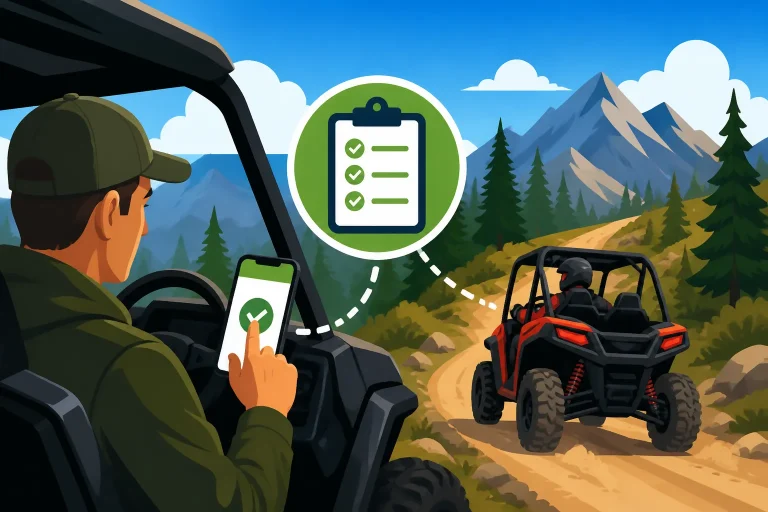
A practical pre-ride checklist
Use this process before riding a new area or taking a machine with a changed exhaust onto public land:
- Identify the land manager. Determine whether the route is on National Forest System land, BLM land, state or county land, or private property. If a route crosses jurisdictions, check each segment.
- Check current access information. Confirm the route is open to your type of machine and review closures, seasonal restrictions and fire orders. Maps can be useful, but check for newer notices.
- Confirm the machine’s exhaust configuration. Use the machine’s exact make, model and year, and account for any aftermarket muffler, insert or other modification.
- Verify the arrester requirement. For a national forest route, confirm the device meets the Forest Service approval requirement. For other land, check the rules that apply to that location and any active order.
- Inspect the part and its condition. Check that the required device is installed, secure and maintained. Do not rely on sound level, a permit decal or the machine’s appearance as proof.
- Carry useful documentation. Keep the manual and part details accessible, especially if the exhaust is not the original configuration. Documentation supports verification but does not replace a working device.
- Recheck before departure. Fire conditions and route access can change. If an order closes the area or prohibits the activity, choose another legal route.
A common mistake is to check only whether a Wyoming ORV permit is displayed. The decal and the exhaust rule address different obligations. Another is to assume that a screen visible at the outlet must be approved. A third is to interpret an open route as permission to ignore a posted fire restriction. Confirm each issue separately.
If a ranger or other authorized officer asks about the exhaust, answer plainly and show the documentation you have. Do not remove or disassemble a hot component at the roadside. If there is genuine uncertainty about compliance, the practical choice is to pause the ride and get a reliable answer before continuing.
Frequently Asked Questions
Does every ATV or UTV in Wyoming need a spark arrester?
Requirements depend on the land and the rules in effect. National Forest System lands have a federal requirement for an approved, properly installed and effective spark arrester on internal-combustion engines. Other areas may have different rules or temporary restrictions, so check the land manager for your route.
Does a stock muffler mean my machine has a spark arrester?
Not necessarily. The exhaust configuration varies by machine, and a muffler by itself is not proof that an arrester is present or approved. Check the documentation for the exact model and any exhaust parts fitted.
Can a quiet exhaust pass as a spark arrester?
No. Noise control and spark arresting are different functions. A quiet exhaust is not proof of an arrester, and an arrester does not automatically meet a separate sound requirement.
Can I ride if the arrester is clogged or damaged?
Do not assume the machine is compliant if the device is clogged, damaged, missing or not working as intended. Follow the manufacturer’s service instructions or have a qualified shop inspect it before riding where an arrester is required.
Disclaimer
This article is for general informational purposes only and does not constitute professional advice. Laws, prices and regulations vary by location and change over time. Consult a qualified professional for guidance on your specific situation.