Wyoming Width Limits on an Enrolled Trail
A Wyoming ORV permit does not mean every ATV or UTV can use every enrolled route. Width limits may apply to a particular trail, and a machine that fits one route may be too wide for another. The key is to check the route’s designation and current land-manager information before you unload, rather than relying on your permit or the machine’s model name.
What a Width Limit Means on an Enrolled Route
Wyoming’s enrolled routes are roads and trails included in the state’s designated riding system by the agencies responsible for managing the land. Enrollment provides access only where and under the conditions shown for that route. It does not turn every road or trail into an open route for every off-road vehicle.
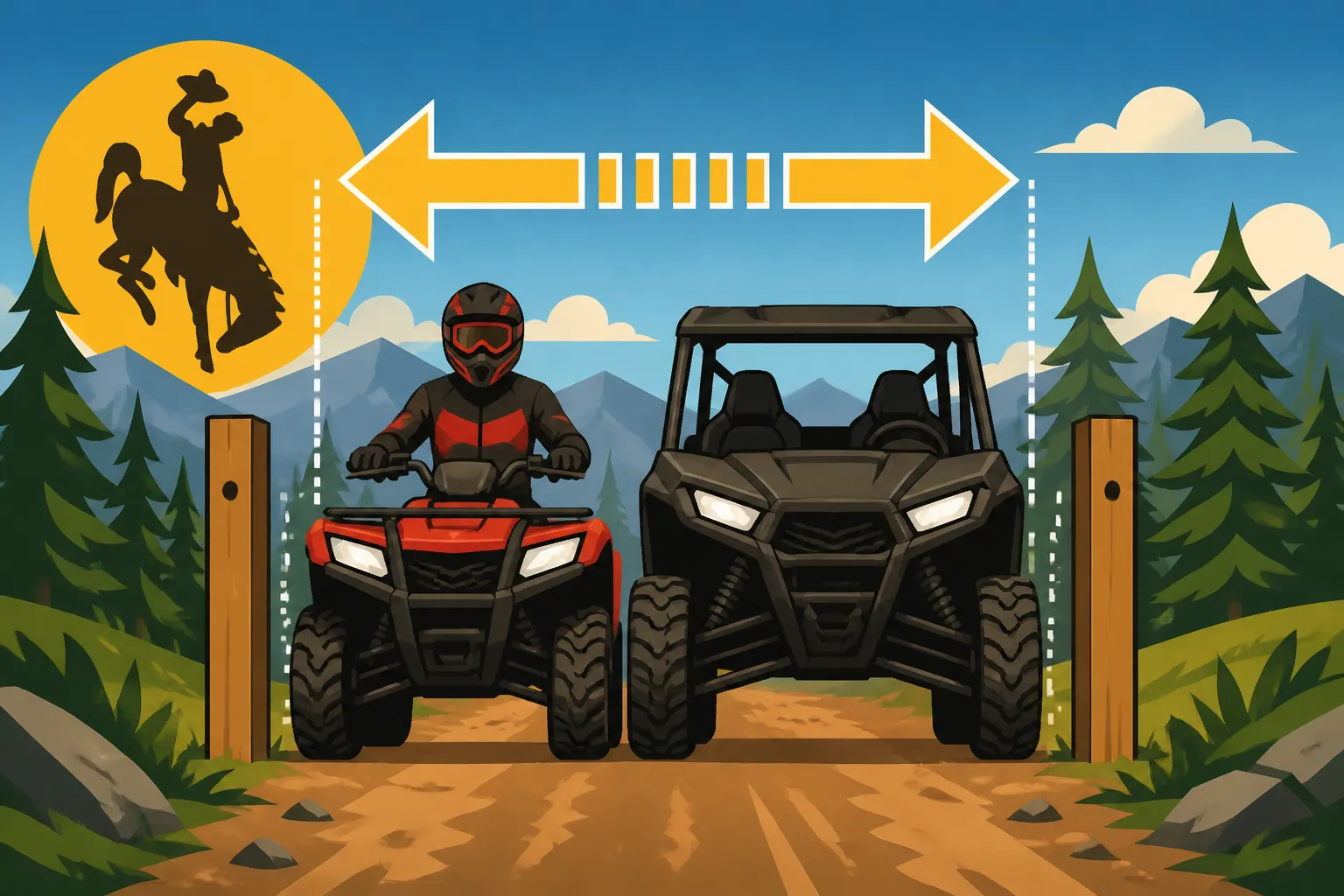
A width limit is a restriction tied to a specific route or route category. For example, a trail may be designated for machines no wider than 50 inches. That does not mean every Wyoming trail has a 50-inch limit, nor that a machine under 50 inches can ride anywhere. The route must still be open to the machine, and other restrictions—such as seasonal closures, surface conditions, or local signs—may apply.
This distinction matters most when moving between machines:
- A narrow ATV may fit a trail designated for smaller vehicles.
- A wider ATV or side-by-side may need to stay on routes that allow its width.
- A vehicle may be narrow enough for a trail but still barred by a closure, vehicle-type rule, or other restriction.
A Wyoming permit and a route’s width designation answer different questions. The permit addresses the machine’s permit requirement; the designation determines where that machine may travel. For a broader overview of route access and enrollment, see Wyoming’s Enrolled Roads and Trails and Which Wyoming Trails Are Held to 50 Inches.
The 50-inch limit is not a statewide blanket rule
The 50-inch figure is useful when a route is specifically marked or mapped with that restriction. It should not be treated as a general allowance for all trails in Wyoming. Some routes may be open to wider machines, while others may have tighter limits or may not be open to motorized use at all.
A route shown as an enrolled road may have different access conditions from a narrow trail. Even within one riding area, a network can include a mix of roads, trails, and connections with different designations. Do not assume that a wide machine can follow a narrow trail just because it can legally travel on nearby roads.
For that reason, look up the exact route rather than asking only whether a riding area is “open to UTVs.” A location may include some routes suitable for a side-by-side and other routes intended for narrower machines.
Your permit does not make a route suitable
The state permit is not a vehicle-width approval. It does not replace the route map, land-manager rules, or a closure sign. A current decal can be valid while the machine is still too wide for a particular trail.
That separation is easy to miss when planning a trip. Riders may focus on buying the permit and reaching the trailhead, then discover that the planned trail is narrower than their machine. Check both requirements before departure: whether the machine needs a Wyoming permit and whether the route allows its width. Wyoming Rules for Riding a Designated Route explains why route designation matters beyond having a decal.
How to Check Whether Your ATV or UTV Fits
Start with the route, then compare its restriction with the machine. The name “ATV” or “side-by-side” alone is not enough to tell you whether a route is suitable. Models vary, and accessories or modifications can affect the machine’s overall dimensions.
1. Find the current route information
Identify the land manager and the exact road or trail you plan to use. Use the relevant travel management map, motor vehicle use map, or other official map for that area, and check any current closure notices. A general recreation map may help you find a trailhead, but it may not show every vehicle restriction.
Wyoming’s enrolled routes can involve different land managers and route conditions. A line on a map is not automatically open to your machine. Read the map legend and route notes, and confirm whether the displayed route has a width designation. For help interpreting maps, see Wyoming Trail Maps and MVUMs and Reading a Wyoming Travel Management Map.
2. Check the machine’s actual width
Look up the manufacturer’s specifications for your exact model, but do not assume the published number matches the measurement used for a particular trail rule. Width can be listed in different ways, and additions such as wheels, tires, spacers, or other accessories may change the machine’s widest point.
If the route has a stated maximum, measure the machine in the way the responsible land manager specifies. When the map or rule does not explain how width is measured, ask the land manager before riding. Do not rely on a rough estimate from a brochure or a visual judgment at the trail entrance.
A tape measure is a simple way to check your machine at home. If you need one, a hardware store or Amazon can be a practical source; the important part is measuring the machine you will actually take, not a similar model. Keep a note of the measurement and the source of the route information with your trip details.
3. Confirm the route is open to your vehicle type
Width is only one part of the check. Look for any rule that limits access by vehicle class, trail category, or season. Also check for temporary closures and local restrictions, especially when conditions or management plans can change.
If your planned route includes several connected segments, check each segment. A wide machine may be permitted on the road leading to a trailhead but not on the narrower trail beyond it. A route may also end where a different land manager’s rules begin.
4. Follow signs on the ground
At the trailhead and at junctions, read posted signs before continuing. Signs may show a closure, a width restriction, or another limit that changes where you can ride. If the map and a sign appear to disagree, do not assume the map gives permission to pass a posted closure. Stop and contact the land manager for clarification.
| What to check | Why it matters | What to do |
|---|---|---|
| Route designation | Enrollment does not mean unrestricted access | Confirm the exact road or trail is open to your machine |
| Width limit | Restrictions can vary by route | Compare the stated limit with your machine’s measured width |
| Machine specifications | Published dimensions may not reflect modifications | Measure the machine as equipped for the trip |
| Seasonal or temporary status | A route may be closed even if normally open | Check current notices and signs |
| Connections between segments | Rules may change at a junction or management boundary | Verify every planned segment |
Planning a Ride With a Wider Side-by-Side
A wider machine does not necessarily rule out a Wyoming ride. It does mean you should plan around routes that permit its width instead of assuming that every trail in the area is available. Roads and trails may have different designations, so a route network can offer options for a UTV even when a particular narrow trail is off limits.
Before loading, make a route plan with at least one suitable alternative. Mark where you will turn around if the route becomes restricted, and avoid treating a narrow connection as a shortcut. A wide machine should not leave an authorized route to bypass a restriction or reach a route that it cannot legally use.
If your group has both narrow ATVs and wider UTVs, agree on a route that all machines can use. A trail that works for one rider may create a dead end for the rest of the group. Check the route’s posted conditions for the widest machine in the party, not just the machine that is easiest to fit.
A few practical steps can prevent a costly or frustrating mistake:
- Confirm the planned route and its width limit before you travel.
- Check the actual machine, including any modifications that affect width.
- Review current map information and closures close to the trip.
- Ask the land manager when the measurement method or route status is unclear.
- Recheck signs at the trailhead and junctions.
- Keep a legal alternative ready if the route is closed or too narrow.
If a trail is specifically limited to 50 inches, do not try to judge by whether your UTV can physically squeeze through. The applicable rule is about authorized access, not whether the machine can pass between trees or obstacles. Use a route that allows your machine’s width. For practical guidance on width measurement, see Measuring Your Machine Tire to Tire.
The same principle applies when a route seems wide enough on the ground. A broad, well-maintained track is not proof that a wider vehicle is permitted. Use the official designation, and treat the physical appearance of a trail as a safety consideration—not as permission to ride it.
What to Do When the Limit Is Unclear
Sometimes a map has no obvious width label, a route description is incomplete, or a rider cannot tell whether a limit applies to one segment or the whole route. In that situation, avoid guessing. Contact the agency or land manager responsible for the specific area and ask about the exact route, your machine’s width, and how the measurement is taken.
Give the person you contact useful details: the route name or map location, the machine’s make and model, its measured width, and any modifications that might affect the measurement. A precise question is more likely to get a useful answer than asking generally whether “UTVs are allowed.”
If you cannot confirm access before the ride, choose a route with clear information or leave the uncertain segment out of the plan. A permit, a map line, or another rider’s account should not be treated as a substitute for a current route designation. When signs at the site indicate that the trail is closed or restricted, stop and follow the posted direction.
A little checking before departure is especially worthwhile for a side-by-side, since width can limit route choices even when the vehicle is otherwise permitted for the area. The simplest rule is: match the machine to the route, not the route to what the machine can physically manage.
Disclaimer
This article is for general informational purposes only and does not constitute professional advice. Laws, prices and regulations vary by location and change over time. Consult a qualified professional for guidance on your specific situation.