Night Riding With Proper Lights
Night riding in Wyoming raises two separate questions: whether your ATV or UTV has the required lights, and whether you may ride that route after dark at all. The answers depend on the route’s designation and your machine’s status. Here’s how to check the lighting rule, permit requirements, and route access before you set out.
Wyoming’s night-light rule
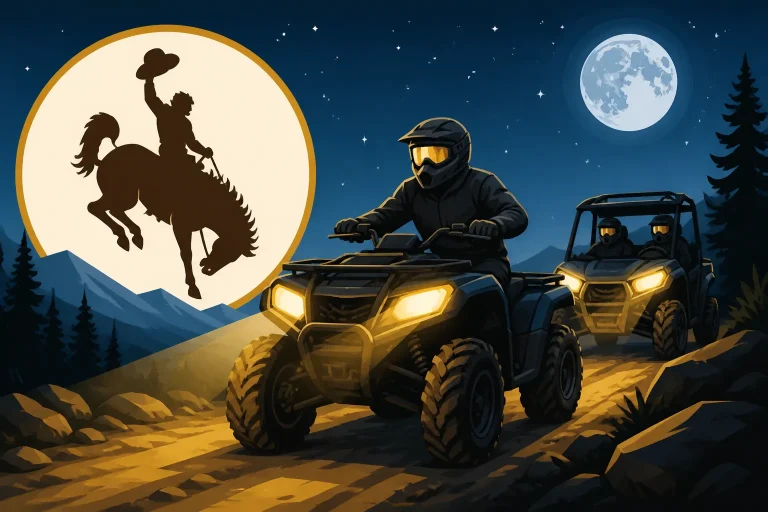
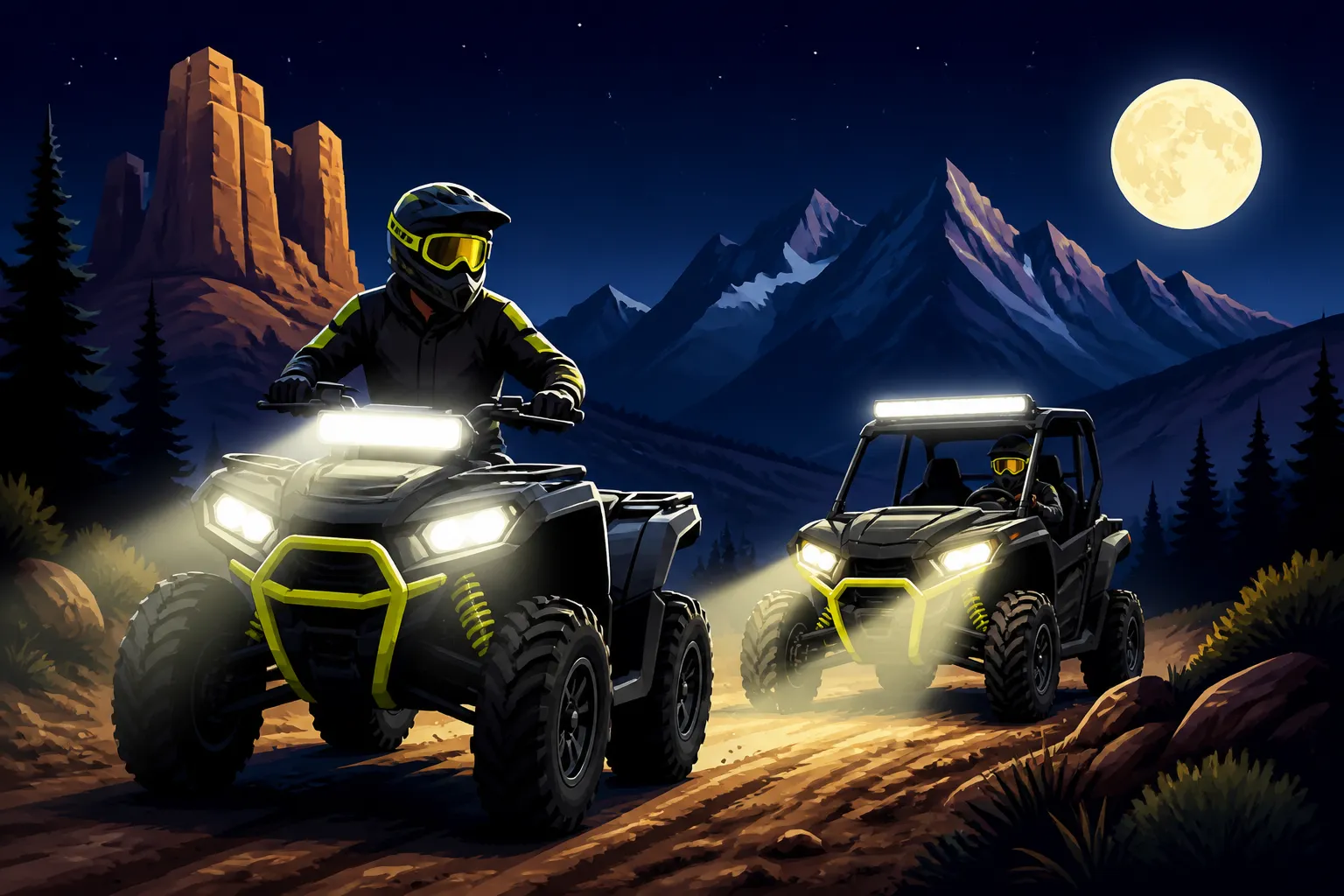
Wyoming State Parks, Historic Sites, & Trails requires an ORV on a road identified as part of the Wyoming ORV Program to have a working headlamp, taillights, and brake light when operated from one-half hour after sunset to one-half hour before sunrise. The requirement is about the vehicle’s operating lights, not simply carrying a flashlight or adding a decorative light bar.
Use that window as your practical cutoff when planning a ride on an enrolled ORV road or route. Check sunset and sunrise for your location, and give yourself time to finish the ride or reach a place where you are allowed to stop before the required lighting period begins.
| Where you ride | What to confirm before riding at night |
|---|---|
| Road or travel route enrolled in the Wyoming ORV Program | A current Wyoming ORV sticker and working headlamp, taillights, and brake light during the required night period, according to Wyoming State Parks, Historic Sites, & Trails |
| Enrolled ORV trail | A current Wyoming ORV sticker and permission to use that specific trail; Wyoming State Parks, Historic Sites, & Trails says the lighting rule applies when operating during the night period |
| Road not enrolled in the program | The machine must be licensed and street legal, with the equipment required for street-legal use |
| Route marked closed or not designated for your vehicle | Do not ride it; lights and a permit do not make a closed or unauthorized route open |
The state’s listed street-legal equipment for an un-enrolled road includes a headlamp, taillight, brake light, red rear reflector, horn, and left-hand rear-view mirror. That equipment list is broader than the basic nighttime lighting requirement for a vehicle traveling on an enrolled program road. If you plan to use both kinds of roads, check that your machine meets the rules for each road rather than assuming one set of equipment covers every situation.
A light bar or auxiliary lamp may help you see, but it does not replace the required working headlamp, taillights, or brake light. Nor does having bright lights establish that a road is open to ORVs. For the distinction between nighttime equipment and other operating rules, see Wyoming Rules for Riding After Dark.
Check the route before you leave
Lights are only one part of a night ride. Wyoming State Parks, Historic Sites, & Trails says ORVs may be operated only on roads, trails, or areas designated as open by the appropriate land manager. A familiar road can have a seasonal closure, a temporary restriction, or a designation that does not allow your machine. Check the current map and signs for the area rather than relying on memory or a route shared by another rider.
For a Forest Service ride, visitors should obtain the relevant motorized vehicle use map to identify open roads and trails. On Bureau of Land Management land, check the current travel information for the specific area as well. The state’s Wyoming’s Enrolled Roads and Trails overview can help explain the program, but the land manager’s current route information is what you need for a particular ride. See also Wyoming Rules for Riding a Forest Road and Wyoming Rules for Riding a BLM Road.
Pay special attention to where a route ends. A legal segment does not automatically make the next road, trail, or connecting track legal for the same vehicle. If a route becomes closed or you cannot confirm its status, turn around rather than continuing in the dark and hoping it connects to an open route.
Night riding also makes it harder to spot gates, loose surfaces, animals, other riders, and changes in trail direction. A conservative plan is to ride a route you have already checked in daylight, keep enough time and fuel to return without rushing, and avoid starting a new route close to the lighting cutoff. Those are practical precautions, not a substitute for following the posted route designation.
Permits, reciprocity, and road status
Wyoming requires its own ORV permit for qualifying ORVs operating on enrolled roads, routes, and trails designated for ORV use. Wyoming State Parks, Historic Sites, & Trails says there is no reciprocity for out-of-state ORV or OHV registrations, so a visitor’s home-state sticker does not by itself meet Wyoming’s permit requirement. For the visitor-specific details, see Wyoming ORV Permit for a Visiting Rider and Wyoming ORV Reciprocity Rules.
A Wyoming permit is valid for a calendar year and applies to residents and non-residents alike, according to Wyoming State Parks, Historic Sites, & Trails. The permit must be displayed while operating on public lands and other designated roads, trails, or areas. If you need to find a sales option before riding, Where to Buy a Wyoming ORV Permit covers the available channels.
The permit does not turn every road into an ORV route. Wyoming State Parks, Historic Sites, & Trails says a vehicle displaying only a Wyoming ORV permit may operate on roadways identified as part of the Wyoming ORV Program. On roads that are not designated for ORV travel and are not enrolled in the program, the ORV must have a current license plate and be street legal. Operators using those un-enrolled roads must also meet the applicable license and insurance requirements.
There is a related distinction for street-legal machines. Wyoming State Parks, Historic Sites, & Trails says a street-legal ORV needs a Wyoming ORV permit when it uses a designated trail that is 50 inches or less in width. Designated ORV trails require the state sticker even if the machine has a license plate. If you are unsure where to put the decal, see Wyoming ORV Decal Placement.
Before riding, match your machine and permit to the route type:
- Identify whether the planned segment is an enrolled road, an enrolled trail, or an un-enrolled road.
- Confirm that the route is currently open to your type of vehicle.
- Check whether your machine needs a Wyoming ORV permit, a street-legal plate, or both for that route.
- Test the headlamp, taillights, and brake light before the ride, and confirm that the decal is visible.
- Check that the operator meets the license or permit rules for the roadway being used.
That last check matters because a decal is not a driver’s license. Wyoming State Parks, Historic Sites, & Trails requires operators using designated roadways with only an ORV sticker to have a valid driver’s license or permit. On an enrolled designated trail, the agency says no driver’s license is required if the ORV displays a current Wyoming permit. Don’t assume that a rule for a trail also applies to a connecting road.
A practical pre-ride lighting check
Test the required lights shortly before departure, not just when the machine comes out of storage. Start the engine if needed, switch on the headlamp, and walk around the machine to confirm the taillights illuminate. Then check that pressing the brake lever or pedal activates the brake light. If a light is dim, intermittent, or out, fix it before riding during the required night period.
Carry a small repair kit suited to your machine and the type of ride, but don’t treat spare parts as a workaround for a failed light. If you order replacement bulbs, connectors, or mounting hardware through Amazon, match the part to your machine’s make and model and verify that it fits before relying on it for a trip. A phone flashlight can help with a roadside repair, but it does not satisfy the vehicle-lighting requirement.
Clean the light lenses and reflectors before leaving. Mud, dust, and scratches can reduce visibility even when a lamp still works. Check that cargo, a rack, or a passenger is not blocking the rear lights. If the machine has been modified, confirm that its lights still operate as intended and that the required equipment remains visible.
Plan for the possibility that a night ride takes longer than expected. A delay, a mechanical problem, or a route that is harder to follow in darkness can push you into the required lighting period. If your lights fail, stop in a safe place and avoid continuing on a route where the required lights are not working. Before setting out, make sure your route plan gives you a way to turn back or reach a permitted stopping place.
Good lighting helps you see and helps other users recognize your machine, but it cannot compensate for a closed route, a missing permit, or equipment that does not meet the rules. Confirm the route, permit, and vehicle status first; then check the lights and keep the ride within the area’s current designations.
Sources
- Forest Service — Bighorn National Forest | Off-Highway Vehicles (OHV) | Forest Service (checked November 3, 2026)
- Wyoming State Parks, Historic Sites, & Trails — Wyoming State Parks, Historic Sites, & Trails – ORV Rules & Regulations – Trails (checked November 3, 2026)
- Wyoming State Parks, Historic Sites, & Trails — Wyoming State Parks, Historic Sites, & Trails – ORV F.A.Qs (checked November 3, 2026)
- Wyoming State Parks, Historic Sites, & Trails — Wyoming State Parks, Historic Sites, & Trails – ORV Requirements – Trails (checked November 3, 2026)
Disclaimer
This article is for general informational purposes only and does not constitute professional advice. Laws, prices and regulations vary by location and change over time. Consult a qualified professional for guidance on your specific situation.