Wyoming Rules for Riding a Snowmobile Trail
A trail marked for snowmobiles can look like an inviting place to take an ATV or UTV, especially when the snow has melted. But the trail’s name alone does not tell you whether other vehicles may use it. The safe approach is to confirm that the route is open to ORVs, check its current designation, and meet Wyoming’s permit and equipment rules before riding.
A snowmobile trail is not automatically open to an ATV or UTV
The key question is not simply whether a route is called a snowmobile trail. You need to know whether the land manager currently allows your type of off-road recreational vehicle (ORV) there and whether that route is enrolled or designated for ORV travel.
Wyoming State Parks, Historic Sites, & Trails says ORVs may be operated only on roads, trails, or areas designated as open by the appropriate local land manager, such as the Forest Service or Bureau of Land Management. That means a snowmobile trail label, an old track on a map, or visible tire marks are not enough to establish permission. Check the land manager’s current map and any signs or closures on the ground.
The state also distinguishes between routes that are enrolled in Wyoming’s ORV program and routes that are not. On a designated trail enrolled in the program, an ORV must display a current Wyoming ORV sticker, even if it has a license plate. The rider must remain on enrolled trails. A route that is open to snowmobiles is not necessarily enrolled for ORV use.
| What you see or know | What it tells you | What to confirm before riding |
|---|---|---|
| A route is called a snowmobile trail | Its name or winter use does not establish ATV or UTV access | Whether the land manager allows ORVs there now |
| The route appears on an ORV map | It may be part of the ORV system | Whether the mapped segment is open and applies to your vehicle |
| A trail is enrolled for ORV travel | Wyoming’s ORV permit rules apply | That your decal is current and the trail is open |
| A gate or sign says closed | The route is not open for your ride | Do not ride past it; check for an alternate authorized route |
| The route is on Bighorn National Forest land | Forest roads and trails have designated motorized uses | The current Bighorn Motorized Vehicle Use Map and local signs |
The Forest Service permits motorized vehicle travel on designated roads and trails across the Bighorn National Forest, but that does not make every route available to every vehicle. Its maps are important because access can differ from one road or trail to the next. For planning help, see Wyoming Trail Maps and MVUMs and Wyoming Rules for Riding a National Forest.
Season matters too. Wyoming State Parks, Historic Sites, & Trails describes the typical snowmobile season as mid-December through April 1, and the typical ORV season as April 1 through mid-December. Those are typical seasonal patterns, not permission to ride a route on a particular day. Snow, maintenance, wildlife protections, or a land manager’s closure can affect access. Confirm the route’s current status rather than assuming that the end of snowmobile season means an ATV or UTV can use it.
If a route’s status is unclear, ask the responsible land manager before unloading. Confirm the exact segment and vehicle type, not just whether the general area is open. A trail system can include routes with different designations, and a valid permit does not override a closure or authorize off-route travel.
Wyoming permits and vehicle limits
For an enrolled road, route, or trail designated for ORV use and 50 inches or less in width, Wyoming State Parks, Historic Sites, & Trails requires a Wyoming ORV permit. The permit requirement applies to residents and visitors alike. Wyoming does not recognize an out-of-state ORV or OHV registration as a substitute, so a machine registered in another state still needs the Wyoming permit when it is operated in Wyoming under these rules. More detail is available in Wyoming ORV Permits Explained and Wyoming ORV Permit for Nonresidents.
The annual user fee for an ORV operated on designated trails and areas in Wyoming is $15, according to Wyoming State Parks, Historic Sites, & Trails, as of November 2026. The permit is valid for a calendar year, must be affixed to the ORV, and must be displayed while operating on public lands and other designated roads, trails, or areas. You can obtain a decal online or from local selling agents, which include some dealers, businesses, Forest Service and State Park offices, and county treasurer offices. Check the state program for current purchase details.
Trail width is another important check for ATV and UTV riders. The Forest Service limits off-highway vehicles on its trails to a maximum width of 50 inches at the widest point. Wyoming State Parks, Historic Sites, & Trails also notes that federal land policy defines trails as no greater than 50 inches wide. Measure the machine at its widest point and check the specific route’s limits; a machine that is too wide for a trail should not be taken onto it.
Street legality does not always remove the permit requirement. Wyoming State Parks, Historic Sites, & Trails says that designated ORV trails enrolled in the program require a state ORV sticker regardless of whether the vehicle is street legal. Street-legal ORVs are only required to purchase a Wyoming ORV permit when operating on a trail 50 inches or less in width. If you are unsure whether your route or machine falls within these rules, verify with the relevant land manager and the Wyoming Trails Program before riding.
A Wyoming ORV permit is not the same thing as permission to use every public road. On an enrolled road, Wyoming State Parks, Historic Sites, & Trails says vehicles must either be street legal or display a state ORV sticker and meet the program’s ORV definition requirements. If an ORV has only a Wyoming ORV permit, it may operate only on roadways identified as part of the Wyoming ORV Program. A plated multipurpose vehicle has different roadway privileges, but those do not turn a closed trail into an open one.
For a snowmobile-trail ride, separate these two questions:
- Is this particular route open to my ATV or UTV? Confirm with the land manager and current map.
- Does my machine need a Wyoming ORV permit on this route? Check whether the route is enrolled or designated for ORV travel and whether it falls under the applicable width rules.
A permit answers the second question; it does not answer the first. For route designations, see Wyoming’s Enrolled Roads and Trails and Wyoming Rules for Riding a Designated Route.
Bighorn National Forest: maps, access, and examples
The Bighorn National Forest has designated roads and trails for motorized travel, but riders need to identify which routes are open to their machine. The Forest Service advises visitors to obtain a Bighorn Motorized Vehicle Use Map to identify open roads and trails. Use the current map to plan the whole route, including connections between a trailhead and a riding area. A short stretch on a closed or unauthorized segment can make an otherwise reasonable route unsuitable.
The Forest Service lists several motorized trails in the Bighorns. Examples include the Adelaide Trail, a 5.2-mile trail along Shell Creek; the Bald Ridge ATV Trail, a 3.9-mile motorized trail; and the Bighorn Reservoir Trail, a 1.4-mile motorized trail. It also describes the Bishop Mine Trail as a 3.2-mile route to historic mining sites, and the Black Mountain Lookout Trail as a 1-mile trail. These descriptions can help with trip planning, but they do not replace checking the current map, trail conditions, vehicle-width limit, and open status.
Before heading out, compare the route on the map with signs at the access point. If a sign on the ground indicates a closure, do not assume that an older map or another route description means the trail is open. If the map and signage appear to conflict, pause and ask the Forest Service or the relevant local land manager to clarify which instruction applies. For a broader look at route markings and access, see Wyoming’s Enrolled Roads and Trails.
In Forest Service campgrounds and recreation sites, vehicles may only be used for entering or leaving, according to the Forest Service. Do not treat campground roads or recreation-site paths as extra riding routes unless the land manager specifically designates them for that use.
Wyoming’s permit rules continue to apply on public land. The Forest Service says riders must possess a current State of Wyoming off-road vehicle registration decal and that a Wyoming off-road recreational vehicle decal is required on off-road recreational vehicles. Before the trip, check that the decal is current and attached properly, then keep your map accessible. A phone map can be useful, but having the official motorized vehicle map available matters when cell service or battery power is unreliable.
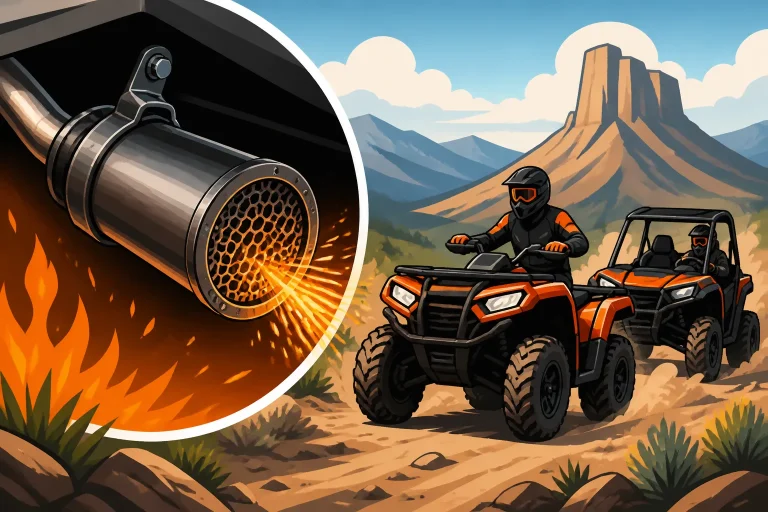
Also check the machine’s required equipment. Wyoming State Parks, Historic Sites, & Trails requires ATVs and trail bikes to have approved, operating spark-arresting mufflers and comply with sound regulations. The same agency says ORVs must have a muffler with an approved spark arrester when operated on trails and roads. Maintain the muffler and spark arrester, and do not assume a quiet machine is exempt from the requirement. See Wyoming Spark Arrester Requirement for more on this issue.
A practical pre-ride check
A little verification before departure can prevent a wasted trip or a citation. Use this checklist whenever you plan to take an ATV or UTV onto a route associated with snowmobiling:
- Identify the land manager. Determine whether the route is managed by the Forest Service, BLM, or another authority. The correct manager is the one that can confirm the route’s status.
- Check the current route map. Look for the specific segment and its motorized-use designation. On Bighorn National Forest land, consult the Bighorn Motorized Vehicle Use Map.
- Confirm the route is open to ORVs. Ask whether your vehicle type is allowed now, especially if the trail is commonly described as a snowmobile trail or seasonal route.
- Check the machine’s width. For Forest Service trails, the vehicle must meet the Forest Service maximum width of 50 inches at its widest point.
- Confirm the permit requirement. For an enrolled road, route, or trail designated for ORV use and 50 inches or less in width, Wyoming State Parks, Historic Sites, & Trails requires the Wyoming ORV permit. A decal from another state does not replace it.
- Check the decal and equipment. Make sure the Wyoming permit is current and displayed, and verify that the required spark arrester and muffler are in operating condition.
- Follow the route and signs. Stay on routes designated for your vehicle, obey closures, and do not ride around barriers or onto nearby ground to get past a blocked section.
A rider without a driver’s license or permit, typically someone 15 years old or younger, may operate an ORV only on enrolled trails, designated riding areas, and private property with permission, according to Wyoming State Parks, Historic Sites, & Trails. A designated trail enrolled in the program does not require a driver’s license if the ORV displays a current Wyoming ORV permit. Road use has separate requirements: operators using designated roadways with only an ORV sticker must have a valid driver’s license or permit. If your plan includes roads as well as trails, check the rules for each part of the route rather than applying the trail rule to the entire trip.
If you still cannot confirm that an ATV or UTV is allowed on a snowmobile trail, choose a route that is clearly designated for ORVs instead. The right map, open status, and permit are separate checks—and all three need to line up.
Sources
- Wyoming State Parks, Historic Sites, & Trails — Wyoming State Parks, Historic Sites, & Trails – ORV Permits – Trails (checked November 3, 2026)
- Forest Service — Bighorn National Forest | Off-Highway Vehicles (OHV) | Forest Service (checked November 3, 2026)
- Wyoming State Parks, Historic Sites, & Trails — Wyoming State Parks, Historic Sites, & Trails – ORV Rules & Regulations – Trails (checked November 3, 2026)
- Wyoming State Parks, Historic Sites, & Trails — Wyoming State Parks, Historic Sites, & Trails – ORV F.A.Qs (checked November 3, 2026)
- Wyoming State Parks, Historic Sites, & Trails — Wyoming State Parks, Historic Sites, & Trails – ORV Requirements – Trails (checked November 3, 2026)
- Wyoming State Parks, Historic Sites, & Trails — Wyoming State Parks, Historic Sites, & Trails – OHV (Off-Highway Vehicle) Partnership Grants (checked November 3, 2026)
Disclaimer
This article is for general informational purposes only and does not constitute professional advice. Laws, prices and regulations vary by location and change over time. Consult a qualified professional for guidance on your specific situation.