Wyoming Rules for Riding After Dark
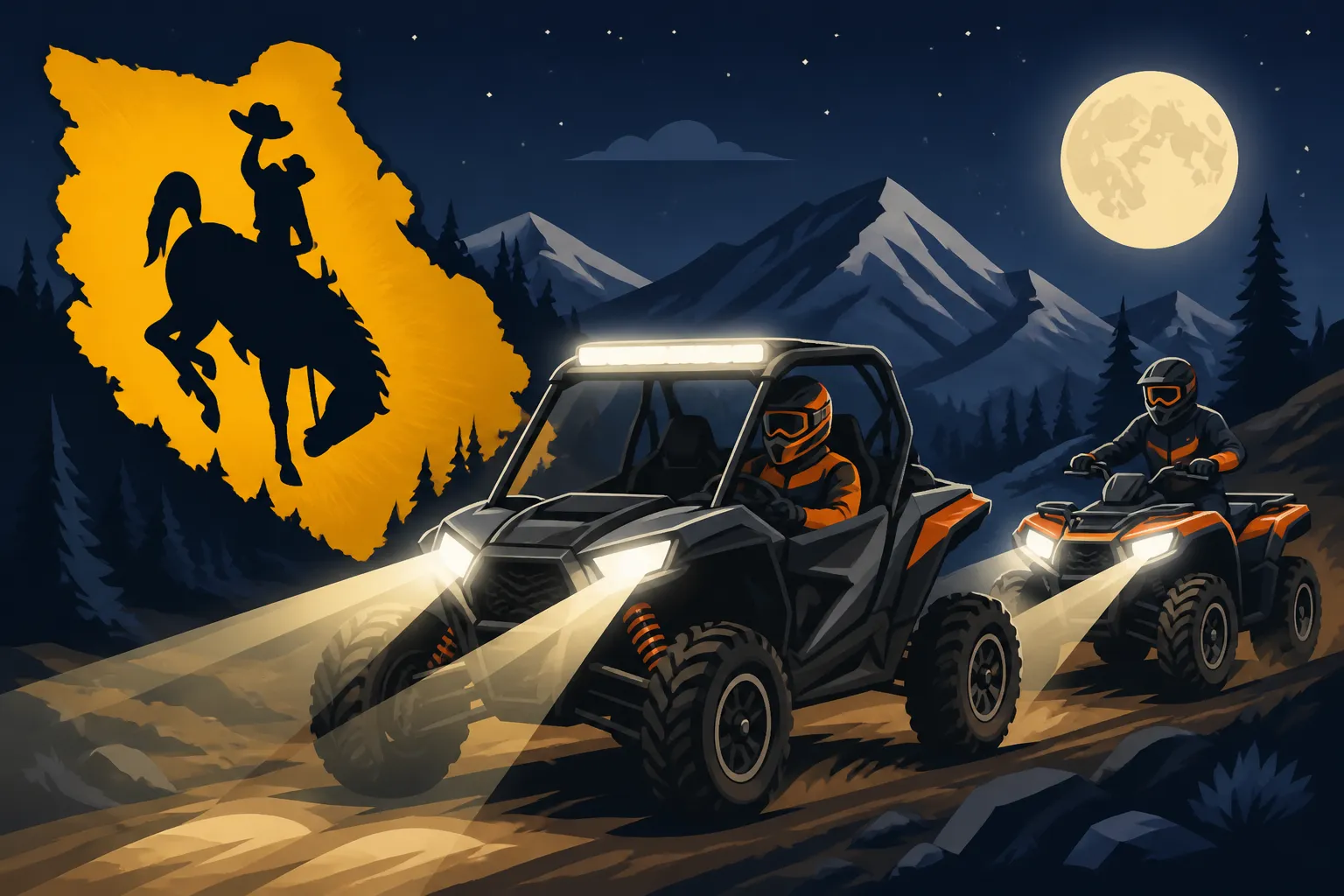
Riding your ATV or UTV after dark in Wyoming can be an absolutely incredible experience, offering a completely different perspective of the landscape under a blanket of stars. However, it's also where the real challenges – and the legal complexities – truly begin. That feeling of the sun dipping below the horizon, knowing you still have miles to go, can quickly turn from exciting to anxiety-inducing if you're not properly prepared or aware of the rules. This guide is here to cut through the confusion and light up the path, ensuring you understand Wyoming's specific regulations for riding your off-road machine once the daylight fades, keeping you safe and legal on every adventure.
Defining "After Dark" and Why It Matters in Wyoming
The phrase "after dark" sounds simple enough, right? But when it comes to riding your ATV or UTV in Wyoming, there's a legal and practical definition that can have significant implications for your safety and your wallet. Understanding when night officially begins in the eyes of the law, and why visibility becomes paramount, is your first step toward responsible night riding.
When Does "Night" Officially Begin?
In Wyoming, like many places, the legal definition of "night" for vehicle operation typically doesn't wait until the moon is high in the sky. Generally, lighting requirements for vehicles, including off-road machines operating on public lands or enrolled roads, kick in during specific low-light conditions. This often aligns with what's called "civil twilight" – that period after sunset when there's still a hint of light in the sky, but natural visibility is significantly reduced. You might still be able to see shapes and outlines, but colors fade, and distances become harder to judge accurately.
Practically, this means that even if you're not riding in absolute pitch black, if the sun has set and natural light is dwindling, you should assume it's "after dark" and activate your machine's lighting. Don't wait until you can't see the trail ahead or until other riders are just vague shadows. Being proactive ensures you're visible to others and can adequately see any obstacles on your path. It's a fundamental aspect of the [Wyoming Rules for Riding After Dark].
The Visibility Challenge and Legal Responsibility
When the sun goes down, everything changes. The familiar trail that seemed so easy in daylight can become a maze of shadows and deceptive terrain. Rocks disappear into the gloom, ruts become indistinguishable from flat ground, and sudden dips can catch you completely off guard. This isn't just about your personal comfort or ability to navigate; it's a matter of legal responsibility. If you're involved in an incident after dark and your lighting was insufficient, you could face hefty fines and liability, even if you felt you could see "well enough."
Your machine's lights are not just for your benefit; they're crucial for other trail users, whether they're other riders, hikers, or even wildlife. A deer standing motionless in the shadows becomes nearly invisible without proper illumination. Moreover, many public lands and enrolled roads have specific requirements for vehicle lighting during these hours, not just to prevent accidents but to uphold the general safety standards of shared spaces. Ignoring these rules puts everyone at risk and can lead to a roadside chat with a ranger that ends with a citation.
Essential Lighting Requirements for Night Riding
When you decide to extend your Wyoming adventure into the night, your machine's lighting isn't just a convenience; it's a legal necessity and your primary safety tool. Wyoming has clear expectations for what your ATV or UTV needs to display once the sun dips below the horizon, especially if you're venturing onto roads.
Headlights, Taillights, and Stop Lamps: The Absolute Minimum
Every ATV and UTV, regardless of whether it's street-legal or purely an off-road machine, needs to have functioning headlights and taillights for operation after dark or in conditions of reduced visibility. This isn't optional; it's foundational. Your headlight (or headlights, for most UTVs) must adequately illuminate the path ahead, allowing you to react to changing terrain, obstacles, and potential hazards. A weak or flickering headlight is not just annoying, it's dangerous and functionally useless.
Your taillight is equally critical, perhaps even more so for those behind you. It ensures that other riders, vehicles, or even passing motorists on a shared road can see you from a safe distance. And don't forget the stop lamp, which illuminates brightly when you apply the brakes, signaling your deceleration to anyone following you. These three components form the absolute minimum legal requirement for visibility after dark. For detailed guidance on these, you'll want to review [Wyoming Lighting Requirements for ORVs] and specifically the requirements for [Headlight, Taillight and Stop Lamp].
While many stock machines come with adequate lighting for basic trail use, if you plan to do a lot of night riding, especially at speed, you might find that upgrading your headlights or adding auxiliary lighting is a wise investment. The difference a brighter, wider beam can make to your confidence and reaction time is invaluable. Brands like SuperATV offer a range of aftermarket lighting solutions that can significantly enhance your visibility and make night riding much safer.
Beyond the Basics: Reflectors, Auxiliary Lighting, and Signals
While headlights, taillights, and stop lamps are the core requirements, Wyoming's rules can extend further, especially if your machine is registered as a Multi-Purpose Vehicle (MPV) and you intend to ride on enrolled public roads. For any machine, a red rear reflector is often a basic safety feature, providing a passive visual marker even if your taillight fails. This [A Red Rear Reflector on a Wyoming Machine] is a simple, inexpensive addition that can offer an extra layer of visibility.
When it comes to auxiliary lighting – think light bars, cube lights, or supplemental floodlights – these can be game-changers for off-road visibility. They can turn night into day on a dark trail, revealing details that your stock headlights might miss. However, a huge caveat here: auxiliary lights designed for off-road use should typically be covered or switched off when operating on public roads. The intense glare can blind oncoming drivers and is often illegal. If your machine is street-legal or you're riding on an enrolled road, any auxiliary lights must meet specific requirements or be disengaged.
For MPVs on enrolled roads, the requirements go beyond just basic illumination. You'll also need turn signals, a horn, and often mirrors, even at night. These are standard features for road-legal vehicles and are critical for communicating your intentions to other traffic. Think of your road-legal side-by-side as a small car when it's on a paved or gravel county road; it needs to adhere to similar signaling and visibility standards. For more on making your machine road-ready, check out [Wyoming's MPV Path to the Road].
Powering Your Lights and Electrical System Considerations
Adding extra lights is great for visibility, but it comes with a practical consideration: power. Your ATV or UTV's electrical system, including its battery and alternator (or stator), is designed to handle the stock components. When you start adding powerful LED light bars, heated grips, winches, and charging ports, you're demanding more electricity. If your machine's charging system can't keep up, you risk draining your battery, leaving you stranded in the dark – a situation no rider wants to be in.
Before outfitting your machine with a full suite of aftermarket lights, especially from brands like SuperATV that offer robust, high-output options, it's wise to understand your machine's electrical capacity. Consult your owner's manual or a trusted mechanic to ensure your additions won't overload the system. You might need to upgrade your stator or add an auxiliary battery if you plan extensive lighting setups. Always test your lighting before heading out for a night ride to ensure everything is functioning correctly and your battery is fully charged. There’s nothing worse than having your lights dim or die miles from anywhere.
Navigating Wyoming's Roads and Trails After Dark
Riding after dark isn't just about having the right lights; it's also about understanding where you're permitted to ride and how those rules apply when visibility is low. Wyoming offers a vast network of trails and enrolled roads, each with its own set of guidelines, which become even more critical once the sun goes down.
Riding Enrolled Public Roads at Night
If your ATV or UTV qualifies as a Multi-Purpose Vehicle (MPV) in Wyoming and is properly titled and plated, you gain the privilege of riding on certain enrolled public roads. However, this privilege comes with a heightened responsibility, especially after dark. To be considered street-legal in Wyoming, your MPV needs more than just basic off-road lights. It must meet a full suite of requirements, including a headlight, taillight, stop lamp, a red rear reflector, a horn, mirrors, and turn signals. These features are not just for daytime use; they are absolutely mandatory for operating on enrolled roads at night.
Think about it: you'll be sharing these roads with full-size vehicles whose drivers expect a certain standard of visibility and signaling. Your little taillight from your dirt bike might be fine on a trail, but it won't cut it on a county road where trucks are doing 50 MPH. The goal is to make your machine as visible and communicative as possible, mirroring the standards of other road-going vehicles. Always ensure your machine is fully compliant with all the necessary road equipment, like those described in [Wyoming Mirror Requirements for Road Use] and [Wyoming Horn Requirement on a Road Machine], before hitting an enrolled road after dark. Failing to do so not only endangers you and others but also makes you an easy target for law enforcement.
Night Riding on Designated Trails and Open Play Areas
For dedicated off-road trails and open play areas like parts of the Killpecker Sand Dunes, the rules are generally less stringent regarding "street-legal" equipment, but basic functional lighting (headlights, taillights, and stop lamps) is still an absolute must. Even on private land, common sense and safety dictate that you should have adequate illumination. However, the biggest challenge on trails after dark isn't always legal compliance, but pure navigation and safety.
Trails become much harder to read at night. What looks like a shadow could be a drop-off, and what seems flat could be a hidden rock. It's crucial to slow down significantly, ride within your visible range, and always be aware of your surroundings. Stay on designated routes to avoid getting lost, damaging fragile ecosystems, or stumbling into dangerous terrain. [Wyoming Rules for Riding a Designated Route] applies 24/7, and straying off course at night is far more dangerous than during the day. Consider riding with a buddy, carrying a GPS with pre-loaded maps, and having a powerful flashlight or headlamp as a backup to your machine's lights.
Crossing Interstates and State Highways at Night
While Wyoming does have specific, highly regulated provisions for ORVs and MPVs to cross certain interstates and state highways, these crossings are inherently high-risk maneuvers. Performing them after dark multiplies that risk exponentially. Reduced visibility for both the rider and other motorists, combined with higher speeds on highways, demands extreme caution and absolute adherence to all rules.
For example, when [Wyoming Rules for Crossing an Interstate] are followed, you're usually required to stop, look for traffic, and cross at a perpendicular angle to minimize your time in the lane of travel. Doing this successfully at night requires every piece of your machine's road-legal lighting to be in perfect working order. Your headlights must be bright enough to clearly illuminate the roadway, and your taillights must be unmistakable to fast-approaching vehicles. If you don't have the necessary lighting or confidence, it's simply not worth the risk. It’s always safer to plan your route to avoid night crossings on major highways altogether, or at least use routes with grade-separated crossings (bridges or underpasses) if available.
Safety Protocols and Legal Consequences
Riding your ATV or UTV after dark in Wyoming is an exhilarating experience, but it's one that demands a heightened sense of awareness and a commitment to safety. Beyond the excitement, there are serious legal ramifications if you don't play by the rules, especially when visibility is at its lowest.
Enhancing Rider Safety for Night Operations
When the sun goes down, your personal safety gear becomes even more critical. First and foremost, a clear visor on your helmet is a must; tinted visors that are perfect for sunny days become a dangerous liability at night. Consider investing in a helmet with an integrated light or mounting a powerful headlamp to your helmet, which allows your line of sight to dictate where the light falls, enhancing your ability to see around turns and over obstacles. Reflective clothing or vests are also highly recommended. While your machine has lights, a reflective vest helps you stand out to others, especially if you ever need to dismount.
Riding slower is not just good advice; it's essential for night operations. Your reaction time is naturally slower in the dark, and unseen obstacles can appear with alarming suddenness. Maintain a safe following distance from other riders, as dust or spray from their machines can further obscure your vision. Always ride with at least one other person, and ensure everyone in the group has functioning lights and is aware of the planned route. Carrying extra batteries for any headlamps or auxiliary lights, along with a fully charged phone or a satellite messenger like a Garmin InReach, can be a literal lifesaver if you encounter an unexpected breakdown far from help. For general safety, remember that [Wyoming Helmet Law for ATV Riders] still applies, day or night.
Legal Ramifications: Fines and Citations
Ignoring Wyoming's lighting requirements or riding regulations after dark isn't just a safety oversight; it's a legal one that can result in significant penalties. If a warden or law enforcement officer stops you and your machine doesn't meet the specified lighting criteria for the area you're riding, you can expect a citation. These fines can add up quickly, especially if you're cited for multiple deficiencies or for riding in an area where your machine isn't properly equipped.
For example, failing to have a functioning taillight or a bright enough headlight on an enrolled road can be treated similarly to a car operating without proper lighting. If you're riding an MPV on a public road, but lack a horn or mirrors, those can also lead to fines. It's not uncommon for officers to be more vigilant about compliance after dark, as the risks associated with non-compliance are much higher. While not directly about lighting, the general concept of penalties, like those outlined in [Wyoming Fines for Riding Without a Permit], extends to various forms of non-compliance, including inadequate safety equipment at night.
What to Do If You're Caught Unprepared
Let's be realistic: sometimes, despite our best intentions, things go wrong. Perhaps a light bulb burns out, your battery dies unexpectedly, or you misjudged the time and suddenly find yourself miles from your staging area with daylight fading fast. If you're caught unprepared after dark, your first priority is safety. If a critical light fails, stop riding immediately if it's safe to do so. Do not try to limp back on a dark trail with no visibility.
If you're with a group, consolidate your lights. One machine might be able to lead with its working lights, while another with a broken taillight might be safer bringing up the rear, relying on the leader's lights to illuminate it. If alone, and your lights fail, use a strong flashlight or headlamp to illuminate your immediate surroundings. Call for help if you have cell service or use a satellite messenger. If you can't get assistance, consider waiting until morning if conditions are safe and you have the necessary gear (warm clothing, water, food) to do so. It's always better to be safe than to risk an accident or getting lost in the dark.
| Requirement/Scenario | Designated Off-Road Trail (Night) | Enrolled Public Road (Night – MPV) |
|---|---|---|
| Headlight(s) | Required (adequate brightness for visibility) | Required (adequate brightness, often specific lumen/distance minimums) |
| Taillight | Required (visible from 500 ft rear) | Required (visible from 500 ft rear) |
| Stop Lamp | Required (activates with brake) | Required (activates with brake) |
| Red Rear Reflector | Recommended (passive safety) | Required |
| Turn Signals | Not required (use hand signals) | Required |
| Horn | Not required | Required |
| Mirrors | Not required | Required (left-side minimum, often two) |
| Auxiliary Lights (e.g., Light Bar) | Permitted (enhance visibility) | Must be covered or off on roads (can blind drivers) |
| Visibility Gear (e.g., Reflective Vest) | Highly Recommended | Highly Recommended |
| Speed | Reduce significantly | Follow posted limits, reduce for conditions |
Disclaimer
This article is for general informational purposes only and does not constitute professional advice. Laws, prices and regulations vary by location and change over time. Consult a qualified professional for guidance on your specific situation.