Street Legal ATVs in Wyoming: The Short Answer
There’s a common dream out here in Wyoming: cruising your ATV or side-by-side right from your driveway to the trailhead, or even popping into town for groceries without having to load up the trailer. The idea of making your off-road machine "street legal" is incredibly appealing, and the reality can be quite confusing, with a lot of misinformation floating around. This guide is here to untangle the complexities of taking your ATV or UTV onto Wyoming's roads, clarifying what's possible, what's required, and where you can actually go.
The Short Answer: It's Not as Simple as Sticking on a License Plate
When folks ask, "Are ATVs street legal in Wyoming?", the simplest, most honest answer is: it depends. The machine you likely think of as an "ATV" or "UTV" right off the dealership floor isn't automatically legal for public roads in Wyoming. There's a very specific pathway, a whole set of rules, and a different classification that your machine needs to achieve. You can't just slap a license plate on your standard quad and expect to ride freely. Wyoming law draws a distinct line between off-road vehicles (ORVs) and a special class called multipurpose vehicles (MPVs), and only the latter can gain legal access to designated public roads.
Why Your Standard ORV Can't Just Hit the Pavement
Most of us buy ATVs and UTVs for ripping through the backcountry, navigating forest trails, or working on the ranch. These machines, as manufactured, are built for dirt, rocks, and mud, not asphalt. They typically lack the safety equipment required for public road use, like proper mirrors, turn signals, and often, even a horn. More importantly, legally, they are defined as ORVs – vehicles designed for off-road use only.
The state of Wyoming, like many others, wants to keep machines built purely for rugged terrain separate from the flow of street traffic for safety reasons. Imagine a lightweight sport quad, designed for agility on trails, trying to keep up with highway speeds or navigate busy intersections without proper lighting. It's a recipe for disaster. This distinction protects both the riders and other motorists. While you absolutely need a [Wyoming's Annual ORV Permit] to ride your ORV on enrolled trails, that permit explicitly does not grant you permission to ride on public roads.
The Multipurpose Vehicle (MPV) as Your Road-Legal Gateway
If you truly want to ride your off-road machine on Wyoming's public roads, you need to understand the Multipurpose Vehicle (MPV) classification. This is the state's answer for allowing certain types of ORV-like machines to be legally operated on roadways. The MPV category was created specifically to bridge the gap between pure off-roaders and street-legal vehicles, acknowledging that many larger UTVs, in particular, could be safely modified for road use.
This isn't just a matter of adding a few accessories; it's about meeting a specific legal definition and going through a formal titling and registration process. If your machine doesn't meet the core MPV definition right off the bat, then no amount of modification will make it street legal in Wyoming. This is the crucial starting point for anyone dreaming of taking their side-by-side or ATV on the pavement.
Understanding Wyoming's MPV Definition: Not Every Machine Qualifies
The absolute first step in making your off-road machine street-legal in Wyoming is understanding whether it even can qualify as a Multipurpose Vehicle (MPV). This isn't just about what you want it to be; it's about strict legal definitions laid out in Wyoming Statutes. Many riders mistakenly believe that if they just add a few lights and mirrors, they're good to go. But if your machine doesn't fit the fundamental characteristics of an MPV, you're essentially trying to fit a square peg in a round hole.
Key Criteria for a Multipurpose Vehicle in Wyoming
Wyoming's definition of an MPV is quite specific, and it's laid out in detail in [Wyoming's MPV Definition in W.S. 31-1-101]. It's designed to ensure that only machines with certain inherent safety features and capabilities are allowed on public roads. Primarily, an MPV must be a vehicle that:
- Has four or more wheels. This immediately disqualifies dirt bikes or two-wheeled machines, which are considered ORV-MC (off-road recreational vehicles-motorcycle) and cannot be converted to MPVs. Even three-wheeled ATVs (trikes), while rare now, would also be excluded.
- Is designed for travel on unimproved roads. This acknowledges their off-road heritage but points to their potential for road use.
- Has a non-straddle seating position. This is a critical one. It means you sit in the vehicle, like a car, not on it, like a motorcycle or traditional ATV. Most side-by-sides (UTVs) meet this, but almost no traditional ATVs do. This is a common point of frustration for ATV owners wanting to make their quad street legal.
- Is 50 inches or less in width. This is another major hurdle for many popular side-by-sides, as many newer models exceed this width for stability and passenger comfort. You'll need to measure your machine carefully, tire-to-tire.
- Weighs between 300 and 3,000 pounds. This weight range ensures the vehicle isn't too light to be stable on roads, nor too heavy to be effectively managed as a smaller vehicle. Many utility-focused UTVs easily fall into this category.
- Has a seat height of at least 24 inches from the ground. This is measured to the lowest part of the driver's seat. Again, most UTVs will meet this, while traditional ATVs, where you straddle the seat, typically have a lower, more integrated seating position.
It’s crucial to understand these specifications before you even consider buying aftermarket parts or heading to the county clerk's office. If your machine is, say, 60 inches wide, it simply cannot be titled as an MPV in Wyoming, no matter what other modifications you make. [Weighing a Machine Before You Register It] and [Measuring Seat Height From the Ground] are essential steps.
The Frustration for Traditional ATV Owners
For those who own a traditional, quad-style ATV, the MPV definition presents a significant roadblock. The "non-straddle seating position" rule essentially means that your typical ATV, where you sit astride the engine like a motorcycle, cannot be classified as an MPV. This can be a real disappointment for riders who love their quad and want the flexibility of road access.
While there are many aftermarket kits that add turn signals, mirrors, and even horns to traditional ATVs, these modifications alone do not change the fundamental classification of the vehicle in Wyoming. It will still be considered an ORV in the eyes of the law, and therefore, it will still be restricted from public road use (except on specifically designated ORV roads, which we'll discuss later). This distinction can feel arbitrary, but it's firmly in place to differentiate vehicle types based on design intent and inherent safety characteristics.
The Path to Street Legality: Titling and Registering Your MPV
Once you've confirmed that your UTV (or a very specific, narrow-bodied ATV that somehow meets the non-straddle seating rule) actually qualifies as an MPV based on Wyoming's definition, the real work of making it street-legal begins. This isn't an overnight process, and it involves multiple steps with different county offices. It's a journey that can feel a bit like a bureaucratic scavenger hunt, but it's essential if you want to legally hit the pavement.
Step 1: Acquiring an MPV Title at the County Clerk's Office
The first major hurdle is getting a title for your machine as an MPV. Unlike standard ORVs, which generally don't require titles in Wyoming (unless they were previously titled in another state), an MPV must have a title. This process happens at your local [Wyoming County Clerk Title Process]. You'll need proof of ownership, like a manufacturer's certificate of origin (MCO) if it's new, or a bill of sale and previous title if you're buying it used.
This is where the [What the MPV and ORV-MC Checklist Form Asks] comes into play. You'll fill out a specific form that essentially acts as an affidavit, attesting that your machine meets all the physical requirements for an MPV (width, weight, seat height, wheel count, non-straddle seating). The county clerk's office will review this checklist alongside your ownership documents. This process is critical because without an MPV title, you cannot proceed to the next step of getting a license plate. It confirms that your vehicle legally can be an MPV before you invest further.
Step 2: Registering and Getting a License Plate at the County Treasurer's Office
After successfully titling your machine as an MPV, you'll take your new MPV title over to the [Wyoming County Treasurer Plate Process]. This is where you actually register the vehicle for road use and receive a license plate. This is the moment when your machine officially becomes "street legal" in the eyes of the state for general road travel.
The county treasurer will collect the necessary registration fees, which are typically based on the vehicle's value or age. [Wyoming MPV Registration Cost] will vary, so it's always best to check with your local county treasurer for current figures. You'll also need to show proof of insurance, as liability insurance is mandatory for any vehicle operating on public roads in Wyoming. Once all the paperwork is in order and fees are paid, you'll be issued a standard vehicle license plate, which must be displayed clearly on the rear of your MPV, just like any other car or truck.
The Two-Counter Dance: Clerk to Treasurer
Many riders find the distinction between the County Clerk and County Treasurer confusing, especially when they're used to a one-stop-shop for vehicle registration in other states or for regular cars. It's a common point of frustration, but in Wyoming, these are two separate offices, each with distinct responsibilities. The County Clerk handles the titling – establishing legal ownership and classification of the vehicle. The County Treasurer handles the registration and licensing – allowing the vehicle to operate on public roads and collecting related taxes and fees.
So, you'll literally make two stops, often in different parts of the same building, or even entirely separate buildings, to complete the process. Think of it as: Clerk first to prove what your machine is, and Treasurer second to prove it's allowed to be on the road. It's a bit of a dance, but understanding the roles of each office makes it a less bewildering experience.
Essential Equipment for Your Street-Legal MPV
Getting your MPV titled and registered is just one piece of the puzzle. For your machine to be truly street-legal and safe on Wyoming roads, it absolutely must be equipped with specific safety features, much like any other motor vehicle. This isn't optional; these are legal requirements designed to ensure visibility, control, and communication with other drivers. Many off-road UTVs, as they come from the factory, will be missing several of these crucial items.
Required Lighting and Visibility Features
When you're sharing the road with cars and trucks, being seen is paramount. Wyoming law mandates specific lighting for MPVs operating on public roads, especially during dawn, dusk, or nighttime conditions.
- Headlights: Your MPV must have at least one, but preferably two, working headlights that emit a white light visible from a distance. These need to be properly aimed and powerful enough to illuminate the road ahead. Many UTVs come with headlights, but sometimes they're more for trail illumination than road compliance.
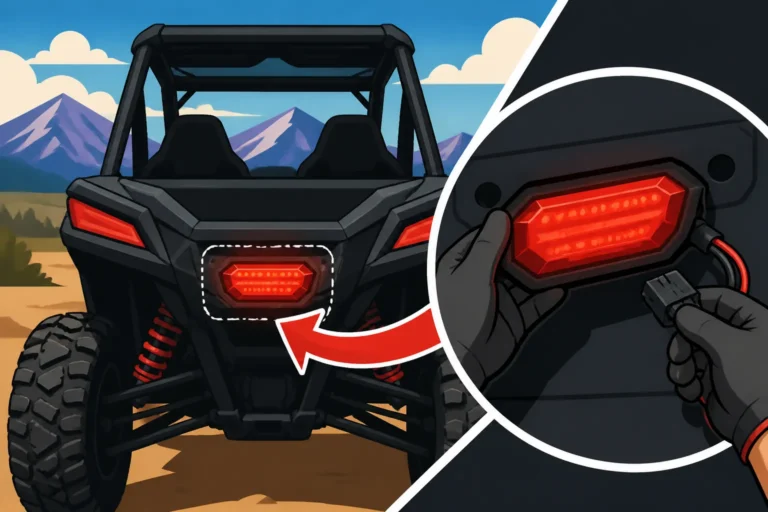
- Taillights and Stop Lamps: A red taillight is required on the rear of the machine, visible from behind. Crucially, your MPV also needs a working stop lamp (or brake light) that illuminates when the brake is applied. This alerts drivers behind you that you are slowing down or stopping.
- Turn Signals: This is often one of the biggest additions for an MPV. You need amber turn signals, both front and rear, that blink to indicate your intended direction of travel. Many aftermarket kits, like those from SuperATV, offer comprehensive turn signal setups specifically designed for UTVs, often integrated with a horn and hazard lights.
- Rear Reflector: A red reflector must be mounted on the rear of the MPV, visible from 500 feet, to enhance visibility even if your taillights fail.
- License Plate Light: Your rear license plate needs a working white light to make it visible from 50 feet at night.
Neglecting any of these lighting requirements isn't just a safety hazard; it's a ticket waiting to happen. A Wyoming Highway Patrol trooper will quickly spot missing or non-functional lights. [Wyoming Lighting Requirements for ORVs] outlines these specifics, even though the MPV class is a distinct path.
Mirrors, Horn, and Safety Gear
Beyond lighting, other fundamental safety features are required to make your MPV road-ready:
- Mirrors: You must have at least one mirror, mounted on the left side of the machine, that provides a clear view of the road to the rear for at least 200 feet. Many UTVs come with a rearview mirror, but a side mirror is often an aftermarket addition. [The Left-Side Mirror Wyoming Wants] is non-negotiable for road travel.
- Horn: A working horn is required to provide an audible warning signal. This is critical for alerting other drivers or pedestrians to your presence. [Fitting a Horn to a Road-Legal Side-by-Side] is usually a straightforward aftermarket installation.
- Muffler and Spark Arrester: While important for all off-road vehicles on public lands, an efficient muffler is also crucial for road use to keep noise levels reasonable. A U.S. Forest Service approved spark arrester is typically already part of your exhaust system on most modern machines and is required to prevent wildfires, particularly when you're transitioning between roads and trails. [Wyoming Muffler and Spark Arrester Rules] apply.
- Brakes: Your MPV must have fully functional brakes capable of stopping the vehicle safely. This should be a given for any vehicle, but it's legally mandated for road use.
- Seat Belts: If your MPV is equipped with seat belts (which most UTVs are), they must be in good working condition and worn by all occupants. While Wyoming's general helmet law focuses on riders under 18, wearing a helmet on an open-air MPV is always a wise safety precaution, regardless of age. [Wyoming Helmet Law for ATV Riders] details these rules, and it's always better to err on the side of caution.
Many companies specialize in street-legal kits for UTVs, offering bundles of these essential components. Before you hit the road, double-check that every single one of these items is present and fully functional. It's not just about avoiding a fine; it's about your safety and the safety of everyone else on the road.
Driver & Passenger Rules for MPVs on Wyoming Roads
Operating a street-legal MPV on Wyoming's roads comes with a specific set of rules regarding who can drive, who can be a passenger, and what documentation you need to carry. These regulations are designed to align MPVs with other road-going vehicles as much as possible, ensuring drivers are competent and passengers are safe. Just because your machine is licensed doesn't mean anyone can jump behind the wheel.
Driver's License and Endorsement Requirements
This is a critical point that often catches people by surprise. To legally operate an MPV on any Wyoming public road, you must possess a valid driver's license. This isn't just any license; it needs to be appropriate for the type of vehicle.
- Motorcycle Endorsement (M or MR): In Wyoming, an MPV operator is generally required to have a motorcycle endorsement (Class M) on their driver's license. This signifies that you have passed tests proving your ability to operate a two- or three-wheeled vehicle safely. For a four-wheeled MPV, some may qualify for an MR endorsement, specifically for multipurpose vehicles. This means taking an additional knowledge and skills test at the Department of Motor Vehicles.
- Minimum Age: Drivers must meet the minimum age requirements for a motorcycle license in Wyoming, which is typically 16 years old. [Wyoming Minimum Age to Ride a Road] applies to MPVs as well.
- Proof of Insurance: As mentioned before, you absolutely must carry proof of liability insurance for your MPV when operating it on public roads. This is a non-negotiable requirement for all road-legal vehicles in Wyoming. A physical insurance card or digital proof on your phone should be readily available if requested by law enforcement. [Wyoming ATV Insurance Requirement] is a vital piece of the puzzle.
Trying to drive an MPV on a public road without the correct endorsement on your license, even if you have a standard driver's license for a car, could result in a citation. It's important to clarify the exact requirements with your local DMV office before you drive.
Passenger Rules and Helmet Requirements
Passenger rules for MPVs are also important to understand, especially if you plan on taking family or friends along for the ride.
- Passenger Capacity: MPVs typically have designated seating for passengers, and you should only carry as many passengers as your machine is designed for. Overloading an MPV can compromise stability and control, creating a dangerous situation.
- Age Limits for Passengers: While there isn't a strict statewide minimum age for passengers on all MPVs, common sense and manufacturer recommendations should always be followed. For example, some manufacturers suggest passengers be able to place their feet on the floorboards and grasp handholds. If you're renting an MPV, be aware that rental companies often have their own stricter age policies for both drivers and passengers, with some requiring [Wyoming Rentals for Children] to be a certain age.
- Helmet Law: Wyoming's helmet law requires all riders and passengers under the age of 18 to wear an approved safety helmet when operating or riding on an off-road vehicle (which the MPV derives from) on public land or roads. While an MPV technically bridges the gap to a road vehicle, for consistency and safety, it's wise to adhere to this rule. Even for adults, wearing a helmet on an open-air MPV is a strongly recommended safety practice. [Wyoming Helmet Law for Passengers] is clear on this.
It’s about more than just compliance; it’s about safety. Operating a machine designed with some open-air characteristics on roads shared with larger, heavier vehicles demands extra caution and adherence to all safety guidelines.
Where You Can (and Cannot) Ride Your MPV in Wyoming
Having a street-legal MPV in Wyoming grants you significant freedom, but it's not an open invitation to ride absolutely everywhere. There are still restrictions, particularly concerning higher-speed roadways and specific jurisdictions. Understanding these limitations is crucial to avoid fines and ensure you're riding legally and safely.
Riding on Designated Roads and Highways
The primary benefit of an MPV is access to a vast network of public roads.
- County and Forest Roads: Generally, once your MPV is properly titled, registered, and equipped, you can ride it on most county roads, Forest Service roads, and BLM (Bureau of Land Management) roads. These often serve as excellent connectors between trail systems or allow access to dispersed camping and hunting areas. [Wyoming Rules for Riding a County Road] are fairly consistent across the state, but local ordinances can sometimes add specific regulations, especially regarding speed limits within residential areas.
- State Highways: Many Wyoming state highways are also open to MPVs, particularly in rural areas. However, this is often at the discretion of the Wyoming Department of Transportation (WYDOT) and the county. You'll need to pay close attention to signage. If a road is not posted as open to MPVs, assume it is closed. It's always best to consult local maps and signs, especially [Wyoming's Designated ORV Roads], to confirm legality.
- Interstates are Generally Off-Limits: This is a big one. While Wyoming has made some specific, limited exceptions for ORV crossings of interstates in certain circumstances (like the unique situation in Evanston to connect divided trail systems), for general travel, interstates are closed to MPVs and ORVs. These are high-speed, high-traffic thoroughfares, and MPVs are not designed for that environment. [Interstates Closed to MPVs and Dirt Bikes] is a rule you should never break.
Always remember that speed limits apply to MPVs just as they do to cars. If you're on a county road with a 45 mph limit, you need to adhere to it, even if your machine can go faster. [Wyoming Rules for a Slow Machine on a Road] may also apply, sometimes requiring a slow-moving vehicle emblem if your machine typically travels below a certain speed.
City Streets and Other Restrictions
Access to city streets can be a bit more complicated and varies significantly by municipality.
- City Ordinances: While your MPV might be state-legal for roads, individual cities and towns in Wyoming have the authority to enact their own ordinances restricting or prohibiting MPV use on their streets. Before you plan to ride your MPV into a specific town, it is absolutely essential to check that town's local laws. Many towns, especially larger ones, will restrict or completely ban MPVs from their main thoroughfares or residential streets due to noise, traffic concerns, or congestion.
- Designated Crossings: Even in towns where general MPV use is prohibited, there might be specific designated crossings or routes that allow you to move from one trail system to another, or to access fuel and food. Look for clear signage.
- Private Property: Of course, you can always ride your MPV on private property with the owner's explicit permission. This is separate from public road regulations.
- Wilderness Areas and Closed Trails: Even with an MPV license plate, you are still prohibited from riding in designated wilderness areas, on trails closed for seasonal wildlife migration, or on trails permanently closed to motorized vehicles. The MPV designation is for road use, not for granting special access to restricted off-road areas. Always consult [Wyoming Trail Closures to Check First] and [Wyoming Fire Restrictions That Close Trails] before heading out.
Using an MPV on roads means you are sharing the space with much larger, faster vehicles. Defensive driving, constant vigilance, and strict adherence to traffic laws and posted signage are not just good ideas—they are critical for your safety and to maintain the privilege of MPV road access for all riders.
Beyond the Basics: Permits, Insurance, and Potential Fines
Even after you've successfully navigated the MPV titling and registration process and understand where you can ride, there are ongoing responsibilities and potential pitfalls to be aware of. Just like any other vehicle owner, you'll need to keep your documentation current and understand the consequences of non-compliance.
Annual Renewal and Proof of Insurance
Your MPV's registration and license plate are not a one-time deal. They require annual renewal, typically tied to the month you initially registered. You'll receive a renewal notice from your County Treasurer's office, and you'll need to pay the appropriate fees and, critically, show proof of current liability insurance. Forgetting to renew your registration or letting your insurance lapse can lead to fines and legal trouble if you're caught operating the vehicle on public roads.
It's also worth reiterating that your [Wyoming ORV Permit Cost] is a separate expense and for a different purpose. The ORV permit, which you need for designated off-road trails, is a calendar-year permit expiring December 31st, whereas your MPV registration is typically for a rolling 12-month period based on when you first registered it. Don't confuse the two, as both serve different functions and are required for their respective types of use. [Why an ORV Permit Is Not a Road License] is a key distinction.
What a Law Enforcement Officer Checks Roadside
If you're pulled over while operating your MPV on a public road in Wyoming, law enforcement (which could be a local sheriff's deputy, state trooper, or even a Forest Service or BLM ranger if you're on federal land) will be looking for several key things:
- Valid Driver's License with Endorsement: Do you have the correct Class M or MR endorsement?
- Current Registration and License Plate: Is your plate current, properly displayed, and matched to your machine?
- Proof of Insurance: Can you provide valid proof of liability coverage?
- Required Equipment: Are all your lights, mirrors, horn, and other safety features present and working?
- Compliance with Road Rules: Are you adhering to speed limits, traffic signals, and other rules of the road?
- Open Container/DUI: Just like any other vehicle, operating an MPV under the influence of alcohol or drugs is strictly prohibited and carries severe penalties. [Wyoming DUI Rules for ATV Riders] apply fully.
Don't be surprised if a trooper performs a thorough check, especially if MPVs are less common in their patrol area. Being fully compliant not only avoids fines but also demonstrates responsible riding, which helps maintain the privilege of road access for all MPV owners. [What a Wyoming Trooper Checks Roadside] can be quite comprehensive.
Understanding Potential Fines and Citations
Operating your MPV on Wyoming roads without meeting all the legal requirements can lead to various fines and citations. These can range from minor equipment violations to more serious offenses.
- Operating Without Required Equipment: Missing a mirror, non-working brake light, or no horn can result in a citation. These are often fix-it tickets where you might have a chance to show proof of repair, but there will still be an associated fine.
- No Registration or Expired Registration: This is a more significant offense, similar to driving an unregistered car. Fines can be substantial, and your vehicle could potentially be impounded.
- No Proof of Insurance: This is a serious offense in Wyoming. Fines are high, and it can also lead to suspension of your driver's license.
- No Proper Driver's License/Endorsement: Operating without the correct license endorsement is a violation and can carry fines and potentially impact your driving record.
- Riding in Prohibited Areas: If you take your MPV onto an interstate or a city street where it's explicitly forbidden, you'll likely face a trespass or traffic violation fine. [Wyoming Fines for Riding a Closed Road] are real.
The bottom line is that while Wyoming offers a path to road legality for certain off-road machines, it comes with the full responsibility of being a motor vehicle operator on public thoroughfares. It's not a free pass; it's a regulated privilege.
Making the Conversion: Parts, Modifications, and Cost Considerations
So, you've decided to take the plunge and convert your qualifying UTV into a street-legal MPV. This journey often involves more than just a trip to the DMV; it means outfitting your machine with the necessary components to meet Wyoming's safety standards. While some UTVs come closer to being road-ready from the factory, many will require significant aftermarket additions.
Essential Aftermarket Components for Conversion
Most UTVs will need several additions to comply with Wyoming's MPV equipment list. Thankfully, the aftermarket industry is robust, and many companies offer kits designed for this very purpose.
- Street-Legal Kits: Many manufacturers and accessory companies (like SuperATV) offer comprehensive "street-legal kits" for popular UTV models. These kits often include a combination of turn signals, horn, mirrors (side and/or rearview), and sometimes a license plate bracket with a light. These kits are often designed for relatively easy installation, providing all the necessary wiring and components in one package. It's often more cost-effective and simpler to buy a kit rather than sourcing each component individually.
- Windshields: While not explicitly mandated by Wyoming law for an open-air MPV, a windshield is a highly recommended safety and comfort upgrade for any UTV intended for road use. It protects against wind, debris, and insects at higher speeds. You'll want to ensure it's made from a shatter-resistant material and properly installed.
- Wipers: If you install a full windshield, consider adding a wiper kit. Rain, snow, and mud can quickly obscure your vision on the road, making wipers essential for safety.
- Tires: While your knobby off-road tires are great for trails, they might wear quickly and be loud on asphalt. Consider "all-terrain" or "hybrid" tires that offer a smoother, quieter ride on the road while still providing decent traction off-road. You don't need dedicated street tires, but something balanced will improve your road experience.
- Blinkers and Horn Integration: Some UTVs might have basic headlights and taillights, but adding turn signals and a horn requires careful wiring. If you're not comfortable with electrical work, it's a good idea to have a professional powersports mechanic handle the installation of these critical safety components.
When choosing aftermarket parts, always prioritize quality and compliance. Look for components that are durable and designed for the specific demands of road use. Don't skimp on items that are crucial for safety and legality.
Cost Considerations for MPV Conversion
Converting your UTV to an MPV isn't just about the initial purchase price of the machine; there are several layers of cost involved.
- Parts and Installation: The cost of aftermarket parts can vary widely. A basic street-legal kit might cost a few hundred dollars, while adding a full windshield, wipers, and new tires can easily push the total into the thousand-dollar range or more. If you're paying a shop for installation, factor in labor costs as well.
- Titling and Registration Fees: As discussed, you'll pay fees to the County Clerk for the title and to the County Treasurer for annual registration. These fees fluctuate and are often based on the vehicle's value or age. Always call ahead for current figures.
- Insurance: Road-legal liability insurance for an MPV will be an ongoing cost. The premiums will depend on your driving record, the value of the machine, and the coverage limits you choose. It's often more expensive than basic off-road coverage due to the increased risks of road operation.
- Motorcycle Endorsement Costs: If you don't already have one, obtaining a motorcycle endorsement involves fees for knowledge tests, practical skills tests, and potentially a motorcycle safety course, which can cost several hundred dollars.
While the upfront and ongoing costs might seem significant, consider them an investment in the freedom and convenience of expanded riding opportunities. Being able to ride from your property directly to the vast [Wyoming's Enrolled Roads and Trails] without having to load and unload on a trailer is a huge benefit for many riders.
Table: ORV vs. MPV for Road Use in Wyoming
To help clarify the distinctions, here's a quick comparison of a standard Off-Road Vehicle (ORV) versus a Multipurpose Vehicle (MPV) for road use in Wyoming:
| Feature/Requirement | Standard ORV (e.g., typical ATV or UTV off-road) | Multipurpose Vehicle (MPV) (for road use) |
|---|---|---|
| Wyoming Permit | Required for public trails ([Wyoming's Annual ORV Permit]) | Required for public trails (still an ORV when off-road), in addition to road plate |
| Title Required | Generally No (unless out-of-state) | Yes ([Titling a Multipurpose Vehicle in Wyoming]) |
| License Plate | No | Yes ([Wyoming MPV Plate Requirements]) |
| Road Access | Only on designated ORV routes/roads ([Wyoming's Designated ORV Roads]) | Most county, forest, BLM, and some state roads (check local ordinances) |
| Interstate Access | No (except specific crossings) | No (except specific crossings) ([Interstates Closed to MPVs and Dirt Bikes]) |
| Driver's License | Not always required for off-road trails (age limits apply) | Yes, with Class M or MR endorsement ([Wyoming Motorcycle Endorsement for an MPV]) |
| Insurance | Recommended (often optional for off-road) | Required for road use ([Wyoming ATV Insurance Requirement]) |
| Seating Position | Straddle (on top) | Non-straddle (in seats) |
| Wheels | 2, 3, or 4 | 4 or more |
| Width | Any | 50 inches or less |
| Weight | Any | 300 to 3,000 pounds |
| Seat Height | Any | At least 24 inches |
| Required Equipment | Basic lights (some models) | Headlights, taillights, brake lights, turn signals, horn, mirrors, reflector |
This table clearly illustrates why simply owning an "ATV" or "UTV" doesn't automatically grant road access in Wyoming. The MPV category is a distinct classification with specific criteria and requirements.
Conclusion: Weighing the Benefits and Responsibilities
The journey to making your off-road machine street-legal in Wyoming is certainly not without its twists and turns. It demands careful attention to legal definitions, specific equipment requirements, and adherence to various bureaucratic processes. However, for many riders, the benefits of having a street-legal Multipurpose Vehicle (MPV) in Wyoming far outweigh the effort.
Imagine being able to leave your house and head straight to your favorite [Riding Wyoming's Bighorn National Forest] trails without the hassle of trailering, or being able to connect different riding areas via scenic county roads. The convenience for ranch work, accessing hunting grounds, or simply exploring the vast expanse of Wyoming's public lands becomes unparalleled. This flexibility opens up entirely new possibilities for recreation and utility, truly integrating your machine into your daily life and adventures.
However, with this newfound freedom comes significant responsibility. Operating an MPV on public roads means you are a full-fledged member of the vehicular traffic system. You must know and obey all traffic laws, drive defensively, and always have your machine properly equipped and documented. It's not just about avoiding fines; it's about ensuring your safety and the safety of everyone else on the road. By understanding and respecting Wyoming's specific MPV laws, you can confidently and legally enjoy the unique experience of taking your machine from the dirt to the pavement.
Disclaimer
This article is for general informational purposes only and does not constitute professional advice. Laws, prices and regulations vary by location and change over time. Consult a qualified professional for guidance on your specific situation.