Grazing Leases and Public Roads
There's nothing quite like the feeling of heading out on your ATV or UTV into Wyoming's vast, open country. But that excitement can quickly turn to frustration when you encounter a closed gate or a "No Trespassing" sign on what you thought was a public road or trail. Many riders, myself included, have felt that pang of uncertainty, wondering if we're doing something wrong or if we've stumbled onto private land when we just wanted to enjoy the public access we believed was ours. This guide is here to untangle the complexities of riding on roads and trails that intersect with Wyoming's grazing leases, helping you navigate these unique landscapes with confidence and respect for everyone involved.
Understanding Wyoming's Landscape: Public vs. Private, Lease vs. Owned
Wyoming's land ownership can feel like a complex puzzle, especially when you're looking at a map and trying to figure out where you can legally ride. It's not always as simple as a clear line between public and private, and grazing leases add another layer to that complexity.
The Checkerboard: A Common Source of Confusion
If you've ever looked at a land ownership map of Wyoming, particularly in the eastern and southern parts of the state, you've probably noticed what's often called the "checkerboard" pattern. This pattern came about primarily from railroad land grants in the 19th century, where alternating sections of land were granted to railroad companies to encourage construction. What this means for us riders today is that you'll often find squares of public land (like those managed by the Bureau of Land Management or the National Forest Service) immediately adjacent to, or even surrounded by, private land.
This interspersion of public and private property creates numerous access challenges. A road or two-track might appear continuous on a basic map, but it could cross in and out of private ownership multiple times. What's public one minute might be private the next, then public again. This is where detailed maps, like those showing land ownership, become absolutely invaluable. Many riders have stories of following a promising path only to realize they're suddenly on private property, leading to awkward turnarounds or, worse, potential trespass. Knowing the difference between public routes and private driveways is key to a smooth ride. You also need to understand the nuances of [Wyoming Trespass Rules for Riders].
What Exactly is a Grazing Lease?
When we talk about grazing leases, we're discussing a system where federal or state lands are leased to private ranchers for livestock grazing. This is a common practice across the West, and it's essential for the cattle and sheep industries that are so vital to Wyoming's economy and heritage. It's crucial to understand that a grazing lease does not mean the land becomes private property. The land remains public, and with it, the public's right to access it for recreation, including ATV and UTV riding, generally remains intact.
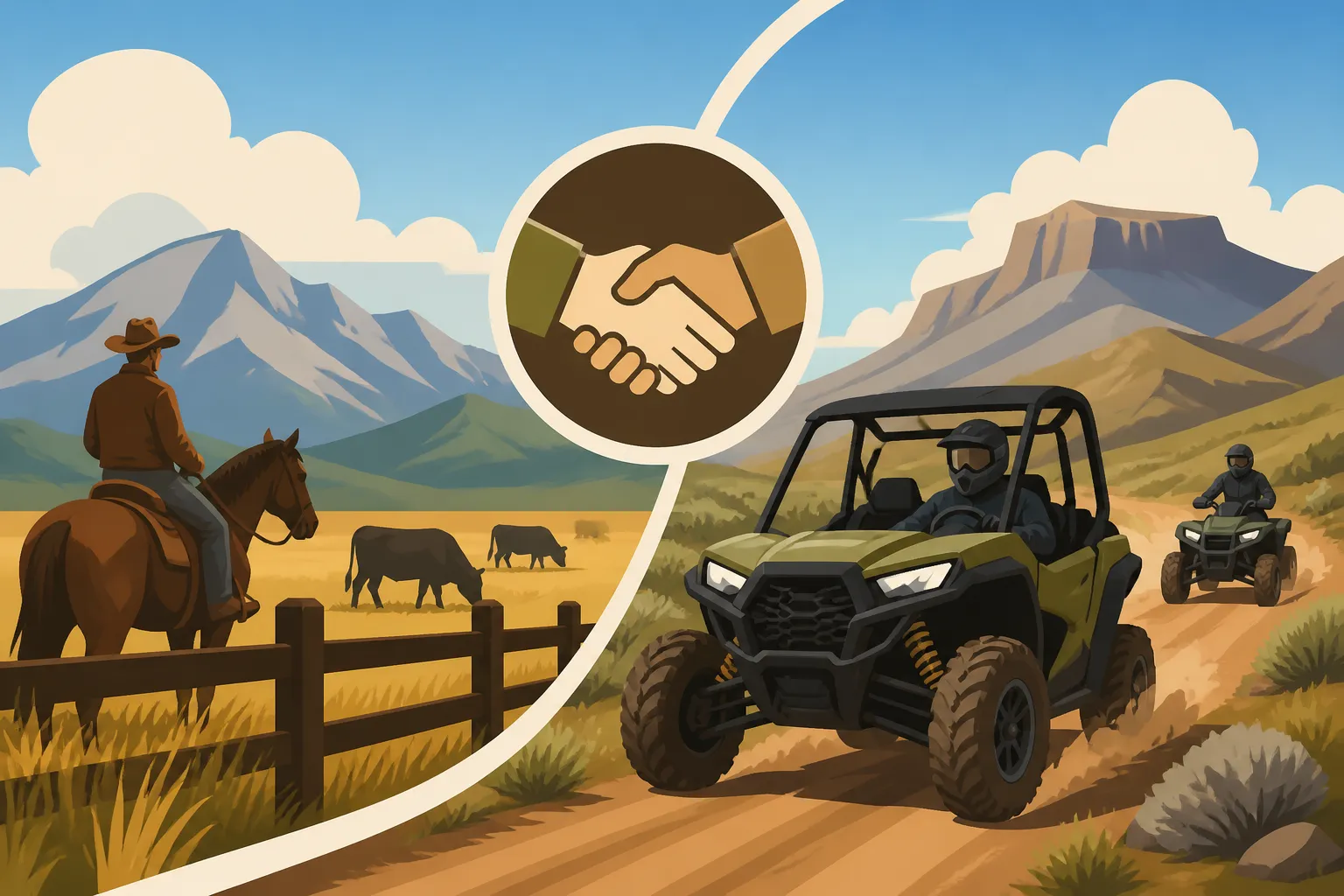
However, the rancher who holds the grazing lease has certain rights and responsibilities related to managing their livestock on that leased land. This often includes installing fences, maintaining water sources, and, yes, putting up gates across roads or trails. These aren't necessarily meant to keep people out, but rather to keep animals in (or out of specific areas). The presence of a lease means you need to be extra mindful of your impact and interactions within these areas. It's a balance between public access and agricultural use, and understanding that balance is fundamental to being a responsible rider in Wyoming's vast expanses.
Navigating Gates, Fences, and Signage on Leased Land
One of the biggest sources of confusion and anxiety for riders on Wyoming's vast trail network is encountering gates, fences, or signage that might seem to restrict access. It's a common scenario: you're cruising along a beautiful two-track, feeling the wind in your face, and suddenly, there's a fence and a closed gate right across your path. Do you open it? Is it private? What do the signs mean?
The "Open Gate, Close Gate" Rule
This is, perhaps, the single most important rule to remember when riding in areas with grazing leases: if you open a gate, you must close it. And not just loosely close it – make sure it's latched securely, just as you found it. This isn't just a courtesy; it's a critical aspect of respecting the land, the livestock, and the livelihoods of ranchers. The gates are there for a reason, primarily to control the movement of cattle, sheep, or horses. An open gate can lead to livestock straying, mixing with other herds, or wandering onto highways, creating significant problems and costs for the rancher.
Imagine the frustration and financial burden on a rancher if their cattle get out because a rider didn't close a gate. It's a real-world consequence that directly impacts someone's livelihood. In many cases, not closing a gate can be considered a form of trespass or, at the very least, a serious breach of etiquette that could lead to closures of otherwise accessible routes in the future. Always take the time to dismount, open the gate, drive through, and then securely close it behind you. This small act of responsibility goes a long way in fostering good relationships between recreationists and the ranching community. You can find more specific details on [Wyoming Rules for Opening a Gate].
Interpreting "No Trespassing" Signs and Fences
This is where things can get particularly tricky. Not every fence or "No Trespassing" sign means you can't proceed. Sometimes, fences simply delineate grazing pastures or property lines, even on public land, without necessarily prohibiting access to a public road or trail that crosses it. A "No Trespassing" sign, however, typically indicates private land where entry is forbidden without explicit permission.
The key is clarity. A lawful "No Trespassing" sign should clearly indicate that the road or trail itself is private, or that the land beyond the sign is private. If you encounter a fence across what appears to be a designated public road or a clearly marked public two-track, and there's a gate without a "No Trespassing" sign specifically for the road, it's generally safe to open, pass through, and re-close the gate. However, if the gate is locked, or if there are clear signs indicating the road itself is private or that you are entering private property, you must respect that and turn back. Never climb over fences or force locked gates. These actions constitute trespass and can lead to legal consequences and further restrictions on public access for everyone.
It's also worth noting that some private landowners might place "No Trespassing" signs along the boundary of their land, even if a public road passes through or alongside it. The important distinction is whether the sign refers to the land adjacent to the road or the road itself. When in doubt, it's always better to err on the side of caution or consult a detailed land ownership map.
Recognizing Public Roads and Two-Tracks
Identifying whether a road or two-track is truly public, especially in remote areas or those crisscrossed by grazing leases, is paramount. This isn't always obvious just by looking at the track on the ground. A two-track that looks well-used could be a private ranch road, while a faint trail might actually be a designated public route.
The best way to determine public access is to use official travel management maps. These maps are provided by agencies like the Forest Service and the Bureau of Land Management (BLM) and are invaluable resources for riders. They clearly delineate designated roads and trails that are open to ATV and UTV use, as well as land ownership boundaries. You can usually find these maps online on the respective agency websites, or sometimes at local ranger stations or BLM field offices. Many GPS units and smartphone apps also integrate this data, making navigation easier in the field. This brings up the importance of [Carrying a Travel Management Map in Wyoming].
A public right-of-way, even if it crosses a grazing lease, generally means you have the right to travel on that specific path. However, this right typically does not extend to venturing off the designated route onto the adjacent leased or private land. Staying on these marked routes helps prevent conflict and ensures continued access. It’s important to understand the concept of [Wyoming Rules for Riding a Two-Track] versus a full-fledged road. Remember, the general rule in Wyoming is "travel on designated routes only" when on federal public lands.
Rider Responsibilities and Etiquette in Grazing Areas
Riding through Wyoming's incredible landscapes, especially those managed for grazing, comes with a big responsibility. It's not just about knowing the rules; it's about being a respectful and considerate user of the land. Our actions directly influence how land managers and ranchers perceive off-road enthusiasts, and ultimately, whether access remains open for future generations.
Respecting Livestock and Property
When you're out on the trails and encounter livestock, remember that this is their home and their livelihood. Always slow down significantly when approaching cattle, horses, or sheep. Give them a wide berth and avoid actions that might startle or scatter them. Loud engine noises, sudden movements, or aggressive riding can stress animals, especially cows with calves or ewes with lambs, which can lead to serious problems for the rancher. If animals are blocking the trail, approach slowly and steadily, giving them time to move. Never try to "herd" them with your machine or push them aggressively. Patiently wait for them to clear the path. [Wyoming Rules for Riding Near Livestock] are in place for a good reason.
Beyond the animals themselves, it's crucial to respect all property and improvements you encounter. This includes fences, water tanks, irrigation systems, and any structures. Do not damage or interfere with these. Stay on the designated routes to avoid disturbing pastures, crops, or fragile ecosystems. Remember, a grazing lease means someone is actively managing that land for a specific purpose, and our recreational activities should complement, not hinder, their efforts. This extends to [Wyoming Rules for Riding a Ranch Road] which can often intersect with grazing allotments.
Communication and Due Diligence
Sometimes, despite all your map-reading and rule-following, you might find yourself uncertain about access. Perhaps a gate is locked, or a sign is ambiguous. In such situations, if possible, seeking clarity from a local rancher or land manager can be incredibly helpful. Most ranchers are reasonable people who appreciate open communication. If you have questions before you ride, contacting the local BLM or Forest Service office for the area you plan to visit can often clear up confusion regarding specific routes or seasonal closures.
It's always a good idea to know whose land you're on and what the local rules might be. This due diligence can save you a lot of trouble and ensure you're riding legally and respectfully. This is particularly important on [Wyoming State Trust Land and Its Own Rules], which often has unique access permits. A little research upfront can prevent unintentional trespass or conflicts. Carrying detailed maps, whether paper or digital, that show land ownership and designated routes is your best friend in these situations.
Maintaining Equipment for Minimal Impact
Our machines, while powerful and fun, can also have an impact on the environment and the grazing areas we ride through. Proper equipment maintenance is a key part of responsible riding. Ensuring your ATV or UTV has a properly functioning spark arrester is not just a good idea; it's often a legal requirement on public lands, especially in dry Wyoming conditions where wildfires are a constant threat. A well-maintained spark arrester prevents hot carbon particles from escaping your exhaust and potentially igniting dry grass or brush.
Brands like SuperATV offer a range of high-quality aftermarket exhaust systems and spark arresters designed to meet regulatory standards while often improving performance. Investing in these kinds of components helps ensure you're not inadvertently contributing to fire risks. Similarly, ensuring your muffler is in good working order helps keep noise levels down, reducing disturbance to livestock, wildlife, and other land users.
Beyond exhaust systems, routinely checking your machine for fluid leaks helps prevent contamination of water sources or soil. Carrying out all your trash, and even packing out trash left by others, is another small but significant way to show respect for the environment. Responsible equipment maintenance and clean riding practices demonstrate that off-road enthusiasts are committed stewards of the land, which helps maintain and even expand access opportunities in the future.
Here's a quick summary to help you navigate these situations:
| Situation Encountered | Recommended Action | Why? |
|---|---|---|
| Closed Gate (Unmarked) | Open, pass through, securely close behind you. | Livestock management; it's a shared resource. Respect rancher's operations. |
| Closed Gate (Locked) | Do not attempt to open or bypass. Turn around. | Indicates no public access or a private agreement. Forcing is trespass. |
| "No Trespassing" Sign | Identify if it applies to the road/trail or adjacent land. If unclear, turn back. | Explicitly restricts access to private property. |
| Fences Across Trail | Look for a gate. If none, do not proceed. Never cut fences. | Fences protect livestock and property boundaries. |
| Livestock on Trail | Slow down, give wide berth, wait for them to move. Do not harass. | Prevents stress to animals and avoids property damage. |
| Ambiguous Signage | Consult maps (digital/paper), contact local land manager if possible, or turn back. | Better safe than sorry to avoid trespass or conflict. |
| Designated Public Route | Stay on the route. Do not venture off-trail onto adjacent land. | Maintains access; prevents damage to leased land and potential conflict. |
Disclaimer
This article is for general informational purposes only and does not constitute professional advice. Laws, prices and regulations vary by location and change over time. Consult a qualified professional for guidance on your specific situation.