Getting an M Endorsement at the DMV
It's a common dilemma for folks in Wyoming who love their ATVs and UTVs: you've got this incredible machine perfect for the backcountry, but sometimes you just need to pop onto a paved road to get from one trail segment to another, or maybe even head into town for supplies. The thought of dealing with the DMV for an "M endorsement" can feel like a whole new kind of trail challenge, but for those aiming to make their multipurpose vehicle (MPV) truly road-legal, it's a necessary step that this guide will break down for you.
Why an M Endorsement Matters for Your Wyoming ATV or UTV
You bought your ATV or UTV for tearing up the trails, working on the ranch, or exploring vast open spaces. It's a powerhouse off-road, but the moment those knobby tires hit pavement, you enter a whole new world of regulations. The "M" endorsement, short for "Motorcycle" endorsement, is what tells the state that you're capable and authorized to operate certain motorized vehicles on public roads – and that includes your street-legal UTV or ATV in Wyoming. Without it, you could be facing fines, even if your machine itself is properly equipped and registered.
The Difference Between ORV and MPV Status
Before we even talk about endorsements, it’s crucial to understand the distinction Wyoming makes between an Off-Road Recreational Vehicle (ORV) and a Multipurpose Vehicle (MPV). An ORV is strictly for off-highway use, period. Think of your classic quad or dirt bike used exclusively on dirt trails or designated riding areas. These machines need an [Wyoming's Annual ORV Permit] and a decal, but they absolutely do not belong on public paved roads unless it's a very specific, designated ORV road or crossing.
An MPV, however, is a different beast. This is where your UTV or even some larger ATVs can find a path to street legality. Wyoming has a specific set of criteria that an ORV must meet to be classified as an MPV. This includes things like weight limits (between 300 and 3,000 pounds), having an upright seat at least 24 inches high, and other safety equipment like mirrors and lights. Once your machine meets these structural and equipment requirements and you've gone through the titling and plating process with the county clerk and treasurer, respectively, then it's technically ready for the road. But you, the driver, still need to be ready too, and that’s where the M endorsement comes in. This transition from ORV to MPV is fully detailed in [Wyoming's MPV Path to the Road].
When the Road Calls: Why You Need It
Imagine you're deep in the Bighorn Mountains, enjoying the incredible scenery on an enrolled trail. You want to get from one section to another, and the most direct route involves a couple of miles on a county road. If your machine is an MPV and you, the driver, have an M endorsement, you can legally make that connection. Without it, you're either risking a ticket, or you're stuck trailering your machine for those short distances, which completely defeats the purpose of having a street-legal side-by-side.
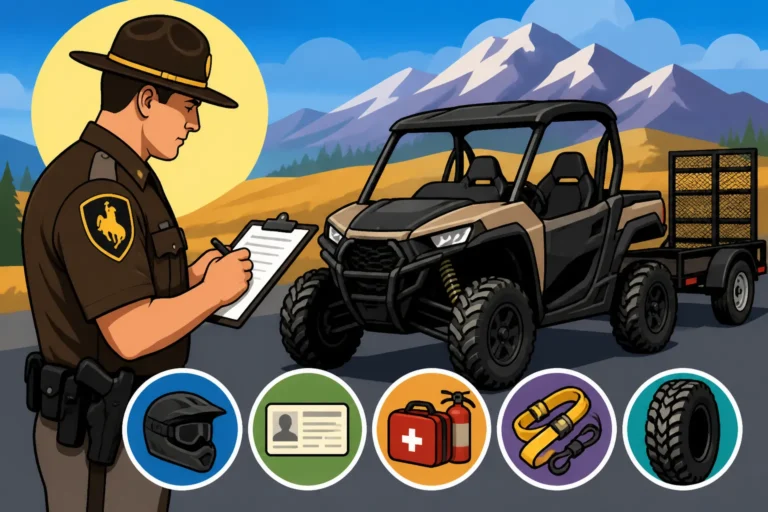
It's not just about convenience; it's about compliance and safety. Law enforcement officers, whether it's a county sheriff or a state trooper, are well-versed in the nuances of Wyoming's vehicle laws. If you're pulled over on a public road, they'll check for your vehicle's registration (is it plated as an MPV?), its equipment (does it have the required lights, mirrors, and horn?), and your driver's license (do you have the proper endorsement?). Getting caught without that M endorsement means you're operating a motor vehicle on a public roadway without the necessary authorization, which can lead to fines and other penalties. It’s an easy way to turn a fantastic day of riding into a stressful and expensive headache. For a complete understanding of what's required, you'll want to review [Wyoming MPV Street Legal Requirements].
Understanding Wyoming's M Endorsement Requirements
The process for getting an M endorsement in Wyoming is similar to obtaining a regular motorcycle endorsement, and it’s designed to ensure you understand traffic laws and can safely operate your specialized vehicle on public roads. It's not just a formality; it's a demonstration of your ability to navigate the same traffic conditions as cars and trucks, albeit on a different kind of machine.
Who Needs an M Endorsement?
Let's clarify this right away: if you plan to operate your MPV on any public road in Wyoming where a regular driver's license is required, you will need an M endorsement. This isn't just for major highways; it includes county roads, state highways, and even some city streets, provided those routes are designated as open to MPVs. [Wyoming's MPV Definition in W.S. 31-1-101] outlines the specific characteristics of what qualifies as an MPV, but for the human behind the handlebars or steering wheel, the M endorsement is key.
However, there's a nuance. If your machine meets the MPV criteria but you only plan to ride on trails and designated off-road areas, you might not strictly need the M endorsement. But the moment you venture onto an enrolled road, that endorsement becomes mandatory. There’s also the question of age: if you're under 18, specific rules apply, often involving helmet use and potentially requiring adult supervision on certain roads. [Wyoming Minimum Age to Ride a Road] touches on these specifics.
It's also important to note that the M endorsement is typically added to an existing driver's license. You need to have a valid Wyoming driver's license (or an equivalent from another state if you're a new resident transferring your license) before you can add the M endorsement. This isn't a standalone license; it's an addition that signifies your expanded driving privileges.
The Knowledge Test: What to Expect
The first hurdle to clear is the written knowledge test. This isn't just about knowing how to ride your side-by-side; it's about understanding the rules of the road that apply to all vehicles, with an emphasis on situations specific to motorcycles and similar vehicles. You’ll be tested on traffic laws, road signs, safe driving practices, and defensive driving techniques. Think of it as a refresher on everything you learned for your regular driver's license, but with a twist to include two- and three-wheeled (or even four-wheeled, in the case of MPVs) vehicle operation.
The Wyoming Driver Handbook, specifically the motorcycle section, is your best friend here. It covers everything from lane positioning and hazard perception to the specific equipment requirements for motorcycles and MPVs on the road. Don’t underestimate this test; while some questions might seem straightforward, others require careful thought about how a smaller, more exposed vehicle like an MPV interacts with other traffic. It’s not a test of how well you can power slide; it’s a test of how safely and lawfully you can share the road. Many find it helpful to take practice tests online to get a feel for the types of questions asked and to identify areas where they need to study more.
The Skills Test: Proving You Can Ride Safely
Once you pass the knowledge test, you'll move on to the skills test, often called the "road test" or "driving test." This is where you physically demonstrate your ability to operate your MPV safely. You'll perform a series of maneuvers designed to assess your control, balance, and judgment. While it's typically administered on a motorcycle, the principles apply directly to an MPV. These maneuvers might include:
- Basic Vehicle Control: Starting, stopping, turning, and shifting (if applicable).
- Cone Weave: Navigating through a series of cones at low speed, demonstrating precision steering and control.
- Figure Eight: Maneuvering your machine in tight circles, testing your ability to handle it in confined spaces.
- Quick Stop: Braking effectively and safely from a moderate speed.
- Obstacle Avoidance: Swerving to avoid an imaginary obstacle, simulating an emergency situation.
You will typically need to provide your own MPV for the skills test, and it must be legally equipped for road use (headlights, taillights, brake lights, horn, mirrors, etc.). The examiner will check these items before you begin. Remember, the focus is on safe, controlled operation within legal limits. They aren't looking for stunt riding, but rather proof that you can confidently and predictably handle your machine in real-world scenarios. Many experienced riders find these tests surprisingly challenging because they require very precise, controlled movements, which might be different from their usual style of aggressive off-road riding. Getting comfortable with these specific maneuvers beforehand is key.
The Step-by-Step Process to Get Your M Endorsement
Navigating the process to get your M endorsement might seem like a maze of paperwork and tests, but breaking it down into manageable steps makes it much less daunting. With a little preparation, you’ll be well on your way to legally cruising those Wyoming roads.
Preparing for Your Tests
Preparation is truly half the battle when it comes to the M endorsement. For the knowledge test, your primary resource is the official Wyoming Driver Handbook. Pay special attention to the sections on motorcycles, as these cover many of the principles that apply to MPVs on the road. You can usually find a digital copy on the Wyoming Department of Transportation (WYDOT) website. Don't just skim it; read it thoroughly, and consider highlighting key sections. Practice tests, readily available online, can also be invaluable for gauging your readiness and identifying areas that need more study.
For the skills test, practice, practice, practice! Find a safe, open area, like an empty parking lot, and set up a makeshift course. Use cones, chalk, or even water bottles to simulate the maneuvers you expect to perform. Work on your low-speed control, tight turns, smooth braking, and quick stops. If you have a friend with an M endorsement who can coach you, that's a huge bonus. Remember, the goal isn't just to complete the maneuvers, but to do so smoothly and safely, demonstrating consistent control over your machine. Ensuring your MPV is in top shape, with all lights, brakes, and tires functioning perfectly, is also a critical part of preparation. Think of it as a pre-ride inspection, but with higher stakes. Some folks even consider upgrading their mirrors or adding a louder horn, perhaps from a brand like SuperATV, to ensure they meet requirements and feel safer on the road.
Visiting the Wyoming DMV: What to Bring
When it's time to visit the Wyoming Driver Services office (often referred to as the DMV), come prepared. You don't want to make multiple trips just because you forgot a crucial document. Here’s a checklist of what you'll typically need:
- Proof of Identity: Your current valid Wyoming driver’s license is a must. If you're new to the state, you'll need documents proving your identity, residency, and legal presence in the U.S., similar to what you presented for your initial driver’s license.
- Proof of Residency: Documents like utility bills, lease agreements, or mail from government agencies can establish your Wyoming residency.
- Social Security Number: You'll need to provide your Social Security number, though you usually don't need to bring the card itself.
- Your MPV (for the skills test): As mentioned, you'll need to bring the actual machine you intend to operate on the road. It must be a properly registered and titled MPV, not just an ORV.
- Proof of Insurance for your MPV: Just like any other road-legal vehicle, your MPV needs to be insured. Bring your insurance card or policy documentation. [Wyoming ATV Insurance Requirement] further details this.
- Helmet: For the skills test, you will need to wear an approved helmet. Even if you're over 18, it's a requirement for the test. [Wyoming Helmet Law for ATV Riders] is a good resource for understanding helmet rules.
- Payment for Fees: There will be fees associated with taking the tests and updating your license. Be prepared to pay with cash, check, or card, depending on the specific office's policies.
It's always a good idea to call your local Driver Services office beforehand or check their website to confirm their exact requirements and operating hours. This can save you a lot of time and frustration.
After You Pass: What Happens Next?
Congratulations! You’ve passed both the knowledge and skills tests. The sense of accomplishment is real, but there's one final step. The Driver Services office will process your new M endorsement. They'll typically issue you a temporary paper license with the new endorsement immediately, and your official updated driver’s license card will be mailed to you within a few weeks.
Once you have that temporary license in hand, you are legally authorized to operate your MPV on enrolled public roads in Wyoming, assuming your MPV itself is properly registered, titled, plated, and equipped. It's important to always carry your driver’s license with the M endorsement (or the temporary paper copy) whenever you're operating your MPV on a public road. A copy on your phone usually doesn't count. Just like with any other vehicle, being able to present your license, registration, and proof of insurance is essential if you're stopped by law enforcement. Now, you can confidently take those road segments, knowing you've met all the legal requirements.
Alternative Options and Important Considerations
While the M endorsement is the primary path for full road legality for MPV operators, Wyoming does offer an alternative for some, and there are crucial equipment considerations to keep in mind for any machine venturing onto public roads.
The MR Permit: A Different Path for MPVs
You might hear talk of an "MR permit" as an alternative to the full M endorsement. This is another type of credential issued by Wyoming that allows you to operate an MPV on certain public roads. The "MR" stands for "Multipurpose Vehicle Restricted." It's generally a more limited permit compared to a full M endorsement. Often, it's an option for those who don't want to go through the full motorcycle endorsement process but still need limited road access for their MPV.
The MR permit may have specific restrictions, such as limiting the roads you can travel on or requiring an existing valid driver's license (but not necessarily a motorcycle endorsement). It's crucial to understand the exact scope and limitations of an MR permit if you choose this route. For example, it might allow you to ride on county or forest roads, but not on busier state highways or interstates. The requirements for obtaining an MR permit are typically less stringent than a full M endorsement, often only requiring a written test specific to MPV rules. This can be a good option for ranch hands or those who primarily use their MPVs for work or access to remote trails, needing only occasional, limited road use. You can explore the differences in detail by looking up [The M or MR Endorsement Wyoming Asks For].
Equipment Your Machine Needs for the Road
Regardless of whether you get an M endorsement or an MR permit, your MPV itself must meet a very specific list of equipment requirements to be considered street-legal in Wyoming. This isn't optional; it's what truly transforms your off-road warrior into a road-worthy machine.
Here's a breakdown of the essential equipment:
- Headlights: At least one, but usually two, capable of illuminating the road at night. They need to meet brightness and aiming standards.
- Taillights and Brake Lights: A red taillight visible from the rear, and brake lights that illuminate when the brakes are applied.
- Turn Signals: Front and rear turn signals are required to indicate your intentions to other drivers.
- Mirrors: At least one rearview mirror, typically mounted on the left side, that provides a clear view of the road behind you. Many riders choose a high-quality mirror from SuperATV for better visibility and durability.
- Horn: A working horn capable of emitting a sound audible from at least 200 feet.
- Muffler and Spark Arrester: These are usually standard on modern machines, but they must be in good working order to keep noise levels down and prevent wildfires.
- Tires: Road-legal tires are essential. Off-road-only tires might not be rated for sustained pavement use and can wear quickly or perform poorly.
- Windshield (recommended, often required for MPV registration): While not always explicitly listed as a driver requirement, a windshield is often a practical necessity and helps meet the enclosed cab aspects of some MPV definitions.
- Seat Belts (for UTVs): If your MPV is designed with seatbelts, they must be functional and worn by all occupants.
Many riders will add aftermarket accessories to their machines to meet these requirements. Companies like SuperATV offer a wide range of street-legal kits, including mirrors, turn signal kits, and horns, making it easier to convert an off-road UTV into an MPV. Don't overlook any of these items; a single missing or non-functional piece of equipment can lead to a citation and make your M endorsement irrelevant for that particular ride. [Equipment a Wyoming Road Machine Needs] provides an in-depth look at these specifics. Taking the time to properly equip your MPV and obtain the right endorsement ensures that your adventures across Wyoming's vast and diverse landscapes are both thrilling and entirely legal.
| Requirement Category | ORV (Off-Road Only) | MPV (Road-Legal Capable) | Driver Endorsement Needed |
|---|---|---|---|
| Vehicle Registration | Wyoming ORV Permit/Decal | Wyoming Title & Plate | N/A |
| Primary Use | Trails, off-road areas | Public roads & off-road | N/A |
| Required Equipment | Spark arrester, muffler | Headlights, taillights, brake lights, turn signals, mirrors, horn, seatbelts (UTV), speedometer, odometer, horn, proper tires | N/A |
| Driver's License | Standard Class C | Standard Class C + M Endorsement (or MR Permit) | Yes |
| Insurance | Not typically required for off-road use | Required for road use | N/A |
| Helmet | Recommended | Required for under 18; recommended for all | N/A |
Disclaimer
This article is for general informational purposes only and does not constitute professional advice. Laws, prices and regulations vary by location and change over time. Consult a qualified professional for guidance on your specific situation.