What a Wyoming Trooper Checks Roadside
It’s a moment many off-road enthusiasts dread: you’re out enjoying the wide-open spaces of Wyoming on your ATV or UTV, cruising an enrolled county road, when you spot a flashing light in your rearview. Instantly, your mind races with questions about whether your machine is fully compliant. This guide is here to alleviate that anxiety by breaking down exactly what a Wyoming trooper is looking for during a roadside stop, helping you ride with confidence and stay on the right side of the law.
The Basics: Registration and Identification
When a trooper pulls you over, whether you’re on a county road, a designated Forest Service route, or even crossing a state highway, the first things they'll want to see are basic proofs of your machine's legality and your identity. Think of it like any other vehicle stop – they need to verify who you are, what you're driving, and that you have permission to be driving it.
Current Wyoming ORV Permit
One of the absolute first things a Wyoming trooper will check for is a current and properly displayed Wyoming ORV permit. This isn't just a suggestion; it's a requirement for riding on any designated public lands or enrolled roads in the state. If you've been on the trails for a while, you know that little sticker is your ticket to ride.
They'll be looking for that square decal, typically on the front fender or another easily visible spot. It needs to be the current year’s permit, clearly visible and securely affixed. Many riders forget to update theirs, or perhaps it got scraped off during a particularly aggressive ride. An expired or missing decal is a pretty clear signal for an officer to dig a little deeper, and it can result in a citation. It’s not just about having a permit; it's about having the right permit, displayed correctly. Think about it: that decal helps fund the very trails and roads you’re enjoying, so ensuring it's current is part of being a responsible rider. Make sure to check out [Wyoming's Annual ORV Permit] and [Sticking a Decal Where It Shows] for more details on placement and renewal.
Proof of Ownership and Identity
Just like with your car or truck, you need to be able to prove that the machine you're operating is yours (or that you have permission to use it). This typically means having a bill of sale, if you're the owner, or some other form of ownership document. While most off-road vehicles in Wyoming don't require a title for trail use, if you're riding an MPV (Multipurpose Vehicle) on the road, a title certainly comes into play. Even without a title for a pure ORV, a bill of sale helps establish ownership and can ward off suspicion of a stolen machine.
Beyond the machine, the trooper will want to confirm your identity. Your driver's license or state-issued ID is essential. They'll compare the name on your ID to any ownership documents you provide. It’s always a good idea to keep these documents in a waterproof bag or container on your machine, easily accessible. Getting pulled over and fumbling through a muddy glove box for soggy papers isn't ideal for anyone involved. Having your [A Wyoming Bill of Sale for an ATV] handy, along with your personal ID, makes this part of the stop go much smoother. They might also check the VIN (Vehicle Identification Number) on the machine against your paperwork, just to be sure everything matches up. This is a standard procedure and helps ensure the machine isn't reported stolen. Consider running a [Wyoming ATV VIN Check Before Buying] for used machines to ensure you have clean paperwork.
Machine Equipment for Road Use
Wyoming has specific requirements for ATVs and UTVs (Multipurpose Vehicles, or MPVs) that are being operated on enrolled public roads. It's crucial to understand that simply having an ORV permit doesn't automatically make your machine street-legal. If you're riding on any county, state, or federal road that has been designated for ORV or MPV use, your machine needs to meet certain equipment standards that are similar to, though not identical to, a regular car.
Essential Lighting and Reflectors
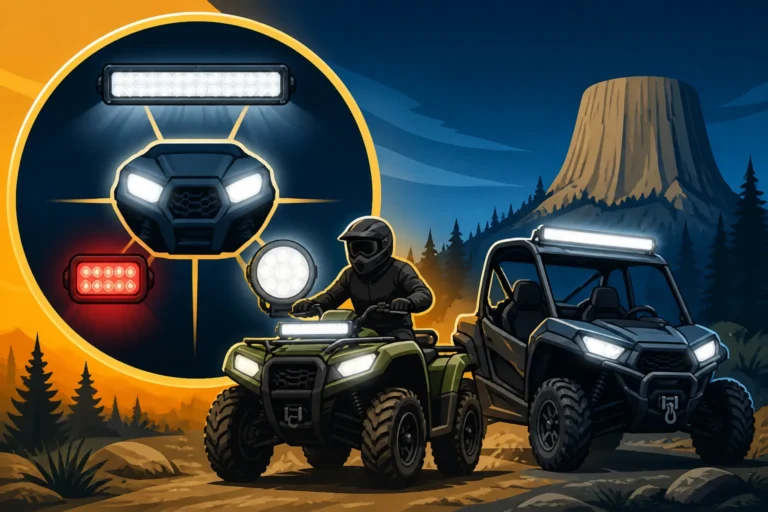
When you're sharing a road, even a dirt road, with other vehicles, visibility is paramount. Troopers will be looking for functional headlights, taillights, and brake lights. Your headlights need to cast a clear beam forward, illuminating the path ahead, and your taillights must be visible from a distance, especially at dusk, dawn, or in adverse weather conditions.
The brake light is equally critical. When you hit the brakes, that light needs to illuminate clearly and immediately, signaling to anyone behind you that you're slowing down or stopping. Beyond active lighting, your machine also needs a red rear reflector. This passive safety feature ensures you're still visible even if your taillight fails. Riders often upgrade their lighting for better trail visibility, but it’s important to make sure those upgrades also meet road-legal requirements, where applicable. For a comprehensive look at what's required, check out [Wyoming Lighting Requirements for ORVs].
Mirrors, Horn, and Other Safety Gear
Beyond lighting, there are other pieces of equipment designed to enhance safety and communication on the road. A trooper will definitely be checking for a mirror, specifically one mounted on the left side of your machine. This mirror is essential for seeing traffic approaching from behind without having to turn your head completely. It's a fundamental piece of safety equipment for any road-going vehicle.
You also need a horn. A functional horn allows you to signal to other drivers or pedestrians, alerting them to your presence in situations where a visual cue might not be enough. This could be to prevent an accident or simply to acknowledge another rider. For those larger, slower-moving UTVs or ATVs, especially if you're on a road with a higher speed limit, you might also be required to display a slow-moving vehicle emblem – that distinct orange triangle – on the rear of your machine. This alerts faster traffic that you'll be traveling well below the posted speed limit. Companies like SuperATV offer a range of mirrors and horn kits that are designed to meet these safety requirements, making it easier for you to get your machine road-ready. Making sure you have a working horn is as important as having working brakes when you're sharing the pavement. [Fitting a Horn to a Road-Legal Side-by-Side] is a good resource, as is [When a Machine Must Carry a Slow-Moving Vehicle Emblem]. Also check [Wyoming Mirror Requirements for Road Use] to ensure compliance.
Mufflers and Spark Arresters
Wyoming takes its environmental protection and noise regulations seriously, particularly on public lands. A trooper will want to ensure your machine is equipped with a functioning muffler and a U.S. Forest Service-approved spark arrester. The muffler's job is to reduce the noise output of your engine to acceptable levels, preventing excessive disturbance to wildlife and other recreational users. Loud pipes might sound cool to some, but they can be a real nuisance and are often illegal on public land.
The spark arrester is a critical safety device, especially in a state like Wyoming, which can be prone to wildfires. It's designed to prevent hot carbon particles (sparks) from exiting the exhaust system, which could ignite dry grasses or brush. Without a proper spark arrester, your machine is a fire hazard. Officers are very aware of this risk, especially during dry seasons. They'll often do a quick visual check, sometimes even a physical inspection, to ensure the arrester is present and in good condition. If you've modified your exhaust system, it's vital to ensure any aftermarket muffler still includes a spark arrester and meets sound regulations. Many riders find that a simple check of their stock system or a compliant aftermarket solution from a reputable provider, such as those found through SuperATV, keeps them within legal limits. Take a look at [Wyoming Muffler and Spark Arrester Rules] and [A Forest Service Rated Arrester in Wyoming] for more information.
Rider and Passenger Requirements
Beyond the machine itself, the person operating it, and any passengers, also have specific legal requirements in Wyoming, especially when venturing onto roads. These rules are in place to ensure the safety of everyone on public thoroughfares.
Driver's License and Endorsements
This is where many riders get confused. If you're strictly riding on designated off-road trails and not enrolled roads, a standard driver's license isn't always required, though supervision rules apply for younger riders. However, if your ATV or UTV (specifically an MPV) is being operated on a public road in Wyoming, you absolutely need a valid driver's license. Furthermore, if you're operating an MPV, you'll need the proper endorsement on your license.
For some MPVs, especially those that blur the line between an off-road vehicle and a motorcycle (like a three-wheeled ATV or certain side-by-sides), an M (motorcycle) or MR (motorcycle-related) endorsement might be required. This acknowledges that operating such a machine on public roads requires specific skills and knowledge different from driving a car. A trooper will ask to see your driver's license and verify that it carries the correct endorsements for the type of machine you're driving on that particular road. Not having the correct license or endorsement can lead to a significant citation. Always double-check [Wyoming Driver's License Rules for ORVs] and [The M or MR Endorsement Wyoming Asks For] before hitting any paved or gravel roads.
Helmet Laws and Age Restrictions
Wyoming has clear laws regarding helmet use, especially for younger riders and passengers. While adults aged 18 and over are generally not required to wear a helmet when operating an ORV or MPV on designated trails or roads, it is highly recommended for safety. However, if you or any passenger are under the age of 18, wearing an approved helmet is mandatory.
This isn't just a suggestion; it's a legal requirement. A trooper will certainly be looking to see if all underage riders and passengers are wearing appropriate head protection. Additionally, there are age restrictions for operating ATVs and UTVs, particularly on public roads and sometimes even on trails. Younger riders often require adult supervision or must meet specific age and training criteria. It's vital to know these rules for every person on your machine. Carrying a child passenger? Make sure you know [Wyoming Passenger Rules on an ATV]. For driver-specific rules, check [Wyoming Helmet Law for ATV Riders].
Proof of Insurance
Just like your car, if your ATV or UTV is being operated on any public road in Wyoming (as an MPV), it must be insured. Proof of liability insurance is a non-negotiable requirement. A trooper will ask for your insurance card or documentation, showing that your machine is covered.
This isn't just about avoiding a ticket; it's about financial protection in case of an accident. Collisions can happen, even on quiet dirt roads, and having insurance ensures that you and others are protected from potential financial devastation. Without proof of insurance, you're looking at a significant fine and potential other penalties. Keep your insurance card handy with your other vehicle documents. Many insurance providers offer specific policies for off-road vehicles that cover both trail and road use. Make sure your policy covers you for road operations if that's part of your riding plan. Check out [Wyoming ATV Insurance Requirement] for more details on what's needed.
Where You're Riding: Designated Routes and Restrictions
One of the most common reasons riders encounter law enforcement in Wyoming is due to being in the wrong place at the wrong time, or simply not knowing the specific rules for the area they're riding in. Wyoming has a vast network of trails and roads, but not all of them are open to ATVs and UTVs.
Staying on Enrolled Roads and Trails
The concept of "enrolled" roads and trails is central to legal off-road riding in Wyoming. These are specific routes that have been designated and approved for ATV and UTV use by the relevant land management agencies (like the Forest Service, BLM, or county governments) in conjunction with the state. A trooper will want to confirm that you are on such an enrolled route.
Riding off-route, or "cross-country," is generally prohibited and carries significant penalties. Troopers often patrol popular areas to ensure riders are adhering to these rules. It’s your responsibility as a rider to know where you are and whether the route you’re on is open to your type of machine. This often involves carrying and consulting MVUMs (Motor Vehicle Use Maps) provided by federal agencies, or county-specific maps. These maps clearly mark which roads and trails are open, to what types of vehicles, and during which seasons. Relying solely on a general GPS without current map data can lead you astray. Don't leave home without knowing the lay of the land; [Wyoming's Enrolled Roads and Trails] and [Wyoming Rules for Riding a Designated Route] are excellent resources to consult.
Prohibited Areas and Trespassing
Beyond simply staying on enrolled routes, there are certain areas where off-road vehicle use is strictly prohibited, regardless of whether you have a permit or a road-legal machine. This includes designated wilderness areas, most National Parks (like Yellowstone and Grand Teton, where ATVs/UTVs are generally not allowed), and any private land where you do not have express permission from the landowner.
Trespassing is a serious offense, and troopers will enforce private property rights vigorously. If you cross a fence line, ignore "No Trespassing" signs, or ride onto private ranch land without permission, you can expect to face consequences. Even if the land appears unposted or unfenced, it's still someone's property, and it's your responsibility to know whose land you're on. Using apps or maps that delineate public versus private land can be incredibly helpful. Furthermore, some trails may be seasonally closed to protect wildlife during sensitive periods like calving or winter migration. Disregarding these closures, even if unintentional, will lead to a citation. Be aware of [Wyoming Trespass Rules for Riders] and [Wyoming Fines for Riding a Closed Road] to understand the repercussions of riding in restricted zones.
Rules for Crossing Highways and Interstates
Wyoming, like many western states, has unique rules for off-road vehicles when it comes to crossing paved highways and even interstates. You cannot simply ride your ATV or UTV down a state highway or across an interstate at will. There are very specific protocols that must be followed if you need to get from one enrolled section to another across a major road.
Troopers are highly aware of these rules because these crossings present significant safety hazards for both off-road riders and highway traffic. Generally, you must come to a complete stop, yield to all highway traffic, and cross at a 90-degree angle. You should only proceed when you have clear sight lines in both directions and can safely cross without impeding traffic. For interstates, the rules are even stricter, often requiring designated, marked crossings and sometimes even grade-separated crossings (underpasses or overpasses). Attempting an illegal crossing is a surefire way to get pulled over and issued a citation. Make sure you fully understand [Wyoming Rules for Crossing an Interstate] and [How to Cross I-80 Legally on an ATV] before you even consider such a maneuver.
Impairment and Conduct
Just like operating any other motor vehicle, operating an ATV or UTV while impaired or engaging in reckless behavior is illegal and dangerous. Troopers are vigilant about enforcing these laws to ensure the safety of all recreationists and the public.
DUI/DWI Laws for ORVs
This is a critical point that sometimes gets overlooked: Wyoming's DUI (Driving Under the Influence) and DWI (Driving While Intoxicated) laws apply to off-road vehicles just as they do to cars and trucks. If you are found operating an ATV or UTV on public lands, enrolled roads, or even some private lands (depending on the specific law and situation) while under the influence of alcohol or drugs, you will be subject to the same penalties as if you were driving a passenger car.
These penalties are severe and can include hefty fines, license suspension (even for your regular driver's license), jail time, and mandatory rehabilitation programs. A trooper will be looking for signs of impairment such as erratic driving, slurred speech, or the smell of alcohol. It’s a common misconception that "off-road" means "off-limits to DUI laws." That is absolutely not the case. Your ATV is a motor vehicle, and you are responsible for operating it safely and soberly. Never risk your life, the lives of others, or your freedom by riding while impaired. The consequences are simply not worth it. For more information on this serious topic, refer to [Wyoming DUI Rules for ATV Riders].
Open Container and Responsible Riding
Beyond operating under the influence, Wyoming also has open container laws that apply to off-road vehicles on public roads and trails. This means that having an open container of alcohol within reach of the operator or passengers while the machine is in operation is generally prohibited. Even if you're not impaired, an open beer can in the cup holder can lead to a citation.
Troopers also look for overall responsible conduct. This includes adhering to speed limits (even on dirt roads), yielding to other users (especially horses and hikers), and generally operating your machine in a safe and courteous manner. Reckless driving, excessive noise, or disruptive behavior can draw unwanted attention from law enforcement and other users, potentially leading to warnings or citations. The goal is to ensure that everyone can enjoy Wyoming's beautiful outdoor spaces safely and respectfully. Your behavior reflects on the entire riding community, so always ride responsibly. To understand more about what's expected, look at [Wyoming Open Container Rules on an ATV].
Common Trooper Check Points
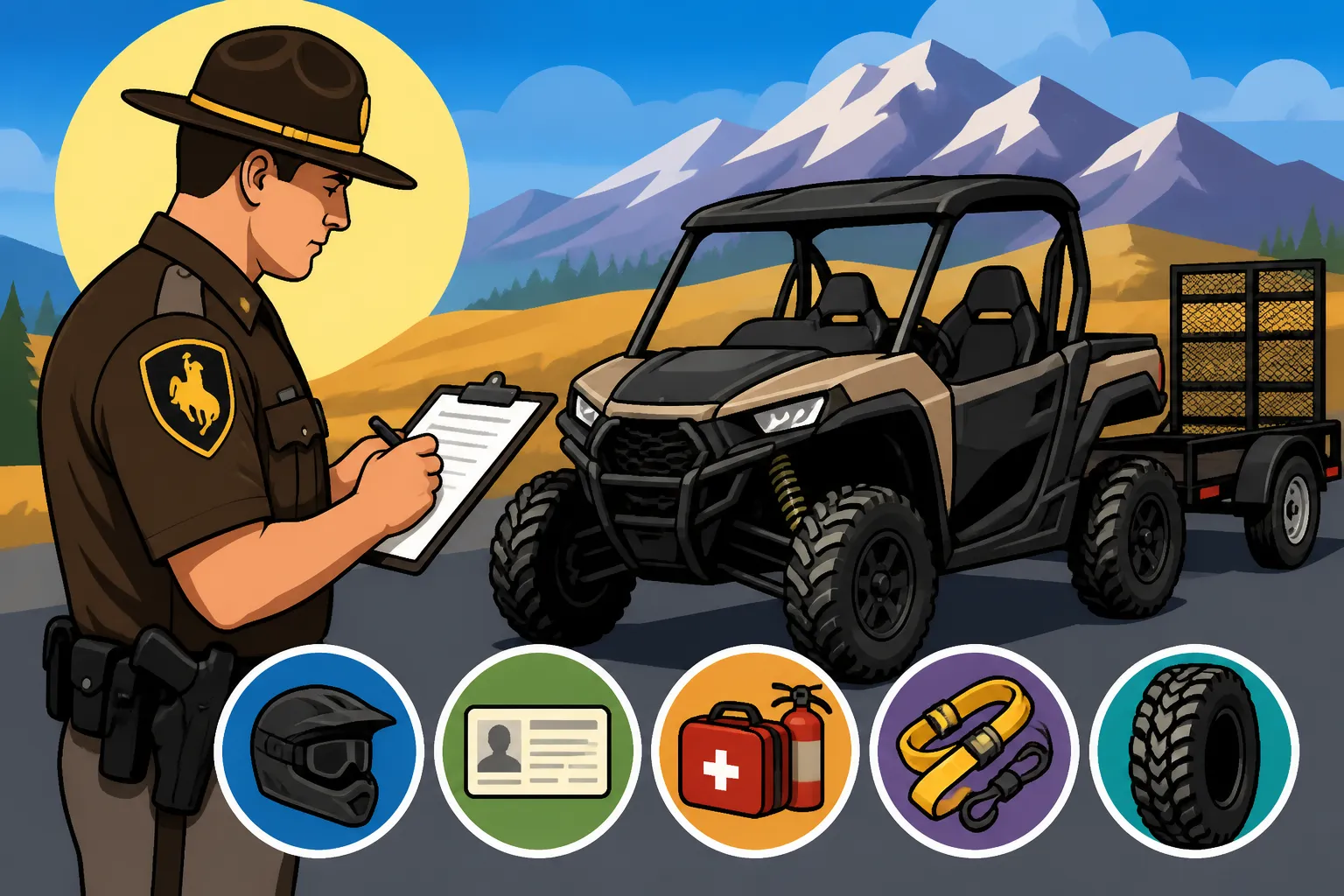
To give you a clearer picture, here's a table summarizing the key things a Wyoming Trooper will typically check during a roadside stop involving an ATV or UTV, especially if you're riding on an enrolled road or designated trail.
| Category | Specific Checks | Why It's Checked |
|---|---|---|
| Machine Registration | Current Wyoming ORV Permit/Decal | Mandatory for public land access; funds trail maintenance. |
| Decal placement and visibility | Must be clearly visible and securely affixed for easy verification. | |
| Machine Equipment (Road Use) | Headlights (low/high beam), Taillights, Brake Lights | Essential for visibility and signaling, especially on roads. |
| Red Rear Reflector | Passive safety feature for visibility if lights fail. | |
| Left-Side Mirror | Required for rearward visibility on roads. | |
| Functional Horn | Allows for signaling and warning other users. | |
| Muffler and Spark Arrester | Reduces noise pollution and prevents wildfires. | |
| Slow-Moving Vehicle Emblem (if applicable) | Alerts faster traffic to a low-speed machine. | |
| Rider & Passenger | Valid Driver's License (for road use) | Confirms identity and legal authorization to operate. |
| Proper Endorsement (M/MR, if applicable) | Validates specific training/qualification for certain MPVs on roads. | |
| Helmet Use (for riders/passengers under 18) | Mandatory safety requirement for minors. | |
| Proof of Liability Insurance (for road use) | Legal requirement for financial protection in case of accidents. | |
| Personal Identification (e.g., State ID) | Confirms rider's identity. | |
| Riding Area & Conduct | Staying on Designated/Enrolled Routes | Prevents trespassing and environmental damage; ensures legal access. |
| Awareness of Prohibited Areas/Closures | Ensures compliance with land management rules (wilderness, private land, seasonal). | |
| Safe Crossing Procedures (highways/interstates) | Prevents accidents with other vehicles on major roads. | |
| Signs of Impairment (DUI/DWI) | Enforces laws against operating under influence; protects public safety. | |
| Open Container Violations | Enforces public consumption laws. | |
| General Safe & Respectful Operation | Addresses reckless driving, excessive noise, and conflicts with other users. |
Staying informed about Wyoming's ATV and UTV laws is your best defense against unexpected roadside stops and potential citations. By ensuring your machine is properly equipped, your permits are current, and you're riding responsibly on designated routes, you can enjoy the stunning landscapes and incredible trails Wyoming has to offer with peace of mind.
Disclaimer
This article is for general informational purposes only and does not constitute professional advice. Laws, prices and regulations vary by location and change over time. Consult a qualified professional for guidance on your specific situation.