Wyoming Fines for Riding a Closed Road
You followed a two-track off a forest road near Sheridan, the gate was open, and twenty minutes later a ranger was writing you a ticket for riding a route that closed for the season weeks ago. Closed-road citations in Wyoming are confusing because several agencies close roads for different reasons. This guide explains who writes these tickets, what they cost, and how to stay legal.
What Counts as a Closed Road in Wyoming
The phrase “closed road” sounds simple, but on Wyoming ground it covers at least half a dozen different situations. A road can be closed to every vehicle, closed only to off-road vehicles, closed for part of the year, closed because of fire danger, or simply never opened to your type of machine in the first place. The fine you face, and the agency that writes it, depends on which of those situations you rode into.
Understanding the difference is the single best way to avoid a citation. Most riders who get these tickets were not trying to break any rules. They misread a map, trusted an open gate, or assumed that a road they could drive their pickup on was automatically open to their side-by-side.
Roads That Were Never Open to Your Machine
This is the most common situation and the one that catches newcomers. In Wyoming, a public road is not automatically open to off-road vehicles just because it is public. For an ORV to legally use a county road or similar public route, that road generally has to be enrolled in the state’s ORV program, which requires the agreement of the agency that manages the road and Wyoming State Parks, Historic Sites and Trails. The background on this is covered in Why a Road Needs Two Designations, and it explains why so many perfectly drivable county roads are still off limits to a quad.
So if you ride your ATV down a gravel county road outside Douglas that has not been enrolled, you are effectively on a closed road as far as your machine is concerned, even though cars and trucks are rolling by all day. The road is open to licensed highway vehicles, not to you.
Wyoming’s network of enrolled routes is large, and Wyoming’s Designated ORV Roads gives a good overview of how it fits together. The key point is that enrollment is route by route, not county by county.
Roads Closed by a Land Manager
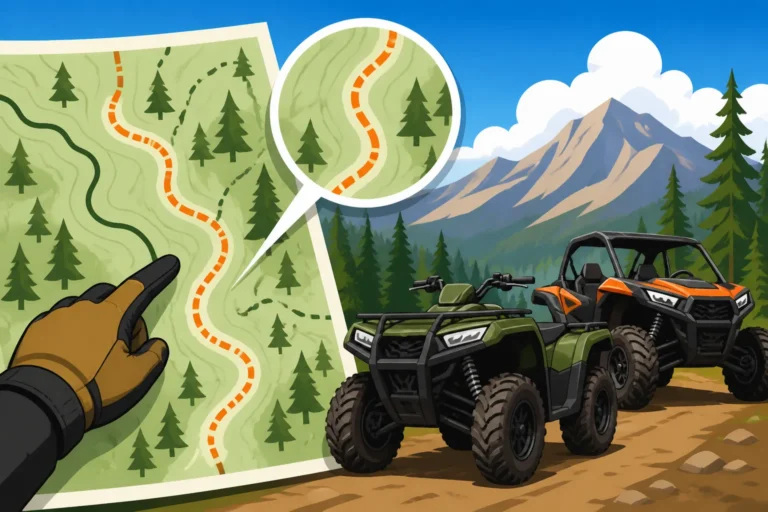
On national forests and BLM ground, the land manager decides which roads and trails are open to which kinds of vehicles. On the national forests, that decision is shown on the Motor Vehicle Use Map, usually called the MVUM. If a route is not shown as open to your vehicle class on the MVUM, it is closed to you, whether or not there is a sign or a gate on the ground.
BLM field offices work through travel management plans, which designate routes as open, limited or closed. Some BLM areas in Wyoming are still more open than national forest land, but more and more of the state’s BLM ground is now under route-specific designations. Wyoming Rules for Riding a Forest Road and Wyoming Rules for Riding a BLM Road go into the specifics for each.
Within these designations there are also routes open to some machines and not others. A road may be open to highway-legal vehicles but closed to ORVs, or a trail may be open to motorcycles but closed to anything wider than 50 inches. If you ride a wide side-by-side down a single-track open only to dirt bikes, you are on a closed route. Roads Open to Some Machines but Not Others covers those mixed designations in detail.
Seasonal and Wildlife Closures
Wyoming’s wildlife is a big part of why its land managers close roads seasonally. Crucial winter range for elk, mule deer and pronghorn is commonly closed to motorized use from early winter into spring, often through April and sometimes into May, so animals that are already stressed by cold and deep snow are not pushed off their feeding grounds. Calving and fawning areas can carry their own closures in late spring.
Some roads also close in spring simply because they are too wet. Forest roads in the Bighorns and the Medicine Bow can stay closed until late June while snowdrifts melt and the roadbed dries out. Riding a muddy road early not only earns a ticket, it also rips ruts that cost real money to repair.
The tricky part with seasonal closures is that the same road can be perfectly legal one month and a citation the next. The MVUM usually shows the dates a route is open. Reading those dates every time you plan a ride, rather than relying on what was true last fall, prevents a lot of tickets. Wyoming Rules for Riding in Winter discusses how the colder months change where you can go.
Fire, Emergency and Temporary Closures
During dry summers, Wyoming’s forests and BLM districts may put fire restrictions in place, and in the worst conditions they close entire areas to all entry. Those closure orders can be issued quickly and are often posted at trailheads and on the agency’s news pages. Riding into an area under a closure order is a separate violation from riding a route that is normally closed.
Temporary closures also happen for road construction, logging operations, washouts, wildlife conflicts like a grizzly working a carcass near a trail, and post-fire hazards like falling trees. A sign or barricade that says “Road Closed” on a route that is normally open on your MVUM still means closed.
Highways, Interstates and City Streets
Interstates are a special category. Wyoming does not allow ORVs, MPVs or dirt bikes to ride along its interstates, and Interstates Closed to MPVs and Dirt Bikes explains the rule. Crossings of an interstate are limited to specific approved locations under a separate set of rules, and riding the right of way outside those locations is treated much like riding any other closed road.
State highways and city streets come with their own rules. Some municipalities allow ORVs on certain streets by ordinance, others ban them completely. A multipurpose vehicle with a plate and the right equipment has much broader road access than a standard ORV with only a decal, but even an MPV cannot ride the interstate.
Private Roads and Ranch Roads
A gate across a two-track on private ground, or a ranch road with a “No Trespassing” sign, is a closed road in the most literal sense. Riding it without the landowner’s permission is not a travel management violation; it is trespass, and it is enforced under state criminal law. Wyoming Trespass Rules for Riders covers this in depth, and Wyoming Rules for Opening a Gate explains what to do when you do have permission to pass through.
Who Writes the Ticket and What It Costs
Because different agencies close roads for different reasons, the citation you receive depends on who stopped you and which rule you broke. That affects the amount, where you pay it, and what happens if you contest it.
Federal Citations on Forest Service and BLM Ground
When a Forest Service law enforcement officer or forest protection officer finds you on a route that is not open to your vehicle under the MVUM, the typical result is a federal violation notice. Operating a vehicle in a way that is inconsistent with the designations on the Motor Vehicle Use Map is a violation of the Forest Service’s federal regulations, and these offenses are treated as petty misdemeanors under federal law.
A federal violation notice works differently from a state ticket. It lists a collateral amount, which is the amount you can pay to resolve the case without appearing in court. That amount is set by the federal district court’s collateral schedule for the District of Wyoming, and it is paid through the Central Violations Bureau. If the officer marks the notice as requiring a mandatory appearance, which can happen when there is significant resource damage or other aggravating factors, you cannot simply pay the collateral and must appear before a federal magistrate judge.
The maximum penalties for a federal petty misdemeanor are far higher than a typical collateral amount. A judge can impose fines in the thousands of dollars and, in rare and serious cases, short jail sentences. Restitution for resource damage can be added on top. Most first-time riders who stray onto a closed forest route pay the collateral and never see a courtroom, but repeat offenses or damaging riding change that picture quickly.
On BLM ground, the structure is similar. BLM rangers write federal citations for riding off designated routes or on closed routes, and those are also federal misdemeanors handled through the federal court system. The collateral amounts come from the same district court schedule.
State Citations From Rangers, Wardens and Deputies
State officers can write citations under Wyoming law for riding an ORV on a road that is not enrolled or not open to ORVs, for riding without a valid ORV permit, and for related equipment or age violations. These citations go to the circuit court in the county where the stop happened. The bond amounts come from the Uniform Bail and Forfeiture Schedule adopted for Wyoming’s circuit courts, and court costs are added on top.
Game wardens deserve their own mention. They are out on forest roads and BLM two-tracks constantly in the fall, and they enforce wildlife closures, including crucial winter range closures and closures on Wyoming Game and Fish wildlife habitat management areas. A warden who finds you behind a closed gate on a habitat management area in March is going to treat that as a wildlife law violation, not just a travel violation. Those can carry stiffer consequences, especially if animals were disturbed.
County sheriff’s deputies and Wyoming Highway Patrol troopers handle stops on county roads and state highways. What a Wyoming Trooper Checks Roadside walks through what happens at a roadside stop, which often includes checking the decal, the license, insurance for road-registered machines and required equipment.
Trespass on Private Ground
Riding a private road without permission is criminal trespass under Wyoming law, which is a misdemeanor. The general ceiling for an ordinary misdemeanor in Wyoming, where a statute sets nothing else, is a fine of up to $750, up to six months in jail, or both. In practice, a first-time trespass on a ranch road often ends with a citation and a stern conversation, but landowners can and do press charges, and civil claims for damage to fences, crops or livestock are possible.
Trespass is also the violation most likely to damage the relationships that keep Wyoming’s checkerboard ground accessible. Ranchers who grant access to riders and hunters remember the ones who left gates open or tore up a hay meadow.
Comparing the Citation Types
Here is how the main closed-road citations compare. Exact amounts come from the schedules in effect when you are cited, so the table describes the structure rather than quoting numbers that change.
| Situation | Usual Enforcer | Type of Citation | Where It Is Resolved | What Can Raise the Penalty |
|---|---|---|---|---|
| Riding a route not open on the MVUM | Forest Service officer | Federal violation notice | Central Violations Bureau or federal magistrate | Resource damage, repeat offenses, mandatory appearance |
| Riding a closed BLM route or off route | BLM ranger | Federal violation notice | Central Violations Bureau or federal magistrate | Damage to soils, cultural sites or habitat |
| Riding a county road not enrolled for ORVs | Deputy, state ranger | State misdemeanor citation | County circuit court | Missing permit, age or equipment violations |
| Entering a seasonal wildlife closure | Game warden, federal officer | State or federal citation | Circuit court or federal court | Harassing wildlife, riding during calving or wintering |
| Riding into a fire closure area | Federal officer | Federal violation notice | Central Violations Bureau or federal magistrate | Starting a fire, ignoring posted orders |
| Riding a private ranch road without permission | Deputy, landowner complaint | Criminal trespass | County circuit court | Property damage, gates left open, livestock harmed |
| Riding along an interstate | Trooper | State traffic citation | County circuit court | Speed, endangerment, unlicensed operator |
What Stacks on Top of the Closed-Road Ticket
A closed-road stop often turns into several citations at once. Officers who stop you for riding a closed route will also check your ORV decal, your driver’s license if the situation requires one, helmet use for riders under 18, the passenger setup, and whether your machine has the required spark arrester. Missing any of those can add a separate violation.
If your machine has no current permit, you can expect that to be part of the conversation. Wyoming Fines for Riding Without a Permit covers that citation in detail. For road-registered MPVs, officers also check insurance and required equipment like mirrors, lights and horns.
Resource damage is the other big factor. Ruts in a wet meadow, tracks through a riparian area or new paths cut around a closure gate can lead to restitution claims for the cost of repair, which can dwarf the original fine.
How to Know Whether a Road Is Open Before You Ride
The good news is that nearly every closed-road ticket is avoidable with ten minutes of homework. Wyoming land managers publish their maps, and the information you need is almost always available before you unload.
Reading the Motor Vehicle Use Map
The MVUM is the legal document for travel on national forest land. It is free and available from the forest’s offices and website, and many riders load it into a mapping app on their phone so their position shows on the map in real time. Finding an Enrolled Road on a Forest Map walks through how to read the symbols.
Here is how to use an MVUM before every ride:
- Get the current MVUM for the forest and ranger district where you plan to ride. These maps are updated, so make sure you are not relying on an old copy.
- Find your planned route and check which vehicle classes it is open to. Routes may be open to all vehicles, highway-legal vehicles only, vehicles 50 inches or less, or motorcycles only.
- Look for seasonal dates. Many routes show the months they are open, and outside those dates they are closed.
- Note any routes that cross private land or end at a boundary, since the MVUM does not grant access across private ground.
- Check the forest’s current alerts for fire closures, temporary closures and construction.
- Download the map to your phone so it works without cell coverage, which is spotty or nonexistent in much of Wyoming’s backcountry.
The most important rule about the MVUM is that it controls, even when the ground looks different. A route that is not shown on the MVUM is closed, even if there is no gate and the tracks on the ground look well used. Illegal user-created routes look just like real roads after a few years of traffic.
Checking BLM and State Routes
BLM travel management in Wyoming varies a lot by field office. Some areas have route-designated maps that work like the MVUM, while others still have limited designations or areas where travel is restricted to existing roads and trails. Call or visit the field office for the area you are riding, ask whether there is a travel management plan, and get a copy of the current route map.
For enrolled county roads and other state program routes, Wyoming State Parks publishes maps of the enrolled system. Look for the specific segment you plan to ride, because enrollment often stops at a county line or a property boundary, and the road beyond it may not be open to ORVs at all.
Reading Signs and Gates on the Ground
Signs and gates add information to your map, but they are not the whole picture. Here is how they fit together:
| What You See | What It Means | What to Do |
|---|---|---|
| Route shown as open on the map, no sign on the ground | Generally open to the listed vehicle class during listed dates | Ride it, staying on the route |
| Route shown as open on the map, closure sign or barricade | Temporarily closed for fire, construction, wildlife or safety | Turn around; the sign controls |
| Route not shown on the map, no sign, tracks on the ground | Closed; likely an illegal user-created route | Do not ride it |
| Closed gate across a route shown as open | May be a seasonal or temporary closure, or private access | Check the map dates and any posted notice before passing |
| Open gate across a route not shown on the map | Still closed to your machine | Do not ride through |
| Brown carsonite post with a vehicle symbol and a slash | Closed to that vehicle type | Turn around |
The open-gate situation in the last two rows is where a lot of tickets are written. A rancher, a logging crew or another rider may have left a gate open, but an open gate does not make a closed route legal.
Tools That Make Staying Legal Easier
Riders who rarely get tickets tend to have a few habits and a bit of gear in common. A solid phone or tablet mount keeps your offline map visible while you ride, so you are not stopping every ten minutes to dig out your phone. Many riders order a mount designed specifically for their machine from aftermarket suppliers such as SuperATV, which makes it far easier to glance at your position than balancing a phone on your knee.
Good lighting matters too. Most closed-road tickets at dusk happen because riders missed a sign or a junction in the fading light. If you ride into the evening, an upgraded light bar or headlight kit helps you read signs and spot carsonite posts. Again, aftermarket shops like SuperATV carry lighting kits sized for most popular side-by-sides and quads, but always confirm that your lighting setup is legal for the roads you plan to use.
Finally, carry the basic recovery gear you need to get yourself out of trouble without cutting a new path. A winch, a tow strap and a shovel, whether you buy them from SuperATV, your local dealer or a farm supply store, let you recover a stuck machine on the route instead of driving around an obstacle and creating new ruts.
Real-World Scenarios on Wyoming Roads
Rules are easier to remember when you can picture them. Here are situations that play out on Wyoming routes every season, and what typically happens.
The Open Gate in the Bighorns
A group of riders from Buffalo heads up into the Bighorn National Forest in late May. They follow a forest road that was open the previous September and find the gate standing open. They ride about four miles before a forest protection officer catches up with them. The road is closed until late June each year, which is clearly shown on the MVUM, and the gate was opened by a logging contractor.
Each rider receives a federal violation notice. Because there was no significant damage and the riders were cooperative, the notices list a collateral amount that can be paid by mail through the Central Violations Bureau. If the road had been soft and the riders had left deep ruts, the officer could have required a court appearance and pursued restitution.
The lesson is simple: the gate’s position does not matter. The map and its dates do.
The County Road Outside Lander
A rider who recently moved from Utah, where many counties open roads to ORVs broadly, assumes Wyoming works the same way. They ride their quad on a county road toward Sinks Canyon. A deputy stops them because that segment is not enrolled in the ORV program. The rider has a current decal, but the decal only covers riding on routes that are actually open to ORVs. The deputy writes a state citation, which goes to the circuit court in Lander.
The rider could have avoided the ticket by checking the enrolled road map or calling the county before riding, or by trailering to the trailhead instead of riding the road.
The Wildlife Habitat Area in March
A rider near Cody sees a two-track leading into a Wyoming Game and Fish wildlife habitat management area and follows it around a closed gate in March, looking for shed antlers. A warden on patrol spots fresh tracks in the snow and finds the rider half a mile inside. Winter range closures exist to protect elk and deer at their most vulnerable, so the warden treats it seriously.
The rider is cited for entering a closed area during the closure period. Because the rider was looking for sheds, there may also be questions about antler-gathering regulations, which are separate from travel rules. Shed hunting seasons and closure dates are taken seriously in Wyoming, and wardens are often waiting at popular access points when closures lift.
The Wide Machine on a Narrow Trail
A family rents a 64-inch side-by-side and follows a trail on the Medicine Bow National Forest shown on the MVUM as open only to vehicles 50 inches wide or less. A ranger stops them at a junction. The trail is effectively closed to their machine. The family receives a federal citation, and the rental company later charges them for brush damage to the machine.
Width designations matter, and rental machines are a common source of confusion. Before you head out, measure your machine or check the specification sheet and compare it with the trail’s designation on the MVUM.
The Shortcut Across a Ranch Road
Riders heading back to their trucks near Kaycee find a locked gate on a public road that was washed out and decide to cut across a ranch two-track to reach the next public route. The ranch owner calls the sheriff. The riders face criminal trespass citations, and the rancher files a claim for a damaged fence where a rider pushed through. A ten-mile backtrack would have been a lot cheaper.
The Interstate Shortcut Near Evanston
A rider on a dirt bike decides to ride a quarter-mile along the I-80 shoulder to reach a frontage road rather than looking for an approved crossing. A trooper stops the rider. Dirt bikes are not permitted on Wyoming’s interstates, and riding the right of way outside an approved crossing is a citation under state law. If the rider is also unlicensed or underage, more charges follow.
How to Handle a Closed-Road Citation
Even careful riders occasionally get a ticket. How you handle it determines whether it becomes a minor expense or a long-running headache.
At the Stop
Your behavior during the stop shapes everything that follows. Officers have discretion, and riders who are calm and honest often receive warnings or lighter treatment than riders who argue.
- Stop your machine, turn off the engine and remove your helmet so you can talk clearly.
- Keep your hands visible and let the officer start the conversation.
- Provide your identification, the machine’s permit information, and any registration or insurance documents the officer asks for.
- If you believe the route was open, say so calmly and explain why, such as showing the map you were using. Do not argue the point at length on the roadside.
- Accept the citation if one is issued. Signing a citation is not an admission of guilt; it is an acknowledgment that you received it.
- Ask the officer how to get back to an open route without riding further on the closed one. Many officers will escort riders or give directions.
After the Stop
Read the citation carefully when you get home. It tells you which court has jurisdiction, the amount of the bond or collateral, whether an appearance is mandatory, and the deadline to respond.
For a federal violation notice, you can usually pay the collateral online, by mail or by phone through the Central Violations Bureau, unless the notice requires an appearance. Paying the collateral resolves the case and is treated as a forfeiture rather than a trial.
For a state citation, follow the instructions for the circuit court listed on the ticket. You can usually pay the bond by mail or in person, or you can enter a plea and appear in court if you want to contest the charge.
Do not ignore either kind of citation. Missing a federal deadline can lead to a warrant, and missing a state deadline can lead to additional charges and problems with your driver’s license.
When It Makes Sense to Contest
Contesting a closed-road ticket can make sense if you have strong evidence that the route was actually open. Examples include a current MVUM showing the route open to your vehicle class during that month, no closure order in effect, and photographs showing no closure signs. It also makes sense to talk with a lawyer if the citation requires a mandatory appearance, involves alleged resource damage or restitution, or is attached to other serious charges.
A lawyer familiar with federal petty offense practice in Wyoming, or with the circuit court in your county, can tell you whether contesting is worth it. For simple first offenses with no damage, most riders choose to pay and move on.
Keeping Your Wyoming Riding Season Ticket-Free
A closed-road ticket is not the end of the world, but it is frustrating, expensive and almost always avoidable. The riders who stay out of trouble season after season tend to share a few habits.
Habits That Prevent Tickets
- They download the current MVUM and BLM route maps before every trip, even to areas they have ridden for years.
- They check the forest’s alerts for fire restrictions and temporary closures on the morning of the ride.
- They treat an open gate as meaningless and a closed gate as a reason to check the map before going any further.
- They know the width of their machine and the width limits of the trails they plan to ride.
- They keep their ORV decal current and on the machine.
- They ask landowners before crossing private ground and close every gate behind them.
- They trailer to trailheads instead of riding county roads they are not sure about.
Gear Checklist for Staying on Open Routes
| Item | Why It Helps |
|---|---|
| Current MVUM or BLM route map, downloaded offline | Shows which routes are open, to which vehicles and when |
| Phone or tablet mount | Keeps your position visible without stopping |
| Spare battery or charging cable | Keeps your map running on long rides |
| Paper map backup | Works when electronics fail |
| Lighting suitable for dusk | Helps you see signs and junctions late in the day |
| Recovery strap, shovel and winch | Lets you recover a stuck machine on the route instead of driving around |
| Current ORV decal on the machine | Avoids a second citation at any stop |
| Contact numbers for the ranger district and field office | Lets you ask about closures before you ride |
Asking Before You Ride
One of the most underused tools in Wyoming riding is the telephone. Ranger district offices, BLM field offices and county road departments field questions about route status all the time, and the staff there usually know about washouts, logging traffic and late snowdrifts long before a new map is printed. A five-minute call the week before a trip can tell you whether the road you are counting on is open, whether a fire restriction is likely, and whether there is an easier legal route to the area you want to reach.
Local riding clubs are another good source. Many clubs work directly with the Trails Program and land managers on route maintenance and signing, so their members tend to know which segments are enrolled, which gates are seasonal, and which ranch roads are strictly off limits. Joining a club ride in a new area is one of the quickest ways to learn the local rules without collecting a ticket along the way.
When you do get information by phone or from a club, write down who told you and when. If a route turns out to be closed after all, that note will not cancel a citation, but it helps you explain an honest mistake and it reminds you to double check next time.
Respecting Why Roads Close
It helps to remember why roads close in the first place. Winter range closures keep elk and mule deer alive through harsh winters. Wet-season closures keep roads from turning into impassable ruts. Fire closures protect lives and communities. Private road closures protect ranch families’ property and livestock.
When riders respect those closures, land managers and landowners are more willing to keep routes open and to work with clubs and the Trails Program on new connections. When riders ignore them, routes close permanently and the whole riding community pays the price.
Treat every ride as a chance to show that riders can be trusted on Wyoming ground. Check the map, respect the gate, close what you open, and the only thing you will bring home from your ride is dust and good memories.
Disclaimer
This article is for general informational purposes only and does not constitute professional advice. Laws, prices and regulations vary by location and change over time. Consult a qualified professional for guidance on your specific situation.