The Left-Side Mirror Wyoming Wants
Trying to navigate the maze of rules and regulations for making your beloved ATV or UTV street legal in Wyoming can feel like deciphering ancient hieroglyphs. It’s not just about slapping a license plate on it; there are specific equipment requirements, and one seemingly small detail, the left-side mirror, often trips up even the most diligent riders. This guide will walk you through exactly what Wyoming expects from your machine when it comes to mirrors, why these rules exist, and what else you need to consider to hit the road legally and confidently.
Why Mirrors Matter for Road-Legal Machines in Wyoming
When you're out on the trails, roaring through the backcountry, or kicking up dust in the dunes, mirrors might not be at the forefront of your mind. You're focused on the terrain ahead, the immediate obstacles, and the sheer thrill of the ride. But the moment you consider taking your off-road vehicle onto a paved public road in Wyoming, the game changes entirely. The law isn't just trying to be a stickler; these requirements are rooted in basic safety for everyone sharing the pavement.
The Core Difference: ORV vs. MPV
First, let’s clear up some fundamental terminology that often causes confusion. Most ATVs and UTVs, straight from the factory, are classified in Wyoming as Off-Road Vehicles (ORVs). This designation means they are intended purely for off-highway use on designated trails, open areas, or private property. As ORVs, they don't have the same equipment requirements as vehicles meant for public roads, and critically, they cannot be made "street legal" in the traditional sense. You can register an ORV with an [Wyoming's Annual ORV Permit] for trail use, but that permit is not a ticket to the highway.
The path to road legality in Wyoming for an ATV or UTV lies in converting it, on paper and in practice, into a Multipurpose Vehicle (MPV). This is a distinct class of vehicle defined by Wyoming law, created specifically to bridge the gap between pure off-roaders and street-legal vehicles. The distinction is crucial because MPVs are held to a much higher standard of safety equipment, including the mirror requirements we're discussing. It can be incredibly frustrating to realize your machine, which seems perfectly capable, is legally barred from a simple trip to town unless it meets a whole new set of criteria. The state wants to ensure that if you’re sharing the road with cars and trucks, your machine can operate with similar safety features.
Safety and Visibility on Paved Roads
The primary reason Wyoming mandates specific mirrors for MPVs is safety. On a trail, your awareness is often hyper-focused on what's directly in front of you or what might be coming at you from the side. You might occasionally glance over your shoulder or rely on your riding buddies to signal dangers. But on a public road, especially one with higher speed limits or more traffic, a quick head turn isn't always enough, or safe. You need constant, passive awareness of what's happening behind and to the sides of your machine.
Imagine pulling out of a side road, changing lanes, or even just stopping at an intersection. Without adequate mirrors, you’re essentially blind to approaching traffic, cyclists, or pedestrians that might be directly behind you or in your blind spots. Wyoming's law aims to prevent accidents by ensuring that MPV operators have the same basic tools for situational awareness that drivers of cars and motorcycles do. It's about minimizing risk not just for you, but for everyone else on the road, which is a sensible approach when you think about the vastly different speeds and sizes of vehicles sharing the same space.
Wyoming's Specific Mirror Requirements
So, you understand why mirrors are important for road safety. But what exactly does Wyoming law say you need? This is where the specifics can make all the difference between a legal ride and a roadside chat with a state trooper. It's not just "any mirror will do," there's a definite requirement for what kind of mirror and where it must be located.
The "Left-Side Mirror" Rule Explained
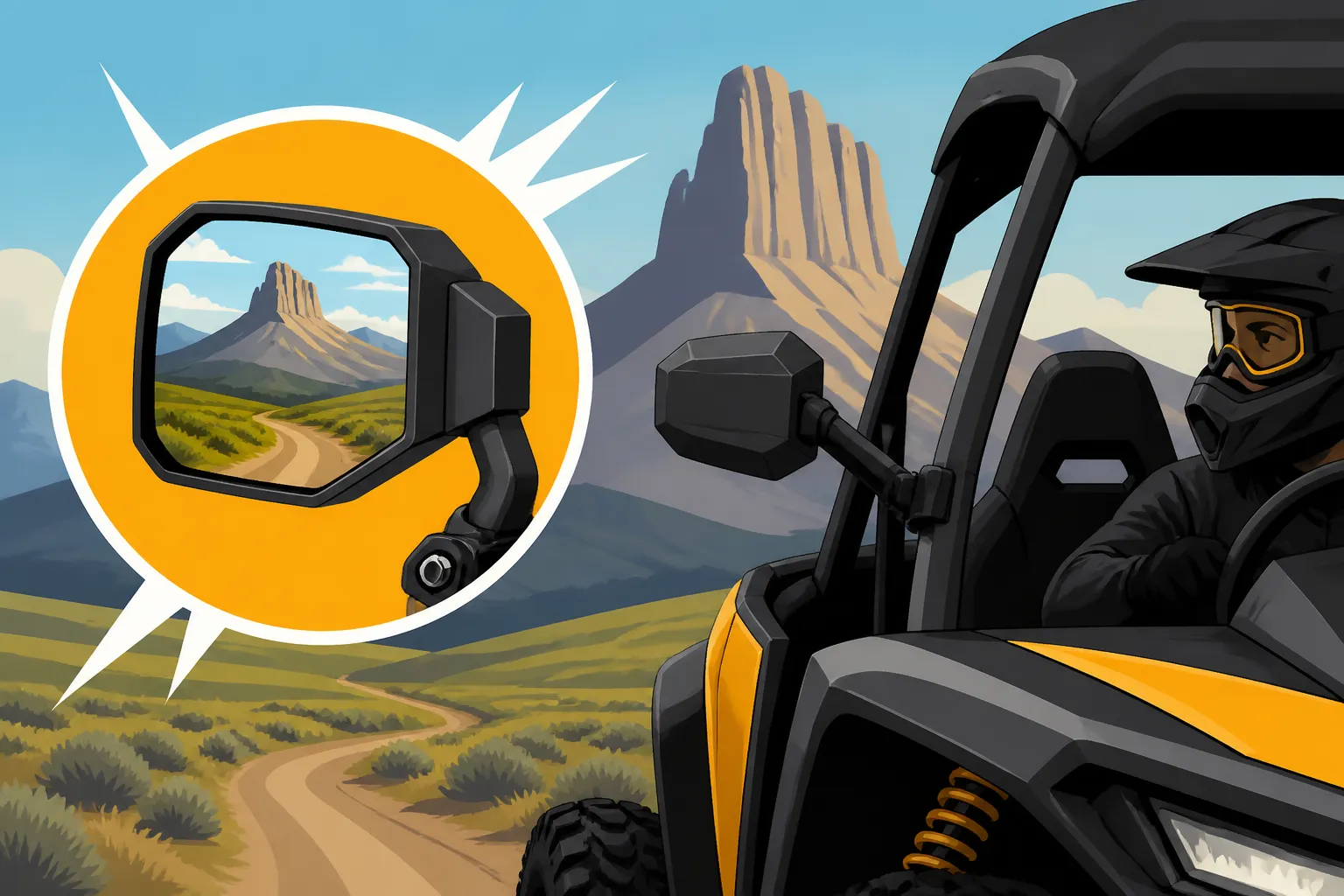
Wyoming Statute 31-5-953(a)(v) is quite clear on this point: an MPV, to be considered street legal, must be equipped with "at least one (1) mirror, securely attached to the left side of the multipurpose vehicle, and located as to reflect to the driver a view of the highway for a distance of at least two hundred (200) feet to the rear of the multipurpose vehicle." Let's break that down.
First, "at least one (1) mirror" means you absolutely must have one. You can have more, and many riders opt for two for better visibility, but the minimum is one. Second, it must be "securely attached to the left side." This isn't optional; a helmet-mounted mirror or one that constantly shakes loose isn't going to cut it. Third, and critically, it needs to provide a clear, unobstructed view of the highway to the rear for "at least two hundred (200) feet." This isn't just about seeing something behind you; it’s about having a functional, useful range of vision that allows you to assess approaching vehicles, their speed, and their distance. This 200-foot requirement often means a mirror of a certain size and convex curvature (though too much convexity can distort distance perception). It’s a common misconception that any small mirror will suffice, or that a single center mirror is enough, but for MPV purposes, the left-side placement is a non-negotiable.
Beyond the Letter of the Law: Practical Considerations
While the law strictly mandates one left-side mirror, most experienced road riders will tell you that having a right-side mirror is a massive advantage for safety and peace of mind. While not legally required, a second mirror provides invaluable peripheral vision, significantly reducing blind spots and making lane changes, turns, and even simply knowing what’s around you much safer. It’s hard to put a price on knowing you’ve done everything possible to mitigate risk when sharing busy roadways.
When you're shopping for mirrors, especially for a machine that will still see off-road action, durability and adjustability are key. You want something that can withstand the vibrations of the trail, potential bumps, and the elements, but also be easily adjusted for optimal viewing on the road. Many aftermarket companies like SuperATV specialize in robust mirrors designed for UTVs and ATVs. You’ll find options that mount to your roll cage, handlebars, or even directly to your windshield frame. Look for mirrors with shatter-resistant glass and sturdy mounts. Some even feature break-away designs, which allow the mirror to fold in on impact rather than breaking off, a real lifesaver if you snag a branch on a tight trail. The goal is a mirror that stays put and provides a clear view, whether you're cruising through town or heading down a county road to your favorite trailhead.
The Full Equipment Checklist for Wyoming Road Use
The mirror is undoubtedly important, but it's only one piece of the puzzle. Converting your off-road machine into a legitimate Multipurpose Vehicle (MPV) for road use in Wyoming means adhering to a comprehensive set of equipment standards, not just a single item. Neglecting any of these components can render your vehicle non-compliant, regardless of how perfect your left-side mirror might be.
Mirrors Are Just One Piece of the Puzzle
Think of it like this: you wouldn't send a car out on the road with just one working headlight, even if it met the letter of some law. Wyoming's MPV designation requires a suite of safety features to ensure your machine is as visible and controllable as possible on public roads. Beyond that crucial left-side mirror, you'll need:
- Headlights: At least one, but most MPVs will have two, capable of illuminating the road ahead for a specified distance, and typically with high/low beam functionality.
- Taillights and Stop Lamps: Red taillights visible from a distance, and bright stop lamps (brake lights) that activate when you apply the brakes, clearly indicating to traffic behind you that you're slowing or stopping.
- Horn: A functional horn capable of emitting an audible sound from at least 200 feet away. A polite "beep-beep" might not cut it; it needs to be an effective warning device.
- Red Rear Reflector: Even with a taillight, a passive red reflector at the rear is required to ensure visibility if your lights fail or are off.
- Fenders: To prevent water, mud, and debris from being thrown onto other vehicles or pedestrians.
- A "Slow-Moving Vehicle" Emblem: If your machine is incapable of sustaining a speed of 25 mph on a level highway, this orange triangular emblem is required on the rear to warn faster traffic.
- Muffler and Spark Arrester: While important for trail use, they're also a requirement for road use to control noise and prevent wildfires.
This list isn't just a suggestion; it's the law. Each item ensures that your MPV operates safely and predictably in a road environment. For a full breakdown of requirements, you'll want to review [Wyoming's MPV Street Legal Requirements]. Understanding [Wyoming's MPV Definition in W.S. 31-1-101] helps clarify the specific criteria your machine must meet to even qualify for this class. It’s a significant investment of time and possibly money to get everything in order, but it’s absolutely necessary if you want to legally utilize [Wyoming's MPV Path to the Road].
Driver Licensing, Registration, and Insurance
Even if your machine is equipped perfectly, the battle isn't over. You, as the operator, also have responsibilities. Wyoming requires that anyone operating an MPV on a public road possess a valid driver's license. Furthermore, because MPVs operate in a manner similar to motorcycles, you'll typically need an M (motorcycle) or MR (multipurpose vehicle) endorsement on your driver's license. This ensures that you've demonstrated at least a basic level of proficiency in operating such a vehicle. Getting [The M or MR Endorsement Wyoming Asks For] usually involves a written test and a practical riding test, just like a motorcycle endorsement.
Once your machine is properly equipped, you'll need to go through the official registration process. This involves two distinct steps: first, obtaining a title for your MPV through the [Wyoming County Clerk Title Process] (or rather, [Titling a Multipurpose Vehicle in Wyoming]), which establishes ownership and confirms its MPV classification. After that, you'll take your title to the County Treasurer's office to get your actual license plate, a process often referred to as getting [Plates From a Wyoming County Treasurer]. It's a two-step dance, and both are non-negotiable for road legality.
Finally, and this is a big one, you must carry liability insurance. Just like any other vehicle on a public road, your MPV needs to be insured. [Wyoming ATV Insurance Requirement] mandates a certain level of coverage to protect you and others in case of an accident. Riding uninsured on Wyoming roads is a significant offense with serious consequences. Don't confuse this with the optional insurance you might carry for off-road damage; this is specific liability insurance for public road use. It's crucial to consult with your insurance provider to ensure you have the appropriate coverage for an MPV.
What Happens If You Don't Comply?
It’s easy to think that if you’re just making a quick hop down the road or aren’t driving fast, you might fly under the radar. But that’s a risky gamble. Wyoming law enforcement takes road safety seriously, and an improperly equipped or registered MPV (or an ORV attempting to be an MPV) can lead to some inconvenient and expensive consequences.
The Risks of Riding Under-Equipped
The most immediate risk of riding an under-equipped machine on Wyoming roads is a citation. Law enforcement officers, whether it's a local sheriff, state trooper, or a Game and Fish warden in certain areas, are trained to spot vehicles that don't meet road-legal standards. Getting pulled over can lead to fines that quickly add up. A simple missing or non-compliant mirror, for instance, could be a primary reason for a stop. [What a Wyoming Trooper Checks Roadside] often includes a thorough inspection of your vehicle's safety equipment. You could face separate fines for each missing or non-compliant item, turning a quick errand into a costly lesson.
Beyond fines, there's the possibility of your machine being impounded. If an officer deems your vehicle unsafe or illegally operated on a public road, they have the authority to have it towed. Retrieving an impounded vehicle involves towing fees, storage fees, and often requires proof that the machine has been brought into compliance, adding significant hassle and expense. And let's not forget the absolute biggest risk: an accident. If you're involved in a collision while operating a non-compliant vehicle, your insurance coverage could be denied, leaving you personally liable for damages and injuries. The small savings or convenience of skipping a required mirror or light could lead to financial ruin in the event of a serious incident. [Wyoming Fines for Riding a Closed Road] gives a glimpse into the penalties for other types of non-compliance, but riding an illegal machine on an open road can be just as, if not more, impactful.
Common Mistakes and How to Avoid Them
Many riders genuinely try to do the right thing but still fall short due to common misunderstandings. One frequent mistake is assuming that because a dealer sold you an accessory, it automatically makes your machine compliant. Always verify against the actual Wyoming statutes yourself, or ask the dealer specifically how the part meets the 200-foot rear visibility rule for the left-side mirror. Another error is focusing solely on the "big ticket" items like a license plate and neglecting smaller, but equally crucial, components like a functioning horn or proper reflectors.
Perhaps the biggest pitfall is confusing an ORV permit with MPV registration. An [Why an ORV Permit Is Not a Road License] is for trails, not for public roads, even if those roads are unpaved county routes. The permit is a sticker for off-road use, whereas an MPV requires a title, county registration, and a physical license plate. These are two entirely different legal designations with different sets of rules. To avoid these frustrations, create a checklist of all the MPV requirements for Wyoming, from equipment to licensing and insurance. Go through it rigorously before you ever turn a wheel on a public road. If you're buying accessories, consider reputable brands like SuperATV that often design products with specific regulations in mind, but always double-check the exact letter of the Wyoming law. It's far better to spend a little extra time and money upfront than to face fines, inconvenience, or worse, after the fact.
Finding and Installing the Right Mirror
Once you understand what Wyoming wants, the next step is actually getting it on your machine. This isn't just about grabbing the first shiny mirror you see; it's about selecting a mirror that meets the legal requirements for visibility and durability, especially considering your machine's primary purpose.
Shopping for Compliant Mirrors
When you head out to find that essential left-side mirror (and perhaps an optional right-side one!), you'll have a few options for where to look. Local powersports dealerships and accessories shops are a great starting point, as they often stock items specifically designed for ATVs and UTVs and may be familiar with local regulations. Online retailers, of course, offer a vast selection, but require you to do more of your own homework.
The key is to look for mirrors that are built tough. Your off-road machine isn't a sedan, and its mirrors will be subjected to more vibration, dust, and potential impacts. Features to prioritize include:
- Robust Mounting: Look for heavy-duty clamps or bolt-on options that will resist loosening from engine vibration and trail bumps. Many UTVs use roll-cage mounted mirrors, while ATVs might utilize handlebar mounts.
- Shatter-Resistant Glass: This is crucial for safety and longevity. Acrylic or tempered glass options are common and much safer than standard glass if an impact occurs.
- Optimal Field of View: While not explicitly stated in law, a slightly convex mirror can provide a wider field of view, making it easier to meet that 200-foot rear visibility requirement. Be careful not to choose mirrors that are too convex, as they can distort distance perception and make objects appear further away than they are.
- Adjustability: Easy, tool-free adjustment mechanisms are a godsend when you're transitioning from trail to road, or if different riders are using the machine.
- Breakaway Feature: Some higher-end mirrors are designed to fold in or "break away" upon impact, preventing damage to the mirror itself or your machine. This is a huge bonus for any machine that will still see off-road action.
Brands like SuperATV are well-known in the UTV and ATV community for producing a wide range of accessories, including mirrors, that are designed with the rigors of off-road use in mind while often offering road-legal compliance. Always read product descriptions carefully and ensure they meet the specific needs of your machine and Wyoming’s regulations.
Installation Tips and Best Practices
Once you have your mirror in hand, proper installation is paramount. A poorly installed mirror is worse than no mirror at all, as it can vibrate, shift, or even fall off, distracting you and negating its safety purpose.
Here are some tips for installation:
- Read the Instructions: It sounds obvious, but different mirror kits have different mounting hardware and procedures.
- Secure Mounting: Ensure the mirror is clamped or bolted tightly. Use thread locker on screws if recommended by the manufacturer, especially if your machine experiences significant vibration. A loose mirror will quickly become useless.
- Optimal Positioning: With the machine on level ground and you in the normal driving position, adjust the mirror so you have a clear, unobstructed view of the highway for at least 200 feet behind you. You want to see the road, not mostly your cargo bed or fender.
- Test Drive and Re-adjust: Take a short, slow test drive on private property if possible. Does the mirror vibrate excessively? Does it stay in position? Does it give you the required view? Make any necessary micro-adjustments until you're satisfied.
- Regular Checks: Before every road ride, give your mirror a quick check. Is it tight? Is it clean? Is it properly adjusted? The harsh conditions of off-roading can loosen things over time.
Remember, the goal is not just to have a mirror, but to have a mirror that consistently provides the clear, stable rearward view that Wyoming law requires. Taking the time to select and install it correctly will pay dividends in safety and compliance.
Comparing ORV and MPV Equipment Requirements
To help clarify the distinctions between an Off-Road Vehicle (ORV) and a Multipurpose Vehicle (MPV) in Wyoming, especially concerning the equipment needed for road legality, here’s a handy comparison. This table highlights the critical differences you need to be aware of when considering taking your machine from the trail to the street.
| Feature / Requirement | Off-Road Vehicle (ORV) | Multipurpose Vehicle (MPV) |
|---|---|---|
| Primary Use | Designated trails, open areas, private land. | Public roads (where permitted), also capable of off-road use. |
| Mirror | Not legally required. | Mandatory: At least one securely attached to the left side, providing a 200-foot rear view. |
| Headlights | Required for night operation (often one). | Required, typically with high/low beams. |
| Taillights/Stop Lamps | Taillight often required. Stop lamps usually optional. | Required (red taillights, bright stop lamps activated by braking). |
| Horn | Not legally required. | Mandatory: Functional horn audible from 200 feet. |
| Reflectors | Not legally required. | Mandatory: Red rear reflector. |
| Fenders | Generally not required by law. | Required to prevent debris projection. |
| Turn Signals | Not legally required. | Not legally required for MPVs, though often recommended for safety. |
| Brakes | Required (functional). | Required (functional, often hydraulic). |
| Muffler/Spark Arrester | Required for public lands. | Required for public roads (noise and fire prevention). |
| License Plate | ORV decal for trail use. | Mandatory: State-issued license plate (county registration). |
| Title | Often not titled (Bill of Sale sufficient). | Mandatory: Titled through County Clerk. |
| Insurance | Liability often optional (check specific land rules). | Mandatory: Liability insurance for public road use. |
| Driver's License | Often not required for trail use (age restrictions). | Mandatory: Valid driver's license with M or MR endorsement. |
| Slow-Moving Vehicle Emblem | Not required. | Required if machine cannot maintain 25 mph on level road. |
This article is for general informational purposes only and does not constitute professional advice. Laws, prices and regulations vary by location and change over time. Consult a qualified professional for guidance on your specific situation.