Wyoming’s MPV Path to the Road
Navigating the rules and regulations around riding your ATV or UTV on public roads in Wyoming can feel like deciphering ancient hieroglyphs. You’ve probably heard whispers, conflicting advice from friends at the trailhead, or confusing snippets online, leaving you wondering if your beloved machine can ever legally cruise down a paved county road to the next trail segment. This guide is here to cut through the confusion and lay out Wyoming's specific "Multipurpose Vehicle" (MPV) path, explaining exactly what it takes to get your machine street-legal in the Cowboy State.
Understanding the Street Legal Landscape in Wyoming
It’s a common dream for off-road enthusiasts: to ride directly from their campsite to the general store for supplies, or link up distant trails without the hassle of loading and unloading onto a trailer. But the reality of street-legal ATVs and UTVs across the country is often murky, and Wyoming is no exception. It’s easy to get frustrated when you see others doing it, but can’t quite figure out how they managed it legally, or if they’re even truly legal at all.
Why the "Street Legal ATV" Myth Persists
For years, the idea of a "street legal ATV" felt like an urban legend in many states. People would jury-rig lights and mirrors, slap a license plate on, and hope for the best. This informal approach often led to tickets or, worse, dangerous situations on public roads not designed for these machines. The problem stems from the fact that most ATVs and UTVs are manufactured for off-road use only, and adapting them to meet strict federal and state highway safety standards is a complex undertaking. Many riders, understandably, just want a simple yes or no answer, and when that answer isn't straightforward, they might default to what they've seen others do, even if it's not quite right.
The truth is, while a standard ATV as defined by the federal government isn't designed for on-road use, Wyoming has created a specific classification, the Multipurpose Vehicle (MPV), which allows certain machines to be legally operated on public roads under specific conditions. This distinction is crucial, and it's where many misunderstandings begin.
The Core Distinction: ORV vs. MPV
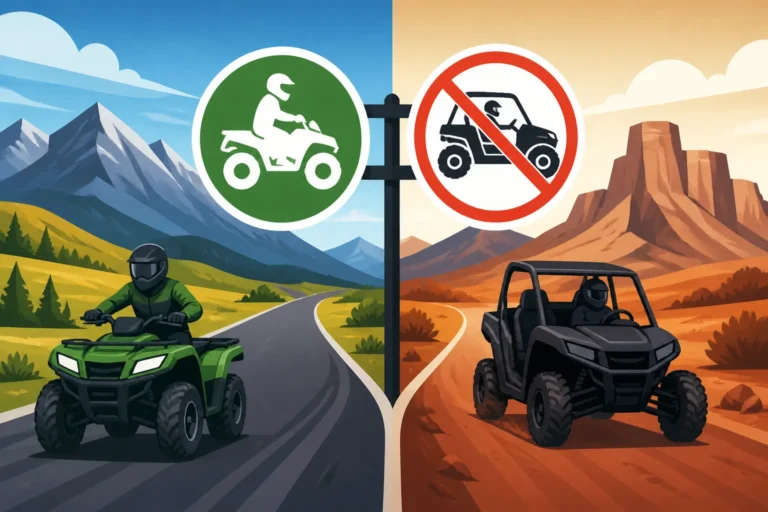
In Wyoming, your off-road machine essentially has two lives: as an Off-Road Recreational Vehicle (ORV) or as a Multipurpose Vehicle (MPV).
An ORV is what most people typically think of when they imagine an ATV, UTV, or dirt bike. These machines are designed solely for off-road use, on trails, dunes, or private land. To ride them on designated public off-road trails or areas in Wyoming, you absolutely need a [Wyoming's Annual ORV Permit], which is a decal that sticks to your machine. This permit allows you to access the vast network of enrolled trails and roads managed by the Forest Service, BLM, and State Parks. However, possessing an ORV permit does not grant you permission to ride your machine on paved public roads or highways – it's strictly for off-highway use.
An MPV, on the other hand, is a specific category within Wyoming law that allows certain ORVs to be registered, titled, and plated for on-road use, provided they meet a specific set of criteria and are equipped accordingly. Think of it as taking your off-road machine and giving it a formal "street-legal" status within Wyoming's legal framework. This is the key difference, and it’s what allows you to bridge the gap between trail riding and necessary road travel. Understanding this fundamental difference is the first step in navigating Wyoming's system. [Wyoming's MPV Path to the Road] is all about understanding this distinction and the process to achieve MPV status.
The Frustration of Mixed Information
It’s completely understandable to feel overwhelmed by the sheer volume of information out there, much of it contradictory or incomplete. One person tells you to just put a flag on it, another insists you need a full inspection, and yet another says it’s impossible. This patchwork of advice, often based on outdated laws, different state regulations, or personal anecdotes, only adds to the confusion. You might have even tried looking up the actual state statutes, only to find them dense and difficult to interpret without a law degree. This isn't just a Wyoming problem; it's a nationwide issue for anyone trying to make their off-road vehicle road-worthy.
The reality is that Wyoming has gone to great lengths to define what an MPV is and what it takes to get one on the road. The process, while specific, is clear once you know where to look and what steps to follow. The goal here is to consolidate that accurate information, so you can confidently determine if your machine qualifies and what you need to do to make it legal.
What Exactly is a Multipurpose Vehicle (MPV) in Wyoming?
The term "Multipurpose Vehicle" isn't just a fancy name; it's a legal classification that carries specific requirements and privileges under Wyoming law. Unlike simply adding a few aftermarket parts to your ATV, becoming an MPV involves a formal process of inspection, titling, and registration that fundamentally changes how your machine is recognized by the state. This designation is critical because it's the only way most side-by-sides and larger ATVs can legally travel on Wyoming's public roads.
Decoding the Wyoming State Statute
Wyoming's definition of a Multipurpose Vehicle is enshrined in state law, specifically Wyoming Statute 31-1-101. This statute lays out the precise characteristics a vehicle must possess to qualify for MPV status. It's not a nebulous guideline; it's a set of concrete, measurable criteria that your machine must meet. If your vehicle doesn't fit these definitions, it simply cannot be titled and plated as an MPV, no matter how many lights or mirrors you add.
The law defines an MPV as a vehicle that is primarily designed for off-road use, has four or more wheels, a steering wheel, and a non-straddle seat. Crucially, it must also have a curb weight between 300 and 3,000 pounds. This definition immediately excludes several types of common off-road machines, such as traditional two-wheeled dirt bikes or many smaller, lighter ATVs. It's tailored specifically for the increasingly popular side-by-sides (UTVs) and some larger, utility-focused ATVs that fit the physical and functional description. Understanding this foundational legal definition is step one in evaluating your machine. You can find more details about [Wyoming's MPV Definition in W.S. 31-1-101] if you want to dig into the exact text.
Key Criteria: Weight, Seat Height, and Wheels
Beyond the general definition, the statute specifies even more precise physical characteristics that an MPV must adhere to. These are the measurable aspects that county clerks and law enforcement will use to determine if your machine truly qualifies.
First, as mentioned, the curb weight of your vehicle must fall within a specific range: between 300 and 3,000 pounds. This is a critical factor and often the first hurdle for many machines. Smaller, lighter ATVs might not meet the 300-pound minimum, while some heavily accessorized or larger utility UTVs might exceed the 3,000-pound maximum. If your machine is near either end of this spectrum, it's wise to get an accurate weight measurement before proceeding. [Weight Between 300 and 3,000 Pounds] is a good resource for understanding this specific requirement.
Second, the machine must have a non-straddle seat with a seat height of at least 24 inches from the ground. This particular requirement is often the deal-breaker for traditional ATVs. Most ATVs are designed with a straddle-type seat, similar to a motorcycle, and their seat height is usually well under 24 inches when measured from the ground. Side-by-sides, with their bucket or bench seats, typically meet this criterion easily. This distinction clearly pushes most conventional ATVs out of the MPV category, despite their four wheels. [A Seat at Least 24 Inches Up] explains this measurement in more detail.
Third, the vehicle must have four or more wheels. While this seems obvious for side-by-sides, it reinforces that dirt bikes or three-wheeled ATVs (though rare these days) cannot be MPVs. The combination of these specific criteria—weight, seat type/height, and wheel count—creates a narrow, but clear, pathway for certain off-road machines to achieve street-legal status.
Common Machines That Qualify (or Don't)
Given these strict criteria, it becomes clearer which machines have a realistic shot at MPV status in Wyoming.
Machines that commonly qualify as MPVs:
- Side-by-Sides (UTVs): Most modern side-by-sides, such as models from Polaris, Can-Am, Yamaha, and Honda, easily meet the four-wheel, non-straddle seat, and 24-inch seat height requirements. Their weight typically falls within the 300-3,000 pound range as well. These are the primary beneficiaries of Wyoming's MPV classification. If you have a two-seat or four-seat side-by-side, it's very likely a candidate. [Registering a Side-by-Side as a Wyoming MPV] covers this process specifically.
- Some Larger Utility ATVs: A select few larger, often utility-focused ATVs that feature a bench-style or bucket seat (rather than a straddle seat) and meet the weight and seat height requirements might qualify. These are less common than side-by-sides but are worth checking if your ATV fits that unusual configuration.
Machines that almost never qualify as MPVs:
- Traditional ATVs (Quads): The vast majority of standard ATVs, with their straddle seats and typically lower seat heights, simply do not meet the legal definition of an MPV. This means that while you can get an ORV permit for them and ride them on trails, you cannot legally title and plate them for road use in Wyoming. This is often the biggest disappointment for ATV owners hoping to make their machine street legal. [Why a Quad Cannot Qualify as an MPV] goes into this in more depth.
- Dirt Bikes: As two-wheeled vehicles, dirt bikes are immediately excluded from the MPV category. While some states have specific "street legal dirt bike" conversions, Wyoming's MPV law does not apply to them.
- Electric Machines: While electric side-by-sides are emerging, they must still meet all the physical criteria, including weight, seat type, and height, just like their gasoline-powered counterparts. The power source itself isn't the primary disqualifier, but rather the physical attributes of the vehicle.
It's a disheartening reality for many ATV owners, but Wyoming's law is quite specific. Before you invest time and money into modifications, ensure your machine fundamentally fits the MPV definition.
The MPV Titling and Registration Process
So, you've confirmed your side-by-side or qualifying ATV meets the strict definition of a Multipurpose Vehicle. Great! Now comes the paperwork, which, while detailed, is a clear path once you know the steps. Unlike getting an ORV decal, which can be done through various vendors, becoming an MPV involves interacting with county government offices.
Navigating the County Clerk and Treasurer
The process for titling and registering an MPV in Wyoming involves two distinct county offices: the County Clerk and the County Treasurer. This can be a point of confusion for many, as you might expect a "one-stop shop" for vehicle paperwork. However, in Wyoming, these roles are separated by function.
The County Clerk's office is responsible for titling your vehicle. This is where you'll establish legal ownership and receive your official MPV title. Think of it as proving that you own the machine and that it qualifies to be a titled vehicle in Wyoming. They will verify your identification, review your bill of sale or previous title, and ensure your machine meets the MPV definition. This process is similar to titling a car or truck, but with the added layer of the MPV-specific requirements. [Wyoming County Clerk Title Process] will guide you through what to expect.
Once your MPV is successfully titled by the County Clerk, you'll then take that title to the County Treasurer's office. The Treasurer's office is responsible for registering your vehicle and issuing your license plates and registration sticker. This is the step that allows your MPV to be legally operated on public roads. They handle the collection of registration fees and ensure you have valid insurance. It's a two-stage process, and you absolutely cannot skip the Clerk's office if you want to get a plate from the Treasurer. [Wyoming County Treasurer Plate Process] provides more detail on the registration side.
Essential Paperwork and the Checklist Form
Preparing your paperwork diligently will save you a lot of headaches and potential delays. You’ll need several key documents when you head to the County Clerk’s office:
- Proof of Ownership: This is usually your Manufacturer’s Statement of Origin (MSO) if the machine is new, or a properly executed title from a previous owner if it’s used. If you bought it used and there was no title (common for ORVs from states that don't title them), you might need a bill of sale and possibly a lien release, if applicable. Be sure to check with your specific county clerk beforehand to confirm their exact requirements, especially for out-of-state machines or those without a prior title.
- Bill of Sale: Even with a title, a detailed bill of sale showing the purchase price is crucial for calculating sales tax (if applicable) and proving the transaction.
- Identification: Your valid driver's license or state ID.
- The MPV and ORV-MC Checklist Form: This form is absolutely vital for MPV titling. It’s a specific document provided by the state (often available through the county clerk’s office or online) that acts as a checklist for all the physical attributes your machine must possess to qualify as an MPV. This form will ask you to confirm:
- The number of wheels (four or more).
- The type of seating (non-straddle).
- The seat height (at least 24 inches from the ground).
- The curb weight (between 300 and 3,000 pounds).
- Confirmation of a steering wheel.
- The vehicle's VIN (Vehicle Identification Number).
You'll need to accurately complete this form, attesting that your machine meets all the legal requirements. It's often required to be signed by a law enforcement officer or a designated inspection agent to verify the information. Don't underestimate the importance of this form; it's the state's way of ensuring your machine physically fits the MPV definition. [What the MPV and ORV-MC Checklist Form Asks] provides a deep dive into this important document.
From Title to Plate: A Two-Step Journey
Once you have all your documents ready, the journey from off-road machine to street-legal MPV unfolds in these distinct phases:
-
The County Clerk (Titling):
- Bring all your paperwork, including the MSO/previous title, bill of sale, ID, and the completed MPV checklist form.
- The clerk will review everything, verify the VIN, and confirm that your machine meets the MPV definition based on the checklist.
- If approved, you'll pay any applicable sales tax and titling fees.
- The clerk will then process your Certificate of Title for a Multipurpose Vehicle. This document legally establishes your ownership and the machine's MPV status. [Wyoming Paperwork for an MPV Title] covers the specifics.
-
The County Treasurer (Registration and Plates):
- With your new MPV title in hand, head to the County Treasurer's office.
- You'll present your title, proof of insurance (which is mandatory for road-legal vehicles), and your ID.
- The Treasurer's office will process your registration, collect the annual registration fees, and issue you your Wyoming MPV license plate and registration sticker. This plate is distinct from the small ORV decal; it's a full-sized license plate like you'd find on a car.
- The registration is typically valid for one year and must be renewed annually. [Plates From a Wyoming County Treasurer] details this final step.
It's a systematic process, and patience is key. Double-checking requirements with your local county offices before you go can save you a return trip.
Equipping Your MPV for Wyoming Roads
So, your machine fits the MPV definition, and you're ready to tackle the titling and registration. But before you hit the pavement, your MPV needs to be properly equipped to meet Wyoming's on-road safety standards. This isn't just about avoiding a ticket; it's about ensuring your safety and the safety of others sharing the road. Neglecting these requirements could lead to significant fines or even an accident.
Mandatory Road Equipment for Safety and Compliance
Just like any other street-legal vehicle, an MPV operating on Wyoming roads must have specific safety equipment. These aren't optional accessories; they are legal requirements designed to make your machine visible, controllable, and compliant with traffic laws. Trying to ride without these could result in a citation for [Wyoming Fines for Riding Without a Permit] (or proper equipment, in this case).
The core requirements generally include:
- Headlights: Your MPV needs at least one, but ideally two, properly functioning headlights that emit white light and are visible from a specified distance. These are crucial for night riding and for being seen during the day.
- Taillights: A red taillight is required on the rear, visible from a specific distance, to indicate your presence to vehicles behind you.
- Stop Lamps (Brake Lights): When you apply the brakes, a red light (or lights) on the rear of your MPV must illuminate to signal your slowing or stopping action.
- Rear-view Mirror: At least one rear-view mirror is mandatory, mounted on the left side of the vehicle, providing you with a clear view of traffic approaching from behind. Many riders opt for a second mirror on the right for enhanced visibility.
- Horn: A working horn is necessary to alert other drivers or pedestrians to your presence.
- Tires: Your tires must be designed for highway use and have adequate tread depth. Off-road-only knobby tires may not be suitable or safe for sustained highway speeds.
- Muffler and Spark Arrester: While crucial for off-road environments, these also apply to road use. Your exhaust system must have a muffler that keeps noise levels within legal limits and a U.S. Forest Service-approved spark arrester to prevent accidental fires.
- Windshield/Eye Protection: While a full windshield isn't always explicitly required by law for MPVs, appropriate eye protection (goggles or a face shield) is generally advisable and sometimes mandatory depending on local ordinances or if you don't have a windshield.
This list covers the basics, but it's always smart to consult the Wyoming Department of Transportation (WYDOT) or your local law enforcement for the most current and specific regulations regarding equipment. [Wyoming's Road Equipment Rules Come From] various sources, and it's your responsibility to be aware of them.
Lighting, Mirrors, and Other Essential Additions
Let's dive a little deeper into some of these critical equipment requirements.
Lighting: For night riding, your headlights must illuminate the road sufficiently, often specified as a certain distance ahead. Taillights and brake lights ensure you're visible from the rear. Many modern UTVs come with decent lighting packages, but it's worth checking if they meet the specific candlepower or visibility distances required for on-road use. Some stock lights might be adequate for trails but insufficient for highways. Adding turn signals, while not always explicitly listed as a primary MPV requirement in all statutes, is a highly recommended safety upgrade for any vehicle sharing the road with cars and trucks, and some municipalities might require them.
Mirrors: The requirement for at least one left-side mirror is non-negotiable. This isn't just a small convex mirror; it needs to provide a clear and substantial view of the rear. Many aftermarket mirrors specifically designed for UTVs attach to the roll cage and offer excellent visibility. [The Left-Side Mirror Wyoming Wants] is all about ensuring you have this crucial piece of safety equipment.
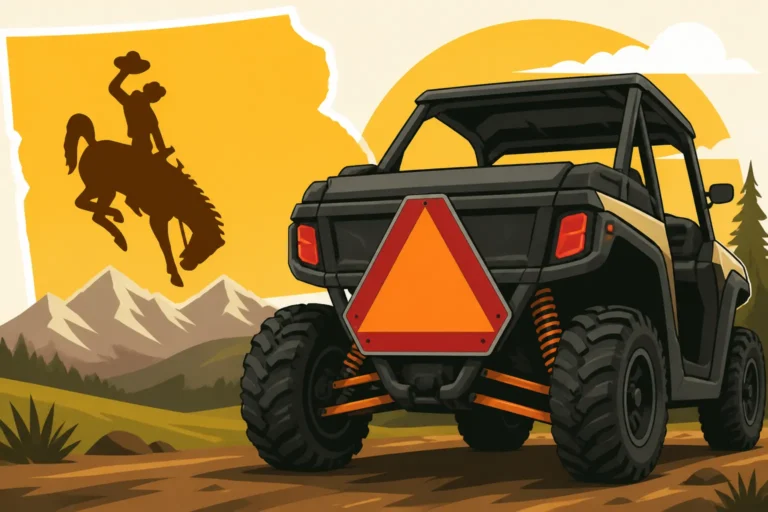
Reflectors: A red rear reflector, mounted on the back of your MPV, is often a requirement to make your machine visible even if your taillights fail. This is a low-cost, high-impact safety item that should not be overlooked. [A Red Rear Reflector on a Wyoming Machine] is an easy check to make sure you're compliant.
Speedometer: While not always explicitly listed for MPVs, a speedometer is a fundamental tool for safe driving, allowing you to adhere to posted speed limits. Most modern UTVs come equipped with one.
These additions aren't just about compliance; they are about dramatically increasing your safety profile on roads where cars and trucks travel at much higher speeds.
Upgrading Your Machine with Aftermarket Parts
If your MPV doesn't come from the factory with all the necessary road-legal equipment, you'll need to outfit it with aftermarket parts. This is where companies like SuperATV shine, offering a wide array of products specifically designed to make your UTV or qualifying ATV road-ready.
When selecting aftermarket parts, always prioritize quality and compliance. Don't just buy the cheapest option; ensure the headlights are bright enough, the mirrors are sturdy and provide a clear view, and the horn is loud enough to be effective.
Here's how SuperATV and similar companies can help:
- Lighting Kits: You can find comprehensive street-legal kits that include turn signals, horns, and sometimes even updated headlights and taillights. Many UTVs, for example, have stock taillights that double as brake lights but lack dedicated turn signals, making these kits essential.
- Mirrors: SuperATV offers a variety of side-view and rear-view mirrors that securely mount to your roll cage, providing the necessary visibility for on-road operation. Choose ones that are durable and offer a wide field of view.
- Horns: If your machine doesn't have a horn, or if it's not loud enough for highway use, you can easily install an aftermarket horn.
- Windshields: While optional in some cases, a full or half windshield drastically improves rider comfort and protection from road debris. SuperATV provides many options tailored to specific UTV models.
- Tires: If your current tires are strictly for aggressive off-road use, consider a set of DOT-approved all-terrain or hybrid tires that offer a better ride on pavement while still providing traction off-road.
The key is to integrate these components cleanly and securely. A professional installation or careful DIY approach is crucial to ensure everything functions reliably and looks good. Remember, the goal is not just to pass an inspection, but to create a safer vehicle for yourself and others.
Driver and Passenger Requirements for MPVs on Wyoming Roads
Once your MPV is titled, registered, and properly equipped, you're almost ready to hit the pavement. However, the legal requirements extend beyond just the machine; they also apply to the operator and any passengers. Understanding these rules is crucial to avoid citations and ensure everyone's safety.
Licensing and Endorsements for MPV Operators
Operating an MPV on public roads in Wyoming is not like driving an ORV on a trail; it's considered operating a motor vehicle on a highway, and as such, requires a proper driver's license.
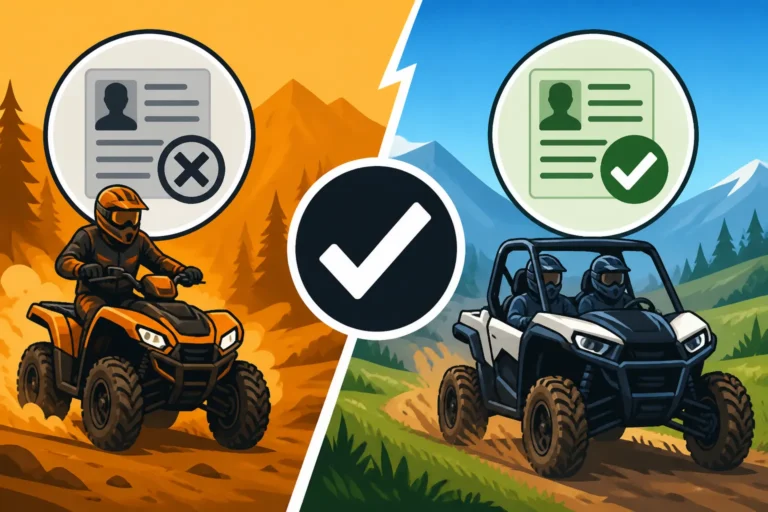
- Valid Driver's License: Any person operating an MPV on a public road in Wyoming must possess a valid driver's license. This means you cannot have your MPV street-legal and then let an unlicensed individual drive it on the road. This is no different than driving a car or truck.
- Motorcycle Endorsement (M or MR): This is a critical point that often catches MPV owners by surprise. Wyoming law requires that a person operating an MPV on a public road hold either a Class M (Motorcycle) endorsement or a specific Class MR (Multipurpose Vehicle) endorsement on their driver's license.
- The Class M endorsement is typically obtained by passing a written test and a skills test on a motorcycle. If you already have this for a motorcycle, you're good to go.
- The Class MR endorsement is specifically for Multipurpose Vehicles. It's designed for those who don't necessarily ride a motorcycle but need the legal credential to operate their MPV on the road. You'll need to check with the Wyoming Department of Transportation (WYDOT) or your local driver's license office for the specific requirements to obtain this endorsement, which usually involves a knowledge test and potentially a skills test in an MPV.
Ignoring this endorsement requirement is a common mistake and can lead to a ticket. It reinforces the idea that an MPV, while rooted in the off-road world, is treated with the same seriousness as other road-going vehicles once it enters the public highway system. [The M or MR Endorsement Wyoming Asks For] is an excellent resource to clarify these requirements.
Helmet Laws and Passenger Rules
Wyoming has specific helmet laws that apply to MPV operators and passengers, particularly for younger riders.
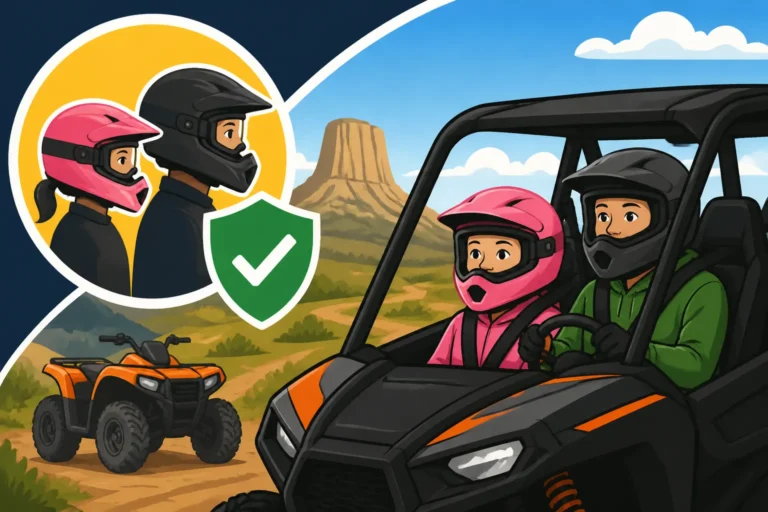
- Operators and Passengers Under 18: Anyone operating or riding as a passenger on an MPV on a public road who is under 18 years of age must wear a properly fitted and fastened safety helmet. This is not an option; it's a legal requirement designed to protect young riders.
- Operators and Passengers 18 and Over: For those 18 years of age and older, helmets are not legally mandated for MPV operation on public roads. However, wearing a helmet is always a wise safety choice, regardless of age, especially given the open nature of many MPVs and the speeds involved on roads. You might see experienced riders foregoing helmets, but that doesn't make it the safest choice. [Wyoming Helmet Law for ATV Riders] further clarifies this.
Passenger Rules: Beyond helmets, general safety rules apply to passengers.
- All passengers must be seated in a designated seating position and use available seatbelts.
- Passengers should be able to reach the floorboards or footrests.
- The number of passengers must not exceed the manufacturer's design capacity for the machine. Overloading your MPV is both illegal and dangerous.
- The driver is responsible for ensuring all passengers are safely secured and compliant with helmet laws. [Wyoming Passenger Rules on an ATV] are important for family rides.
Insurance and Other Important Considerations
Just like your car, your MPV needs to be insured to operate on public roads in Wyoming.
- Proof of Insurance: You must carry proof of liability insurance coverage that meets Wyoming's minimum requirements for motor vehicles. This insurance protects you financially in case you are involved in an accident that causes damage or injury to others. Without it, you cannot legally register or operate your MPV on public roads. A copy of your insurance card or policy on your person or in the vehicle is mandatory. [Wyoming ATV Insurance Requirement] details the specifics.
- Registration Card: Always carry your MPV's registration card with you when operating on public roads. This, along with your driver's license and proof of insurance, is what a law enforcement officer will ask for during a stop.
- Age and Supervising Youth: While MPVs can be driven on roads by licensed individuals, the minimum age to obtain a driver's license (and thus an M or MR endorsement) in Wyoming means younger riders (under 16) typically cannot legally drive an MPV on public roads, even with supervision, unless they have a specific learner's permit that allows it. Off-road trails have different rules for youth, but public roads are far stricter.
By understanding and adhering to these operator and passenger requirements, you ensure your MPV adventures on Wyoming's roads are not only enjoyable but also fully compliant with state law.
Where You Can (and Cannot) Ride Your MPV in Wyoming
Even with a titled, plated, and equipped MPV, you can't just ride everywhere. Wyoming has specific rules about which roads are open to MPVs. This distinction is crucial, and ignoring it can lead to fines, especially when you encounter a closed road or an area where MPVs are simply not allowed.
Understanding Enrolled Roads and Designated Routes
Wyoming's approach to allowing ORVs and MPVs on public roads is based on the concept of "enrolled roads" and "designated routes." This means that a road isn't automatically open to MPVs just because it's public.
-
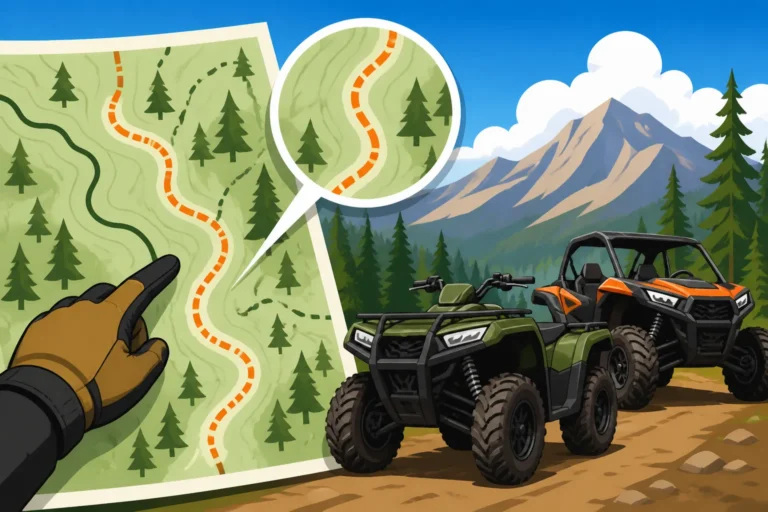
Enrolled Roads: These are specific roads that have been officially designated and approved by the managing agency (such as the U.S. Forest Service, Bureau of Land Management, or a county government) for ORV/MPV use, in cooperation with the Wyoming Department of State Parks and Cultural Resources (which manages the ORV/MPV program). These roads are typically marked with specific signage indicating that ORVs/MPVs are permitted. You might find a [Finding an Enrolled Road on a Forest Map] or BLM travel management map. These maps are your best friend for planning routes.
-
Designated Routes: Similar to enrolled roads, these are specific trails or routes on federal or state lands that have been designated for ORV use. While MPVs generally have more freedom on paved roads, they still need to stick to these designated routes when venturing off-highway.
The key takeaway is this: if a road is not explicitly marked or designated as open to ORV/MPV use, assume it is closed. This "closed unless posted open" rule is fundamental to responsible riding in Wyoming. You cannot simply ride your MPV on any two-track or gravel road you find.
The Interstate Challenge and Specific Crossings
Perhaps one of the most confusing and historically restrictive areas for MPVs and ORVs in Wyoming has been the interstate highway system. For a long time, riding across an interstate was largely prohibited or extremely difficult. However, recent changes have opened up very specific, limited opportunities.
- General Prohibition: As a general rule, MPVs (and certainly ORVs) are not permitted to operate on interstate highways in Wyoming. Interstates are high-speed, multi-lane roads designed for conventional vehicles, and it's unsafe and illegal for MPVs to use them for travel.
- Designated Crossings: There are now very specific, limited grade-separated interstate crossings that allow ORVs and MPVs to pass under or over an interstate highway without actually driving on the interstate itself. These crossings are designed to connect segments of the ORV/MPV trail system that would otherwise be cut off by the interstate. These crossings are strictly controlled and often have specific rules, such as a cap on the number of machines that can use them per year (e.g., 1,000 machines). [How to Cross I-80 Legally on an ATV] provides information on these specific crossings.
- WYDOT and Local Agreements: The opening of these crossings often involves extensive collaboration between WYDOT, local counties, and the State Parks Trails Program. You can't just decide to cross an interstate; it has to be a formally approved and marked crossing. The intent is to facilitate trail continuity, not to allow MPVs to use the interstate as a general travel corridor.
The frustration of having trails split by major highways is real, and these specific crossings are a response to that. But they are exceptions to the rule, not an invitation to treat interstates as part of your regular MPV route. [Interstates Closed to MPVs and Dirt Bikes] is the general rule you should remember.
Navigating City Streets, County Roads, and BLM/Forest Lands
The rules for riding your MPV on other types of public thoroughfares vary:
-
City/Town Streets: This is where things can get particularly localized. While Wyoming state law allows properly equipped and registered MPVs on public roads, individual cities and towns have the authority to pass ordinances restricting or prohibiting MPV use on their municipal streets. This means what's legal in one town might be illegal just a few miles down the road. Always check with the local city or town government offices before riding your MPV on city streets. [Wyoming Rules for Riding a City Street] are determined locally.
-
County Roads: Many county roads (paved or gravel) are generally open to MPVs, provided they are not specifically closed by county ordinance or designated as off-limits. However, counties can and do enact restrictions, so it's always best to check with the county commissioner's office or sheriff's department in the specific county you plan to ride. Often, they work in conjunction with the state to enroll roads for ORV/MPV use. [Wyoming Rules for Riding a County Road] are crucial to understand.
-
Bureau of Land Management (BLM) and National Forest Roads: These vast federal lands offer immense riding opportunities. Generally, MPVs can use designated open roads and trails on BLM and Forest Service lands, provided they are properly permitted (ORV decal) and equipped (MPV registration for road segments). However, both agencies operate under "Travel Management Plans" which identify specific routes open to different types of vehicles. You must stick to these designated routes. Riding cross-country or on routes not explicitly marked as open is illegal and environmentally damaging. Always carry an up-to-date [Wyoming Trail Maps and MVUMs] (Motor Vehicle Use Map) for the area you are in. [Wyoming Rules for Riding BLM Land] and [Wyoming Rules for Riding a National Forest] highlight the importance of adhering to these maps.
In summary, being street-legal with an MPV in Wyoming means you have the potential to ride on roads, but you must still verify local rules, check for "enrolled" status, and always adhere to designated routes. Ignorance of the local rules is not an excuse.
Common Pitfalls and How to Avoid Them
The path to getting your MPV on Wyoming roads is clear, but it's also laden with potential missteps. Many riders, eager to hit the pavement, overlook crucial details that can lead to frustration, delays, or even expensive fines. Being aware of these common pitfalls can save you a lot of trouble.
The Importance of Up-to-Date Information
One of the biggest challenges for riders is keeping up with ever-changing laws and regulations. What was true last year might have changed this year, or a new local ordinance could impact your riding plans. Relying on outdated information from forums, old blog posts, or even well-meaning friends can lead you astray.
- Government Sources are Key: Always go directly to the source for the most accurate and current information. This means checking the official websites of the Wyoming Department of State Parks and Cultural Resources (for ORV/MPV program info), the Wyoming Department of Transportation (for driver's license and vehicle equipment laws), and the specific county and city governments where you plan to ride.
- Don't Assume: Never assume that because a friend rides their UTV on a particular road, it's legal for you. Their machine might be an MPV, or they might simply be breaking the law. Always verify the status of roads and regulations yourself.
- The MPV Checklist: Remember the [What the MPV and ORV-MC Checklist Form Asks]? This form is your friend. It's designed by the state to ensure compliance. If you can't confidently check all the boxes, you probably don't have a legal MPV.
It's a small investment of time to call a county clerk or visit a government website, but it can prevent much larger headaches down the road.
Fines and Consequences of Non-Compliance
Riding an illegally equipped or unregistered MPV (or a regular ORV) on public roads in Wyoming can result in a range of penalties, from minor citations to significant fines and even impoundment of your vehicle.
- Driving Without a Valid License/Endorsement: Operating an MPV on a road without the proper M or MR endorsement is essentially driving without the correct license. This can lead to fines, points on your driving record, and potentially even suspension of your driving privileges, similar to driving a car without a license.
- Unregistered/Untitled Vehicle: Operating an MPV without proper registration and a license plate is illegal. You could be pulled over, fined, and your vehicle could be impounded until you can prove ownership and proper registration.
- Missing or Improper Equipment: A missing mirror, non-functioning brake light, or lack of a horn can also result in a fix-it ticket or a fine. Law enforcement officers are trained to look for these details on vehicles operating on public roads. [What a Wyoming Trooper Checks Roadside] can include a thorough inspection of your MPV.
- Riding on Closed Roads/Interstates: Intentionally riding an MPV on roads designated as closed, or attempting to use an interstate where it's not a designated crossing, can lead to substantial fines and citations. These rules are in place for safety and environmental protection. [Wyoming Fines for Riding a Closed Road] can be steep.
- Insurance Violations: Driving without mandatory liability insurance is a serious offense that carries heavy penalties, including fines, license suspension, and possible vehicle impoundment.
These consequences aren't trivial. They can quickly turn an enjoyable ride into a very expensive and frustrating ordeal. It's far better to invest the time upfront to ensure full compliance.
Planning Your Ride Legally and Safely
With your MPV legally prepared, your focus should shift to planning safe and legal rides. This means more than just knowing where you're going; it means understanding the environment and potential hazards.
- Route Planning: Use official maps (like BLM or Forest Service MVUMs) to identify open and designated roads and trails. If you're using county or city roads to connect trail segments, verify their status. Avoid venturing off marked routes.
- Road Conditions: MPVs handle differently than cars on pavement. Be aware of your machine's limitations, especially at higher speeds or in adverse weather. Paved roads can be slick when wet, and gravel roads present their own challenges.
- Visibility: Even with proper lighting, MPVs are smaller than most cars. Drive defensively, assume other drivers don't see you, and make yourself as visible as possible. Consider bright clothing.
- Emergency Preparedness: Carry basic tools, a first-aid kit, and communication devices. If you're planning a long ride that incorporates remote roads, let someone know your route and expected return time. SuperATV also offers accessories like winches and recovery gear that can be invaluable if you encounter trouble, whether on the trail or a remote road.
- Respectful Riding: Share the road respectfully with other vehicles. Adhere to speed limits, signal your turns, and follow all traffic laws. When transitioning from road to trail, be mindful of hikers, mountain bikers, and equestrians.
Wyoming offers incredible opportunities for MPV enthusiasts to explore its vast landscapes. By understanding and adhering to the MPV path, from titling and equipment to licensing and designated routes, you can enjoy these experiences safely and legally.
Disclaimer
This article is for general informational purposes only and does not constitute professional advice. Laws, prices and regulations vary by location and change over time. Consult a qualified professional for guidance on your specific situation.