When a Machine Must Carry a Slow-Moving Vehicle Emblem
Ever found yourself on a quiet county road, connecting one stretch of trail to another, wondering if that bright orange triangle on the back of your neighbor's side-by-side really applies to you? It's a common point of confusion for ATV and UTV riders in Wyoming. Many assume that because their machine can hit higher speeds, rules about slow-moving vehicles don't apply. But navigating Wyoming's roads with your off-road machine comes with specific safety requirements, and knowing when you need a slow-moving vehicle emblem isn't just about avoiding a citation—it's about ensuring your safety and visibility to other drivers. This guide will walk you through the nuances of Wyoming law, helping you decipher exactly when your machine needs that distinctive orange triangle.
Understanding Wyoming's Rules for Slow-Moving Vehicles
Riding an ATV or UTV on designated public roads in Wyoming offers incredible access and convenience, but it also means adhering to rules designed for highway safety. One of the most important, and often misunderstood, of these rules involves the use of a slow-moving vehicle (SMV) emblem. It's not just for tractors or farm equipment; it's a critical safety device for any vehicle that might pose a visibility challenge due to its speed.
What Exactly is a Slow-Moving Vehicle Emblem?
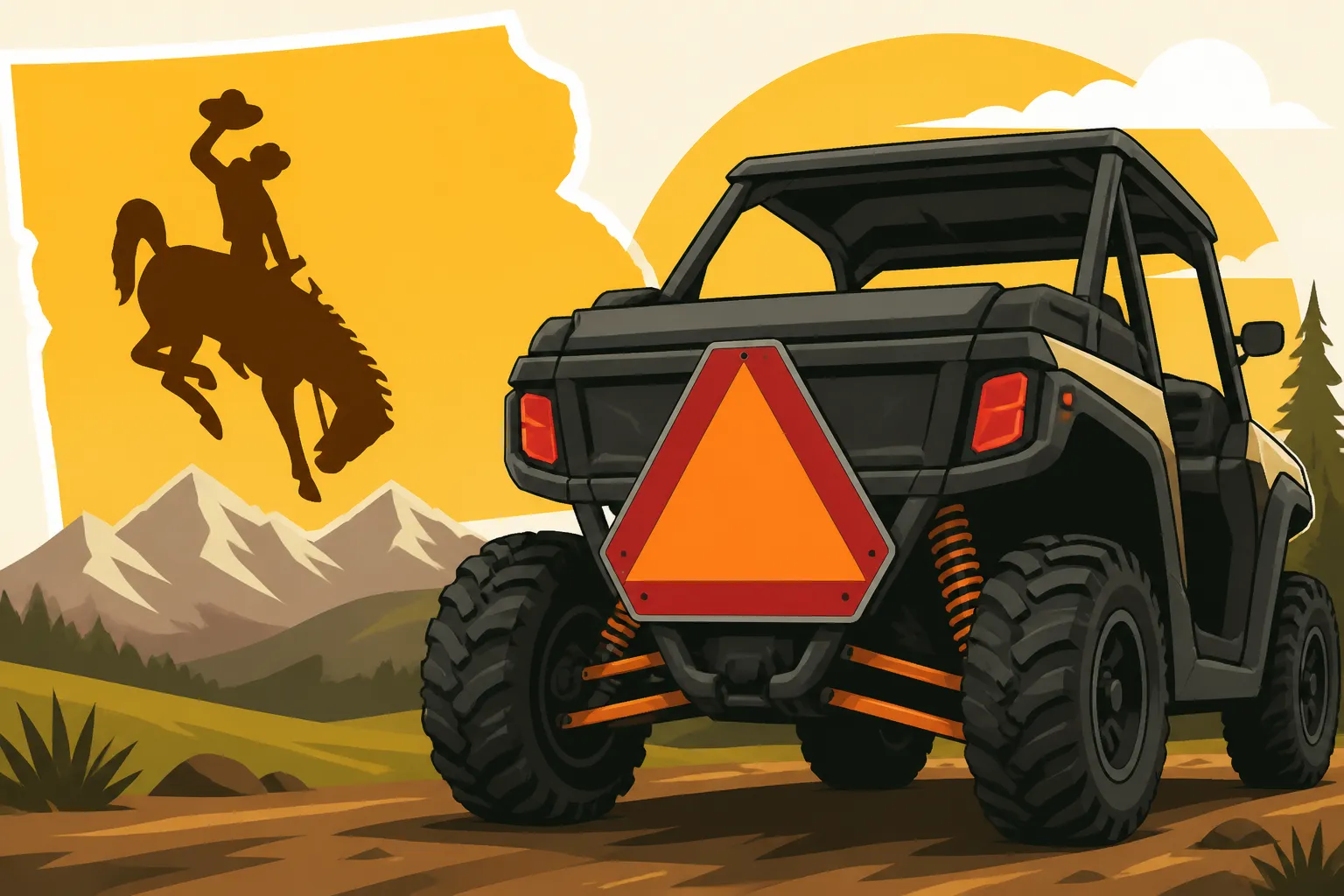
At its heart, a slow-moving vehicle emblem is a universal symbol of caution. Picture a bright fluorescent orange triangle, outlined with a reflective red border. It's unmistakable and designed to catch the eye of approaching drivers from a distance, day or night. The primary goal of this emblem is simple: to alert other motorists that the vehicle ahead is traveling at a significantly slower speed than the normal flow of traffic. Without this clear visual warning, a driver coming up behind a slow-moving ATV or UTV might not register the speed difference quickly enough, especially on roads with higher speed limits or limited visibility.
The design of the emblem isn't arbitrary; it's standardized across most of North America. The fluorescent orange ensures high daytime visibility, while the red reflective border provides critical nighttime recognition. It's a passive safety device that buys crucial seconds for other drivers to react, slow down, and safely navigate around your machine. In a state like Wyoming, where open roads can invite higher speeds and your off-road machine might be sharing pavement with anything from semi-trucks to sedans, this warning can literally be a lifesaver.
The Speed Threshold in Wyoming Law
Wyoming's vehicle codes, much like those in other states, define what constitutes a "slow-moving vehicle" on public roads. While the exact wording can vary slightly by statute, the core principle is consistent: any vehicle designed to operate at, or typically operating at, speeds significantly below the posted speed limit for that roadway must display the emblem. For most general purposes, this threshold is often around 25 miles per hour or less. It's important to understand that this isn't just about the maximum speed your machine can achieve, but rather the speed at which you are actually operating it on a public road.
So, even if your powerful side-by-side from SuperATV could easily cruise at 50 mph, if you're using it to putter along a county road at 15 mph to check fence lines or just connect to a nearby trail, you fall squarely into the "slow-moving vehicle" category. The law isn't concerned with the machine's potential, but with its actual behavior in traffic. This distinction is crucial for ATV and UTV riders, as these machines, by their nature, often travel at varying speeds, sometimes much slower than typical road traffic, especially when used for utility tasks or traversing short road sections to reach trails.
When Your ATV or UTV Becomes a "Slow-Moving Vehicle" on Wyoming Roads
The key to knowing when to display the SMV emblem isn't just about having an ATV or UTV; it's about how and where you're operating it. Wyoming has specific pathways for off-road machines to gain road access, and even then, certain conditions trigger the need for that distinctive orange triangle.
The Core Criteria: Speed and Road Type
In Wyoming, the requirement for a slow-moving vehicle emblem hinges primarily on two factors: your machine's operating speed and the type of road you're on. Generally, if your ATV or UTV is being operated on a public road at a speed of 25 miles per hour or less, the emblem is required. This applies whether you're on a county road, a state highway with a designated ORV segment, or even a local street where your machine might be legally allowed. The important takeaway here is the actual travel speed, not the theoretical top speed of your machine.
Consider a scenario where you're using your side-by-side to cross a state highway that has been designated for ORV use. The speed limit on that highway might be 65 mph, but you're only going 20 mph to make a safe crossing. In this instance, because your operating speed is significantly less than the prevailing traffic and below that 25 mph threshold, the SMV emblem becomes a mandatory safety feature. It's about minimizing the risk of a rear-end collision by giving faster-moving vehicles ample warning that you are indeed a slower obstruction. This ensures that whether you're cruising on a gravel county road or briefly traversing a paved state route, other drivers are properly alerted to your presence and speed. You might find more details on which roads are open by checking [Wyoming's Designated ORV Roads].
Why an MPV Title Doesn't Always Exempt You
This is where things can get a little tricky and often trip up riders. Wyoming has a classification for "Multipurpose Vehicles" (MPVs), which are essentially UTVs or side-by-sides that meet certain criteria (like weight limits and seat height) and can be titled and registered for street-legal use, much like a car. This means they get a regular license plate and can operate on most public roads. You can learn more about this by reading [Wyoming MPV Street Legal Requirements] or [Titling a Multipurpose Vehicle in Wyoming]. It sounds like a full pass to bypass all "off-road" rules, right? Not quite.
While obtaining an MPV title and plate certainly grants your machine more extensive road privileges, it doesn't automatically exempt you from the slow-moving vehicle emblem requirement. The law differentiates between a vehicle being legally allowed on the road (which an MPV is) and a vehicle operating slowly on that road. If your street-legal MPV is cruising along a paved road at 20 mph, perhaps because you're looking for an address, navigating tricky terrain, or simply taking it easy, it is still moving significantly slower than the typical traffic flow. Therefore, even with a license plate, that orange triangle is still necessary to signal your reduced speed to other motorists. The MPV designation allows for the general use of roads, but safe operation, particularly regarding speed differentials, is paramount. [Wyoming's MPV Path to the Road] outlines this progression from ORV to MPV.
Practical Application: Scenarios Requiring the Emblem
Understanding the legal definitions is one thing, but knowing how these rules apply in your everyday riding is crucial. The requirement for a slow-moving vehicle emblem crops up in a variety of common situations for ATV and UTV owners across Wyoming.
Riding to a Trailhead or Across Town
One of the most frequent reasons riders find themselves on public roads is to simply get from point A to point B. Maybe your home is a short distance from an incredible trail system, and rather than loading your machine onto a trailer for a five-minute drive, you choose to ride it. Or perhaps you're out camping and need to make a quick trip into a small town for supplies, or connect two segments of a vast public land trail network that are separated by a paved road. These are prime examples of scenarios where your off-road machine will likely be operating at speeds well below the posted limit, particularly on the short paved stretches or through residential areas.
On these short road excursions, even if your side-by-side can easily exceed 25 mph, you're probably not going to be pushing those limits. You'll be taking it easy, observing traffic, and prioritizing safety. Because your operating speed will likely fall into that "slow-moving" category, the emblem becomes a critical piece of safety equipment. It loudly and clearly signals to other drivers that you're not moving at the same pace as a typical vehicle. This is especially true when [Wyoming Rules for Riding to a Trailhead] involve traversing town streets or when [Wyoming Rules for Crossing a Highway] put you directly in the flow of faster-moving vehicles. Forgetting the emblem in these moments isn't just a compliance issue; it's a significant safety oversight.
Agricultural and Ranch Use
Wyoming is big sky country, and a significant portion of ATV and UTV use here is deeply intertwined with agriculture and ranching. From checking livestock and fences to hauling feed and tools, these machines are indispensable workhorses. While much of this activity occurs on private land, it's not uncommon for ranchers, farmers, and their employees to cross public roads to get from one pasture to another, move equipment, or access different sections of their property. In these situations, the rules of the road absolutely apply, even if the primary purpose of the machine is work.
Imagine a rancher needing to take their quad a quarter-mile down a county road to reach a gate on the other side of a section line. They'll be loaded with gear, likely traveling slowly, and focused on their task. Even though the machine might be used almost exclusively on private land, that brief transit on a public road instantly triggers the requirement for a slow-moving vehicle emblem. The logic is simple: when you're sharing the road with the public, public safety rules take precedence. While a machine used exclusively on private land might not need a [Wyoming ORV Permit] if it never touches public routes, any foray onto a public roadway, however brief, demands adherence to these safety standards. This is particularly relevant when considering if [Does a Ranch-Only Quad Need a Wyoming Permit?] and what other rules apply when it ventures off the ranch.
Choosing and Mounting Your Slow-Moving Vehicle Emblem
Once you understand when you need a slow-moving vehicle emblem, the next steps are all about acquiring the right one and ensuring it's properly installed for maximum effectiveness. This isn't just about sticking any orange triangle on your machine; there are specific standards to meet for compliance and safety.
Sourcing a Compliant Emblem
The good news is that slow-moving vehicle emblems are widely available and relatively inexpensive. You don't need a special permit to buy one, nor are they exclusive to certain types of vehicles. You can typically find them at any reputable auto parts store, farm and ranch supply retailers, or even larger general merchandise stores with an automotive section. For those who prefer online shopping or are looking for a wider selection of accessories, companies like SuperATV offer SMV emblems, often as part of larger road-legal conversion kits or as standalone items. When purchasing, ensure the emblem meets the standard specifications: it should be a fluorescent orange triangle with a reflective red border, approximately 14 inches high with a base width of about 16 inches. These dimensions and color properties are crucial for its intended visibility. Don't compromise on quality here; a faded or undersized emblem won't provide the same level of warning, defeating its purpose.
Proper Placement for Maximum Visibility
Having the right emblem is only half the battle; proper placement is equally critical. The slow-moving vehicle emblem must be mounted on the rear of your ATV or UTV, centered, and as close to the top as practical without obscuring other required lighting or signals. The aim is to make it as visible as possible to following traffic. Generally, it should be mounted with the top of the triangle between 2 feet and 6 feet from the ground. Avoid placing it too low where it might be easily obstructed by mud, dust, or a hitch, or too high where it could be difficult for drivers of lower vehicles to see.
For side-by-sides, this often means mounting it on the rear roll cage or the tailgate. For ATVs, it might be on the rear rack or a fabricated mount. Ensure it's mounted securely, using bolts or strong brackets, so it doesn't flap in the wind or fall off on bumpy terrain. Regular checks to ensure the emblem is clean, unfaded, and unobstructed are also important. A muddy emblem won't reflect light or provide the necessary fluorescent visibility. When you are preparing to mount this crucial safety device, you can look for guidance on [Mounting the Orange Triangle on the Back].
Here's a quick comparison of general road requirements for ORVs versus MPVs in Wyoming:
| Feature | Off-Road Vehicle (ORV) | Multipurpose Vehicle (MPV) |
|---|---|---|
| Primary Use | Recreational trail riding, utility work off-road | Recreational, utility, and general road transportation |
| Road Access | Limited to designated ORV roads, crossings, private land | Most public roads (with exceptions like interstates) |
| License Plate | No (requires ORV permit decal) | Yes, standard vehicle license plate |
| Title Requirement | Generally no (unless MPV conversion) | Yes, requires a vehicle title |
| SMV Emblem Required? | Yes, if operating on public roads ≤ 25 mph | Yes, if operating on public roads ≤ 25 mph |
| Insurance Required? | No (on trails), Yes (on public roads, typically liability) | Yes, standard vehicle liability insurance |
| Driver's License? | Varies by age/road type, often not required for trails | Yes, valid driver's license (or motorcycle endorsement) |
Penalties for Non-Compliance and Related Road Safety
Ignoring the requirement for a slow-moving vehicle emblem isn't just a minor oversight; it carries legal consequences and, more importantly, significant safety risks. Riding responsibly means understanding and adhering to all road rules, including those designed to protect you from other traffic.
The Cost of Forgetting Your Emblem
Let's be direct: riding your ATV or UTV on a public road in Wyoming when an SMV emblem is required, but not displayed, can lead to a citation. While I can't give specific fine amounts, these types of traffic infractions can result in monetary penalties. A law enforcement officer, such as a Wyoming Trooper, who spots a slow-moving off-road machine without the proper emblem will likely pull you over. Their priority is public safety, and a missing emblem represents a failure to adequately warn other drivers, creating a hazardous situation.
Beyond the immediate financial penalty, getting pulled over can be inconvenient and might lead to further inspection of your machine to ensure compliance with other road-legal requirements, such as working lights, mirrors, and appropriate registration or permits. It's much easier, and far safer, to simply ensure your machine is equipped with the correct emblem before heading out onto any public roadway. Think of it as an inexpensive insurance policy against potential accidents and citations. [What a Wyoming Trooper Checks Roadside] often includes looking for these crucial safety elements.
Broader Safety Considerations for Road Use
The slow-moving vehicle emblem is just one piece of a larger puzzle when it comes to safely operating your ATV or UTV on public roads. Even if your machine is fully road-legal, whether as an ORV on designated routes or a titled MPV, you must maintain a heightened sense of awareness and respect for other vehicles. Here are some other crucial safety considerations:
- Lighting: Ensure your machine has proper headlights, taillights, and brake lights that are fully functional. Many states, including Wyoming, have specific [Wyoming Lighting Requirements for ORVs] for road use, especially after dark or in low visibility.
- Mirrors: A left-side mirror is often required for road use to allow you to see traffic approaching from behind without constantly turning your head. Consult [Wyoming Mirror Requirements for Road Use] for specifics.
- Helmets: While helmet laws vary, it's always a good idea to wear one when riding, especially on public roads where speeds are higher and traffic is present. Wyoming has specific [Wyoming Helmet Law for ATV Riders] depending on age and road type.
- Insurance: For any machine on a public road, especially MPVs, you'll need at least minimum liability insurance. This protects you and others in case of an accident. Be sure to check [Wyoming ATV Insurance Requirement].
- Signaling: Use hand signals or turn signals (if equipped) to clearly indicate your intentions to other drivers when turning or stopping.
- Stay Right: Always drive as far to the right of the lane as safely possible, giving faster traffic ample room to pass.
- Be Predictable: Avoid sudden movements or erratic driving. Maintain a steady speed and signal your turns well in advance.
- Be Visible: Beyond the SMV emblem, consider wearing bright clothing, especially if your machine isn't brightly colored.
Operating your off-road machine on public roads is a privilege that comes with significant responsibilities. By adhering to all safety regulations, including displaying the slow-moving vehicle emblem when necessary, you contribute to a safer environment for everyone sharing Wyoming's beautiful roads.
Disclaimer
This article is for general informational purposes only and does not constitute professional advice. Laws, prices and regulations vary by location and change over time. Consult a qualified professional for guidance on your specific situation.