What Wyoming Law Says About ORVs on Roads
It's incredibly frustrating when you just want to take your ATV or UTV a short distance down a public road to connect trails, grab a bite to eat, or simply get home, but you're unsure if it's even legal. The rules around riding off-road vehicles on paved public roads can feel like a confusing maze, leaving many riders worried about fines or accidents. This comprehensive guide will cut through the confusion, explaining exactly what Wyoming law says about using your ORV on roads, how the unique Multipurpose Vehicle (MPV) class works, and what you need to do to stay on the right side of the law.
The Core Challenge: Why Most ORVs Aren't Street Legal by Default in Wyoming
Let's be real: when you bought your ATV or UTV, you probably envisioned tearing up trails, navigating rocky passes, or cruising through wide-open sagebrush country. You likely weren't thinking about turn signals, DOT-approved tires, or vehicle registration that allows you on Main Street. This difference in intended use is precisely why Wyoming, like many states, distinguishes sharply between off-road vehicles and those meant for public roads. The initial design and regulatory framework for most ORVs simply don't align with highway safety standards, creating a legal gap that riders often struggle to bridge.
The challenge isn't just a bureaucratic hurdle; it's rooted in fundamental differences in engineering, safety features, and performance. An ATV or UTV designed for rugged off-road terrain doesn't automatically possess the mirrors, lighting, and stability needed for safe interaction with cars and trucks on a busy highway. Ignoring these distinctions can lead to dangerous situations and significant legal repercussions.
Understanding the "Off-Road Vehicle" Designation
In Wyoming, an Off-Road Recreational Vehicle (ORV) is defined by its primary purpose: recreational use on designated trails and unpaved areas. This classification includes ATVs (all-terrain vehicles), UTVs (utility terrain vehicles, often called side-by-sides), dirt bikes, and even some snowmobiles (though snowmobiles have their own specific rules for road crossings and limited road use during winter). These machines are built for agility, power, and durability in challenging environments, not for the uniform speeds and traffic patterns of paved roads.
Crucially, an ORV permit, which is mandatory for riding on designated public lands and trails in Wyoming, does not grant you permission to ride on public roads. That permit is specifically for trail access, helping to fund the very trail systems you enjoy. Think of it as a park pass for your machine, not a driver's license for the highway. The sticker you place on your machine allows you to explore the vast network of trails but offers no legal standing for street use. For more on this, check out [Wyoming's Trail User Registration Decal].
The Legal Line in the Sand: ORV vs. Road-Legal Vehicle
The distinction between an ORV and a road-legal vehicle isn't just about what you call it; it's about two entirely different sets of laws and safety requirements. A car or truck is built to Department of Transportation (DOT) standards, with specific crash-worthiness, lighting, braking, and emission controls. Most ORVs simply don't meet these stringent benchmarks. When you attempt to operate an ORV on a public road, you're essentially taking a vehicle designed for one environment and pushing it into another where it might not be safe or legally equipped.
This legal "line in the sand" is why you can't just slap a license plate on your dirt bike and cruise down the interstate. Wyoming law, like that in many states, recognizes that the differences are too great to simply allow all ORVs on all roads. This is where the concept of the Multipurpose Vehicle (MPV) comes into play, offering a specific, regulated path for certain types of off-road machines to gain limited access to the road system. Without meeting MPV criteria, your off-road machine is largely confined to the trails and private property.
Wyoming's Pathway to the Pavement: The Multipurpose Vehicle (MPV) Class
If you're wondering how some ATVs and UTVs seem to be driving on Wyoming roads legally, the answer almost certainly lies with the state's Multipurpose Vehicle (MPV) class. This isn't a blanket "street-legal" designation for all ORVs; rather, it's a specific classification for certain off-road machines that, with the right equipment and modifications, can meet a set of safety and design standards allowing them limited use on public roadways. It's Wyoming's way of acknowledging the versatility of modern side-by-sides while ensuring a baseline level of safety for everyone on the road.
The MPV class was introduced to address the growing popularity and capability of UTVs, many of which are designed with features that bring them closer to traditional vehicles than older ATVs. However, it's not an automatic upgrade. You can't just declare your machine an MPV; you have to prove it by meeting specific requirements and going through the proper registration and titling procedures. Understanding this pathway is key to legally enjoying both the trails and the connecting roads. You can find more details on this specific classification by looking up [Wyoming's Multipurpose Vehicle Class].
What Makes an ORV an MPV? Key Physical Requirements
Converting your ORV into an MPV that is compliant with Wyoming law isn't just a matter of saying it's so. There are very specific physical and design requirements your machine must meet before it can even be considered for MPV status. These aren't arbitrary rules; they're designed to ensure that any vehicle sharing the road with cars and trucks has a fundamental level of stability, visibility, and control. This means taking an honest look at your machine and potentially making some modifications.
First off, your machine must have four or more wheels. This immediately rules out traditional dirt bikes and three-wheeled ATVs. Secondly, it must have an unladen weight (that's the weight of the machine without any passengers or cargo) of at least 300 pounds but not more than 3,000 pounds. This weight range is critical; too light, and it might not be stable enough for road speeds, too heavy, and it starts to cross into truck territory. For more specific details on this, explore [Wyoming MPV Weight Limits]. In addition to weight, the machine must have a seat or seats that are at least 24 inches from the ground when measured from the lowest point of the seat cushion to the ground. This ensures a certain ride height, which contributes to visibility and safety when interacting with other vehicles. You can check the specifics around [Wyoming MPV Seat Height Rule]. These criteria are fundamental to differentiating MPVs from smaller, less stable off-road machines or larger, truck-like vehicles. If your machine doesn't meet these basic structural requirements, it won't qualify for MPV status, no matter how many accessories you bolt on.
The Registration and Titling Process for an MPV
Once your machine physically meets the definition of an MPV, you're ready to tackle the paperwork side of things. This process involves both titling your machine as an MPV and then registering it, which is a two-step dance that many riders find a bit confusing because it involves different county offices. It's a departure from the simple ORV decal process, indicating a more formal legal standing for your vehicle.
The first step is obtaining a title for your MPV. Unlike standard ORVs, which often don't have titles in Wyoming unless they're converted to MPVs, an MPV must be titled. You'll generally do this at your county clerk's office. You'll need your manufacturer's certificate of origin (MCO) or a previous title if you bought it used, along with proof of sale. This process officially recognizes your machine as an MPV in the state's records. For comprehensive guidance on this, look into [Titling a Multipurpose Vehicle in Wyoming]. After your MPV is titled, you'll then proceed to register it and get a license plate. This is typically handled by your county treasurer's office, similar to how you'd register a car or truck. You'll need proof of insurance, your MPV title, and likely pay a registration fee. Once registered, your MPV will be issued a standard license plate that must be displayed, much like any other road-legal vehicle. It’s important to complete both steps, as one without the other won't grant you legal road access.
Essential Equipment for Street-Legal Operation in Wyoming
Just meeting the MPV definition isn't enough; your machine also needs to be properly equipped for road use. Imagine driving your dirt bike on the highway without a headlight or brake lights – it's simply not safe or legal. Wyoming law mandates specific equipment for MPVs to ensure they can operate safely alongside other vehicles, signal intentions clearly, and be visible both day and night. This typically involves adding or upgrading components that might not be standard on an off-road model. Many riders turn to aftermarket suppliers like SuperATV for these crucial upgrades, as they specialize in kits and individual components designed for just this purpose.
Failing to have the correct equipment can result in fines and citations, even if your machine is technically registered as an MPV. It's not just about compliance; it's about your safety and the safety of everyone else on the road. Before you even think about hitting a paved road, double-check every item on this list.
Lights, Mirrors, and Safety Features
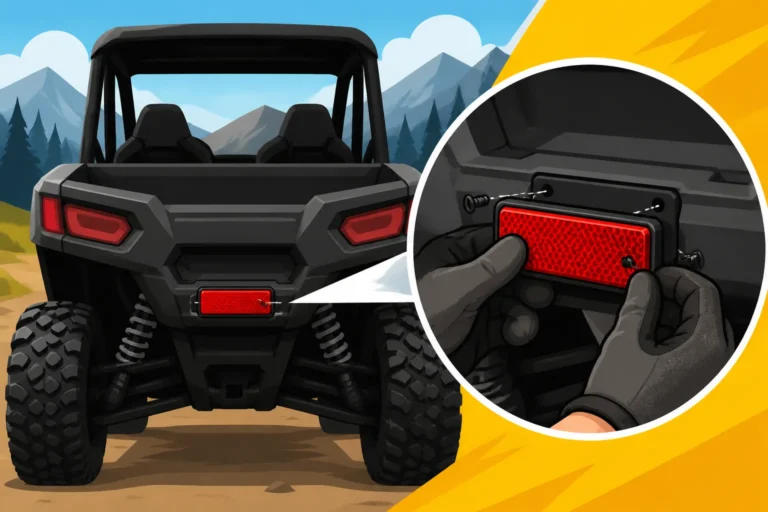
When you take an MPV onto a public road, it needs to be as visible and communicative as any other vehicle. This means having a full complement of functional lighting. Your MPV must have working headlights, taillights, and brake lights. The headlights need to illuminate the road ahead, and the taillights must be visible from a specified distance to the rear. Crucially, you'll also need turn signals, both front and rear, so other drivers know your intentions. Some off-road machines come with basic lighting, but often, dedicated turn signal kits from companies like SuperATV are needed to meet road-legal standards. Check out [Wyoming Lighting Requirements for ORVs] for more detail.
Beyond lighting, mirrors are non-negotiable for safe road operation. You must have at least one mirror that allows you to see at least 200 feet to the rear of your vehicle. While some UTVs might come with a basic rearview mirror, many riders find they need to add side mirrors for optimal visibility, especially when pulling a trailer or carrying cargo that obstructs the rear view. For specific requirements, refer to [Wyoming Mirror Requirements for Road Use]. Finally, a working horn is also required. This isn't just for sounding off; it's a vital safety tool for alerting other drivers or pedestrians to your presence. A simple push-button horn will usually suffice, and aftermarket options are readily available if your machine doesn't have one. You can read up on [Wyoming Horn Requirement on a Road Machine] for more information.
Addressing Noise and Emissions
While the primary focus for street legality is often on safety equipment like lights and mirrors, noise and emissions also play a role, albeit a more nuanced one for MPVs than for traditional vehicles. Wyoming law generally requires all motor vehicles, including MPVs, to have a muffler in good working order that prevents excessive or unusual noise. This is less about specific decibel limits on public roads and more about ensuring your machine isn't creating a nuisance or violating general noise ordinances.
Additionally, most off-road machines are equipped with spark arresters as a fire prevention measure, especially when riding on public lands. While not always explicitly listed as a "road-legal" requirement, having a properly functioning spark arrester is a good practice and often a requirement for any off-road machine operating in wildland areas, which many of Wyoming's "designated roads" might traverse. While companies like SuperATV offer performance exhaust systems, it's crucial to ensure any modification still allows your machine to meet noise regulations and retains its spark arrester for trail use.
Navigating Wyoming's Roads: Rules and Restrictions for MPVs
Even with an MPV title, registration, plate, and all the right equipment, you can't just drive your side-by-side anywhere you please in Wyoming. The MPV designation grants limited access to public roads, not carte blanche to treat it like a car. Understanding where you can ride and under what conditions is paramount to avoiding fines and ensuring safety. Wyoming has specific rules about which roads are open to MPVs, how you should operate them, and who is eligible to drive them.
This section will help clarify the geographical and operational boundaries that come with MPV status. It's a balance between enjoying the freedom of connecting trails and respecting the safety and flow of traditional road traffic. Ignoring these rules can lead to serious consequences, not to mention damaging the reputation of all responsible riders.
Designated Roads vs. Prohibited Routes
The most crucial distinction for MPV operation on roads is whether a particular road is "designated" for ORV or MPV use. While many county roads and some state highways might be open to MPVs, interstates and certain heavily trafficked or high-speed state highways are generally off-limits. The term "designated" often means a specific government entity (like a county commission or the state parks department) has explicitly approved that road segment for MPV use. This means you can't assume every paved road is fair game.
It's your responsibility as a rider to know which roads are open. This often requires consulting county maps, state parks information, or local ordinances. Many of Wyoming's forest roads and BLM roads are open to MPVs, connecting vast trail systems. However, a paved state highway might only allow MPVs for short stretches or for specific crossing points. Always look for signage indicating where MPVs are permitted. Failing to do so could land you on a prohibited route, leading to a citation. A good starting point for understanding these areas is [Wyoming's Designated ORV Roads]. Additionally, while a machine might be street legal as an MPV, there are very strict rules about [Wyoming Rules for Crossing an Interstate]. These crossings are typically grade-separated (bridges or underpasses) or at specifically designated points, never simply driving down the main lanes.
Driver Requirements, Age, and Insurance
Operating an MPV on a public road in Wyoming comes with the same responsibilities as driving any other motor vehicle. This means the driver needs to meet certain qualifications, and the vehicle needs to be covered by insurance. This isn't like riding on a private ranch or even a designated trail where licensing requirements might be more relaxed; once you're on a public road, the rules tighten considerably.
First and foremost, any person operating an MPV on a public road must possess a valid driver's license. This isn't just an ORV permit; it's a full-fledged driver's license for a motor vehicle. Depending on the machine, an M (motorcycle) or MR (multipurpose vehicle) endorsement might also be required on your license. The MR endorsement is specifically designed for MPVs and acknowledges the unique handling characteristics of these machines. For details on endorsements, check out [Wyoming Motorcycle Endorsement for an MPV]. Age requirements align with driver's license laws, meaning you generally need to be 16 years old to drive an MPV on a public road, though there can be variations for supervised learners. Finally, proof of liability insurance is mandatory. Just like with a car, you must carry insurance that meets Wyoming's minimum coverage requirements. This protects you and others in case of an accident. Make sure to review [Wyoming ATV Insurance Requirement] to understand the specific coverage needed.
Interstate Crossings and Other Special Scenarios
Wyoming's vast and often rugged landscape means that major highways, particularly interstates, can sometimes be the only practical way to connect riding areas or reach services. Recognizing this, Wyoming has enacted specific, and very limited, rules for how MPVs can interact with interstates. It's not about riding on the interstate, but across it. This rule is a direct response to the needs of communities and riders who found themselves geographically separated from trails by these major arteries.
As mentioned, riding on an interstate highway itself is generally prohibited for MPVs. However, Wyoming law does allow for designated crossings. These are not open-ended permissions; they are typically at specific points where a county or state has coordinated with the Department of Transportation (WYDOT) to allow MPVs to traverse the interstate from one side to the other. These crossings might be grade-separated (overpasses or underpasses) or at-grade intersections with strict right-of-way rules. These are usually marked, and it's imperative to follow all posted signs and traffic laws. It's a privilege, not a right, and misusing these crossings can lead to severe penalties. Riders must be acutely aware of their surroundings and other traffic when making such crossings.
Beyond Legalities: Practical Considerations for Road Riding
Getting your ORV legally classified and equipped as an MPV for road use is a significant step, but the journey doesn't end there. Operating a modified off-road machine on public roads introduces a whole new set of practical considerations, from heightened safety awareness to specific maintenance needs. Riding an MPV on asphalt is fundamentally different from tackling a rocky trail, and neglecting these real-world differences can quickly diminish the fun and increase the risks.
This section delves into the practical wisdom that seasoned riders understand. It’s about being prepared, being visible, and being a responsible participant in traffic, not just a legal one. After all, the goal is to enjoy your machine safely, whether you're connecting trails or simply cruising down a county road.
Safety First: Gear and Awareness
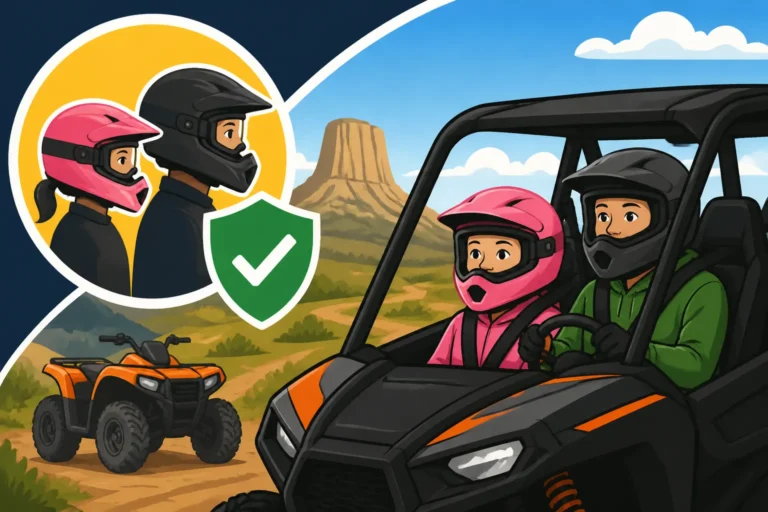
When you transition from dirt to asphalt, your safety priorities need to shift. While helmets are always a good idea off-road, they become absolutely crucial on paved roads. In Wyoming, [Helmet Rules for Wyoming Riders] are pretty clear: anyone under the age of 18 operating or riding as a passenger on an ORV (including MPVs) on a public road must wear a helmet. Even if you're over 18, wearing a DOT-approved helmet significantly reduces the risk of serious injury in a collision, which is much more likely on a public road than on a remote trail. Beyond helmets, consider other protective gear like gloves, long sleeves, and sturdy footwear to minimize injury in a fall or accident.
Visibility is also paramount. Your machine, even with proper lighting, is smaller and often less noticeable than a car or truck. Consider wearing bright, high-visibility clothing. Riding defensively is key: assume other drivers don't see you, use your turn signals early and deliberately, and maintain a safe following distance. Remember that while your MPV might be great at accelerating, its braking distance on asphalt, especially with off-road tires, can be longer than a traditional vehicle. Stay alert and aware of your surroundings at all times.
Maintenance and Road-Specific Adaptations
An ORV used on roads will experience different stresses and wear patterns than one used exclusively off-road. Regular maintenance becomes even more critical. Pay close attention to tire pressure; off-road tires, while capable of road travel, wear much faster on pavement and may require different pressures for road use compared to trail use to prevent excessive wear and ensure stability. Inspect your brakes frequently, as they'll be used more consistently and under different conditions on paved surfaces.
Furthermore, ensure all your newly installed road-legal equipment—lights, turn signals, horn, mirrors—is always in perfect working order. A blown fuse or a loose mirror can turn a legal ride into a ticketable offense. If you've added aftermarket components, especially from brands like SuperATV, make sure they are properly installed and maintained to manufacturer specifications. Keeping your MPV in top mechanical shape is not just about avoiding breakdowns; it's about ensuring it performs predictably and safely when sharing the road with other traffic.
ORV vs. MPV: A Quick Comparison
To help clarify the distinctions we've discussed, here's a table summarizing the key differences between a standard Off-Road Vehicle (ORV) and a Multipurpose Vehicle (MPV) in Wyoming when it comes to road use.
| Feature | Standard ORV (e.g., Trail-focused ATV/UTV) | Multipurpose Vehicle (MPV) |
|---|---|---|
| Primary Use | Designated trails, unpaved areas, private land | Designated trails, unpaved areas, and specific public roads |
| Wyoming Permit | Required for public land/trail use | Required for public land/trail use (same decal) |
| Road Legality | Generally NOT street legal | Street legal on designated roads only |
| Titling | Not typically titled for off-road use | Required to have an MPV title |
| Registration/Plate | No vehicle registration, no plate | Required to be registered, issued a license plate |
| Weight Requirements | None specific for road use | 300 lbs min, 3,000 lbs max (unladen) |
| Seat Height | No specific requirement | At least 24 inches from ground to lowest seat point |
| Wheels | 3 or more | 4 or more |
| Headlights | Often present for trail use | Required (DOT compliant where applicable) |
| Taillights/Brake Lights | Often present for trail use | Required (DOT compliant where applicable) |
| Turn Signals | Not typically standard | Required (front and rear) |
| Mirrors | Not typically standard | Required (at least one providing 200 ft rear view) |
| Horn | Not typically standard | Required |
| Spark Arrester | Generally required for public lands | Generally required for public lands (good practice for roads too) |
| Driver's License | Not required for trail use (age restrictions apply) | Required (valid driver's license, M or MR endorsement often needed) |
| Insurance | Not required for trail use | Required (liability insurance for road use) |
| Interstate Access | Prohibited | Prohibited, except at designated crossing points |
Disclaimer
This article is for general informational purposes only and does not constitute professional advice. Laws, prices and regulations vary by location and change over time. Consult a qualified professional for guidance on your specific situation.