Wyoming Slow-Moving Vehicle Emblem Rules
Picture this: you're cruising your side-by-side down a beautiful Wyoming county road, heading from one trail segment to the next. The scenery is incredible, but then you catch yourself wondering, "Am I visible enough for other drivers? Do I need that bright orange triangle?" It's a valid concern for anyone transitioning their off-road vehicle to a public road. This guide will demystify the Wyoming Slow-Moving Vehicle (SMV) emblem rules, helping you understand when and how to properly display this crucial safety device on your ATV or UTV.
Understanding the Wyoming Slow-Moving Vehicle Emblem
When you take your ATV or UTV onto a public road in Wyoming, even a designated county or forest road, you're entering a shared space with other traffic, including cars and trucks that move much faster than you might. This is where the slow-moving vehicle (SMV) emblem comes into play. It's not just a suggestion; it's a legal requirement designed to enhance your visibility and prevent accidents.
What Exactly Is an SMV Emblem?
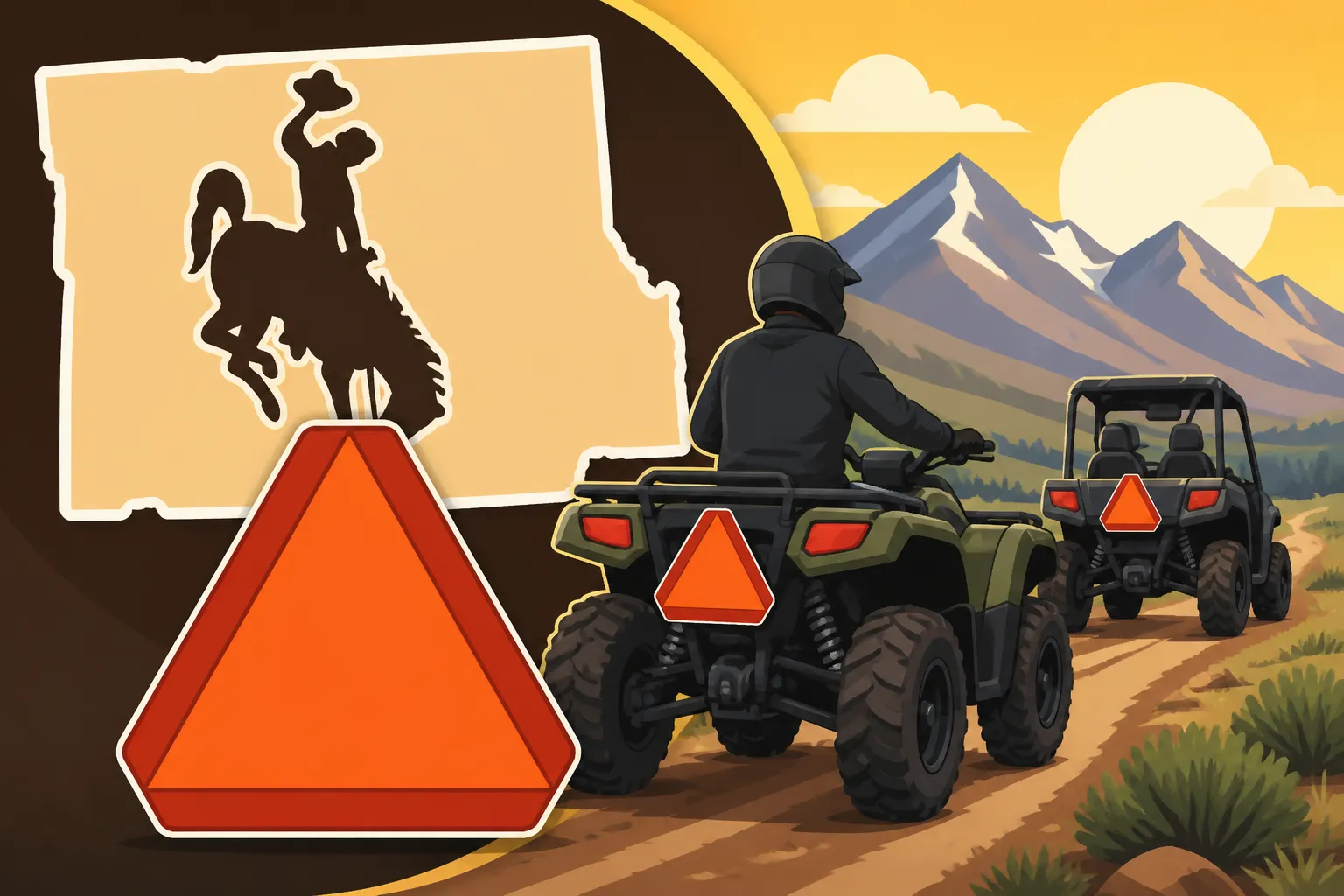
The SMV emblem is a distinct, highly recognizable safety device. It's a triangular sign with a red reflective border and a fluorescent orange center. This specific design isn't arbitrary; it's engineered for maximum visibility, especially during daylight hours and when illuminated by headlights at night. The fluorescent orange makes it highly noticeable in daylight, while the red reflective border ensures it stands out in low light conditions or darkness when struck by another vehicle's headlights. Its purpose is singular and critical: to instantly communicate to other drivers that the vehicle ahead is operating at a significantly lower speed than typical road traffic.
Think of it as a universal sign that screams, "Slow Down! I'm moving slowly!" This immediate recognition helps drivers behind you adjust their speed, create a safe following distance, and prepare to pass you safely. Without this clear visual cue, a driver approaching your ATV or UTV might not realize how slowly you're moving until it's too late, potentially leading to a dangerous situation. It's a simple, yet incredibly effective, tool in the arsenal of road safety, particularly when your off-road machine is sharing the pavement.
The "When" of Needing an SMV Emblem
So, when does your trusty ATV or UTV need this orange triangle beacon? The core rule in Wyoming is quite clear: any vehicle designed to operate at speeds of 25 miles per hour (mph) or less, when being operated on a public road or highway, must display a slow-moving vehicle emblem. This isn't just for tractors or farm equipment anymore; it absolutely applies to your off-road machine if it meets this speed criterion and you're taking it on a road.
Consider a scenario where you've registered your side-by-side as a Multipurpose Vehicle (MPV) and equipped it to be [Street Legal ATVs in Wyoming: The Short Answer]. While an MPV might be capable of higher speeds on certain road types, there will be instances where you're moving slower, perhaps pulling a small trailer, navigating tricky terrain on a designated low-speed ORV road, or simply traveling below the 25 mph threshold. Even if your machine can go faster, if your current operation puts you below that 25 mph mark, the emblem is a must. Many ATVs and UTVs, especially when traversing between trails or through small towns, will naturally fall into this slower speed range. It’s also crucial for those stretches of [Wyoming's Designated ORV Roads] where you might be sharing space with hikers, cyclists, or other slow-moving vehicles. The intent is to clearly mark yourself as a potential hazard for faster-moving traffic. You can find more specific details about this requirement in [When a Machine Must Carry a Slow-Moving Vehicle Emblem].
Displaying Your SMV Emblem Legally in Wyoming
Getting an SMV emblem is one thing, but displaying it correctly is just as vital. It's not enough to simply have one; it needs to be affixed in a way that maximizes its visibility to everyone sharing the road. A poorly placed or obstructed emblem is essentially no emblem at all when it comes to preventing accidents.
Proper Placement for Maximum Visibility
The Wyoming law specifies that the slow-moving vehicle emblem must be mounted on the rear of the vehicle, in the center, and between two and six feet above the ground. This precise placement ensures it's at an optimal height to be seen by drivers of all types of vehicles, from low-slung sports cars to towering semi-trucks. Imagine a car following you; if the emblem is too low, it might be blocked by your tires or frame. Too high, and it could be above a driver's line of sight, especially if they're close behind you.
Furthermore, it's absolutely critical that the emblem is unobstructed. This means no gear bags, spare tires, flags, or anything else should cover any part of the orange triangle or its reflective red border. It needs to be clean and clearly visible at all times, not caked in mud or obscured by dust. For UTV owners, this might mean carefully considering where you mount your rear cargo box or spare tire, ensuring it doesn't interfere with the emblem's visibility. Many riders use sturdy mounting brackets designed specifically for this purpose, and you can find various robust options for this, often from accessory providers like SuperATV, to ensure your emblem stays put and visible, even over rough terrain. It’s a small detail that makes a huge difference in your safety profile on public roads.
SMV Emblem Versus Other Road Equipment
It’s easy to think of the SMV emblem as a "one-and-done" solution for road safety, but that's not quite how it works. While incredibly important, the SMV emblem is only one piece of the puzzle when operating your ATV or UTV on public roads. It's a supplementary device, not a replacement for other crucial safety equipment. The law is clear that it does not replace the need for proper lighting, turn signals, or braking lights, especially when riding at dawn, dusk, or night.
If you're operating your machine on roads where vehicles move at higher speeds, you absolutely still need functioning headlights, taillights, and brake lights, as well as turn signals. The SMV emblem tells drivers you're slow, but your lights tell them you're there and what you're doing. For instance, [Wyoming Lighting Requirements for ORVs] mandate specific equipment for road use. Moreover, an SMV emblem won't exempt you from carrying proof of insurance or having the correct driver's license or endorsement if your machine is registered as an MPV. The emblem is about indicating speed; other equipment is about basic road legality and communicating your intentions. It all works together to create a safer environment, so don't cut corners on any of these essential components. A Wyoming Trooper will certainly be looking for all these elements during a roadside check, as detailed in [What a Wyoming Trooper Checks Roadside].
Safety Beyond the Orange Triangle for Slow-Moving ORVs
While the bright orange triangle is your primary visual indicator for slow speeds, true safety on Wyoming's roads involves a holistic approach. It’s about being seen, being predictable, and understanding the environment around you. The emblem is a great start, but it's far from the only consideration, especially when your off-road machine is sharing space with passenger cars and commercial vehicles.
The Importance of Supplemental Lighting and Awareness
Even with an SMV emblem prominently displayed, your ATV or UTV can be surprisingly difficult to see, especially during certain times of day or in adverse weather. This is where supplemental lighting becomes absolutely critical. While your machine might have basic lights, consider upgrading or adding to them for enhanced visibility on the road. Bright LED headlights and taillights, additional running lights, and even amber flashing lights on the rear can make a huge difference, particularly in dusty conditions, rain, fog, or when riding near sunrise or sunset. Companies like SuperATV offer a vast array of aftermarket lighting solutions that are designed to withstand tough off-road conditions while providing exceptional brightness for on-road use.
Beyond just the lights themselves, cultivate an acute awareness of your surroundings. Continuously scan your mirrors for approaching traffic. Assume that other drivers might not see you, and ride defensively. [Keeping to the Right Edge in Wyoming] is not just a polite suggestion; it's often a legal requirement and a critical safety practice for slow-moving vehicles. Avoid sudden movements and always signal your turns well in advance. Remember, a vehicle traveling at 55 mph closes a mile in about a minute; a slow-moving ATV can create a significant speed differential that demands extra caution from both you and other drivers. Always be prepared for the unexpected, especially on winding rural roads where visibility might be limited.
Riding Etiquette for Slow-Moving Vehicles
Operating a slow-moving vehicle on public roads requires a specific kind of riding etiquette that prioritizes the safety of everyone. It’s about being a considerate and predictable road user. One of the most fundamental rules is to stay as far to the right as safely possible. This allows faster traffic more room to pass you without having to dangerously cross the center line or encroach on the shoulder. On narrow roads, this might mean occasionally pulling over to let a line of vehicles pass. It's a small courtesy that significantly reduces frustration and the risk of impatient drivers making rash decisions.
Furthermore, clear communication is essential. If your ATV or UTV doesn't have functioning turn signals (though many MPVs do, as per [Wyoming MPV Street Legal Requirements]), use clear and exaggerated hand signals for turns and stops. Make eye contact with other drivers when possible, especially at intersections or when changing lanes on a wide [Wyoming Rules for Riding a County Road]. Remember that your machine, even if street-legal, will handle differently than a car, particularly at higher speeds or in emergency braking situations. Practice smooth acceleration and deceleration, and always maintain extra space between your machine and any vehicles in front of you. Being predictable, visible, and courteous are your best defenses against potential hazards on Wyoming’s diverse road network.
Wyoming SMV Emblem Requirements Summary
To help you keep track of the essential rules for slow-moving vehicle emblems in Wyoming, here's a quick summary.
| Requirement | Detail |
|---|---|
| When Needed | Vehicle designed to operate at 25 mph or less, when on a public road or highway. |
| Emblem Type | Standard fluorescent orange triangle with red reflective border. |
| Placement | Mounted on the rear, in the center of the vehicle. |
| Height | Between 2 and 6 feet above the ground. |
| Visibility | Must be clean, unobstructed, and clearly visible at all times. |
| Supplemental | Does NOT replace required headlights, taillights, brake lights, or turn signals. |
| Purpose | Alerts faster-moving traffic to a slow-moving vehicle ahead. |
Always remember that these rules are in place for your safety and the safety of everyone else on the road. Taking a few moments to ensure your SMV emblem is correctly displayed and maintained can prevent misunderstandings and potential accidents.
Disclaimer
This article is for general informational purposes only and does not constitute professional advice. Laws, prices and regulations vary by location and change over time. Consult a qualified professional for guidance on your specific situation.