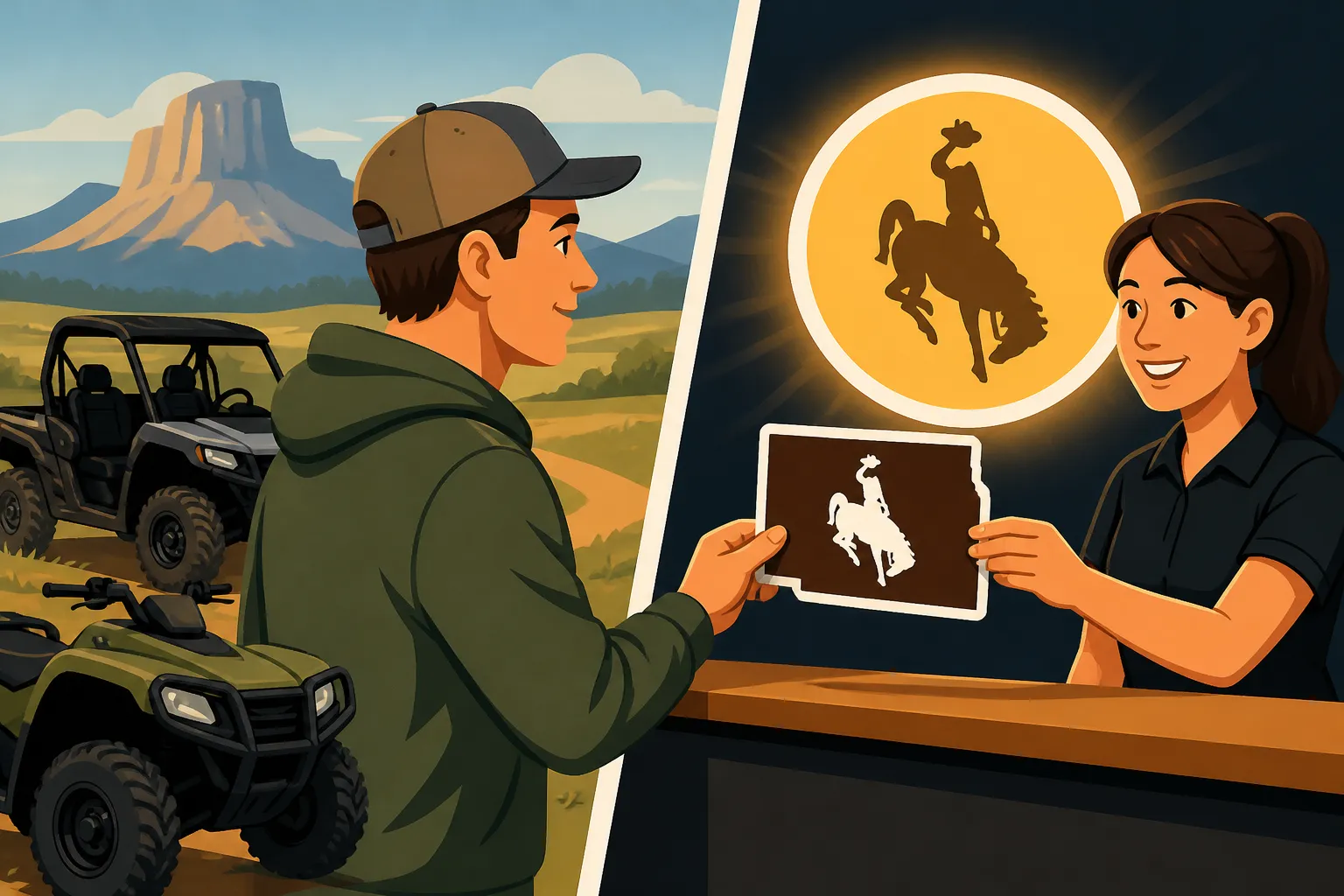
A Rider From Billings Buying a Wyoming Decal
A Billings rider planning an ATV or UTV trip in Wyoming may already have a Montana registration sticker and still need another decal. Wyoming does not recognize out-of-state ORV registrations as a substitute for its own permit. Here’s how to tell when the Wyoming decal applies, where to get it, and what else to check before riding.
Does a Montana registration count in Wyoming?
No. A Montana registration or OHV sticker does not replace the Wyoming ORV permit when a machine is operated in Wyoming. Wyoming State Parks, Historic Sites, & Trails says there is no reciprocity for out-of-state ORV or OHV registrations, so nonresidents must buy a Wyoming permit when one is required for their use.
That can catch riders out because a machine’s paperwork may be valid at home but still not meet Wyoming’s requirements. The Wyoming permit is a separate state requirement, not a transfer of your Montana registration. For the short answer to the reciprocity question, see Does Wyoming Honor a Montana Registration? and Wyoming ORV Reciprocity Rules.
The main distinction is where you plan to ride and how the route is designated:
- Enrolled trails: A current Wyoming ORV sticker is required on trails designated for ORV travel and enrolled in the program, even if the machine is street legal or has a license plate. Wyoming State Parks, Historic Sites, & Trails also says ORV travel must remain on enrolled trails.
- Enrolled roads and routes: Requirements depend on the road and the machine. Wyoming State Parks, Historic Sites, & Trails says an enrolled road may be used by a vehicle that is street legal or displays a Wyoming ORV sticker and meets the ORV definition requirements. Check the designation and the applicable rules before you ride.
- Unenrolled roads: A Wyoming ORV permit is not a road license. Wyoming State Parks, Historic Sites, & Trails says a machine on a road not designated for ORV travel and not enrolled in the program must have a current license plate and be street legal.
The state says the permit is required for enrolled roads, routes, and trails of 50 inches or less designated for ORV use. Wyoming State Parks, Historic Sites, & Trails also says federal land policy defines trails as no greater than 50 inches in width, so an ORV cannot be wider than 50 inches on Wyoming trails. Check your machine’s fit and the route’s rules rather than assuming that every public road or trail is open to every type of vehicle.
Street-legal status affects some situations, but it does not cancel the permit requirement everywhere. Wyoming State Parks, Historic Sites, & Trails says street-legal ORVs need a Wyoming ORV permit when operating on a trail that is 50 inches or less in width. A plated machine headed onto an enrolled trail therefore still needs the Wyoming decal.
| Where you plan to ride | What to check |
|---|---|
| Enrolled ORV trail | Wyoming State Parks, Historic Sites, & Trails requires a current Wyoming ORV sticker, including for street-legal machines. |
| Enrolled ORV road or route | Wyoming State Parks, Historic Sites, & Trails says the vehicle must meet the applicable enrolled-road requirements, which may be met by being street legal or displaying the state permit and meeting the ORV definition. |
| Unenrolled road | Wyoming State Parks, Historic Sites, & Trails says the vehicle must have a current license plate and be street legal. |
| Public land route | Wyoming State Parks, Historic Sites, & Trails says riders may use only roads, trails, or areas designated as open by the appropriate land manager. |
For more detail on how the permit applies to a particular machine, see Wyoming ORV Permit for a Visiting Rider, Wyoming ORV Permit for a Side-by-Side, or Wyoming ORV Permit for a Dirt Bike.
Buying and displaying the Wyoming decal
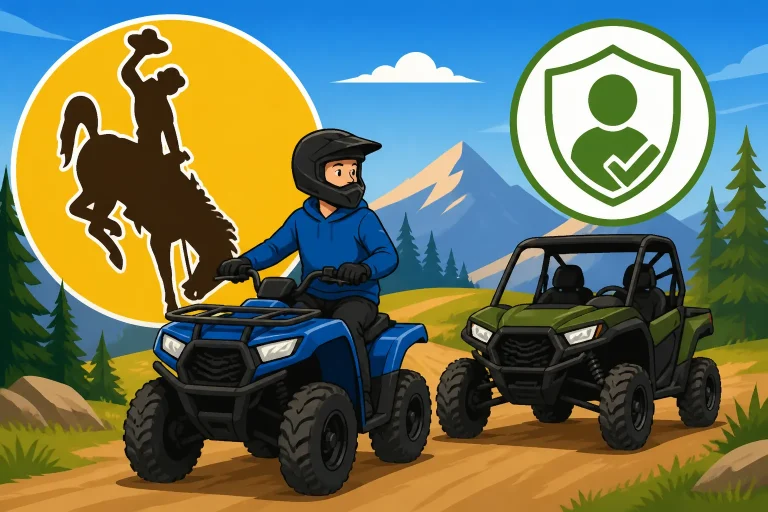
The Wyoming Department of State Parks and Cultural Resources administers the ORV registration program through the Wyoming Trails Program. Wyoming State Parks, Historic Sites, & Trails lists the annual registration user fee as $15 and says the fee applies equally to residents and nonresidents. The permit is valid for a calendar year, rather than a rolling year from the day you buy it.
That timing matters for visitors. A permit purchased for a trip is not automatically valid for a full year from the purchase date; it follows the calendar-year validity period. Check the permit’s current validity and buying options when planning a trip. Wyoming’s Calendar-Year Permit explains the timing, and Wyoming ORV Permit for a Visiting Rider covers the out-of-state rider’s situation.
Wyoming State Parks, Historic Sites, & Trails says ORV decals are available online and in person. Local selling agents can include ATV and motorcycle dealers, local businesses, selected Forest Service and State Park offices, and some county treasurer offices. You can compare purchase options in Where to Buy a Wyoming ORV Permit or use Buying a Wyoming Permit Online if you want to arrange the permit before setting out from Billings.
After obtaining it, affix and display the permit on the ORV. Wyoming State Parks, Historic Sites, & Trails says all ORVs must display the Wyoming permit while operating on public lands and other designated roads, trails, or areas. A receipt or proof of purchase is not a substitute for the required decal displayed on the machine.
A practical pre-trip check is to confirm that:
- The decal is current for the calendar year in which you plan to ride.
- It is attached to the machine as required, rather than kept loose with your papers.
- The machine’s size and type fit the route’s rules.
- Your chosen routes are enrolled and open to ORV travel.
- You have checked any separate registration, licensing, insurance, or equipment requirements for road use.
The exact location for a decal can depend on the machine and the program’s instructions. Follow the directions supplied with the permit and keep the decal visible and securely attached. If the machine is borrowed or rented, ask whether it already displays a current Wyoming permit; do not assume a prior rider’s paperwork or a Montana sticker covers your trip.
Before riding from Billings toward Wyoming trails
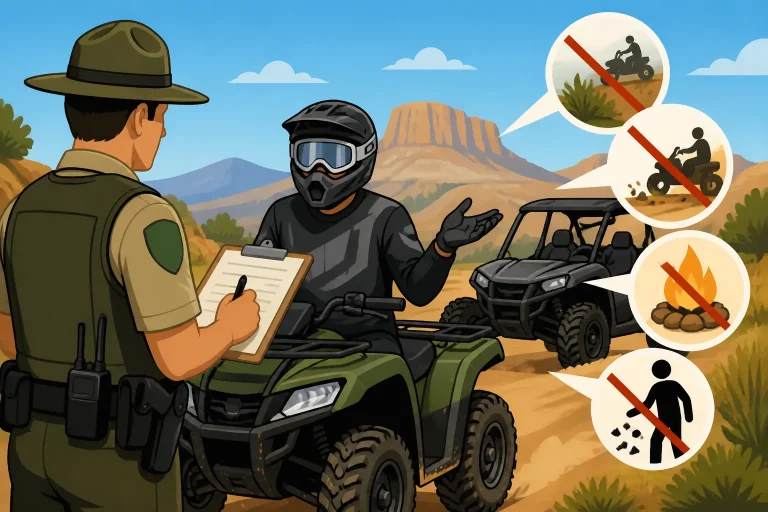
Buying the decal solves only the permit question. It does not give a rider permission to use every road, trail, or piece of public land. Wyoming State Parks, Historic Sites, & Trails says ORVs may be operated only on roads, trails, or areas designated as open by the appropriate local land manager, such as the Forest Service or BLM. Route status and seasonal access can vary, so check the land manager’s current information before traveling.
The Bighorn National Forest is one example of why a route check matters. The Forest Service says motorized travel is allowed on designated roads and trails across the forest, and visitors should obtain a Bighorn Motorized Vehicle Use Map to identify which routes are open. The Forest Service also says visitors must possess a current Wyoming off-road vehicle registration decal. A trail name on a general map is not enough to establish that a route is open to your machine.
The Forest Service lists routes such as the Adelaide Trail, the Bald Ridge ATV Trail, the Bighorn Reservoir Trail, and the Bishop Mine Trail. Their listed lengths are 5.2 miles, 3.9 miles, 1.4 miles, and 3.2 miles, respectively, according to the Forest Service. Those details can help with trip planning, but they do not replace checking the Motorized Vehicle Use Map and current local closures. The Forest Service says off-highway vehicles are limited to a maximum width of 50 inches at their widest point.
Plan to stay on the routes identified as open and permitted for your vehicle. Wyoming State Parks, Historic Sites, & Trails says all ORV travel must remain on enrolled roads and travel routes, and designated trails enrolled in the program require a state sticker regardless of whether the machine is street legal. Wilderness areas are closed to motorized vehicles; Wyoming State Parks, Historic Sites, & Trails names Encompassment River, Huston Park, Platte River, and Savage Run as permanently closed to motorized vehicles and mechanized equipment.
Also separate off-road riding from road travel. A rider with only a Wyoming ORV permit may use roadways identified as part of the Wyoming ORV Program, not any road they choose. Wyoming State Parks, Historic Sites, & Trails says operators using designated roadways with only an ORV sticker must have a valid driver’s license or permit. When operating on roads identified as part of the program, operators must also carry proof of liability insurance. The state’s rules for road use are different from the rules for designated trails, where Wyoming State Parks, Historic Sites, & Trails says a driver’s license is not required as long as the ORV displays a current permit.
If the machine is street legal and you plan to use an unenrolled road, check that it meets the state’s street-legal equipment and operator requirements. Wyoming State Parks, Historic Sites, & Trails lists a headlamp, tail light, brake light, red rear reflector, horn, and left-hand rear-view mirror among the equipment required for un-enrolled-road use. It also says operators on those roads must have a valid driver’s license with an M or MR endorsement or a permit, and proof of insurance. The ORV decal alone does not satisfy those requirements.
For a broader overview of where Wyoming routes are enrolled and how to check them, see Wyoming’s Enrolled Roads and Trails and Wyoming Trail Maps and MVUMs. Maps are planning tools, not permission to ignore signs or closures: if a route is marked closed, do not ride it.
A straightforward checklist for Montana visitors
Before leaving Billings, work through the permit and route details in order:
- Identify the machine and intended use. Note whether it is an ATV, UTV, dirt bike, or another ORV, and whether you plan to ride trails, enrolled roads, or ordinary roads.
- Check whether the Wyoming permit applies. If you plan to ride an enrolled ORV trail, a current Wyoming decal is required even if the machine is street legal. Do not treat Montana registration as a substitute.
- Buy the Wyoming permit and attach it. Wyoming State Parks, Historic Sites, & Trails lists the annual user fee as $15 for residents and nonresidents alike, and says permits are valid for a calendar year. The required decal must be displayed on the ORV.
- Check the route’s designation and open status. Use the appropriate land manager’s current map or information. For the Bighorn National Forest, the Forest Service recommends the Bighorn Motorized Vehicle Use Map.
- Confirm road-use requirements separately. A permit does not make a machine street legal or authorize travel on an unenrolled road. Check licensing, insurance, and equipment rules for any road riding.
- Check the machine’s width and route limits. The Forest Service says off-highway vehicles on its routes are limited to 50 inches at their widest point. Confirm the specific route is appropriate for the vehicle.
- Keep the machine on open, designated routes. Wyoming State Parks, Historic Sites, & Trails says ORVs may operate only on routes or areas designated open by the appropriate land manager.
If you are still deciding where to ride, use route-specific information rather than choosing a destination based only on distance from the Montana border. The Bighorn Motorized Vehicle Use Map and the relevant land manager’s closure notices help establish what is open and which vehicle types may use it. Buying a decal is a necessary step for covered ORV use, but the map and current signs determine where the machine can go.
The bottom line for a rider from Billings is simple: get the Wyoming decal when your planned riding requires it, display it on the machine, and confirm that each route is open and appropriate for that vehicle. A Montana registration does not stand in for Wyoming’s permit, and a Wyoming permit does not stand in for street-legal registration when using roads outside the ORV program.
Sources
- Wyoming State Parks, Historic Sites, & Trails — Wyoming State Parks, Historic Sites, & Trails – ORV Permits – Trails (checked November 3, 2026)
- Forest Service — Bighorn National Forest | Off-Highway Vehicles (OHV) | Forest Service (checked November 3, 2026)
- Wyoming State Parks, Historic Sites, & Trails — Wyoming State Parks, Historic Sites, & Trails – ORV Rules & Regulations – Trails (checked November 3, 2026)
- Wyoming State Parks, Historic Sites, & Trails — Wyoming State Parks, Historic Sites, & Trails – ORV F.A.Qs (checked November 3, 2026)
- Wyoming State Parks, Historic Sites, & Trails — Wyoming State Parks, Historic Sites, & Trails – ORV Requirements – Trails (checked November 3, 2026)
- Wyoming State Parks, Historic Sites, & Trails — Wyoming State Parks, Historic Sites, & Trails – OHV (Off-Highway Vehicle) Partnership Grants (checked November 3, 2026)
Disclaimer
This article is for general informational purposes only and does not constitute professional advice. Laws, prices and regulations vary by location and change over time. Consult a qualified professional for guidance on your specific situation.