Buying a Used ATV in Wyoming
Buying a used ATV or UTV in Wyoming can feel like a ride through a rocky canyon – full of twists, turns, and unexpected bumps. It's not just about finding a good deal; it's about navigating the paperwork, verifying the machine's history, and making sure you're not inheriting someone else's problems. This comprehensive guide is here to walk you through every step of the process, ensuring you can confidently find, purchase, and register your next off-road companion without getting stuck in the mud.
The Initial Hunt: Where to Find a Used Machine in Wyoming
The first hurdle in finding your next off-road adventure vehicle is knowing where to look. Wyoming is a big state with a strong outdoor culture, so there are usually plenty of machines changing hands. However, where you look can significantly impact your experience and the transparency of the transaction.
Online Marketplaces and Local Listings
When you're searching for a used ATV or UTV, the internet is often the first place we all turn. Websites like Craigslist, Facebook Marketplace, and various dedicated ATV/UTV forums are bustling with listings. These platforms offer a vast selection, often allowing you to filter by location, price, make, and model, which is super convenient when you're just starting your search from the comfort of your couch in Cheyenne or Cody.
The appeal of online marketplaces is undeniable. You can browse machines from sellers across the state, compare prices, and sometimes even get a sense of how well a machine has been cared for through photos and descriptions. However, this convenience comes with a fair share of risks. You're dealing with private sellers, and the level of honesty and transparency can vary wildly. It's not uncommon to encounter sellers who might not be fully aware of their machine's issues, or worse, those who are intentionally trying to hide problems. Always remember that a digital handshake is no substitute for a real-world inspection, and never feel pressured to commit before seeing the machine in person and verifying all its details.
Dealerships and Consignment Lots
While private sales dominate the online landscape, don't overlook the more traditional routes: dealerships and consignment lots. These options might not always offer the rock-bottom prices you sometimes find in private sales, but they often come with a layer of security and convenience that can be incredibly valuable, especially for less experienced buyers.
Dealerships, whether they specialize in powersports or have a used recreation vehicle section, typically offer machines that have undergone some level of inspection and servicing. This means you might get a limited warranty or at least the peace of mind that a professional has looked it over. They also handle all the paperwork, which can be a huge relief. Consignment lots, on the other hand, act as a middleman, selling machines on behalf of private owners. While they might not offer the same extensive checks as a full-service dealer, they often facilitate a smoother transaction and can provide a safer environment for viewing and purchasing than meeting a stranger in a parking lot. If you're considering this route, check out our guide on [Buying a Quad at a Consignment Lot] for more detailed insights. Either way, these options can make the purchase process feel a lot less like a gamble.
Essential Checks Before You Even Talk Price
Once you’ve found a promising machine, the real work begins. Before you even think about negotiating a price, you need to conduct a thorough inspection. This isn't just about kicking the tires; it's about looking for hidden problems that could turn your great deal into a money pit.
Performing a Thorough Visual Inspection
Meeting a seller and seeing the ATV or UTV in person is your first, and most crucial, step. Don't rush this part. Take your time to walk around the machine, observing every detail. Look for obvious signs of abuse or neglect: bent handlebars, cracked plastics, missing bolts, or patched-up components. Examine the frame closely for any signs of welding, cracks, or serious bends – this could indicate a major accident. Check for rust, especially on critical components like the suspension, brakes, and exhaust system. Excessive rust can be a sign of poor maintenance or prolonged exposure to harsh elements.
Pay attention to the tires; are they worn unevenly, indicating suspension issues? Are there any visible leaks around the engine, transmission, or differentials? A small drip can indicate a minor seal issue, but larger puddles could point to something more serious. Check the chain or driveshaft for proper tension and wear. It's like looking at a house; you want to see if the foundation is solid before you consider buying it. For a more detailed walkthrough, be sure to read our guide on [Checks Before You Buy a Used Wyoming Quad].
Verifying the Vehicle Identification Number VIN
The Vehicle Identification Number (VIN) is like the machine's DNA – a unique identifier that tells you its story. Verifying the VIN is absolutely critical before you move forward with any purchase. You'll typically find the VIN stamped on the frame, often near the steering column, on a lower frame rail, or occasionally under the seat. Make sure the VIN on the machine matches any paperwork the seller provides, like a previous registration or, in some specific cases, a title. Discrepancies here are a massive red flag and should prompt you to walk away immediately.
Once you have the VIN, use it to conduct a background check. There are online services that can provide a vehicle history report, which might reveal if the machine has been reported stolen, involved in an accident, or has a salvage title. While these reports aren't foolproof, they can offer invaluable insights and help you avoid buying a stolen machine or one with a hidden history of extensive damage. Understanding the VIN's importance is key to a safe purchase, and you can learn more about this by checking out [Wyoming ATV VIN Check Before Buying].
Engine and Drivetrain Assessment
A visually appealing machine is great, but what truly matters is what's under the hood, or in this case, inside the engine and drivetrain. If the seller is hesitant to let you start and test ride the machine (in a safe, appropriate area), that’s a significant warning sign. When you start the engine, listen carefully. Does it turn over easily, or does it struggle? Are there any knocking, tapping, or grinding noises? These could indicate serious internal engine problems. Check the exhaust for excessive smoke – blue smoke often means burning oil, while white smoke can point to coolant issues.
Once running, let it warm up. Test the brakes, checking for spongy levers or grinding sounds. Engage all gears, both forward and reverse, making sure they shift smoothly without slipping or popping out. If a test ride is possible, pay attention to the suspension; does it feel balanced, or does it lean heavily to one side? Does the steering feel tight and responsive, or loose and wobbly? A quick, safe test ride can reveal a multitude of issues that a static inspection simply cannot. Remember, a machine might look good, but its operational health is paramount for a reliable and enjoyable riding experience.
Understanding Wyoming's Paperwork Maze for Used ATVs/UTVs
Navigating the administrative side of buying a used off-road vehicle in Wyoming can be confusing, especially if you're used to traditional car purchases. The rules for ATVs and UTVs (which includes many side-by-sides) are distinct, and it's essential to understand them to ensure a smooth, legal transfer of ownership.
The Importance of a Bill of Sale
In Wyoming, the bill of sale is your most critical piece of documentation when buying a used ATV or UTV. While many off-road vehicles don't have a traditional title (we'll get to that in a moment), the bill of sale serves as your legal proof of ownership. It establishes that the machine has officially changed hands from the seller to you, detailing the terms of that transfer. Without a properly executed bill of sale, you could run into serious trouble proving ownership, especially if any disputes arise or if you ever need to sell the machine yourself.
A good bill of sale should contain specific, non-negotiable details. It needs the full legal names and addresses of both the buyer and the seller. It must clearly identify the machine by its make, model, year, and most importantly, its full Vehicle Identification Number (VIN). The purchase price and the date of the transaction are also essential. Both parties should sign and date the document, and it's always a good idea to have a witness, though not always legally required. Don't be afraid to use a template to ensure all necessary information is included; resources like LawDepot offer reliable, customizable bill of sale forms that can simplify this process. Having a clear, detailed bill of sale protects both you and the seller. For more specifics, refer to our guide on [Wyoming ATV Bill of Sale Requirements].
Why Most Wyoming Off-Road Machines Don't Have a Title (and When They Do)
Here's where many new buyers get confused, and understandably so! Unlike cars, trucks, or even motorcycles, the vast majority of traditional off-road vehicles (ORVs) in Wyoming, like most ATVs and dirt bikes, do not receive a certificate of title from the county clerk. This is a common point of frustration for riders moving from other states or those new to the off-road scene. The logic is that these machines are primarily for off-road use and aren't typically registered for highway travel in the same way a car is.
However, there's a significant exception: Multipurpose Vehicles (MPVs). These are a specific class of off-road machines, most commonly certain side-by-sides, that can be titled and registered for limited street-legal use in Wyoming. For a machine to qualify as an MPV, it generally needs to meet certain criteria, such as weighing between 300 and 3,000 pounds and having a seat at least 24 inches high. If the used UTV you're looking at falls into this MPV category, it will have a title, and you'll need that title, properly signed over, to transfer ownership. This distinction is crucial, so always ask the seller if the machine has a title, and understand that the answer will depend on whether it's classified as a standard ORV or a street-legal MPV. Our article [Why Most Wyoming Off-Road Machines Have No Title] dives deeper into this, and for direct answers, see [Do You Need a Title for an ATV in Wyoming?].
Registering Your "New" Used Machine
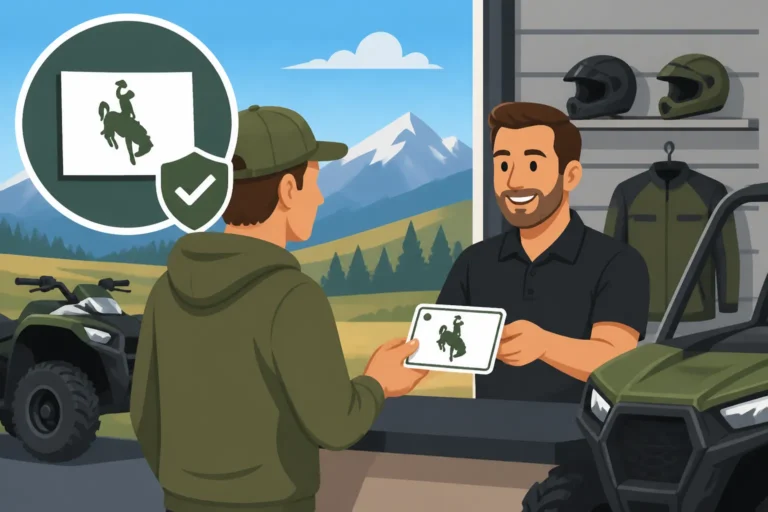
Once you've purchased your used ATV or UTV and have that all-important bill of sale (and title, if applicable), your next step is to register it with the state of Wyoming. This isn't about getting a license plate for the street (unless it's an MPV, which is a different process for plating), but about acquiring an annual Wyoming ORV Permit. This permit is a decal that must be affixed to your machine and is required for riding on designated public lands and trails throughout the state. It's essentially your ticket to legally enjoy Wyoming's vast off-road network.
The process is straightforward: you'll need your bill of sale, the machine's VIN, and typically a small fee. You can purchase these permits from various selling agents across the state, including some county courthouses, powersports dealers, and even some forest service offices. The permit is valid for the calendar year, expiring on December 31st, regardless of when you purchase it. So, if you buy your used machine in September, that first permit will only be good until the end of the year. Don't delay getting this permit; riding without one can lead to fines. Getting your machine legally registered is a vital step in becoming a responsible Wyoming rider. For a full breakdown of the process, check out [Registering an ORV in Wyoming] and [Wyoming's Annual ORV Permit].
Navigating the Transaction and Protecting Yourself
Making an offer and shaking hands is just the start. The actual transaction – handling payment and avoiding scams – requires careful attention to detail to ensure you don't fall victim to fraud or unexpected issues.
Negotiating the Price and Payment Methods
When you're buying a used ATV or UTV, negotiation is almost always expected. Do your homework before you meet the seller. Research the fair market value for the specific make, model, and year of the machine you're looking at, considering its condition and any accessories. Websites like Kelley Blue Book Powersports or NADA Guides can provide estimated values. This knowledge empowers you to make a reasonable offer and counter a high asking price. Don't be afraid to point out any flaws or maintenance needs you identified during your inspection as leverage for a lower price.
When it comes to payment, safety is paramount. While cash might seem convenient, carrying a large sum of money can be risky, especially when meeting a stranger. Consider using a certified cashier's check or initiating a bank transfer. These methods offer a verifiable paper trail, which is crucial if any disputes arise later. If you absolutely must use cash, try to complete the transaction in a public place, ideally during daylight hours, and consider bringing a trusted friend or family member along for safety and as an extra set of eyes. Never feel rushed into a payment method that makes you uncomfortable.
Avoiding Scams and Red Flags
The used market, unfortunately, is a hunting ground for scammers. Being vigilant and recognizing red flags can save you a lot of headache and money. One of the biggest warning signs is a price that seems too good to be true. If a machine is listed for significantly less than its market value, there's usually a reason – and it's rarely a good one. Be wary of sellers who are vague or evasive when answering questions about the machine's history, condition, or why they're selling it. If they pressure you to make a quick decision or refuse to let you inspect the machine thoroughly, those are massive warning signs.
Another common scam involves sellers who claim to be out of state and want you to send money via wire transfer or gift cards before they "ship" the machine. Always insist on seeing the machine in person before exchanging any money. Be cautious of sellers who have no paperwork at all for the machine; while many ORVs don't have titles, a complete lack of any previous registration, bill of sale, or even a basic owner's manual should raise alarms. For more on this, our article [Buying From a Seller With No Paperwork at All] offers critical advice. Trust your gut; if something feels off, it probably is. It's better to walk away from a potential deal than to fall victim to a scam.
Post-Purchase Considerations
Congratulations, you've bought your used ATV or UTV! But the journey isn't quite over. There are a few important steps to take immediately after your purchase to ensure you're ready to hit the trails safely and legally. First, even if the seller assured you the machine was in perfect condition, it's wise to perform some basic maintenance. Change the oil and filter, check the air filter, inspect the spark plugs, and top off all fluids. This gives you a baseline for future maintenance and helps you get familiar with your new machine.
Next, familiarize yourself with Wyoming's specific riding regulations. Beyond the ORV permit, there are rules about spark arresters, noise limits, and designated riding areas. You'll also want to consider insurance. While liability insurance might not be legally mandated for off-road use on private land, it's a very good idea for public lands and crucial if you plan to convert your UTV to an MPV for street use. Our guide on [Wyoming ORV Permit and Insurance] can help clarify these requirements. Taking these steps will ensure your new-to-you machine is trail-ready and you're prepared for whatever Wyoming's vast and beautiful landscape throws your way.
Special Cases and Out-of-State Machines
Sometimes, buying a used ATV or UTV isn't a straightforward local transaction. You might encounter situations where the seller lacks proper documentation, or you might be purchasing a machine from outside Wyoming. These scenarios require extra diligence and a clear understanding of Wyoming's specific rules.
What if the Seller Has No Paperwork?
Imagine finding what seems like the perfect used ATV, but when you ask for the bill of sale or any ownership documents, the seller shrugs and says they don't have any. This is a truly tricky situation, and one that requires extreme caution. While it's true that many older ATVs or those purchased new from smaller, non-dealership outlets might not have a formal title in Wyoming, there should always be some form of documentation. This could be an old bill of sale from a previous owner, a prior registration from another state (though Wyoming doesn't honor them for riding, it still shows ownership history), or even a notarized statement of ownership.
If a seller genuinely has no paperwork whatsoever, even after repeated inquiries, the risks far outweigh any potential savings. You have no verifiable proof that they are the rightful owner, which means you could be buying a stolen machine. If you purchase it, you may never be able to legally register it for an ORV permit, and you could face legal consequences if the true owner ever comes forward. In most cases, it is safest to walk away from a deal where the seller cannot provide any documentation of ownership. It might be a fantastic deal, but it's not worth the potential legal and financial headaches down the road.
Buying an Out-of-State Machine for Wyoming Use
Many riders come to Wyoming from neighboring states like Colorado, Utah, or Montana, or even further afield, bringing their off-road machines with them. It’s a common misconception that if your ATV or UTV is registered in another state, you’re good to go on Wyoming’s trails. Unfortunately, that's not the case. Wyoming has very specific rules regarding ORV permits, and there is absolutely no reciprocity with other states' registrations. This means that a Montana sticker or a Colorado plate, while valid in their home states, does not grant you permission to ride on Wyoming's designated public lands.
If you purchase a used machine from an out-of-state seller, or if you're bringing your own machine when you move to or visit Wyoming, you must acquire a Wyoming ORV permit decal before riding on public trails. The process is the same as if you bought it from a Wyoming resident: you'll need proof of ownership (like a bill of sale or out-of-state title), the VIN, and the permit fee. This is a non-negotiable requirement for everyone, resident or nonresident, visitor or new transplant. Failing to get a Wyoming permit will result in a citation if you're stopped by law enforcement or a trail warden. So, plan ahead and factor in the permit process if you're bringing a machine from outside the Cowboy State. You can find more detailed information on this topic in our articles [Registering an Out-of-State Machine in Wyoming] and [Wyoming ORV Reciprocity Rules].
| Feature | Private Seller (Online/Local) | Dealer/Consignment Lot |
|---|---|---|
| Price | Often lower, more room for negotiation | Generally higher, less negotiation room (covers overhead/profit) |
| Selection | Varies widely, can be very specific or limited to local | Often wider selection of specific brands/models |
| Inspection | Buyer's responsibility, no professional pre-check | Usually inspected/serviced, some dealers offer limited warranty |
| Paperwork | Buyer's responsibility to ensure complete, accurate Bill of Sale | Handled by dealer, generally smooth title/ownership transfer |
| Risk | Higher risk of hidden issues, scams, or incomplete ownership docs | Lower risk, often more reliable machines and secure transactions |
| Convenience | Arranging meetings, inspections, and payment can be time-consuming | One-stop shop for viewing, test riding, and paperwork |
| Financing | Typically cash or personal loan | Dealers often offer financing options |
| After-Sale | No recourse if problems arise (unless specified in Bill of Sale) | May offer service, repairs, or support (especially with warranty) |
Disclaimer
This article is for general informational purposes only and does not constitute professional advice. Laws, prices and regulations vary by location and change over time. Consult a qualified professional for guidance on your specific situation.