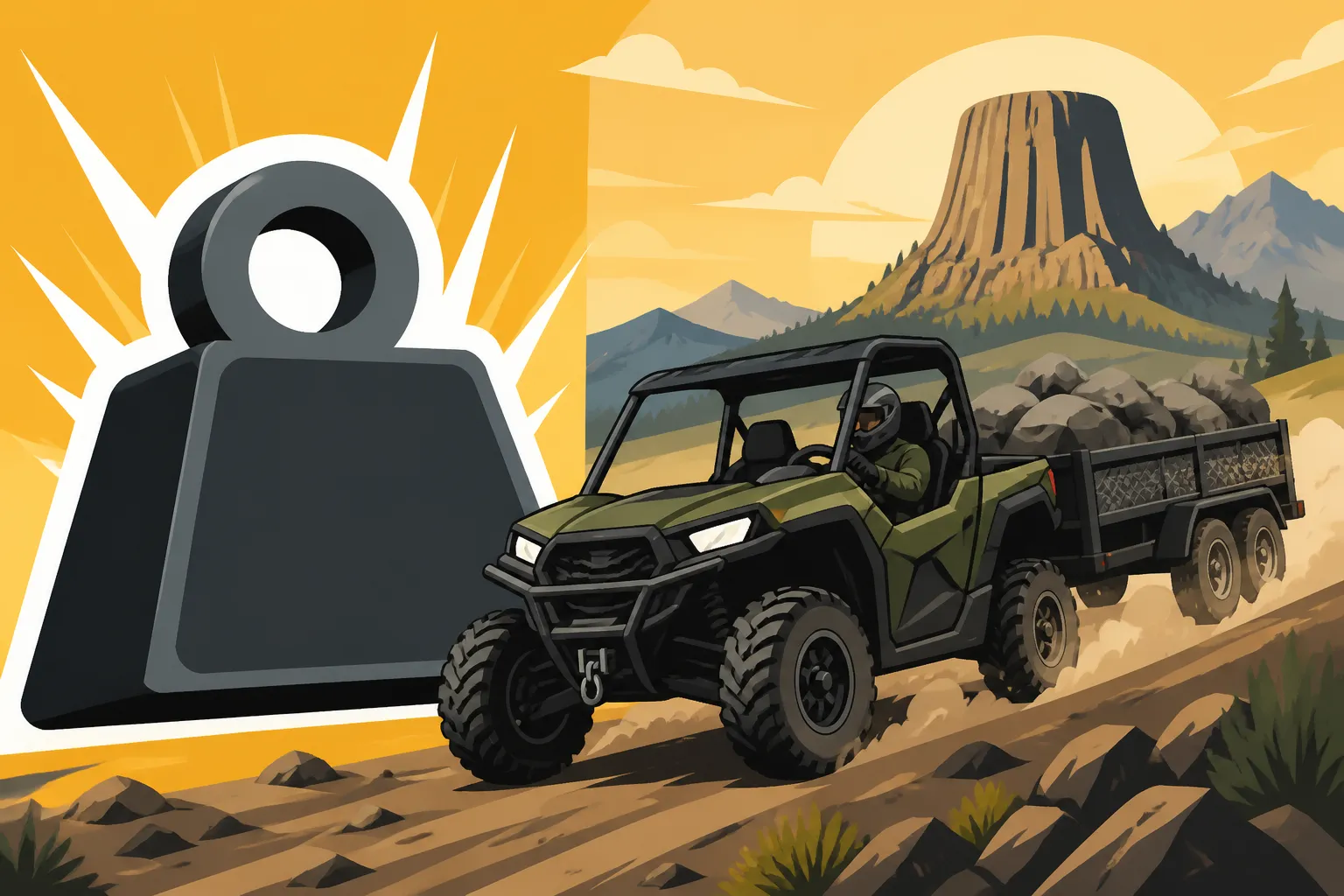
3,000 Pounds at the High End
Trying to navigate the rules for getting your ATV or side-by-side legal for some road use in Wyoming can feel like deciphering ancient texts, especially when you start encountering specific numbers like weight limits. Many riders get frustrated, thinking their powerful machine should just be able to go anywhere, only to hit a roadblock when they realize there are very specific criteria, and that magic 3,000-pound number for Multipurpose Vehicles (MPVs) is a big one. This guide is here to break down exactly what that 3,000-pound high end means for your machine in Wyoming and how it impacts your ability to hit both the trails and certain public roads.
Unpacking Wyoming's Multipurpose Vehicle (MPV) Designation
Wyoming recognizes that many folks use their off-road vehicles for more than just tearing up dirt; they're vital tools for ranch work, hunting, or simply getting from a trailhead to a cafe. To bridge the gap between pure off-road recreation and limited on-road utility, the state created the Multipurpose Vehicle (MPV) classification. This isn't just about sticking a plate on any old quad; it's a specific legal designation that allows certain qualified machines to be registered and titled for restricted road use, distinct from a regular Off-Road Vehicle (ORV) permit that only allows trail access.
The MPV designation is a game-changer for many, offering the flexibility to run errands in small towns or connect between different trail systems without needing to trailer your machine every single time. However, this flexibility comes with a set of specific requirements that your machine must meet. It’s not a universal pass for all roads, but it certainly opens up new possibilities. The state put this classification in place to balance the needs of riders with public safety and infrastructure considerations, creating a path for responsible integration of these vehicles into the broader transportation network. Without this classification, most ATVs and UTVs would remain strictly off-road, limiting their utility significantly for many Wyoming residents and visitors.
The Critical 3,000-Pound Weight Limit
When you're looking at making your machine an MPV, the maximum weight of 3,000 pounds is absolutely non-negotiable and one of the first things you need to verify. This isn't some arbitrary figure; it's a key determinant in how the state categorizes and regulates your vehicle for road use. If your machine tips the scales at anything over 3,000 pounds, it simply won't qualify for MPV status, regardless of how many other criteria it meets. This limit primarily impacts larger side-by-sides, as many modern UTVs, especially those designed for multiple passengers or heavy utility work, can easily exceed this weight once you factor in accessories, a full tank of gas, and maybe even some gear.
Verifying your machine's weight is crucial. Start by checking the manufacturer's specifications. This is usually found in your owner's manual or on a decal somewhere on the vehicle itself. However, remember that manufacturer's dry weight doesn't always tell the full story. Additions like winches, roofs, larger tires, heavy-duty bumpers, sound systems, or even a full cargo box can all add significant weight. If you're close to the limit, or if your machine is heavily customized, it might be wise to take it to a certified scale, like those found at truck stops or scrap yards, to get an accurate reading of its curb weight. This way, you won't get halfway through the registration process only to find out your machine is too heavy. Understanding this limit upfront saves you a lot of headache and potential disappointment.
Other MPV Requirements Beyond Weight
While the 3,000-pound maximum weight (and the 300-pound minimum) is a major hurdle, it's certainly not the only one. To qualify as a Wyoming MPV, your machine needs to check a few more boxes. It must have four wheels – this immediately rules out dirt bikes or three-wheelers, which are classified differently. Additionally, it needs to have a seat or saddle that is at least 24 inches high from the ground. This ensures a certain riding posture and visibility that is deemed appropriate for road use. These combined requirements paint a picture of the type of vehicle Wyoming aims to allow on its roads as an MPV.
Think about why these specific criteria exist. The four-wheel rule ensures stability on public roads, differentiating MPVs from motorcycles. The seat height helps ensure the driver has adequate visibility in traffic, and also dictates a certain vehicle geometry. When you combine the weight restrictions – [Weight Between 300 and 3,000 Pounds] – with the seat height requirement [A Seat at Least 24 Inches Up] and the [Four Wheels and an Upright Seat] rule, you start to see a very specific profile for what constitutes an MPV in Wyoming. These aren't just arbitrary rules; they're designed to ensure a basic level of safety and compatibility with other road users, allowing these versatile machines a defined place on the state's roadways.
The Process of Titling and Registering a 3,000-Pound MPV
Once you’ve confirmed your machine, whether it’s a robust side-by-side or a beefed-up ATV, falls within that crucial 300 to 3,000-pound weight range and meets the other physical criteria, you can begin the journey of getting it officially titled and registered as an MPV. This process is distinct from simply getting an ORV permit for trail riding; it involves interacting with different county offices and fulfilling more stringent requirements, similar to registering a car. It's a two-part administrative dance, requiring you to visit two separate county offices to fully legitimize your vehicle for road use.
You’ll first head to your local County Clerk’s office to handle the titling, which establishes legal ownership. After successfully securing a title, your next stop will be the County Treasurer’s office to get your registration and the actual license plate. This sequential process can sometimes be a bit of a back-and-forth, especially if you’re unsure about the exact forms or documents needed, but understanding the roles of each office makes it much smoother. The goal is to walk out with a valid Wyoming title and an MPV license plate, signaling to law enforcement and other drivers that your machine is compliant for its designated road use.
Paperwork and Verification
The first step in making your sub-3,000-pound machine a legal MPV is getting the right paperwork in order. You'll need proof of ownership, which typically means a Manufacturer's Statement of Origin (MSO) or a Manufacturer's Certificate of Origin (MCO) if the machine is new. If you're buying a used machine, you'll need a properly executed bill of sale. For private sales, especially, it’s critical that this document is complete and accurate, clearly identifying the buyer, seller, machine, and sale price. Services like LawDepot can provide templates for a comprehensive bill of sale, ensuring you don't miss any critical details that could cause issues later. Without solid proof of ownership, the County Clerk simply won't be able to issue you a title.
Beyond ownership, you'll also need to complete the Wyoming MPV Checklist Form. This is where you formally declare that your machine meets all the physical requirements: the 300 to 3,000-pound weight, the 24-inch seat height, and the four wheels. It’s essentially a self-certification, but local authorities can and do verify these details. You’ll present these documents, along with your identification, to the County Clerk. They will review everything, process your application, and if all is in order, issue your official [Titling a Multipurpose Vehicle in Wyoming]. This is a critical piece of paper that proves you legally own the machine and it has met the initial MPV requirements. For a detailed rundown of what's expected, referring to the [Wyoming MPV Title Requirements] and familiarizing yourself with [What the MPV and ORV-MC Checklist Form Asks] can save you time and frustration at the counter.
Costs and Ongoing Requirements
Once you've navigated the County Clerk's office and secured your MPV title, the next phase is registering your machine and obtaining a license plate at the County Treasurer’s office. There will be various fees associated with this, including a registration fee, potential excise tax, and the cost of the plate itself. These fees can vary, so it's always a good idea to check with your specific county's Treasurer's office for current figures before you go. Don't forget that this registration isn't a one-and-done deal; you'll need to renew it annually, just like a standard vehicle, to keep your MPV plate current and legal.
Maintaining proper records of your MPV title and registration is also essential. Whether you keep physical copies in a secure place or utilize digital storage, having easy access to these documents is paramount, especially if you're ever stopped by law enforcement. Again, if you utilized a service like LawDepot for your initial bill of sale, continuing to use organized methods for all your vehicle documentation can be incredibly helpful for future renewals or if you ever decide to sell the machine. Understanding the [Wyoming County Clerk Title Process] and the subsequent [Wyoming County Treasurer Plate Process] helps demystify what can seem like a complex bureaucratic hurdle, ensuring you’re ready for the annual cycle of ownership.
Implications of the 3,000-Pound Limit for Riders
The 3,000-pound high-end limit isn't just a number on a form; it profoundly impacts how and where you can ride your ATV or side-by-side in Wyoming. For machines that successfully meet this and other MPV criteria, a world of enhanced accessibility opens up. You gain the coveted ability to legally operate on certain public roads, allowing for seamless transitions between trailheads, access to local services, or simply enjoying scenic drives where permitted. This is a significant upgrade from a standard ORV permit, which strictly limits you to designated off-road trails and areas.
However, it's crucial to remember that having an MPV plate doesn't grant you carte blanche on every road. MPVs are still subject to specific road designations and equipment requirements. You won't be cruising down an interstate, for example. Instead, it allows for travel on designated county, forest, and BLM roads. This blend of off-road capability and limited on-road legality makes the MPV a truly versatile machine for the Wyoming landscape, but only if it stays within that critical 3,000-pound boundary. Understanding these nuances is key to responsible and lawful riding in the Cowboy State.
Choosing the Right Machine for MPV Status
When you're in the market for an ATV or side-by-side with the intent of making it a Wyoming MPV, that 3,000-pound weight limit needs to be top of mind from the very beginning. Many manufacturers now produce a wide range of UTVs, and while some smaller, sport-oriented or two-seater models might comfortably sit under the limit, larger four-seater, utility-focused, or heavy-duty machines can easily exceed it. It’s not just about the base model either; accessories can quickly add weight. A sturdy full cab enclosure, a heavy-duty winch and bumper, a spare tire, or even a robust sound system can tip a borderline machine over the 3,000-pound threshold.
Therefore, before you commit to a purchase, consult the machine's specifications thoroughly. If possible, consider the 'wet weight' (with fluids) and factor in any planned accessories. Don't just assume it will qualify. Many dealerships in Wyoming are familiar with the MPV requirements, so ask them directly about a specific model's suitability for MPV registration. If you're buying privately, ensure the bill of sale clearly identifies the machine by VIN, and consider getting a scale weight if you have any doubts. LawDepot's bill of sale templates can help ensure all identifying information is accurately captured in a private transaction, providing a solid foundation for your MPV application. This proactive approach saves you from the disappointment of buying a machine only to find it's too heavy for the MPV classification you desired.
Road Equipment for a 3,000-Pound MPV
Getting your sub-3,000-pound machine titled and plated as an MPV is only half the battle for road use. To legally operate it on Wyoming’s designated roads, your MPV must also be equipped with certain safety features, mirroring requirements for other motor vehicles. These aren't optional; they are mandatory for compliance and your safety. While your machine might have lights for the trail, they might not meet the road-legal standards.
Here’s a quick rundown of the essential road equipment:
- Headlights: Must be sufficient to illuminate the road ahead.
- Taillights and Stop Lamps: Required at the rear, signaling when you apply the brakes.
- Rear-view Mirror: At least one mirror, typically on the left side, for visibility.
- Horn: A working horn to signal other drivers or pedestrians.
- Red Rear Reflector: An additional reflector at the back for passive visibility.
These requirements ensure that your MPV is visible and can communicate with other vehicles on the road, crucial for safety. It means that after you've secured your [Wyoming MPV Plate Requirements] and are ready to hit the road, you'll need to double-check that your [Wyoming Lighting Requirements for ORVs] are met, your [Wyoming Mirror Requirements for Road Use] are up to snuff, and you have a working [Wyoming Horn Requirement on a Road Machine]. Many modern side-by-sides come with some of these features, but older ATVs or basic utility models might need aftermarket additions to become road-ready. It’s an investment in safety and legality that goes hand-in-hand with meeting that crucial 3,000-pound weight limit.
MPV vs. ORV: A Quick Comparison
To help clarify the differences that the 3,000-pound limit and other requirements create, here’s a quick overview contrasting a standard Off-Road Vehicle (ORV) with a Multipurpose Vehicle (MPV) in Wyoming:
| Feature | Standard Off-Road Vehicle (ORV) | Multipurpose Vehicle (MPV) |
|---|---|---|
| Weight Requirement | No specific limit for permit | 300 to 3,000 pounds |
| Seat Height | No specific requirement for permit | At least 24 inches from the ground |
| Number of Wheels | Varies (ATV, dirt bike, side-by-side) | Must have four wheels |
| Road Legality | Strictly off-road, designated trails only | Restricted road use on designated county, forest, BLM roads |
| Registration/Titling | ORV permit (decal) | Title from County Clerk, Plate from County Treasurer |
| Required Equipment | Spark arrestor, muffler | Headlights, taillights, stop lamp, horn, mirror, reflector, M or MR endorsement, insurance |
| Annual Cost | ORV Permit fee | Title fees, registration fees, excise tax, annual plate renewal |
This table clearly illustrates how significant the MPV classification is, and why that 3,000-pound limit is so fundamental. It dictates a completely different path for your machine, opening up new riding possibilities, but also imposing more rigorous requirements and ongoing obligations.
Conclusion
Navigating the regulations for off-road vehicles in Wyoming can definitely be a maze, and that 3,000-pound high-end limit for Multipurpose Vehicles is a perfect example of a detail that can make or break your plans. It's a critical threshold that dictates whether your ATV or side-by-side can gain the coveted ability to legally operate on certain public roads. Understanding this weight limit, along with the other specific criteria like seat height and number of wheels, is absolutely essential before you even begin the titling and registration process. By carefully checking your machine's specifications, being prepared with the right paperwork (perhaps even using a reliable template from a service like LawDepot for a private sale), and knowing which county offices to visit, you can successfully transform your capable off-road machine into a versatile MPV. This knowledge not only keeps you compliant with Wyoming law but also enhances your riding experience, allowing you to explore more of the Cowboy State, both on and off the beaten path.
Disclaimer
This article is for general informational purposes only and does not constitute professional advice. Laws, prices and regulations vary by location and change over time. Consult a qualified professional for guidance on your specific situation.