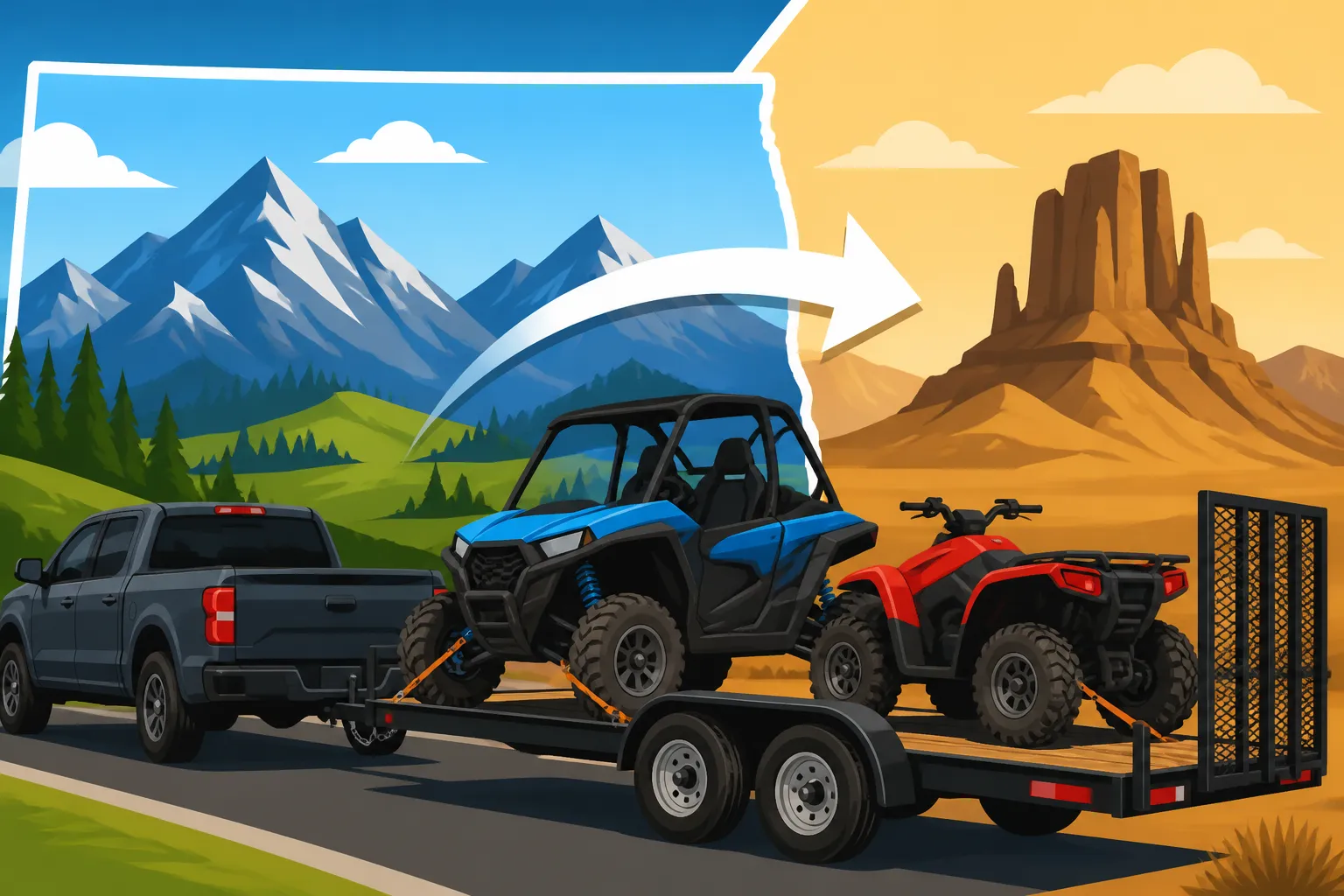
Bringing a Machine From Colorado
You've packed up your rig, loaded your trusty ATV or UTV, and made the scenic drive from the vibrant trails of Colorado, ready to explore the vast, open landscapes and breathtaking backcountry of Wyoming. You probably think, "Hey, my Colorado registration is current, I'm all set!" But here's where many riders hit a snag, often learning the hard way at a trailhead checkpoint: Wyoming has its own set of rules, and they don't play nice with out-of-state registrations. This guide is here to help you navigate Wyoming's specific requirements, ensuring your Colorado machine is legal and ready to roll on the Cowboy State's incredible trails.
Why Your Colorado Registration Isn't Enough in Wyoming
It's a common misconception, especially for those of us who travel between states for our outdoor adventures, that if your off-road vehicle (ORV) is legally registered in your home state, it should be good to go everywhere. Unfortunately, when it comes to Wyoming, that simply isn't the case. Many states have what's called "reciprocity" agreements, meaning they honor each other's registrations for certain vehicle types. For ATVs and UTVs, however, Wyoming operates on an entirely different philosophy.
Wyoming stands firm on its position that any off-road vehicle, regardless of where its owner hails from, must carry a current Wyoming ORV permit decal to ride on designated public lands within its borders. This can be a real head-scratcher and a source of frustration for riders who've dutifully paid their registration fees in Colorado. You might have your Colorado OHV sticker prominently displayed, thinking it's your golden ticket, only to find a Wyoming Game and Fish warden or Forest Service officer shaking their head.
The core reason behind this lack of [No Reciprocity in Wyoming, Stated Plainly] is tied directly to how Wyoming funds its extensive trail system and related programs. Unlike some states where general tax revenue or other sources might supplement trail maintenance, Wyoming's ORV permit fees are specifically earmarked for the very trails you want to ride. Every dollar collected from these permits goes back into maintaining, improving, and managing the vast network of trails across state, federal, and even some private lands that are open for public use. If Wyoming were to honor every state's permit, it would essentially be allowing riders to use its resources without contributing to their upkeep, which just isn't sustainable for the program. This is why when you ask, [Does Wyoming Honor a Colorado Permit?], the answer is a firm no.
Think of it this way: your Colorado registration contributes to Colorado's trail system. When you come to Wyoming, you're tapping into a different resource that needs its own dedicated funding. It's not about singling out Colorado riders; it's a blanket rule applied to everyone, whether you're from Nebraska, Utah, or even a neighboring Wyoming county. This unique approach ensures that the money generated from ORV use directly benefits the ORV community within the state.
The Wyoming ORV Permit: Your New Best Friend
So, if your Colorado registration isn't going to cut it, what do you need? You need a Wyoming ORV permit. This isn't a complex, multi-page document; it's a simple, distinct decal that you affix to your machine. This little sticker is your proof that you've contributed to the maintenance and management of Wyoming's incredible off-road trails and are legal to ride them. Without it, you could face fines and a less-than-pleasant encounter with law enforcement.
The Wyoming ORV permit is mandatory for nearly all off-road vehicles operating on public land. This includes your typical ATV, your rugged side-by-side (UTV), dirt bikes, and even some youth machines. If you're planning to ride on designated trails in places like the Bighorn National Forest, Medicine Bow-Routt National Forest, or vast tracts of Bureau of Land Management (BLM) land, that permit decal needs to be visible on your machine. Exemptions are pretty narrow, usually applying only to machines used exclusively on private land with the owner's permission or certain agricultural equipment, but for recreational use on public land, it's non-negotiable.
One crucial detail to understand is that the [Wyoming's Annual ORV Permit] operates on a calendar year. This means it's valid from January 1st through December 31st, regardless of when you purchase it. So, if you buy your permit in July, it will still expire on December 31st of that same year. This can sometimes catch riders off guard, especially if they're used to permits that are valid for a full 12 months from the date of purchase. It's a system designed for administrative simplicity, but it requires riders to be mindful of the expiration date, especially if planning late-season or early-season rides. Many riders will purchase [Buying Next Year's Permit Early] in the fall to be ready for the new year.
The permit decal itself is designed to be highly visible and durable. Once you receive it, you'll need to affix it in a prominent location on the front of your machine, typically on the hood, fender, or handlebars, where it's easy for a warden to spot during a quick check. The specific instructions usually come with the decal, but the general rule is "clearly visible." You wouldn't want to get a citation simply because your decal was obscured by mud or poorly placed. Knowing [Where the Wyoming Decal Goes on a Machine] is part of being a responsible rider.
Perhaps one of the most surprising aspects for out-of-state riders is that there's [Wyoming's Flat Fee for Residents and Visitors]. Yes, that's right – whether you're a long-time Wyoming resident or just visiting from Colorado for a week, you'll pay the exact same price for the ORV permit. This further emphasizes Wyoming's commitment to ensuring that everyone who uses the trails contributes equally to their upkeep. There are no residency discounts or surcharges for non-residents. This makes it straightforward for riders from places like Denver or Fort Collins; you just pay the standard fee, and you're good to go.
How to Get Your Wyoming ORV Permit
Getting your Wyoming ORV permit is a relatively simple process, designed to be accessible to both residents and visitors. You have several convenient options, so even if you're just passing through on a weekend trip, you should be able to secure your decal without too much hassle.
One of the easiest ways is to buy your [Buying a Wyoming Permit Online]. The Wyoming State Parks, Historic Sites and Trails division manages the online sales. You can typically find their dedicated portal through the Wyoming Game and Fish Department website or the State Parks site. This option is fantastic for planning ahead. You can purchase your permit before you even leave Colorado, have it mailed to your home address, and arrive in Wyoming with your decal already in hand. Just be mindful of mailing times, especially during peak seasons or holidays. It usually takes a short while to process and ship, so don't wait until the day before your trip.
If you're already on the road or prefer to handle things in person, you have a few other choices. Many authorized vendors across the state sell the permits. This includes numerous powersports dealerships, sporting goods stores, and even some convenience stores in towns popular with outdoor enthusiasts. Look for signs indicating "ORV Permits Sold Here." This can be incredibly convenient, as you might find a vendor right on your way to the trailhead. For instance, if you're coming through Evanston or Cheyenne, you can often pick one up at a local dealer or outdoor shop. Getting a decal at a [Buying a Decal at a Powersports Shop] is a quick transaction.
Another option is to purchase your permit directly from a Wyoming County Clerk or County Treasurer's office. While these offices primarily handle vehicle titles and registrations, many are authorized to issue ORV permits as well. Similarly, some Forest Service ranger stations or BLM field offices might also sell them, especially if they are located near popular riding areas. It's always a good idea to call ahead to confirm availability and office hours if you're relying on one of these locations, as their primary functions are often different. Checking with [Buying a Permit at a Forest Office] or [Buying a Decal at a County Counter] can be a good idea, though sometimes the county offices are focused on other tasks.
When you purchase your permit, you'll generally need to provide some basic information about yourself and your machine, such as your name, address, phone number, and the vehicle's make, model, and VIN (Vehicle Identification Number). This information helps the state keep track of permits issued and ensures compliance. The fee for the permit is a flat rate, regardless of your residency, and this amount has generally remained stable over time, making it predictable for riders. The state sets [Who Sets the Price of a Wyoming Permit].
Once you have your decal, adhere it securely to your machine as per the instructions. This is crucial. When a [What a Wyoming Trooper Checks Roadside], they're looking for that visible decal. Remember, this permit is good for the calendar year, so if you plan to return the following year, you'll need a new one. Renewing your [Wyoming ORV Permit Renewal] is just as easy as the initial purchase.
| Feature | Colorado OHV Registration (Example) | Wyoming ORV Permit |
|---|---|---|
| Purpose | Funds CO trails, legal to ride in CO | Funds WY trails, legal to ride in WY |
| Reciprocity | Generally honored in some states | Not honored in Wyoming |
| Cost | Varies, check CO Parks & Wildlife | Flat fee (same for all) |
| Validity Period | Often 12 months from purchase date | Calendar year (Jan 1 – Dec 31) |
| Requirement for WY Trails | No, WY permit required | Yes, mandatory for public land |
| Where to Buy | CO Parks & Wildlife, dealers | WY State Parks online, WY dealers, county offices |
| Proof of Use | Sticker on machine | Decal on machine |
Titling Your Machine in Wyoming (or Not)
This is where things can get a bit confusing, especially when you're bringing an ATV or UTV from a state like Colorado that might have different titling practices. In Wyoming, whether your off-road machine needs a title depends heavily on its classification and intended use. The short answer for most recreational ATVs and UTVs (often simply called ORVs in Wyoming statutes) is: generally, no, they don't get a Wyoming title unless they fit into a specific category.
For the vast majority of traditional ATVs and UTVs used exclusively for off-road recreation, Wyoming does not issue titles. You might be scratching your head, thinking, "But my machine has a Colorado title!" That's perfectly fine; you should absolutely keep your out-of-state title as proof of ownership. However, when you cross into Wyoming for recreational riding, you won't typically be applying for a new Wyoming title for that machine. The state's system prioritizes the ORV permit for trail access, not a title for ownership tracking in the same way it does for street-legal vehicles. This is why [Why No Title for an Off-Road Machine in Wyoming] is a common question.
The primary exceptions to this "no title" rule in Wyoming come into play if your machine qualifies as a "Multipurpose Vehicle" (MPV) and you intend to make it street-legal. Wyoming has a unique classification for MPVs, which are essentially certain types of UTVs or side-by-sides that can be made street-legal and registered for road use. If your machine meets specific criteria—like weight limits (between 300 and 3,000 pounds), seat height (at least 24 inches high), and other equipment requirements (like lights, horn, mirrors)—then it can be titled and registered with a license plate for road use in Wyoming. [Wyoming's Multipurpose Vehicle Class] is very specific.
If your Colorado UTV happens to fit the [Wyoming MPV Title Requirements] and you plan to ride it on Wyoming's public roads (where allowed and enrolled), then yes, you would go through a process to title and register it as an MPV. This involves a trip to the county clerk's office for the title and then the county treasurer for the license plate. This is a much more involved process than just getting an ORV permit, and it comes with additional costs and inspections. It's a completely separate path from merely getting an ORV permit for trail riding.
For machines that don't qualify as MPVs, or for those you only intend to ride off-road, your Colorado title remains your primary proof of ownership. When buying or selling a used ATV or UTV, especially one without a Wyoming title, a robust bill of sale is absolutely critical. This document officially transfers ownership, specifies the purchase price, and includes details like the VIN, make, and model. Tools like those offered by LawDepot can be invaluable for generating a legally sound bill of sale, protecting both the buyer and seller. This is especially important for transactions involving machines that will only ever carry an ORV permit.
In essence, when bringing your ATV or UTV from Colorado to Wyoming:
- For recreational trail use only: Keep your Colorado title as proof of ownership. You will need to purchase a Wyoming ORV permit decal. You will not typically apply for a new Wyoming title for the machine.
- If your UTV qualifies as an MPV and you want to make it street-legal: You would then pursue a Wyoming title and license plate for it, in addition to carrying the ORV permit for trail use.
Understanding this distinction is vital. Don't confuse the ORV permit (for trails) with a vehicle title (for ownership or street-legal status). While LawDepot can assist with creating a proper [A Wyoming Bill of Sale for an ATV] when you're buying or selling, it won't help you get a Wyoming title for a machine that doesn't qualify as an MPV.
Important Considerations for Colorado Riders
Beyond the permit and titling, there are a few other things Colorado riders should keep in mind when venturing into Wyoming's off-road paradise. These are often small details that can make a big difference in the enjoyment and legality of your ride.
First, always check for specific trail regulations. Just because you have your Wyoming ORV permit doesn't mean every trail is open to every type of machine all the time. Many areas, especially in the national forests or BLM lands, have "Travel Management Plans" that designate specific routes for ORV use. Some trails might have width restrictions (e.g., 50-inch maximum width), seasonal closures for wildlife, or other rules. Always carry an up-to-date map (often called a Motor Vehicle Use Map, or MVUM) for the area you plan to ride. These maps are available from Forest Service or BLM offices and clearly mark open trails, restrictions, and closed areas. This is far more important than any sticker you might have.
Next, be aware of fire restrictions. Wyoming, like Colorado, experiences dry conditions, particularly in summer and fall. Fire restrictions can be implemented quickly and might close entire riding areas or restrict activities like campfires. Always check local conditions before you head out. A spark arrester on your exhaust is not just a good idea; it's legally required on public lands in Wyoming, just as it is in Colorado. Ensure your machine is equipped with one and that your muffler is in good working order to meet sound requirements.
Finally, always respect private property. Wyoming has vast tracts of public land, but it's often interspersed with private ranchland. Even if a fence looks old or a gate is open, assume it's private unless marked otherwise. Trespassing is a serious offense. If you encounter a gate on a designated public route, it's usually there for livestock management; open it, pass through, and always close it securely behind you. This simple act of courtesy helps maintain good relationships between riders and landowners.
By understanding Wyoming's unique ORV permit system, knowing when a title might or might not apply, and being mindful of local regulations, your transition from Colorado's trails to Wyoming's vast landscapes will be smooth and enjoyable. Don't let a small detail like a missing permit decal ruin your adventure in the Cowboy State!
Disclaimer
This article is for general informational purposes only and does not constitute professional advice. Laws, prices and regulations vary by location and change over time. Consult a qualified professional for guidance on your specific situation.