Breaking Down Far From Help
A broken belt, punctured tire, or dead battery can turn a Wyoming ride into a long wait when you’re miles from pavement and outside cell coverage. The safest response is usually to stop, assess the people first, communicate your location, and avoid turning a repair into an injury. This guide explains how to prepare for and manage an ATV or UTV breakdown far from help.
Before you ride, make a plan for a breakdown
Tell someone where you’re going
A dependable ride plan is more than a quick text saying you’re heading out. Give someone at home your starting point, intended route, machine description, riding group, and expected return time. Include a clear time to raise the alarm if you haven’t checked in. If your plans change, update them whenever you regain service.
Be specific about trailheads and route choices. “Riding near the Bighorns” may not help a searcher narrow down where you are. A known staging area, road number, trail segment, or map pin is more useful. For a longer outing, leave your vehicle description and parking location too. If you’ve planned a route using onX Offroad or another mapping app, share the route or a screenshot with your contact—but don’t rely on a phone app as your only navigation or emergency tool.
This matters even on a familiar ride. A group may take a side trail, spend longer at a viewpoint, or turn around because of weather. If your contact expects you back at a specific time, they can distinguish a normal delay from a situation that needs attention.
Carry ways to navigate and call for help
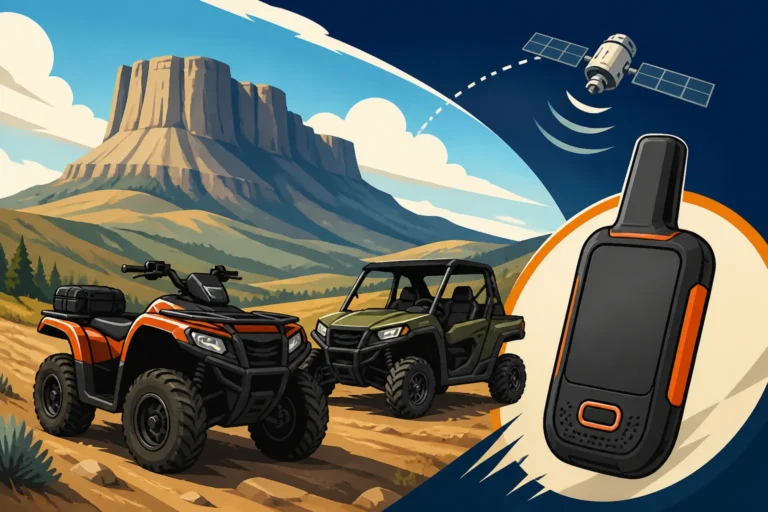
Cell service is inconsistent across Wyoming’s forests, basins, and high-elevation riding areas. Don’t assume you’ll be able to call or send a text just because you had signal in town or at the trailhead. Download maps for offline use, and consider carrying a dedicated satellite messenger or personal locator beacon when your route takes you beyond reliable coverage. Learn how its emergency function works before leaving home, and keep the device accessible rather than buried in a cargo box.
onX Offroad can help you review and save routes before you ride, which is useful when you need to tell someone where you were headed. Offline maps and a satellite device serve different purposes: a map helps you orient yourself; a satellite messenger may let you communicate or request assistance when a phone cannot connect. Carry a paper map or another independent backup if you can, and bring a compass if you know how to use one.
Check your planned route against current land-manager information as well. A line on a map doesn’t automatically mean a route is open to your machine or accessible from the direction you expect. Wyoming Trail Maps and MVUMs and Wyoming Trail Closures to Check First can help you think through map use and route status before departure.
Match supplies to the route, weather, and group
A short ride near a town still deserves basic emergency supplies. Bring enough water, warm layers, food, a first-aid kit, a headlamp, and a way to start a fire where it is safe and permitted. Pack the clothing you’d want if you had to wait after sunset, not just what feels comfortable while riding. Wyoming weather can change quickly, and an exposed ridge or high-elevation route may feel much colder once you’re stationary.
Carry tools and parts that fit your machines and that someone in the group can use safely. A tire plug kit won’t help if nobody knows how to use it, and a spare belt won’t solve every mechanical failure. Before leaving, check the owner’s manual for basic troubleshooting, towing guidance, and any model-specific warnings. Bring a charged phone, but protect it from cold, dust, and impact.
Fuel planning deserves the same attention as repair planning. Distances between fuel stops can be substantial, and detours or slow travel can consume more fuel than expected. Fuel Range Between Wyoming Towns is a useful reminder to plan around the actual ride rather than assuming the next station will be close.
What to do when your ATV or UTV stops
Stop safely and check people first
When a machine loses power or develops a problem, resist the urge to keep moving just to get closer to the trailhead. If the machine can coast or roll safely, move it out of the travel path without putting anyone in danger. Shut it down, set the parking brake if available, and make yourself visible to other riders. Don’t stand in a blind corner or directly behind a machine that could roll.
Check every person for injuries before investigating the vehicle. A rider may feel embarrassed or focused on the breakdown and fail to mention a fall, burn, or head impact. Ask directly whether anyone is hurt, dizzy, unusually cold, or having trouble breathing. If someone may have a serious injury, prioritize emergency communication and basic first aid over repairing the machine.
Then take a moment to assess your surroundings. Is the machine on a steep slope, loose sand, a narrow road, or a place where weather could become dangerous? Are you near a stream that might rise, a wildfire area, or a route with active traffic? Conditions can make waiting beside the machine unsafe. Move people to a safer nearby location if needed, but keep the machine and group within sight when practical.
Diagnose only what you can handle safely
Start with simple checks: fuel level, an obvious loose connection, a disconnected battery terminal, a visible flat tire, or a switch that may have been bumped. Follow your machine’s manual and use the tools you brought. If you don’t know what a part does, don’t start dismantling it on the trail. A small problem can become a larger one when unfamiliar components are removed or electrical connections are damaged.
Stop troubleshooting if the repair would expose you to a serious hazard. Don’t crawl under an unstable machine, work beside moving parts, handle a hot exhaust, or attempt a repair on a slope where the vehicle could shift. Avoid opening a hot cooling system. If fuel is leaking, there is smoke, or you smell a strong burning odor, move people away and don’t attempt to restart the machine.
A useful rule is to distinguish between a safe roadside check and a repair that needs a shop. A plug in an accessible tire may be manageable for a prepared rider, while a damaged wheel, steering issue, belt failure, or unknown engine problem may not be. Tire Choice for Sand and Shale can help with preparation for Wyoming terrain, but no tire setup eliminates the chance of a puncture or sidewall damage.
| Situation | Safer first response | Avoid |
|---|---|---|
| Flat tire with no visible wheel damage | Move to stable ground and use a repair method you’ve practiced | Riding on a flat tire or lifting an unstable machine |
| Dead battery | Check connections and use a suitable jump-start method if you know it | Reversing connections or improvising with damaged cables |
| Overheating or steam | Shut down and let the machine cool; follow the manual | Opening a hot radiator or continuing to ride |
| Fuel leak or burning smell | Shut down, move people away, and seek help | Restarting the engine or using an open flame |
| Unknown mechanical failure | Record symptoms and request assistance if needed | Repeatedly trying to start or forcing the machine to move |
Decide whether to stay, walk, or request help
If everyone is safe and you can contact someone, share a clear location and the nature of the problem. Send coordinates if your device supports them, and include details that help responders find you: trail name or number, nearby junction, direction of travel, machine color, and any obvious landmark. If you’re using onX Offroad, a saved track or location pin may help you communicate where you are, but confirm that the person receiving it can open or interpret it.
When you have no signal, use a satellite communicator or emergency beacon if you brought one. Follow its instructions and be concise. Don’t press an SOS button casually or as a test; use the device’s non-emergency messaging or check-in function for routine updates when available. If an emergency beacon is activated, keep it powered and positioned according to its instructions.
Walking for help is not automatically the best choice. Leaving the machine can make you harder to find and may expose you to weather, darkness, difficult terrain, or injury. If the group has enough supplies and the location is reasonably safe, staying together near the machine is often the more sensible option while communication or recovery is arranged. If you must move away from immediate danger, leave a clear note or marker showing where you went and why, and take navigation, water, and warm clothing.
Getting help and deciding what happens next
Give rescuers useful information
A vague message such as “we’re somewhere on a forest road” can lead to a long search. Provide the most precise location you can, but don’t guess at coordinates if you aren’t sure what they mean. Say whether you are on a named route, at a junction, near a creek crossing, or a certain distance and direction from a recognizable trailhead. Describe the problem and whether anyone is injured.
Keep your phone or satellite device available for follow-up. If someone in your group is communicating, make that person the point of contact so rescuers aren’t receiving conflicting messages. Save battery by dimming the screen, closing unnecessary apps, and limiting repeated attempts to send messages when there is no service. If you use onX Offroad for navigation, keep the map available offline rather than relying on a live connection.
Make your location easier to spot when help is approaching. Keep people out of the route itself, use a light after dark, and follow directions from responders or the recovery provider. Don’t leave to meet help unless you have agreed on that plan and can travel safely. Searchers may be heading toward the location you gave them, so an unannounced change can cause confusion.
Don’t assume another rider can tow you safely
A tow can help in some situations, but an improvised pull can injure people or damage both machines. Before attempting one, consider the ground, slope, visibility, machine weights, and the condition of the disabled vehicle. Use only suitable recovery points and equipment, and follow the owner’s guidance. Never attach a tow line to a part that could break, such as a bumper or suspension component not designed for recovery.
Keep riders and bystanders away from a tensioned strap or winch line. If a line fails, it can move violently. Don’t stand between the machines or in the direct path of a loaded line, and don’t use a winch or strap if you’re unsure how to operate it. A recovery attempt that looks easy on flat ground can become hazardous in mud, deep sand, loose rock, or on a slope.
If the machine cannot be moved without risk, leave it in a safe position and arrange appropriate recovery. A commercial recovery provider may need details about access, terrain, and the machine’s size. Be honest about the situation; a narrow trail, soft surface, or steep approach may require different equipment than a vehicle recovery from a maintained road.
Protect the group while you wait
Waiting is easier when the group has a simple plan. Keep everyone together unless someone needs to move out of immediate danger. Assign practical tasks: one person manages communication, another checks supplies, and someone keeps watch for approaching riders or changing conditions. Share water and warm clothing, and avoid letting a small group split up to search for help.
Weather and daylight can change the plan. A sunny afternoon at the trailhead can become cold and windy higher up. If storms are approaching, move away from exposed ridges and isolated trees, and follow established safety practices for lightning. If the ride is at altitude, pay attention to symptoms such as unusual headache, nausea, dizziness, or shortness of breath. Wyoming Riding at Altitude and Afternoon Thunderstorms in the High Country are worth reviewing while planning a route.
Wildlife is another reason to keep food and supplies organized. Don’t leave food scattered around the machine, and follow local rules and precautions for the area you’re riding in. In bear country, store food and scented items appropriately and keep bear spray accessible if you carry it. Bear Spray on a Machine offers a related planning topic for riders headed into the northwest.
Reduce the chance of a remote breakdown
Inspect the machine and gear before loading up
A pre-ride check doesn’t guarantee a trouble-free outing, but it can catch issues that are easier to handle at home. Look for tire damage, loose hardware, worn belts, leaking fluids, weak battery connections, and controls that don’t work as expected. Check fuel and oil as appropriate for your machine, and make sure lights function if the ride could run late. Follow the service schedule and instructions for your particular model.
Don’t overlook the trailer and tow vehicle. A tire problem or loose tie-down can create trouble before you reach the trail. Confirm that the load is secured, your tools are accessible, and the machine starts and runs properly before leaving town. If you’re new to an unfamiliar rental or borrowed vehicle, ask how to shut it down, where the recovery points are, and what warning lights or sounds should prompt you to stop.
For a machine that has been sitting through winter, test it close to home before taking it deep into the backcountry. A short check ride may reveal a weak battery, stale fuel, or a problem that wasn’t obvious in the garage. Fixing it before the trip is inconvenient; discovering it far from the trailhead is much worse.
Adjust the plan to terrain and experience
Choose a route that matches the least experienced rider and the least capable machine in the group. A wide side-by-side, a small youth quad, and an older ATV may not handle the same trail in the same way. Check access and width restrictions before heading out, and don’t assume a route that looks passable on a screen will be comfortable or legal for your machine.
Build time into the ride for breaks, navigation, and unexpected delays. If a group is already behind schedule, turning around early is usually better than pushing on because the trailhead looks close on a map. Tell your contact when you change the route or return time. Parking a Rig at a Wyoming Trailhead can help with staging considerations, while a saved track in onX Offroad can make it easier to retrace a planned route when the group decides to head back.
Finally, remember that prevention is not only mechanical. Ride at a pace that leaves room to react, keep enough distance between machines to see dust and obstacles, and stop before a small concern becomes a dangerous failure. A sensible turnaround is not a wasted day. It’s a decision that keeps a manageable inconvenience from becoming a rescue situation.
Disclaimer
This article is for general informational purposes only and does not constitute professional advice. Laws, prices and regulations vary by location and change over time. Consult a qualified professional for guidance on your specific situation.