A Utah Registration That Does Not Count in Wyoming
A Utah registration may keep your ATV or UTV properly documented at home, but it does not replace Wyoming’s off-road permit. That distinction can be easy to miss when you’re planning a trip across the state line. Here’s what the Utah paperwork does—and does not—allow, when you may need a Wyoming decal, and how to avoid confusing off-road access with road registration.
What a Utah registration does not cover in Wyoming
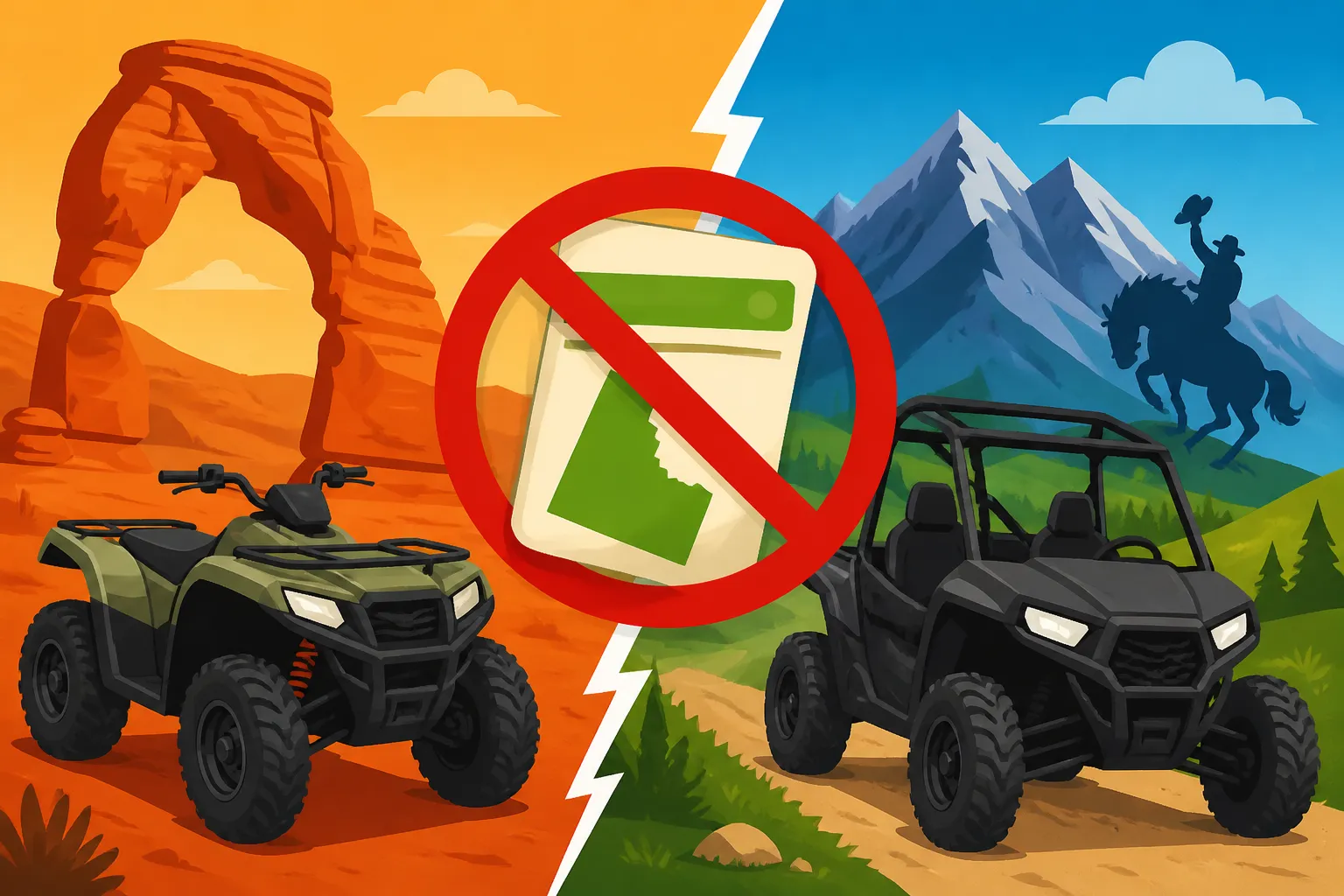
A Utah registration is not a Wyoming ORV permit. Wyoming does not treat another state’s registration or off-road sticker as a substitute for its own permit where Wyoming requires one. If you bring a Utah-registered quad, dirt bike, or side-by-side to ride on a Wyoming route where the permit requirement applies, plan on getting the Wyoming permit for that machine.
The state distinction matters because “registered” can mean different things. A Utah document might show that your machine is registered in Utah, or a Utah decal might show that it has met Utah’s off-highway requirements. Neither automatically satisfies Wyoming’s separate permit requirement. A license plate, a Utah off-road sticker, and a Wyoming ORV decal are not interchangeable documents.
You can read the short version in Does Wyoming Honor a Utah Registration? and the broader rule in Wyoming ORV Reciprocity Rules. The practical takeaway is simple: don’t assume that paperwork valid where you live gives you the same riding access in Wyoming.
| What you bring from Utah | Does it replace a Wyoming ORV permit? | What to keep in mind |
|---|---|---|
| Utah off-road registration or sticker | No | It does not count as Wyoming’s required permit where that permit applies. |
| Utah plate and road registration | No, not for off-road permit purposes | Road registration and off-road access are separate questions. |
| Proof of ownership or a bill of sale | No | Useful for ownership records, but not a riding permit. |
| A Wyoming ORV decal already on the machine | It may satisfy the permit requirement for its valid period | Check the decal’s validity and whether it belongs to the machine you’re riding. |
| Permission to ride on private land | Not a replacement for a required public-land permit | Permission and permit requirements address different things. |
This doesn’t mean a Utah registration is useless. It can document your machine in Utah and may matter for road use there. It simply doesn’t grant a pass to ride every trail, road, or public-land route in Wyoming. The Wyoming decal doesn’t do that either: a permit is not a promise that a route is open to your machine.
A useful way to think about it is that your trip may involve three separate checks:
- Machine paperwork: What documents identify or register the vehicle?
- Permit requirement: Does this Wyoming riding area require a Wyoming ORV permit?
- Route access: Is this particular route open to your machine, and are there other conditions?
Passing one check does not automatically pass the others. For example, having a Wyoming decal does not make a closed forest road legal to ride. A road-registered machine may still be barred from a route that is closed to that vehicle type. And a Utah sticker does not replace the Wyoming permit just because it is visible on the machine.
If you’re visiting for a weekend or a longer vacation, check the permit requirement before you unload at the trailhead. A Utah registration card in your glove box is not a substitute for that check. For more on how the visitor requirement works, see Wyoming ORV Permit for Nonresidents.
Separate the off-road permit from road registration
The most common misunderstanding is treating an ORV permit as if it were a plate, or treating an out-of-state plate as if it covered off-road riding. They answer different questions.
A road registration is associated with operating a vehicle on roads under applicable vehicle and traffic rules. An ORV permit is for riding in places where Wyoming’s off-road permit requirement applies. A Wyoming ORV decal is not a road license, and a Utah road plate does not by itself provide off-road permission.
That distinction is especially important with side-by-sides. A machine may have been registered for road use in Utah, but that doesn’t establish that it can travel on a particular Wyoming forest road or trail. The route’s designation, the machine’s characteristics, and the land manager’s rules all matter. Likewise, a Wyoming ORV decal does not make an otherwise off-limits road open to your side-by-side.
If your plan includes both road travel and trail riding, assess each part of the trip separately. Ask:
- Is the road open to this type of vehicle?
- Does the machine meet the requirements for that road?
- Does the route require a Wyoming ORV permit?
- Are there seasonal or temporary closures?
- Does the land manager restrict vehicle width or other machine features?
A Utah plate may be relevant to the road-registration question, but it does not settle those off-road questions. For a side-by-side, the route can have its own restrictions even when the machine is properly registered at home. Why Wyoming Issues a Decal, Not a Plate explains why the permit takes the form of a decal rather than serving as road registration.
Also keep ownership documents separate from permits. A Utah registration card, title, purchase receipt, or bill of sale may help establish who owns the machine. Those documents do not grant riding access. If you’re carrying a new-to-you machine into Wyoming, keep your ownership paperwork available, but don’t treat it as a replacement for the Wyoming decal.
If your trip includes public roads
Do not assume that an ORV permit authorizes public-road travel. Check road-specific rules and the machine’s legal status for road use. Some routes are designated for certain vehicle types while other roads are not. Local designations, equipment requirements, licensing rules, and insurance requirements can all affect whether a machine may be used on a road.
The reverse is true as well: a vehicle’s road registration does not necessarily exempt it from an ORV permit requirement when it is used off-road. If you plan to ride from a road onto a trail, confirm the rules for both portions before setting out. The [Wyoming Rules for Riding a National Forest] guide is a useful next step for trips on forest land, but always check the route information for the area you intend to visit.
If your trip is only on private land
Private-land permission is not the same thing as a public-land permit. If a landowner has invited you to ride on private property, follow the owner’s directions and any applicable rules. Don’t assume, however, that permission to cross one parcel gives you permission to continue onto a public route or another person’s property.
The same principle applies to ranches, leases, and land with gates. A Utah registration won’t grant access, and a Wyoming ORV decal won’t grant access either. The permit and the landowner’s permission serve separate purposes.
How to get ready before you leave Utah
The least stressful time to sort out a Wyoming permit is before the trailer is loaded. Identify the machines you’ll bring, check the rules for your destination, and arrange a Wyoming permit if the planned riding requires one. A permit is generally associated with the machine, not simply with the person carrying the Utah registration card. Don’t assume a decal on one ATV covers a second machine.
Wyoming’s permit system uses a decal, and the permit period follows a calendar-year cycle. That means a decal can expire at the end of the year rather than lasting for a rolling twelve months from the day you buy it. Check the current requirements and validity before relying on a decal from a previous season. Wyoming’s Annual ORV Permit and How Long a Wyoming ORV Permit Lasts cover those timing questions.
A practical preparation sequence is:
- List every machine. Record the make, model, and identifying details for each ATV, dirt bike, or side-by-side in your group.
- Check the riding area. Confirm that your planned routes are open to your machine and that the Wyoming permit requirement applies—or does not apply—to your intended use.
- Arrange the correct permit. Use an authorized purchase method and follow the current instructions. If you order online, account for delivery time rather than assuming an order confirmation is the same as having the decal in hand. See Buying a Wyoming Permit Online.
- Attach the decal as instructed. Follow the placement guidance so it stays visible and secure while riding. Wyoming ORV Decal Placement explains why placement matters.
- Keep records together. Carry the permit information and your ownership documents in a way that keeps them readable and available.
- Recheck conditions before riding. Closures and access details can change, so confirm the route shortly before the trip.
Buying a permit on the way to a trailhead may be possible in some situations, but it is not a great plan to rely on without checking. A store or office may not be open when you arrive, and an online order may require time before the physical decal reaches you. If your trip is time-sensitive, arrange the permit early and confirm what counts as proof while you wait for the decal.
Keep the Utah paperwork with you if it is useful for identifying the machine or documenting its registration at home. Just store it alongside—not in place of—the Wyoming permit. A simple document sleeve can help protect registration papers from dust and water; if you use Amazon to find one, check that it can close securely and won’t make documents hard to retrieve. A second sleeve or labeled folder for receipts and route notes can also keep your group’s paperwork from getting mixed up. Amazon is one option for basic organizing supplies, but the paperwork itself should come from the relevant state or seller, not from a marketplace listing.
Avoid putting paperwork somewhere that becomes inaccessible when the machine is loaded. If you’re traveling with multiple riders, decide who has the permit information and who has the ownership records. A phone photo can be a useful backup, but don’t assume a screenshot replaces a physical decal or any document the current rules require you to carry. If you need a printed map, download or obtain the correct land-management map before leaving an area with reliable service. Amazon may have map cases and other storage accessories, but make sure any map you use reflects the official route designations for your riding area.
The central point is that preparation is about more than buying a sticker. You need the right permit for the machine, an understanding of where it applies, and a route that is open to your vehicle. A decal doesn’t fix a route-access problem, and a Utah registration doesn’t fix a missing Wyoming permit.
What to do when you arrive at the trailhead
Before unloading, take a few minutes to check the machine and the route. Confirm that the Wyoming decal is attached as directed, then review the signs and route information for the trailhead. Don’t rely only on what a friend remembers from a previous trip or what a map showed when it was downloaded months ago.
A good trailhead check includes:
- Looking for closure notices, seasonal restrictions, and route-specific signs.
- Confirming the route allows your type and size of machine.
- Checking whether the route is open for the season and for current conditions.
- Making sure your permit is on the machine it applies to.
- Keeping Utah registration and ownership documents available without confusing them with the Wyoming permit.
For forest or BLM travel, maps are important because the existence of a two-track on the ground does not automatically mean it is open to motorized use. Follow current travel-management information and signs. Wyoming Trail Maps and MVUMs explains how to use maps for route access. If the map and a sign seem to disagree, don’t treat the disagreement as permission to ride. Stop and verify with the relevant land manager before continuing.
Take care with routes that connect different jurisdictions. A ride can move from a designated trail to a road, a private parcel, or a route managed by another agency. The rules may change at that boundary. A Wyoming permit addresses the permit requirement; it does not settle who owns or manages the land, whether a route is open, or whether you have permission to cross it.
If you’re riding with a group, make the permit check part of the pre-ride routine. Confirm that each machine has its own required decal and that no one is relying on another rider’s paperwork. It’s easy to assume that a single household registration or one trailer’s documents cover every machine. They do not necessarily do so.
It also helps to make the driver and passengers aware of what the documents mean. The Utah registration is not a Wyoming off-road pass. A Wyoming decal is not permission to ride outside designated routes. Making that clear before the group sets off can prevent a disagreement later, especially when one rider is familiar with the machine’s home-state rules but new to Wyoming.
You can organize maps and small essentials before the trip without making the paperwork difficult to inspect. A compact waterproof case can protect a printed map or emergency contact card from mud and rain. If you shop for one on Amazon, choose a size that fits your storage space and does not obstruct controls or safety equipment. Amazon can also be a source for a labeled pouch to separate each rider’s documents, though no accessory substitutes for checking the actual permit and route rules.
If you reach a trailhead and discover that your Utah paperwork is the only documentation you brought, don’t assume you can ride while you sort it out. Find out whether a permit is required, whether it can be obtained locally, and whether a valid decal must be attached before riding. If you can’t confirm the requirement or the route’s status, pause the ride. A short delay is better than treating an unfamiliar rule as optional.
Common mistakes Utah riders can avoid
Treating a Utah decal as reciprocity
The first mistake is assuming that because Utah issued a sticker, Wyoming must accept it. The states’ systems are separate. Wyoming’s permit requirement is not automatically satisfied by a Utah off-road registration, plate, or decal.
This confusion often comes from the word “registration.” A rider may say, “My ATV is registered,” and mean that it has a current Utah off-road sticker. A Wyoming official or land manager may be asking whether the machine has the Wyoming permit. Use the specific terms when checking: ask whether the machine needs a Wyoming ORV permit, rather than asking only whether registration is accepted.
Thinking the Utah plate settles every question
A plate may relate to road use, but it does not make a machine eligible for every trail or exempt it from off-road permit rules. If your side-by-side or ATV is registered for road use in Utah, still check Wyoming’s route rules before riding off pavement.
Assuming every visible track is open
A worn track, gate, or old sign does not necessarily mean the route is open to public motorized use. Check the official map and the signs at the site. This is especially important when an informal-looking route crosses private property, a grazing area, or land with seasonal restrictions.
Believing the permit guarantees access
A valid Wyoming decal answers only the permit question. It does not override a closure, a vehicle-width restriction, a seasonal rule, or a landowner’s access decision. Plan for the route you’re actually allowed to ride, not just the route you can see.
Leaving the permit until arrival
Online orders, retail availability, and office hours can complicate a last-minute plan. Check purchase options and timing before departure. A receipt or order confirmation may not be a substitute for the physical decal; follow the current state instructions rather than guessing.
Confusing an old decal with a current one
Because the permit follows a calendar-year validity period, a decal from a prior year may no longer be valid for a later trip. Check its expiration rather than relying on when you remember buying it. The details are covered in When a Wyoming ORV Permit Expires.
Relying on one rider’s permit for the group
Make a machine-by-machine check. A decal on the tow vehicle, one ATV, or a friend’s side-by-side does not necessarily cover the rest of the group. Keep track of which machine has which permit and confirm that each one is correctly displayed.
Treating a phone receipt as the decal
A digital receipt can help show that you completed a purchase, but don’t assume it satisfies the physical decal requirement. Review the current instructions for online orders and allow time for the decal to arrive. If you’re uncertain whether a temporary confirmation is accepted, ask the relevant state program or authorized seller before riding.
The bottom line for Utah visitors
A Utah registration does not count as a Wyoming ORV permit. Keep the Utah documents for what they establish, but obtain a Wyoming permit when your planned riding requires one. Then check route access separately, because neither state registration nor a Wyoming decal makes every road and trail open to your machine.
Before loading up, confirm the permit rules for each machine, verify the decal’s validity, and review current route maps and closures. Keep ownership records and permit information organized, but don’t mistake one for the other. That simple separation—registration, permit, and route access—will help you arrive prepared and spend less time sorting out paperwork at the trailhead.
Disclaimer
This article is for general informational purposes only and does not constitute professional advice. Laws, prices and regulations vary by location and change over time. Consult a qualified professional for guidance on your specific situation.