Wyoming Trust Land and Its Own Permit
Planning an ATV or UTV ride on Wyoming trust land can raise two separate questions: whether you need permission to be there, and whether your machine needs an ORV permit. The state permit is not a general pass to ride anywhere. Here’s how to distinguish casual access, the Wyoming decal requirement, and the road restrictions that matter before you unload.
Does Wyoming Trust Land Have a Separate Riding Permit?
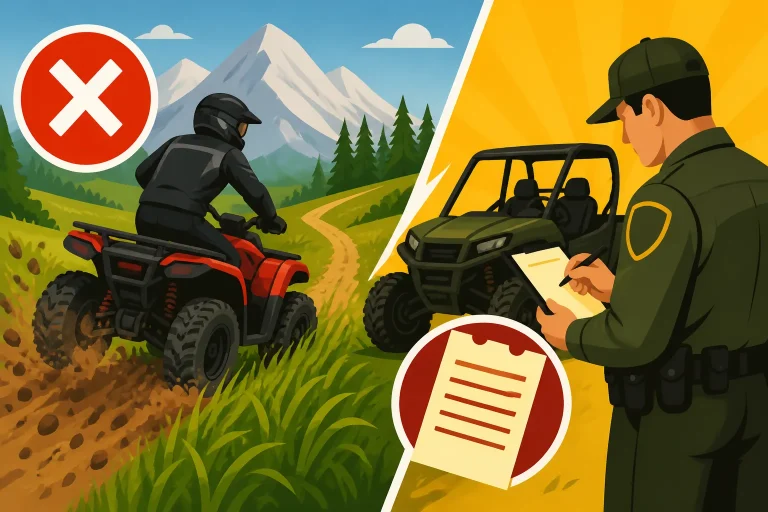
For casual day use, Wyoming State Trust Lands do not require a separate general recreational permit, according to the Wyoming Office of State Lands and Investments. That does not mean every parcel is open to every activity, or that a rider can travel wherever there is room. Motorized use is restricted to established roads, and off-road ORV use is prohibited.
That distinction is central: the absence of a separate general permit does not create permission to leave a road, cross an area that is not open to public use, or assume that a route is available to motor vehicles. Check the land status and access conditions for the particular area before setting out. The Wyoming Office of State Lands and Investments is the relevant place to confirm trust-land rules; the appropriate land manager can help clarify whether a specific road is open.
A state ORV decal is a different requirement from a trust-land recreational permit. Wyoming State Parks, Historic Sites, & Trails administers the statewide ORV registration program. Its permit applies to qualifying ORV use on designated roads, routes, and trails, while the trust-land rule governs where motorized travel may take place. A decal does not turn an undesignated track into an open road.
| Riding situation | What the permit or access rule means | What to check |
|---|---|---|
| Casual day use on trust land | The Wyoming Office of State Lands and Investments says a separate general recreational permit is not required for casual day use. | Confirm that the land is accessible and follow its use conditions. |
| Riding an ORV on trust land | The Wyoming Office of State Lands and Investments confines motorized use to established roads and prohibits off-road ORV use. | Confirm that the road is open to your machine and that your vehicle meets state ORV rules. |
| Riding an enrolled ORV trail | Wyoming State Parks, Historic Sites, & Trails requires a state ORV permit on designated trails enrolled in the ORV program, even if the machine is street legal. | Verify that the trail is enrolled and currently open. |
| Riding an enrolled ORV road | Wyoming State Parks, Historic Sites, & Trails allows an enrolled road to be used by a street-legal vehicle or a qualifying ORV displaying the state permit. | Check the route designation and any local closure. |
| Riding a road outside the ORV program | Wyoming State Parks, Historic Sites, & Trails requires a current plate and street-legal status on roads not designated for ORV travel and not enrolled in the program. | Confirm that the road permits your vehicle and that you have the required equipment and credentials. |
If your trip involves more than casual day use, or if your planned route crosses adjoining land, ask the relevant land manager what permissions and conditions apply. Do not treat a trail map, a visible tire track, or another rider’s use as proof that a route is open. For a broader overview of access distinctions, see Wyoming Riding on State Trust Land and Wyoming Rules for Riding a Designated Route.
When the Wyoming ORV Permit Applies
Wyoming’s ORV permit is required for use on enrolled roads, routes, and trails designated for ORV travel, subject to the state’s rules for the particular type of route and vehicle. According to Wyoming State Parks, Historic Sites, & Trails, a current Wyoming ORV sticker is required on an enrolled designated trail even when the vehicle is street legal. On an enrolled road, the vehicle must either be street legal or display the state ORV sticker while meeting the relevant ORV requirements.
A street-legal ORV does not need a Wyoming ORV permit just because it is being driven somewhere in the state. Wyoming State Parks, Historic Sites, & Trails says a street-legal ORV needs the permit when it is operated on a trail that is 50 inches or less in width. On other roads, separate road-use requirements may apply. The important point is to identify the route first: an enrolled trail, an enrolled road, and a road outside the ORV program do not have identical rules.
Wyoming does not recognize an out-of-state ORV or OHV registration as a substitute for its permit. According to Wyoming State Parks, Historic Sites, & Trails, non-residents must buy a Wyoming ORV permit when operating in the state under the permit rules. The permit applies equally to residents and non-residents and is valid for a calendar year. For a fuller explanation of the statewide decal, see Wyoming ORV Permit Explained and Wyoming ORV Reciprocity Rules.
As of November 2026, Wyoming State Parks, Historic Sites, & Trails lists the annual ORV registration user fee as $15. The state says permits are available online and through local selling agents, including ATV and motorcycle dealers, local businesses, selected Forest Service and State Park offices, and some county treasurer offices. Check the official program for current purchasing details, and attach the decal to the ORV as required.
The permit requirement is not the only condition for riding. Wyoming State Parks, Historic Sites, & Trails says ORVs may be operated only on roads, trails, or areas designated as open by the appropriate local land manager, such as the Forest Service or BLM. That means a valid decal does not override a closure or expand access onto an unapproved route. Use Where to Buy a Wyoming ORV Permit for purchase options and Wyoming Trail Maps and MVUMs for route-planning context.
How to Check a Trust-Land Route Before You Ride
A good pre-ride check separates three questions: whether you can access the land, whether the route is open to motorized use, and whether your vehicle is allowed on that route. Treating those as one question is a common way to end up with the right decal but the wrong route.
- Identify the land and its manager. Confirm that the area is Wyoming trust land and find the current access information for the specific parcel. If the route crosses other land, check those access rules too.
- Confirm the road is established and open. The Wyoming Office of State Lands and Investments confines motorized travel on trust land to established roads. Wyoming State Parks, Historic Sites, & Trails separately requires ORVs to stay on roads, trails, or areas designated open by the appropriate land manager.
- Find out whether the road or trail is enrolled in the ORV program. A route being established does not by itself mean it is enrolled. The route’s designation affects whether the state ORV sticker, street-legal status, or another set of road requirements applies.
- Match your vehicle to the route. On a designated ORV trail, the state decal is required even for a street-legal machine. On an enrolled road, the vehicle must meet the applicable street-legal or ORV-permit conditions. A road that is not enrolled in the program has different requirements.
- Check for changes before departure. Route access can depend on land-manager decisions and current closures. Verify the latest local information instead of relying only on an old map or a route description.
- Carry the documents and equipment required for the route. Wyoming State Parks, Historic Sites, & Trails requires a valid driver’s license or permit for operators using designated roadways with only an ORV sticker. Road use can also involve insurance, licensing, and equipment requirements, so confirm the rules for the particular road.
For the state’s route and vehicle distinctions, Wyoming Rules for Riding a Designated Route is a useful companion. If the ride extends onto private property, check Wyoming Rules for Riding Private Land rather than assuming trust-land access rules continue to apply.
Common Mistakes to Avoid
Assuming “no separate permit” means “free to ride anywhere.” The Wyoming Office of State Lands and Investments’ casual-day-use rule does not authorize off-road travel. Motorized use is confined to established roads, and ORV travel off those roads is prohibited. The relevant road must also be accessible and open for your intended use.
Using the state decal as proof of access. The Wyoming ORV permit addresses the state registration requirement for applicable routes. It does not establish that a road is open, authorize travel off-road on trust land, or replace land-specific access conditions. Check the route with the appropriate land manager.
Treating an out-of-state sticker as enough. Wyoming State Parks, Historic Sites, & Trails says there is no reciprocity for out-of-state ORV or OHV registrations. Visitors operating under the Wyoming ORV permit rules need the Wyoming permit; a home-state registration alone is not a substitute.
Assuming street legal means no permit anywhere. Street-legal status does not exempt a machine from the permit requirement on a designated ORV trail. Wyoming State Parks, Historic Sites, & Trails requires a current state ORV sticker on enrolled trails regardless of whether the machine has a current plate. Street-legal status and permit requirements depend on the route.
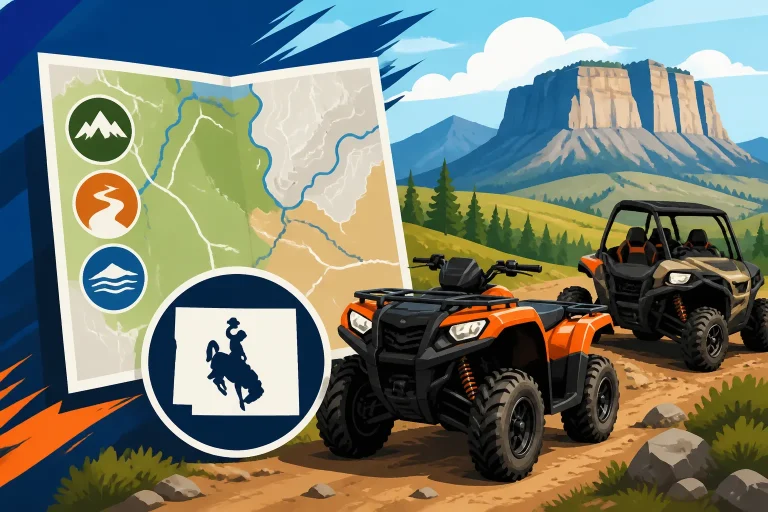
Relying on a track shown on a map without checking its status. Maps help with planning, but the appropriate land manager determines which roads and routes are open. A mapped road may not be enrolled in the ORV program, and a route’s appearance on a map is not by itself confirmation that it is open to motorized travel.
The practical takeaway is straightforward: casual day use on Wyoming trust land does not require a separate general recreational permit, but motorized travel must remain on established roads. Then check whether your selected road or trail is open and enrolled, and carry the Wyoming ORV permit when the state rules require it.
Sources
- Wyoming State Parks, Historic Sites, & Trails — Wyoming State Parks, Historic Sites, & Trails – ORV Permits – Trails (checked November 3, 2026)
- Wyoming State Parks, Historic Sites, & Trails — Wyoming State Parks, Historic Sites, & Trails – ORV Rules & Regulations – Trails (checked November 3, 2026)
- Wyoming State Parks, Historic Sites, & Trails — Wyoming State Parks, Historic Sites, & Trails – ORV F.A.Qs (checked November 3, 2026)
- Wyoming State Parks, Historic Sites, & Trails — Wyoming State Parks, Historic Sites, & Trails – ORV Requirements – Trails (checked November 3, 2026)
- Wyoming State Parks, Historic Sites, & Trails — Wyoming State Parks, Historic Sites, & Trails – OHV (Off-Highway Vehicle) Partnership Grants (checked November 3, 2026)
Disclaimer
This article is for general informational purposes only and does not constitute professional advice. Laws, prices and regulations vary by location and change over time. Consult a qualified professional for guidance on your specific situation.