Wyoming Landowner Permission Rules
Getting permission to ride a Wyoming ranch road or private trail can seem straightforward until a route crosses several properties, a gate is locked, or a map and a sign disagree. The safest approach is to get clear consent from the right landowner, confirm exactly where and when you may ride, and treat access permission as separate from permits and other rules.
Get permission before riding private land
In Wyoming, a landowner’s permission is the starting point for riding an ATV or UTV on private property. A road that looks public, a trail that appears on a phone map, or a route that other riders use does not by itself prove you have permission to cross the land. Ask before entering unless you have confirmed that the route is a public right-of-way or that you have another valid basis for access.
Permission matters even if you plan to ride only briefly. A shortcut across a pasture, a turn from a public road onto a ranch track, or a detour around a muddy section can take you onto land you do not have permission to use. Property lines may not follow visible fences, and a fence can mark a boundary, contain livestock, or serve another purpose. Don’t use it as your only way to determine where you are.
If you are unsure whether a route crosses private ground, stop and check rather than continuing to find out. Maps, signs, and advice from other riders can help identify likely boundaries, but they are not a substitute for confirming access. For more on the general distinction, see [Wyoming Rules for Riding Private Land] and Wyoming Trespass Law and Off-Road Riders.
Ask the person who can grant access
Contact the landowner or a person authorized to speak for the property. On a ranch, that might be the owner, a manager, or someone specifically responsible for granting recreation access. An employee you meet at a gate may not have authority to approve a ride. If you’re not sure who can say yes, ask who handles access requests rather than relying on an assumption.
Be specific about the property and route. “Can we ride here?” may leave too much room for misunderstanding. Explain:
- Which machines you plan to bring, such as ATVs or UTVs
- How many riders and machines are in the group
- The date or time period you have in mind
- Where you expect to enter and exit
- Which roads or trails you want to use
- Whether you plan to stop, camp, hunt, fish, or do anything besides travel through
- Whether children, passengers, dogs, or a commercial guide will be with you
A landowner may allow a particular road but not a nearby trail, or may agree to a one-time crossing but not a full day of riding. Ask about those details before you go.
Get the terms in a form you can check
Permission can be given in different ways, but a clear written record is often the most practical way to avoid disagreements about what was agreed. A text, email, signed note, or permission form can record the route, dates, group size, and conditions. If permission is given in a conversation, repeat the details back and ask the landowner to confirm them in a message if possible.
Keep the record accessible while riding. A copy on your phone can be useful, but don’t rely on a signal being available in a remote area. Save it offline or carry a paper copy, and make sure everyone in the group knows the limits.
An old message or a past invitation may not cover a new trip. Permission for one rider, one season, or one route should not be treated as open-ended authorization for other people or later rides. If the group, dates, or route changes, check whether the original approval still applies.
Understand what permission does and does not cover
Permission is not a general pass to use every road or piece of ground on a property. It only covers what the landowner agreed to. A yes to travel on one ranch road does not necessarily include riding side trails, exploring fields, stopping to camp, or crossing neighboring property.
Ask for boundaries you can follow on the ground. Useful details might include a named entrance, a map pin, a marked road, a turnaround point, or a description of where the approved route ends. If a route is unclear, ask for clarification before departure. Avoid guessing at a fork or treating a worn track as an approved extension.
| Situation | What to confirm before riding |
|---|---|
| A single crossing | The approved entry point, route, and exit point |
| Riding on a ranch road | Which roads are open and whether side trails are excluded |
| A group ride | The number of riders and machines, and whether each participant is covered |
| A return visit | Whether the original permission still applies to the new date |
| A change in route | Whether the landowner approves the alternate road or trail |
| A guided or paid ride | Whether the landowner has agreed to commercial use |
| A gate or livestock area | How to pass through and what to do with the gate afterward |
Permission is limited to the people and use agreed on
If you receive permission for yourself, don’t assume you can invite a group. If permission is for a family ride, don’t assume it also covers a club outing or a tour operator. Give the landowner an honest description of the group and activity. A larger group can create more noise, traffic, dust, and risk to livestock, so the landowner may set a limit or decline.
Likewise, permission to ride does not automatically mean permission to hunt, camp, collect firewood, bring a dog, or use the property for a business. State those plans up front. If permission is limited to travel along a road, stay on that road and leave once you reach the agreed destination.
Don’t transfer permission to another rider without checking. The landowner may have agreed because they know the person who asked, or may have approved only a specific group. If someone in your party will arrive separately, confirm that the landowner is comfortable with the arrangement.
Permission does not replace other requirements
Access consent answers one question: whether you may use the land within the agreed terms. Other requirements may still apply to the machine, the rider, or the route. For example, a permit needed for a public trail does not become unnecessary just because a private road connects to it. A rider must also follow applicable rules for vehicle operation and any restrictions imposed by the land manager or landowner.
The same distinction applies when moving between private and public land. Landowner permission for a private section does not establish that a road on public land is open to your machine, and a public route does not give you permission to continue across private property. Check both sides of each boundary.
Wyoming’s ORV permit system and access rules are separate topics; see Wyoming ORV Permits Explained for a general overview. If your planned ride includes an enrolled public route, check where that segment begins and ends. Riding an Enrolled Road to a Trail explains why the connection between an open route and a trail matters.
Treat roads, gates, and boundaries carefully
A road on private property may be used by the landowner, a tenant, workers, or people with specific access rights. Its appearance does not tell you who may ride it. A county road, a public easement, a private ranch road, and a route across federal land can look similar on the ground, yet have different access rules.
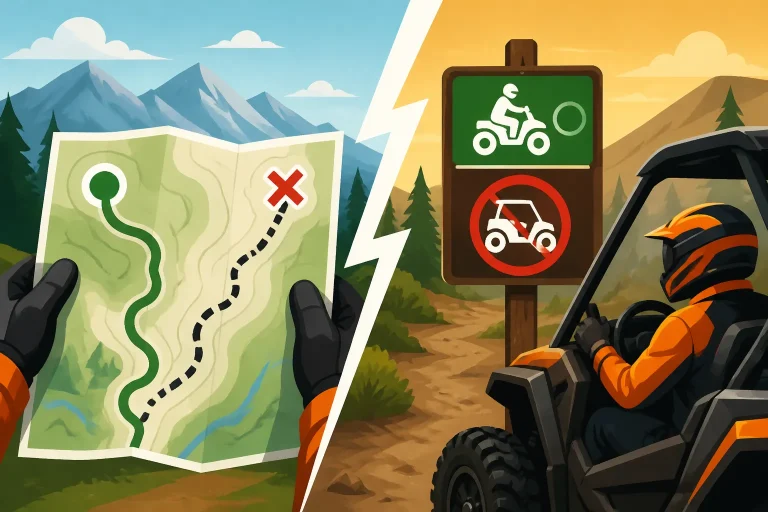
If you believe a route is public, verify its status through a reliable land manager or local authority before relying on it. A line on a recreational map may show a road without confirming that it is open to the public or open to motorized travel. If a map and a sign conflict, do not assume the map gives you permission to pass a closure. See When a Map and a Sign Disagree for a careful way to handle that situation.
A section line can also be misleading. The presence of a mapped line or a straight track does not automatically mean you can ride across adjoining private property. For that issue, see Why a Section Line Is Not a Public Route.
Stop at gates and follow instructions
A gate may indicate a property boundary, control livestock, or manage access. Before your ride, ask how to handle every gate on the approved route. The landowner might want it left closed, opened and closed behind you, or handled in another way. Don’t assume the answer based on what another rider did.
If you encounter a locked gate, a new sign, or a barrier that was not part of the plan, stop. Don’t go around it through a field, climb a fence, or move a barrier to continue. Contact the landowner or turn back. A gate left open can let livestock onto a road or out of an enclosure, and the consequences may extend well beyond your ride. For more detail, see Which Gates You Are Required to Close.
Ride slowly near livestock, homes, equipment, and people working on the property. Give animals room and avoid sudden acceleration or repeated passes. If livestock are on the road, wait for a safe opportunity or ask the landowner what to do. Do not herd, chase, or drive through a group of animals to keep to your schedule.
Don’t extend permission across a neighbor’s property
A landowner can only grant access to land they control or are authorized to open. A road may cross several parcels, and approval from one owner does not necessarily cover the next. Check each private segment, including the return route. If a ride leaves the approved land and later re-enters it, the unapproved part still matters.
This is especially important when following GPS tracks, online routes, or directions shared by another rider. A track may be outdated, may cross private property, or may reflect access arranged for someone else. Treat it as route information, not as proof of permission. If you need access across a ranch, Asking a Wyoming Rancher for Access offers a useful approach to making a clear request.
Separate private land from trust, federal, and leased land
Not every open-looking area in Wyoming is private property, and not every non-private parcel is freely available for motorized recreation. Different land types have different access rules. Identify who manages the ground beneath your route, then check the applicable rules for that specific land.
State trust land is not simply private land
State trust land has its own access framework. A landowner’s permission for an adjoining ranch does not necessarily authorize riding on a trust-land parcel, and a public-land map does not necessarily mean that motorized recreation is allowed there. Check the relevant access and permit requirements before crossing or riding on trust land. Wyoming Trust Land and Its Own Permit explains why this category needs separate attention.
Where a route runs between parcels, confirm that you have lawful access to the connecting segments as well as the destination. It is easy to focus on where you want to ride and overlook the short crossing needed to get there.
A grazing lease does not make you the lessee
Public land may be leased for grazing, but that does not mean a rider can use it as if it were their own land or has permission from the leaseholder to ride anywhere. The underlying land manager’s rules and access conditions still matter. Do not assume a grazing lease grants public motorized access, or that a private ranch permission covers nearby leased ground.
Check the managing agency’s route rules and any applicable access conditions before riding. If you are unsure who controls the area, pause and verify rather than relying on a fence line or a familiar-looking road. See [Wyoming Rules for Riding a Grazing Lease] for more on this distinction.
Federal public land still requires route checks
Public ownership is not the same as unrestricted access. National forests and Bureau of Land Management land may have designated routes, seasonal closures, width limits, or other restrictions. Ride only where the responsible land manager allows your machine. A private landowner cannot open a federal route, and a federal map cannot grant access across a private parcel that it crosses.
Before leaving home, check the current travel-management information from the agency that manages the area. At the trailhead, read posted notices and pay attention to gates and closure signs. Conditions and access can change, and a route that was open on an earlier visit may not be open now. For route planning, Carrying a Travel Management Map in Wyoming can help explain why maps belong in your preparation.
Make a practical permission plan
A short preparation routine can prevent a promising ride from becoming a trespass problem. Work through these steps before loading the machines:
- Map the full route. Identify the start, destination, return route, and every private or managed parcel along the way. Include likely detours and places where you might need to turn around.
- Verify who controls each section. Don’t infer ownership or public access from the appearance of a road. Check available land-management information and contact the appropriate owner or agency when the status is uncertain.
- Request permission with specific details. Describe your group, machines, dates, route, and planned activities. Ask who is authorized to approve access.
- Record the terms. Keep a message, note, or form with the approved dates, route, limits, and contact information. Make it available to all riders.
- Check separate requirements. Confirm the relevant permit, route designation, machine restrictions, and any land-manager rules for each part of the trip.
- Brief the group. Explain where access is allowed, where it ends, how gates should be handled, and what to do if the route is blocked or uncertain.
- Recheck before departure. If weather, closures, livestock movement, or a change in plans affects the route, contact the landowner or agency before proceeding.
If permission is denied or unclear
Accept a refusal and choose another route. Don’t keep asking different people on the same property in the hope that someone will say yes, and don’t use a gate or track just because other riders appear to have done so. If the answer is unclear, treat it as not yet granted. Ask a focused follow-up question or make alternate plans.
If you arrive and find a sign or barrier that changes the access situation, turn around or stop in a safe place and seek clarification. A prior agreement may not cover an unexpected closure, a different route, or a changed date. Do not confront workers or assume they are wrong about access. Record the location for later follow-up and leave without escalating the situation.
Keep the ride within the agreement
Once access is granted, follow the route and conditions exactly. Don’t add riders, explore side trails, or extend the trip beyond the agreed period without approval. Keep noise and speed appropriate for the surroundings, give workers and livestock space, and leave the property as you found it. If the landowner asks you to change plans or leave, cooperate and clarify the situation afterward.
Good access practices also make future requests easier. Landowners are more likely to consider another ride when guests stay within agreed limits, close gates as instructed, avoid damage, and communicate promptly about problems. That does not guarantee future access, but it respects the person who granted it and helps avoid turning a one-time invitation into a conflict.
Frequently Asked Questions
Does a Wyoming landowner’s permission let me ride anywhere on the property?
No. Permission covers only the land, route, dates, people, machines, and activities included in the agreement. Ask before using side trails, camping, hunting, or inviting additional riders.
Does permission to ride a private road replace an ORV permit?
Not necessarily. Permission controls access to the private property, while permits and route rules are separate requirements. Check what applies to each part of your trip, especially if the route connects to public land or a public trail.
Can I ride through a gate if it is open?
An open gate is not proof that you have permission to enter. Use the gate only if you have authorization for the route, and follow the landowner’s instructions about whether to leave it open or close it behind you.
Does permission from a rancher cover nearby trust land?
Not automatically. Trust land has separate access rules, and permission from a neighboring landowner may not authorize use of that parcel. Confirm the land manager and requirements for each segment.
What should I do if a map shows a road but a sign says closed?
Stop and don’t continue on the assumption that the map overrides the sign. Check the current route information with the responsible land manager or property owner, then use another route if access is not confirmed.
Disclaimer
This article is for general informational purposes only and does not constitute professional advice. Laws, prices and regulations vary by location and change over time. Consult a qualified professional for guidance on your specific situation.