Taking a Dog on a Wyoming Trail Ride
Taking a dog on a Wyoming trail ride takes more planning than putting a leash in the glove box. Route rules vary, and a moving ATV or UTV brings noise, dust, heat, wildlife, and rough ground into the mix. Check that dogs are allowed, decide how yours will travel safely, and make a backup plan in case conditions or your dog’s behavior change.
Check whether dogs and machines are allowed
Start with the land manager and the specific route, not just a general map of the area. Rules can differ between a national forest, BLM land, a state recreation area, and private property. A dog being allowed in one part of a riding area does not mean it can go everywhere, and machine access may be restricted on a route where walking is permitted.
Check current notices for seasonal wildlife closures, fire restrictions, and other changes before leaving. A route map can help you plan, but signs and closures on the ground matter too. If a map and a sign seem to conflict, do not assume the route is open; check with the land manager. The same preparation applies to the machine route itself. See Wyoming Trail Closures to Check First, Wyoming Rules for Riding a National Forest, and Wyoming Rules for Riding BLM Land before choosing a destination.
Ask the land manager specific questions rather than relying on a broad question like “Are dogs allowed?” For example:
- Are dogs allowed on the particular road or trail we plan to use?
- Must the dog be leashed, or can it be under voice control?
- Are there wildlife, livestock, or seasonal restrictions?
- Can the dog go into the trailhead or recreation area?
- Are there restrictions on dogs in a vehicle or on a specific route?
If you are riding on private land, get the owner’s permission for both the machine and the dog. Permission to ride does not automatically cover bringing a pet. Likewise, do not assume that a ranch road or two-track is public just because it appears on a map. Wyoming Rules for Riding Private Land and Wyoming Trail Etiquette With Ranchers are useful context when a route crosses working land.
The vehicle’s permit and the dog’s access are separate questions. Where a Wyoming ORV permit is required, it applies to the machine; it does not authorize a dog to enter a restricted area or make a closed route legal. An out-of-state sticker should not be treated as a substitute for Wyoming’s permit requirements. For the machine side of the trip, see Wyoming ORV Permits Explained and Wyoming ORV Permit for a Visiting Rider.
| Question | What to confirm before riding |
|---|---|
| Is the route open to your machine? | Check the land manager’s current map, route designation, and signs. |
| Are dogs permitted there? | Confirm the rule for the specific area, trail, or road. |
| Does the dog need a leash? | Check local requirements and carry one even if off-leash control is permitted. |
| Is the machine properly permitted? | Check Wyoming requirements for the riding location; a dog’s presence does not change them. |
| Are there seasonal hazards or closures? | Look for wildlife restrictions, fire notices, and changing conditions. |
Decide whether your dog should come
A dog that enjoys car rides may still find an off-road trip overwhelming. The noise and vibration can be intense, dust can irritate eyes and airways, and the surface can be hot or rough. A dog may also react unpredictably to unfamiliar riders, horses, livestock, wildlife, or other dogs.
Consider your dog’s health, temperament, and experience before making the trip. A young, older, injured, or medically vulnerable dog may not be a good fit for a long or remote ride. A dog that panics at engine noise, tries to jump from vehicles, or cannot reliably settle in a secure space is better left at home or with a caregiver. A short test around a stationary machine can help you observe the dog’s response, but it cannot guarantee that the dog will cope with hours of engine noise and movement.
Think about the ride’s length and access to help. A route with shade, water, and a quick way back to the trailhead is a more sensible first outing than a remote trip with limited cell service. Even a fit dog can become tired or distressed, and it may be difficult to carry a large dog out if the vehicle breaks down or the dog is injured. If your dog cannot safely ride in the machine, do not plan to have it run alongside. A moving vehicle can injure a dog, and rough terrain makes it hard to control distance and speed.
A UTV may offer more room to secure a dog than an ATV, but more room does not make an unsecured ride safe. Follow the vehicle manufacturer’s passenger and cargo guidance, and do not exceed its capacity. An ATV is generally a poor place to carry a dog: there may be no protected, stable space, and the dog’s movement can interfere with the rider’s control. Avoid carrying a dog on the rider’s lap or loose on a seat or in an open cargo bed.
If the only option is to leave your dog alone in a vehicle at the trailhead, reconsider the outing. Temperatures can become dangerous inside a parked vehicle, and a dog left unattended may escape, become distressed, or be unable to get help. Do not make a plan that depends on the dog waiting in a hot or remote parking area.
Set up safe transport and trail behavior
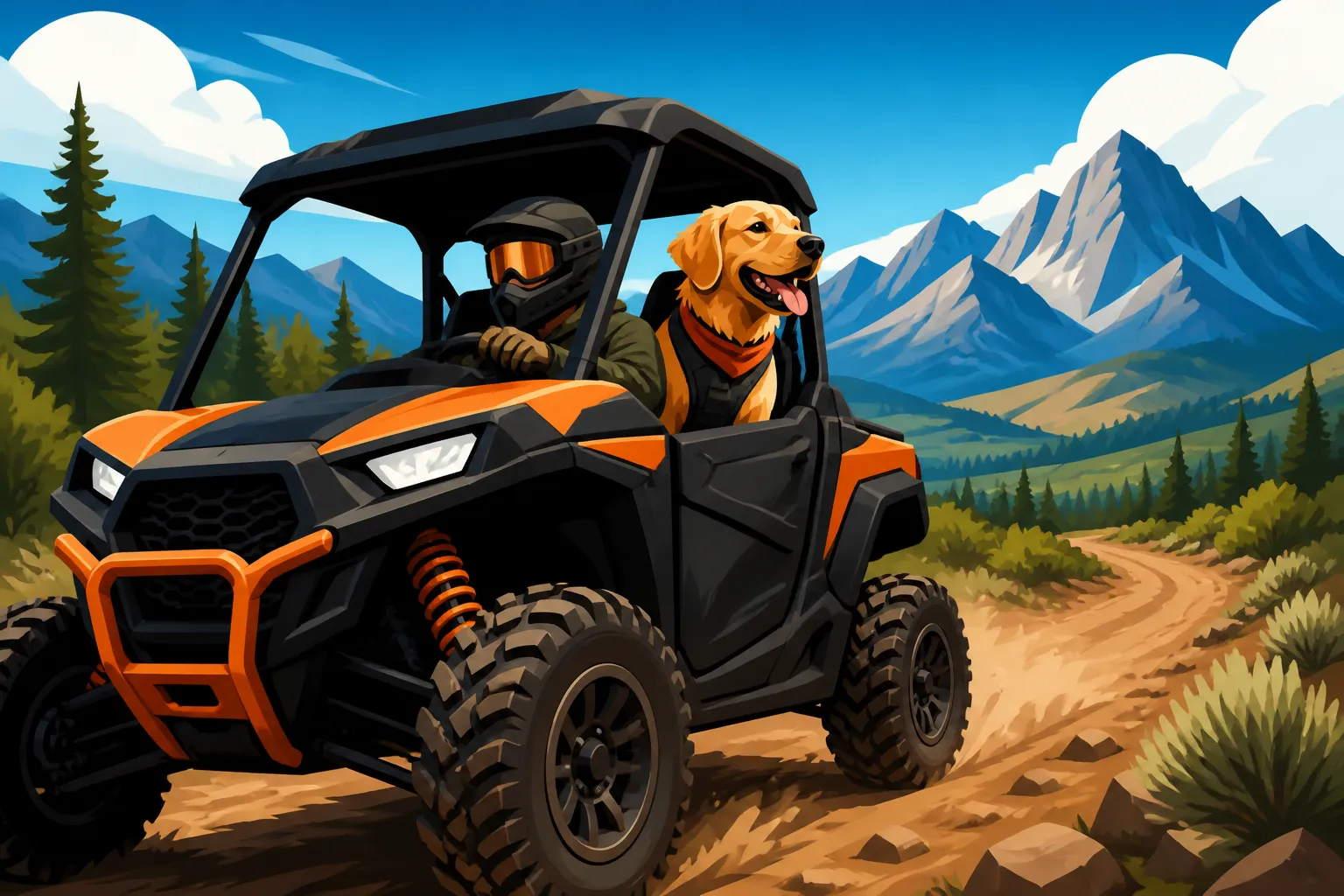
If the dog is permitted and you have decided the trip is appropriate, work out the transport plan before arriving at the trailhead. In a UTV, use a secure crate or a properly fitted vehicle restraint designed for travel, and make sure it is anchored according to its instructions. A restraint should not attach to the dog’s collar in a way that risks neck injury. Keep the dog clear of controls, moving parts, and places where it could fall or be pinched.
A crate should be large enough for the dog to sit and lie down comfortably, but it must also be secured so it cannot slide or tip. Provide ventilation and keep the dog out of direct sun as much as possible. If the UTV has a roof or windshield, do not assume that it blocks dust, debris, or noise sufficiently. Observe the dog during the trip and stop if it shows signs of distress.
A leash is useful at trailheads, rest stops, and other places where dogs must be controlled. Never tie a dog to a moving machine, and do not use a long leash that can snag on wheels, branches, or other equipment. If the dog gets out to walk, keep it close enough to control and only do so where the land manager allows it. Do not let the dog chase wildlife or livestock, approach other riders, or run ahead around blind corners.
Horses and cattle can be startled by dogs, even friendly ones. Give them plenty of space, keep your dog restrained, and follow the rider’s or landowner’s directions. Avoid letting a dog bark at, herd, or approach animals. For more on riding respectfully around working land, see Wyoming Rules for Riding Near Livestock.
Pack water and offer it often, especially in warm weather, at elevation, or on a dusty route. Bring a portable bowl, a leash, waste bags, and a way to clean grit from your dog’s eyes and paws. If you need to buy basic supplies such as a collapsible bowl or a travel restraint, Amazon is one place to compare options, but check that any restraint is intended for vehicle travel and fits your dog and vehicle. A harness or carrier marketed for casual use may not be suitable for a moving UTV.
Protect paws from hot ground, sharp rocks, and abrasive surfaces. Check them during breaks for cuts, lodged debris, or irritation. Dog boots can help some dogs, but introduce them before the trip so the dog can get used to them. Do not rely on boots to make an unsuitable route safe. Watch for heavy panting, excessive drooling, weakness, confusion, limping, repeated attempts to escape the crate, or unusual quietness. These can be signs that the dog needs a break or that the ride should end. Move to a safe place, offer water, and seek veterinary care if the dog’s condition does not improve or seems serious.
Plan around Wyoming conditions and have a backup
Wyoming’s open country can make a ride feel remote even when a trailhead seemed close on a map. Weather changes, high elevation, wind, dust, and long distances between services can affect both people and dogs. Pack more water than you expect to need, bring a basic pet first-aid kit, and make sure someone knows your planned route and return time. Keep your dog’s identification current, and consider carrying a recent photo in case it gets separated.
Wildlife deserves special care. Keep your dog close and do not allow it to chase or approach animals. In areas with bears or other potentially dangerous wildlife, follow local guidance and plan for the possibility of an encounter. A dog that runs after wildlife can return with an animal following it. Review Wyoming Rules for Riding in Grizzly Country before riding in relevant parts of the state.
Choose a route that matches your dog’s abilities, not just the machine’s. A long ride over exposed terrain may offer little shade or water. A narrow route with frequent traffic may leave little room to stop safely. A route that is comfortable for a rider can still be stressful for a dog riding in a crate or restraint. Start with a short outing and check how your dog responds at several points, rather than assuming it will be fine because it seemed calm at the trailhead.
Before each ride, use a simple go-or-no-go check:
- Confirm that the route is open to your machine and that dogs are allowed.
- Check weather, closures, wildlife notices, and the likely length of the trip.
- Make sure the dog is healthy enough for the outing and can be transported securely.
- Pack water, a leash, waste bags, and basic supplies for the dog.
- Identify a safe place to turn back or end the trip if the dog becomes distressed.
Have a backup plan that does not involve leaving your dog unsecured or alone in an unsafe place. That may mean choosing a shorter route, riding with another adult who can stay with the dog, or arranging care before the trip. If your dog shows fear, overheating, pain, or difficulty breathing, end the ride rather than trying to push through. A successful outing is one where the dog stays safe and the route remains within the rules—not simply one where you complete the planned distance.
Disclaimer
This article is for general informational purposes only and does not constitute professional advice. Laws, prices and regulations vary by location and change over time. Consult a qualified professional for guidance on your specific situation.