Bear Spray Rules in the Northwest
A ride through northwest Wyoming can move from open sagebrush into grizzly country without much warning. Bear spray is a practical safety tool, but riders often have questions about whether it is required, how to carry it on an ATV or UTV, and what to do if a bear appears. The key is to check the rules for your route and keep spray reachable, not packed away.
What bear spray rules apply in northwest Wyoming
There is no single bear-spray rule that covers every road, trail, campground, and parcel of land in northwest Wyoming. Requirements can depend on the land manager and the specific area. Bear spray is widely recommended as a safety measure in grizzly country, but a recommendation is not the same as a legal requirement. Before you ride, check current notices and regulations for the area you plan to visit.
Also distinguish a rule about carrying bear spray from rules about carrying firearms or other defensive tools. They are not interchangeable. If you are unsure what is allowed in a particular area, confirm with the land manager rather than assuming a rule for one kind of item applies to another.
Your first task is to identify where the route goes. A ride may cross land managed by different agencies, or pass near private property, a wildlife closure, or a boundary where the rules change. A map can help you plan, but check its date and look for current signs and closure notices. For more on route access, see Wyoming Rules for Riding in Grizzly Country and Wyoming Rules for Riding a National Forest.
| Question | Practical answer |
|---|---|
| Is bear spray required on every northwest Wyoming ride? | Do not assume so. Check the current rules for the route and land manager. |
| Is it useful even when it is not required? | It can be an important defensive tool in bear country when carried accessibly and used according to its label. |
| Can it stay in a storage box? | It is safer to carry it where the rider can reach it quickly, without leaving the vehicle. |
| Does a canister replace careful riding? | No. Noise, distance, attention to surroundings, and following closures still matter. |
| Should you use it as a general wildlife deterrent? | No. Follow the product label and reserve it for a defensive encounter. |
Bear spray is not permission to ride into a closed area or approach wildlife. Nor does carrying it guarantee that an encounter will be safe. It is one part of a wider plan: know your route, watch for signs of wildlife, avoid surprising animals, and be ready to turn around.
When checking rules, look for current information from the agency or land manager responsible for the specific route, trailhead, or campground. A broad travel map may not show temporary closures, seasonal restrictions, or recent changes. If signs on the ground conflict with an older map, stop and resolve the uncertainty before continuing. Which Travel Map You Must Carry in Wyoming explains why a route map needs to be read alongside current signs and notices.
Choosing and carrying bear spray on an ATV or UTV
Use a product specifically labeled as bear spray, and read its instructions before the ride. Check that the canister is in usable condition, that its expiration date has not passed, and that the safety mechanism works as described. Store it within the temperature and handling conditions stated on the label. A canister damaged by impact, heat, or rough handling may not be dependable.
Buying the right item is more important than choosing a particular retailer. If you shop on Amazon, confirm that the listing is for bear spray, review the product details and expiration information, and check how it will be shipped and stored. Do not rely on a product title alone: listings can be confusing, and personal-defense sprays are not necessarily the same product as bear spray.
How you carry the canister matters just as much as what you buy. A spray bottle buried under tools, tied down in a cargo box, or packed in a trailer is of little use in a fast encounter. Choose a secure, accessible position on your person or on the machine that lets the rider reach it promptly. It should not be able to fall out, be crushed, or get snagged when climbing on or off.
For an ATV, a belt or chest holster may keep the canister accessible while the rider is seated or standing. For a UTV, the driver and passenger should each think through how they would reach their own canister while buckled in. A canister clipped somewhere behind a seat may be easy to see but hard to grab quickly. Check the placement while wearing your riding gear and seated in your normal position.
Keep the canister’s safety feature protected as the label directs. A loose item bouncing around in a storage compartment can be damaged or accidentally discharged. At the same time, do not add a cover or attachment that blocks access or interferes with use. Try the setup while parked before the trip, and make sure every rider knows where the spray is and how to remove it from its holder.
If several people ride together, do not assume one canister will be close enough for everyone. Each rider should know who is carrying spray and how to reach it. On a UTV, discuss whether passengers can get out safely, how seat belts and doors affect access, and who will take the lead if an encounter happens. These are better decisions to make at the trailhead than in the middle of an urgent situation.
Bear spray should not be treated as a souvenir or a general-purpose tool. Do not spray it on equipment, campsites, or food as a preventive measure unless the label specifically directs that use. Do not test it casually in a crowded area. Read the label and manufacturer instructions in advance so you are not trying to learn how the canister works during a close encounter.
Riding practices that reduce the chance of a close encounter
The most useful safety step is to avoid surprising a bear. Keep a steady awareness of the trail ahead, especially near blind turns, dense vegetation, creek bottoms, and places where wind or engine noise makes it harder to notice an animal. Slow down where sightlines are short. If you see fresh signs of wildlife or a bear ahead, do not ride closer to get a better look.
Noise is not a substitute for awareness. Engine sound may help make your presence known in some situations, but it can also mask sounds around you. Avoid treating a loud machine as a guarantee that animals will move away. Stay alert, particularly when riding alone or when approaching a bend, a narrow section, or a spot where an animal could be feeding or resting.
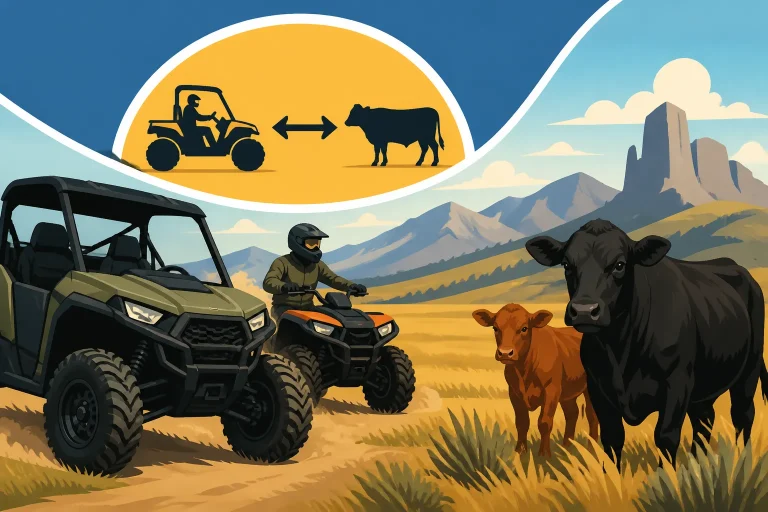
Give wildlife space and leave an escape route. Do not chase, surround, crowd, or attempt to pass close to a bear. If the animal is near the route, stop at a safe distance and assess the situation. Be prepared to back away or turn around rather than press forward. Keep other riders together and make sure no one tries to approach for photos.
The same care applies when you leave the machine. A rider who gets off to take pictures or investigate a track may be less protected by the group and more likely to move toward an animal without noticing. Stay aware of the terrain and surroundings. If you need to stop, choose a location with good visibility and avoid lingering near food, carcasses, or other wildlife attractants.
A few practical checks before setting out can make the ride safer:
- Confirm that the route is open and that you know which land manager controls it.
- Check current wildlife notices, seasonal closures, and trailhead signs.
- Put bear spray where the rider can reach it while wearing riding gear.
- Make sure everyone in the group knows where spray is carried.
- Agree that the group will stop, give wildlife room, and turn around if the route is blocked.
- Tell someone your planned route and expected return time, especially for a remote ride.
A route being open does not mean wildlife will be absent. Likewise, a lack of recent reports does not guarantee that conditions have not changed. Keep the plan flexible and do not let a destination or schedule pressure the group into approaching an animal or continuing through a questionable area.
If a bear is encountered, stay calm enough to follow the guidance for the species and situation. Do not run toward or past it. Do not make a sudden move to take a photo or reach for gear if doing so would bring you closer. Keep bear spray accessible and follow its label and the relevant wildlife guidance. Because the right response can depend on the bear’s behavior and the circumstances, review current advice before the ride rather than relying on a single rule for every encounter.
For broader preparation in grizzly country, see Bear Spray on a Machine. Riders planning to camp should also read Camping Beside a Machine in Bear Country, since safe riding practices do not replace good food storage at camp.
After an encounter and before you head home
If you use bear spray or have a close encounter, first get yourself and the group to a safer place without moving toward the animal. Do not remain at the scene to investigate or try to retrieve equipment if doing so would put anyone at risk. Once safe, notify the appropriate land manager or local authorities if the encounter involved an injured person, a bear that appears injured or unusually persistent, or a continuing hazard on a route.
Follow the reporting instructions for the area. A report can help land managers assess a hazard or decide whether a warning or temporary closure is needed. Give a clear location, the time, what happened, and whether anyone was hurt. If you do not know the exact location, use a trail name, nearby junction, or map reference rather than guessing.
After an exposure, follow the product label and seek medical advice if anyone has breathing difficulty, eye injury, or other serious symptoms. Avoid rubbing contaminated eyes or skin. Follow the label’s decontamination instructions and contact emergency services if symptoms are severe. If spray gets on clothing or equipment, keep it away from other people and handle it according to the product directions.
Before the next ride, inspect the canister and holster. Replace a used canister, and replace one that is expired, damaged, or no longer secure in its holder. Do not assume that a partly used canister will work as expected. Keep a spare stored safely at home or in a vehicle, not loose in a cargo area where it may be damaged.
The same end-of-ride routine should include checking the machine and planning the next route. Look for new closures, verify that the next trail is open to your type of machine, and make sure the group has the right permit and route information. Bear awareness is only one piece of responsible access. For other trailhead checks, What to Expect at a Trailhead Warden Checkpoint is a useful companion, and Food Storage Rules at a Trailhead covers a different but related way to reduce wildlife conflicts.
A simple rule of thumb is to carry bear spray where you can reach it, know how it works before you need it, and avoid putting yourself in a position where you must use it. The details of local rules can vary, but those habits help whether a ride is short, remote, or part of a longer trip through northwest Wyoming.
Disclaimer
This article is for general informational purposes only and does not constitute professional advice. Laws, prices and regulations vary by location and change over time. Consult a qualified professional for guidance on your specific situation.