Wyoming Rules for a Machine Over 50 Inches
It's incredibly frustrating, isn't it? You invest in a fantastic side-by-side, eager to explore Wyoming's vast landscapes, only to hear whispers about "50-inch rules" and suddenly wonder if your machine is too wide for any fun. Many riders feel that pang of anxiety, wondering if their larger UTV is destined to sit in the garage or be limited to private land. This guide is here to clear up the confusion, explaining exactly what Wyoming's rules mean for machines over 50 inches wide and how you can legally enjoy the Cowboy State's incredible backcountry and designated roads.
Understanding the "Over 50 Inches" Challenge in Wyoming
Let's face it, side-by-sides have grown. What started as smaller, agile utility vehicles has blossomed into powerful, comfortable machines often well over 60 inches wide, some even approaching 72 inches or more. This evolution brings fantastic capability and passenger comfort, but it also introduces a significant hurdle when you're trying to figure out where you can legally ride. The "50-inch rule" is probably the most talked-about, and often misunderstood, aspect of off-road riding in many states, including parts of Wyoming.
Why 50 Inches Became a Magic Number
Historically, many of the trails originally designed or maintained for ATVs (all-terrain vehicles) were built with a maximum width in mind: 50 inches. This allowed single-track trails to be cut through dense forests, across narrow bridges, and around tight corners, minimizing environmental impact and maintaining a certain level of challenge. These trails were designed for smaller, nimbler machines, and they represent a significant portion of the designated trail systems in national forests and BLM lands across the country.
When side-by-sides started gaining popularity, often exceeding this 50-inch limit, riders quickly discovered that a large number of established trails were simply off-limits to their new, wider rigs. It's a classic case of infrastructure lagging behind innovation, leaving many riders feeling like they'd bought a fantastic vehicle with nowhere to truly stretch its legs. This isn't just about fitting; it's about protecting the integrity of the trail system, preventing damage to sensitive areas, and ensuring safety on routes not built for wider traffic.
What Kind of Machines Exceed This Limit?
Generally speaking, most modern side-by-sides (UTVs) will exceed the 50-inch width. Think about popular models from manufacturers like Polaris, Can-Am, or Yamaha – many of their recreational side-by-sides, especially the multi-passenger models, are designed for stability and comfort, making them inherently wider. Even some sport quads with modified suspensions or wider A-arms can creep over the 50-inch mark.
If you're looking at a machine and wondering about its width, the easiest way to check is to measure from the widest point of the tire on one side to the widest point of the tire on the other side. Don't just go by the manufacturer's stated width for the chassis, as tires and aftermarket modifications like wider offset wheels or certain suspension kits (even from reputable brands like SuperATV) can significantly change the overall footprint. Always measure your specific machine before heading out to an unknown trail.
The Frustration of Trail Restrictions for Wider Machines
Imagine planning a fantastic trip to a national forest in Wyoming, mapping out all the exciting trails you want to hit, only to arrive and see a sign explicitly stating "50-inch maximum." It's disheartening. For owners of wider machines, this often means extensive research is required before every trip. You can't just assume any trail is open to you. This can lead to a sense of exclusion, making it feel like you're penalized for having a more capable or comfortable machine. The reality is that these restrictions are in place for valid reasons, but that doesn't lessen the frustration when you're trying to find legal and accessible places to ride your pride and joy.
This is where understanding Wyoming's broader rules, especially the Multipurpose Vehicle (MPV) classification, becomes absolutely essential. While many traditional ATV trails will remain off-limits, there are other avenues for wider machines to explore, including designated roads and specific trail systems designed to accommodate them.
The Path to Street Legality: Wyoming's MPV Classification for Wider Machines
For those with machines wider than 50 inches, navigating Wyoming's trails can be a headache. However, Wyoming offers a unique pathway for certain off-road vehicles to become "street legal" on some public roads through its Multipurpose Vehicle (MPV) classification. This is a game-changer for side-by-side owners, as it opens up a world of county roads, Forest Service roads, and BLM routes that would otherwise be inaccessible.
What Exactly is a Multipurpose Vehicle (MPV) in Wyoming?
Wyoming Statute 31-1-101 defines an MPV, and it's key to understanding where your wider machine can legally go. Essentially, an MPV is a machine that started its life as an off-road vehicle but has been equipped to meet certain on-road safety standards. Crucially for our discussion, an MPV cannot be less than 50 inches wide or exceed 65 inches in width (unless you're dealing with a specific set of rules for vehicles that weigh over 3,000 pounds, but let's stick to the common UTV scenario for now). It also needs to have a seat at least 24 inches high, and weigh between 300 and 3,000 pounds. This immediately rules out many traditional ATVs, which often fall under 50 inches, but perfectly describes many modern side-by-sides.
The MPV classification exists to bridge the gap between traditional off-road machines and street-legal vehicles. It acknowledges that many people want to use their UTVs to access trailheads, connect trail segments, or simply enjoy scenic drives on less-traveled public roads. It's not about making every machine a highway cruiser, but rather providing a practical solution for local and recreational travel. [Wyoming's MPV Definition in W.S. 31-1-101] is the place to start if you want to dive into the exact legal language.
Key Requirements for MPV Conversion
Converting your off-road machine to an MPV in Wyoming isn't just a matter of saying it is; you have to prove it by meeting specific requirements. This process involves a bit of paperwork and, more importantly, ensuring your machine is equipped correctly.
1. Machine Specifications:
- Width: Must be at least 50 inches wide but not more than 65 inches wide (tire-to-tire, widest point). If your machine is wider than 65 inches, it generally won't qualify as an MPV in Wyoming unless it falls into the over 3,000-pound commercial vehicle category, which is a different discussion entirely.
- Weight: Your machine needs to weigh between 300 and 3,000 pounds. Most UTVs fit comfortably within this range. [Wyoming MPV Weight Limits]
- Seat Height: The lowest point of the operator's seat must be at least 24 inches from the ground when measured from the bottom of the uncompressed seat cushion to the ground. This ensures a certain riding posture, distinguishing it from lower-slung vehicles. [Wyoming MPV Seat Height Rule]
- Number of Wheels: Must have at least four wheels. This generally includes all side-by-sides.
2. Required Equipment for Road Use:
Once your machine meets the physical specifications, you'll need to outfit it with specific safety equipment to be truly road-legal as an MPV. This is where you might look to aftermarket providers for reliable parts.
- Headlights and Taillights: Must have at least one headlight and one taillight, both functioning. These need to be visible from appropriate distances. [Wyoming Lighting Requirements for ORVs]
- Stop Lamps: A functioning stop lamp (brake light) is essential.
- Mirrors: You'll need at least one rearview mirror, mounted on the left side of the vehicle, providing a clear view of the road to the rear. Many riders opt for a full set of side mirrors, and you can find robust options from companies like SuperATV that are designed for the rigors of off-road use but meet road-legal specs. [Wyoming Mirror Requirements for Road Use]
- Horn: A working horn is mandatory for alerting others. [Fitting a Horn to a Road-Legal Side-by-Side]
- Red Rear Reflector: A red reflector must be mounted on the rear of the machine.
- Muffler and Spark Arrester: While always required for trail riding on public lands, they are also a given for road use to keep sound and emissions in check. [Wyoming Muffler and Spark Arrester Rules]
- Tires: Tires must be DOT-approved if you plan to hit paved roads with any regularity, though this isn't always explicitly stated for every class of enrolled road. It's a good practice for safety and longevity.
3. Registration and Titling:
This is the formal part. You'll go through your County Clerk for titling and your County Treasurer for registration and the issuance of a license plate. [Titling a Multipurpose Vehicle in Wyoming] and [Wyoming MPV Plate Requirements] are key resources here. You'll receive a plate, similar to what a car or motorcycle would have, and this plate is what signifies its legal status for road travel. Remember, this MPV registration is entirely separate from the annual Wyoming ORV permit, which is for designated off-road trails.
ORV Permit vs. MPV Registration: A Critical Distinction
It's vital not to confuse the annual Wyoming ORV permit with MPV registration.
- ORV Permit: This is a decal you purchase annually for a flat fee (often from the State Parks, Historic Sites & Trails office or authorized vendors). It allows you to ride on designated ORV trails and enrolled ORV roads that are specifically marked for off-road use. It's a general permit for machines, regardless of width, to use off-highway systems. [Wyoming ORV Permits Explained]
- MPV Registration & Plate: This is a process akin to registering a car. You get a title from the County Clerk and a license plate from the County Treasurer. It allows your equipped and qualified wider machine (between 50 and 65 inches wide, 300-3000 lbs) to operate on public roads that are specifically designated or "enrolled" for MPV use. These might be county roads, BLM roads, or Forest Service roads. It does not automatically grant you access to every single highway or interstate.
The MPV designation is what unlocks many of Wyoming's vast network of unpaved, secondary roads for wider machines, allowing you to connect trails and explore more freely.
Navigating Wyoming's Roads and Trails with a Wider Machine
So, you have a machine over 50 inches, maybe even legally registered as an MPV. Now what? Where can you actually ride in Wyoming without risking a citation? The Cowboy State offers a surprising number of opportunities for wider machines, but it requires careful planning and a clear understanding of the rules.
Where Wider Machines Can Ride Legally
The good news is that an "over 50 inches" machine isn't doomed to sit in the garage. Wyoming provides several avenues for legal riding:
1. Designated MPV-Enrolled Roads: This is the primary benefit of the MPV classification. Once your machine is titled and plated as an MPV, you can legally drive it on public roads that have been enrolled for MPV use. This includes a vast network of county roads, Forest Service roads, and Bureau of Land Management (BLM) roads. Many of these roads were once simply gravel or dirt routes primarily used by ranchers or for access to dispersed camping, but are now open to MPVs. [Wyoming's Enrolled Roads and Trails] is your go-to resource for finding these routes. It's crucial to understand that not all roads are enrolled, and you must look for signs or consult official maps (often called Motor Vehicle Use Maps or MVUMs for federal lands) to confirm.
- County Roads: Many Wyoming counties have opened up their extensive networks of gravel and dirt roads to MPVs. This provides excellent opportunities for scenic drives and connecting different areas.
- Forest Service Roads: The Medicine Bow-Routt National Forest and the Bighorn National Forest, for example, have many roads that are open to MPVs. These often lead to incredible vistas and remote recreation areas. [Riding the Medicine Bow National Forest] and [Riding Wyoming's Bighorn National Forest] cover these areas.
- BLM Roads: The Bureau of Land Management manages millions of acres in Wyoming, and a significant portion of their road system is open to MPVs. These roads are typically less maintained and offer a true backcountry experience. [Wyoming's 40,000 Miles of BLM Road]
- Connecting Trail Segments: One of the greatest advantages of MPV status is the ability to use enrolled roads to link sections of designated trails, avoiding the need to load your machine onto a trailer for short transfers.
2. Open Play Areas and Wide OHV Trails: Some specific riding areas are designed to accommodate wider machines or have "open play" designations where width isn't a factor.
- Killpecker Sand Dunes: Located near Rock Springs, this vast dune system in southwest Wyoming is a prime example of an open riding area where width restrictions generally don't apply. It's a fantastic destination for side-by-sides. [Killpecker Sand Dunes in Southwest Wyoming]
- Certain Trail Systems: While many trails are 50-inch limited, some newer trail systems or specific routes within larger networks are built wider. Always check the current Motor Vehicle Use Maps (MVUMs) for National Forests and BLM lands. These maps explicitly show which routes are open to which vehicle types and width limits. When you see a map indicating "routes open to vehicles 62 inches or less," you know you've found a spot for your wider side-by-side. [Wyoming Trails for a Wide Side-by-Side]
3. Private Property with Permission: This is always an option. If you have permission from the landowner, you can ride your machine, regardless of width, on private land.
Where Wider Machines Cannot Legally Ride
Just as important as knowing where you can ride is knowing where you can't. Breaking these rules can lead to significant fines and damage to the reputation of the riding community.
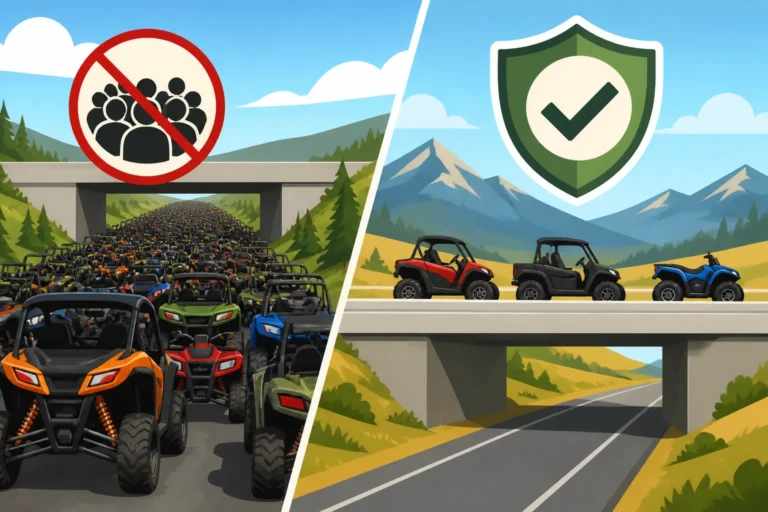
1. 50-Inch Restricted Trails: This is the big one. If a trail is explicitly marked or mapped as "50 inches or less," do not take your wider machine on it. These restrictions are often in place for environmental protection, trail maintenance, and safety reasons. Trying to force a wider machine down a narrow trail can cause excessive erosion, damage trail infrastructure (like bridges or culverts), and widen the trail illegally.
2. Non-Enrolled Public Roads: Even with MPV plates, you cannot simply drive on any public road. Main highways, interstates (with very limited exceptions for crossings, like those detailed in [Wyoming Rules for Crossing an Interstate]), and city streets typically require full street-legal registration as a car or truck, not just MPV status. Always check if a road is designated or "enrolled" for MPV use. Just because it's a dirt road doesn't mean it's automatically open to your MPV.
3. Closed Areas and Wilderness Areas: Always respect closures, whether seasonal (for wildlife protection, mud, or fire danger) or permanent (like designated Wilderness Areas, where motorized travel is prohibited).
4. Off-Route Riding: Even in open areas or on wide roads, going "cross-country" or creating new routes off the designated path is almost universally prohibited on public lands in Wyoming. Stick to marked trails and roads. [Wyoming Penalties for Leaving a Route]
Practical Tip: Always carry up-to-date maps (digital or paper) that show designated routes and their restrictions. The MVUMs for federal lands are your best friend. A good GPS unit with preloaded trails or an app on your phone can be invaluable, but always cross-reference with official maps.
Essential Gear and Considerations for Your Over-50-Inch Ride
Taking a wider machine out on Wyoming's roads and trails, especially as an MPV, comes with specific considerations. Beyond the legal requirements, there are practical aspects of safety, preparation, and maintenance that will ensure you have an enjoyable and responsible experience.
Measuring Your Machine Correctly
Before you even think about applying for an MPV plate or heading to a new trail, grab a tape measure. As mentioned earlier, the width is measured from the widest point of the tire on one side to the widest point of the tire on the other side. This is crucial because aftermarket modifications can easily push your machine over the 50-inch limit for trails, or even over the 65-inch MPV limit, rendering it ineligible for certain uses.
Consider whether wider offset wheels, beadlock rings, or a long-travel suspension kit (some of which are offered by aftermarket companies like SuperATV) have changed your machine's original factory width. Even a small increase can make a difference. Don't guess; measure. This simple step can save you a lot of headache and potential fines down the road.
Outfitting Your MPV for Road Legality
If you're going the MPV route, ensure all the required road-legal equipment is properly installed and functional. Don't cut corners here. A quick checklist before every ride on an enrolled road is a smart habit:
- Headlights, Taillights, Brake Light: All working? Clean and visible?
- Horn: Does it honk clearly?
- Mirrors: Are they secure and giving you a good view behind you? [The Left-Side Mirror Wyoming Wants]
- Reflector: Is it clean and visible on the rear?
- Spark Arrester & Muffler: Is it a USFS-approved spark arrester? Is your muffler sound-compliant? [Wyoming Spark Arrester and Sound Rules]
Beyond the legal necessities, consider adding things like a small tool kit, tire repair kit, first-aid kit, and enough water and snacks for your planned route. When you're out on remote Wyoming roads, help can be a long way off.
Safety on Wyoming's Roads and Trails
Riding a wider machine, especially an MPV on roads, comes with its own set of safety guidelines:
- Helmets: While not always legally mandated for adults on enrolled roads (only required for riders under 18 in Wyoming), wearing a helmet is always a smart choice for any off-road or road-connecting ride. [Wyoming Helmet Law for ATV Riders]
- Driver's License & Endorsement: If you're operating an MPV on enrolled roads, you'll need a valid driver's license. Depending on the machine and your age, an M or MR endorsement might be required. [Wyoming Driver's License Rules for ORVs]
- Insurance: MPVs operating on public roads in Wyoming are generally required to carry liability insurance, just like any other motor vehicle. Always have proof of insurance with you. [Wyoming ATV Insurance Requirement]
- Stay to the Right: On shared roads, always keep to the right side of the road and be prepared to yield to larger vehicles like trucks or cars, which may not expect to see an MPV. [Keeping to the Right Edge in Wyoming]
- Slow-Moving Vehicle Emblem: For machines that don't regularly maintain speeds over 25 mph, a slow-moving vehicle emblem (the orange triangle) may be required on the rear, especially on roads with higher speed limits or limited visibility. [Wyoming Slow-Moving Vehicle Emblem Rules]
- Respect Others: Be mindful of other road users – ranchers, hunters, cyclists, or hikers. Slow down, reduce dust, and wave.
- Wildlife: Wyoming is home to abundant wildlife. Be constantly vigilant for deer, elk, antelope, and even moose, especially at dawn and dusk.
- Weather: Mountain weather can change rapidly. Be prepared for sudden storms, temperature drops, or even early-season snow.
By taking the time to understand Wyoming's specific rules for machines over 50 inches and equipping your vehicle properly, you can confidently and safely explore the vast and beautiful landscapes the state has to offer. Don't let the "50-inch rule" deter you; just make sure you're riding smart and legally.
Disclaimer
This article is for general informational purposes only and does not constitute professional advice. Laws, prices and regulations vary by location and change over time. Consult a qualified professional for guidance on your specific situation.