Riding a Two-Track Across a Pasture
There's nothing quite like the open expanse of Wyoming, the big sky stretching out, and the promise of miles of trail under your tires. But for many off-road enthusiasts, the thought of cutting across a vast, beautiful pasture on a two-track road can bring a mix of excitement and apprehension. It's a common frustration to see what looks like a clear path, only to wonder if you're about to trespass or damage private property. This guide is here to clear up the confusion, helping you understand the rules, etiquette, and legalities involved in riding those intriguing two-tracks across Wyoming's incredible landscape, ensuring you can explore safely and respectfully.
Understanding Two-Tracks and Pasture Access in Wyoming
Wyoming's landscape is crisscrossed with countless unpaved routes, from well-maintained gravel roads to faint paths barely discernible from the surrounding sagebrush. Among these, the "two-track" holds a special place in the hearts of off-road riders – and often, a lot of questions.
What Exactly is a Two-Track?
Imagine a path worn into the earth by years, sometimes decades, of vehicles driving over the same ground. These aren't formally engineered roads with culverts and graded shoulders; instead, they are simply two parallel ruts, perhaps with a strip of grass or brush growing in the middle. They often follow old fence lines, lead to remote wells, or connect one section of property to another. Sometimes they're barely more than game trails that have seen occasional vehicle traffic. They might be maintained by ranchers, oil and gas companies, or simply kept open by the occasional traveler. Because they're not always clearly marked or even listed on official maps, they can be a real mystery. You might be riding along a perfectly legitimate public access route one moment, and then without realizing it, veer onto a private track meant only for specific property owners. It's this lack of clear designation that makes them so alluring for adventure but also so fraught with potential issues.
The Allure and Ambiguity of Pasture Riding
The appeal of riding a two-track across a wide-open pasture is undeniable. It evokes a sense of freedom, adventure, and connection to the vast, wild heart of Wyoming. These routes often lead to breathtaking vistas, remote fishing spots, or simply offer a different perspective of the landscape than a typical paved road. For many, it's the quintessential Wyoming off-road experience. However, this allure is heavily tempered by ambiguity. Unlike a clearly signed national forest trail, a two-track in a pasture rarely comes with a "Public Access" sign. This leaves riders in a constant state of uncertainty: Is this route truly public? Am I about to cross someone's private land? What if I encounter livestock or a rancher? This uncertainty can transform an exciting ride into a stress-inducing experience, making it hard to relax and enjoy the scenery. The challenge lies in distinguishing between legal, accessible routes and private paths, which often look identical at first glance.
Identifying Public vs. Private Two-Tracks
This is where the rubber meets the road, quite literally. Identifying whether a two-track is public or private is perhaps the biggest hurdle. In Wyoming, simply because a gate is open, or there's no "No Trespassing" sign, doesn't automatically mean public access. Many two-tracks are established on private property for ranching operations, access to mineral leases, or simply for the landowner's convenience. Some public lands, particularly those managed by the Bureau of Land Management (BLM), have an extensive network of two-tracks that are open to public use. However, these often crisscross or border private parcels, creating a complex patchwork. Land status maps, often called plat maps or surface ownership maps, are your best friend here. These maps, sometimes available online from county assessors or through specialized mapping apps, show property boundaries and ownership. It’s also important to understand the concept of "designated routes." On federal lands, you can't just ride anywhere; you must stick to routes that are explicitly marked as open, often found on Motor Vehicle Use Maps (MVUMs) for National Forests or BLM Travel Management Plans. If a two-track isn't on one of these official maps, it's best to assume it's closed or private unless you have explicit permission.
Navigating Legalities: Public vs. Private vs. Trust Lands
Understanding whose land you're on is paramount when riding a two-track in Wyoming. The state has a mix of federal, state, and private lands, each with its own set of access rules. Ignoring these can lead to fines, citations, or worse, strained relationships with landowners.
The Critical Role of Land Ownership
Before you even think about putting your tires on a two-track, knowing the land ownership status is the absolute first step. Wyoming is a "checkerboard" state, particularly in its eastern and central regions, due to historical land grants. This means public and private land parcels can alternate every square mile, creating a dizzying pattern of ownership. What looks like one continuous pasture might actually be a mix of private ranchland, BLM ground, and state trust land. The crucial point here is that trespass laws are strictly enforced. Ignorance of land boundaries is rarely accepted as an excuse. This is why investing in good mapping software or physical maps that clearly delineate land ownership is not just a good idea, it's essential for any responsible off-road rider in Wyoming. Tools that overlay land ownership with topographical features can be invaluable.
Wyoming's Rules for Riding Public Land
When you're on federal public lands, primarily National Forests and Bureau of Land Management (BLM) acreage, you generally have a right to access, but that access comes with rules. The most important rule on these lands is that you must stay on "designated routes." This means roads and trails that are officially marked and published on specific maps, such as Motor Vehicle Use Maps (MVUMs) for National Forests or various travel management plans for BLM districts. Many two-tracks on BLM land are designated routes, but not all. A two-track might simply be an old ranch road that hasn't been officially designated for public motorized use. [Wyoming Rules for Riding Federal Land] cover these specifics. If a two-track appears on an MVUM or BLM travel map as an open route, then you're generally good to go, provided your machine meets all other Wyoming ORV requirements, including having a valid [Wyoming's Annual ORV Permit]. Even on public land, respect for the environment and other users (like horseback riders or hikers) is key.
The Nuances of State Trust Land and Private Property
State Trust Lands in Wyoming are managed by the Office of State Lands and Investments, and their primary purpose is to generate revenue for public education and other state institutions. While some state trust lands are open for recreational use, it's not always a given. Often, a specific permit is required. For example, you might need to purchase a [Wyoming State Trust Land Permit Cost] before recreating on these parcels. The rules for accessing these lands can differ from federal lands, so it's vital to check with the Office of State Lands and Investments for current regulations.
Private property is the simplest, yet often most misunderstood, category. If a two-track crosses private land, you absolutely must have explicit permission from the landowner to ride it. This permission should ideally be in writing, especially if you're exploring a new area or don't personally know the rancher. Oral permission can be sufficient, but in a dispute, written proof is always better. Many ranchers use two-tracks as their private access roads, and your presence could interfere with their operations, disturb livestock, or simply make them uneasy. [Wyoming Trespass Rules for Riders] are clear: unauthorized entry onto private land is illegal. It's always better to err on the side of caution and seek permission if you have any doubt.
Understanding Section Lines
Section lines are a unique aspect of Wyoming's land access. These are not always physical roads or trails, but rather invisible lines that mark the boundaries of land sections. Historically, the law has generally held that the public has a right to use section line roads that have been established for public travel. However, the legal interpretation and practical application of this can be complex and often debated. Not every section line is a public road, and many that are legally considered public have never been developed beyond a faint two-track or are effectively blocked by natural barriers or fences. Furthermore, even if a section line technically offers public access, it might cross private land where that section line isn't developed, leading to ambiguity. Always consult detailed land maps and respect any physical barriers, such as fences or gates, that might indicate private ownership or the lack of public right-of-way. Just because a map shows a section line doesn't mean it's an open, rideable trail.
Here's a quick overview of land access types:
| Land Type | Access Rule | Best Practice for Riders |
|---|---|---|
| Federal Public Land | Restricted to designated routes (MVUMs, travel plans). | Carry current maps, stay on marked trails. |
| State Trust Land | Often requires a recreational permit. Rules can vary. | Check OSLI website for permits and specific regulations. |
| Private Property | Explicit permission from landowner is always required. | Seek written permission; respect all "No Trespassing" signs. |
| Section Lines | Public access often implied, but legal status can be complex. | Verify public status with county, respect physical barriers. |
Essential Rules for Respectful and Safe Riding
Beyond the legalities, there are unwritten rules of the range that every responsible off-road rider should follow. These are about respect, safety, and ensuring that access to these incredible lands remains open for everyone.
The "Close the Gate" Rule and Livestock Safety
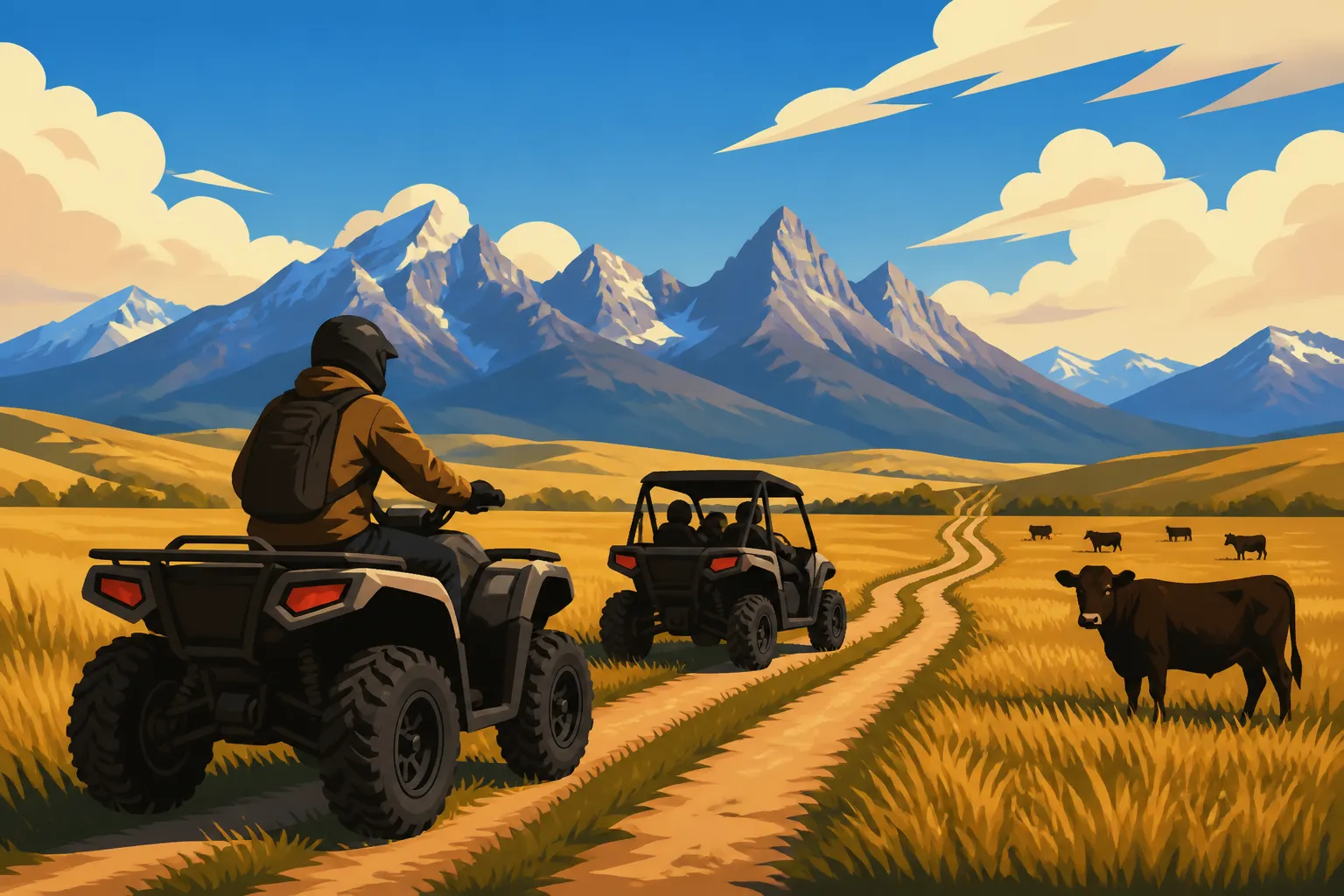
This is perhaps the most fundamental rule of riding in Wyoming's ranching country: always, always close gates that you open, and if a gate is closed, leave it that way unless you have explicit permission to pass. It seems simple, but forgetting this can have severe consequences for ranchers, whose livelihoods depend on keeping their livestock contained. An open gate means cattle can wander onto roads, get lost, or mix with other herds, costing the rancher time, money, and stress. If you see livestock, slow down, give them a wide berth, and never harass them. Accelerating through a herd or trying to "shoo" them with your machine is irresponsible and can injure animals or provoke protective mothers. [Wyoming Rules for Riding Near Livestock] are in place for a reason. Imagine the frustration of a rancher who finds their cattle scattered because someone left a gate open. This small act of courtesy is a giant step towards fostering goodwill between riders and landowners.
Respecting Property and Preventing Damage
Wyoming's pastures, while seemingly rugged, are delicate ecosystems. Staying on existing two-tracks is crucial for preventing damage to fragile soils, native vegetation, and water sources. Driving off-trail can lead to erosion, spread noxious weeds, and disturb wildlife. Always avoid driving through muddy areas if possible, as it widens the trail and creates deep ruts that can be impassable for others. The idea is to "tread lightly" – leave no trace of your passage. This also extends to trash. Pack out everything you pack in, and if you see litter, consider picking it up. Respecting property means not only staying off private land without permission but also understanding the impact your machine has on the land you are allowed to ride. For example, if you're riding a two-track that is part of a grazing allotment, remember that this land is also someone's workplace. Minimizing your impact is a sign of respect.
What to Do If You Encounter a Landowner
It's inevitable that you might encounter a landowner or ranch hand while riding a two-track in a pasture. This can be an intimidating moment, especially if you're unsure of your location or permission status. The best approach is always to be polite, respectful, and cooperative. Pull over, turn off your engine, and remove your helmet so they can see your face and hear you clearly. Greet them calmly and explain where you believe you are and your intentions. If you have permission, show it (especially if it's written). If you're unsure if you're on private land, apologize for any potential trespass, explain you were trying to navigate, and ask for guidance. Avoid confrontation or arguing. A positive, respectful interaction can turn a potentially negative situation into a learning opportunity, and it helps build a better reputation for all off-road riders. Many ranchers are reasonable people and appreciate honest communication, even if you've made an honest mistake.
Preparing Your Machine and Yourself for Pasture Riding
Riding two-tracks across pastures can be demanding on both your machine and your riding skills. Proper preparation is key to a safe and enjoyable outing, preventing breakdowns and ensuring you're ready for whatever the Wyoming landscape throws at you.
Equipping Your Machine for Rough Terrain
Two-tracks, especially those less traveled, can be rugged. They might have large rocks, deep ruts, or stretches of overgrown brush that can snag or damage your machine. Investing in some essential protection for your ATV or UTV is a smart move. Skid plates, for instance, protect the underside of your machine – the engine, transmission, and frame – from impacts. Many riders find that aftermarket options, such as those from SuperATV, offer more comprehensive coverage and durability than factory-installed plates. High-clearance A-arms can also be a game-changer, lifting your machine slightly for better ground clearance and reducing the chance of getting hung up on obstacles.
Tire choice is another critical factor. While aggressive knobby tires are great for mud, a more versatile all-terrain tire with good sidewall protection might be better for the varied surfaces of a two-track, from soft dirt to rocky sections. Always check your tire pressure before heading out, as the right pressure can improve traction and reduce the risk of punctures. It's also wise to carry a basic toolkit, tire repair kit, and a small air compressor. Even the most robust machine equipped with durable SuperATV components can experience a flat or minor issue far from civilization. A well-prepared machine makes the ride more enjoyable and much safer.
Carrying the Right Documentation and Gear
Never leave home without your essential documents. This includes your driver's license, proof of vehicle registration, and your valid [Wyoming ORV Permit Explained]. For non-residents, remember that [Does Wyoming Honor a Montana Registration?] (or any other state's registration)? No, so you'll still need a Wyoming decal. Keep these documents in a waterproof bag, easily accessible but protected from the elements. Beyond paperwork, personal gear is crucial. Wear appropriate riding attire, including a helmet, eye protection, gloves, long pants, and sturdy boots. The weather in Wyoming can change rapidly, so layered clothing is always a good idea, even on a sunny day. Pack extra water, high-energy snacks, a first-aid kit, and sunscreen. A small shovel, tow strap, and a reliable headlamp or flashlight can also be invaluable for unexpected situations.
Planning Your Route and Sharing Your Location
Even if you're a seasoned rider, exploring new two-tracks requires careful planning. Don't rely solely on cell phone service, as many remote areas of Wyoming have no signal. Invest in a good GPS unit or use a mapping app on your phone that allows for offline map downloads. Mark your planned route and potential turn-around points. Always tell someone reliable where you're going, your planned route, and when you expect to return. This "float plan" is a vital safety measure. Consider carrying a satellite messenger or a personal locator beacon (PLB) for emergencies, especially if you're venturing far off the beaten path. These devices can transmit your location to emergency services, even without cell service. Knowing that your machine, perhaps upgraded with sturdy SuperATV accessories, is ready for the terrain, and that you're personally prepared for any eventuality, allows you to truly relax and enjoy the unique experience of riding Wyoming's two-tracks across its magnificent pastures.
Disclaimer
This article is for general informational purposes only and does not constitute professional advice. Laws, prices and regulations vary by location and change over time. Consult a qualified professional for guidance on your specific situation.