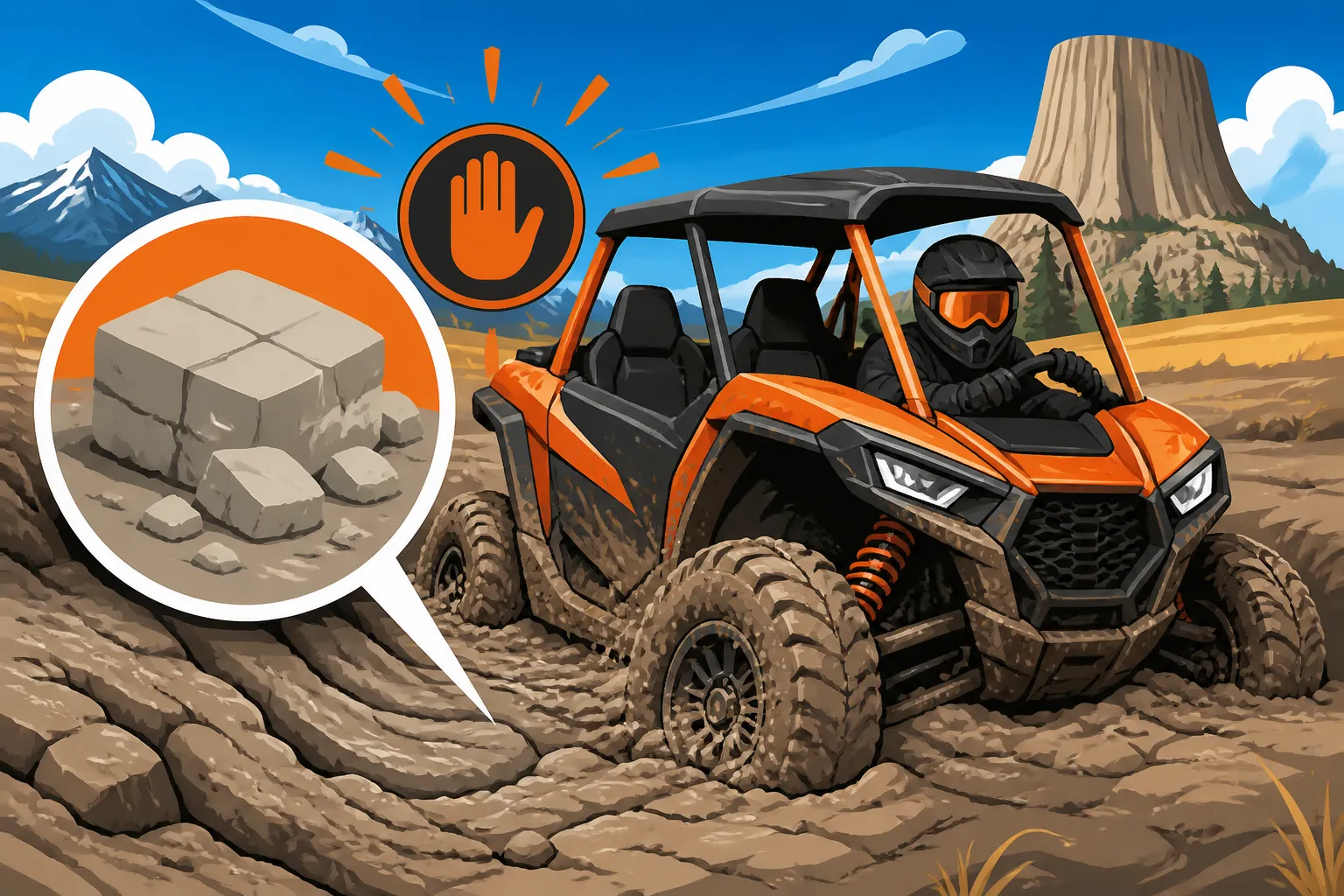
Bentonite Mud and Why It Stops You
Bentonite mud can turn a Wyoming ATV or UTV ride into a frustrating recovery surprisingly fast. A dry-looking track may hide slick clay that coats tires, packs into tread, and makes steering unreliable. This guide explains why bentonite is so troublesome, how to assess conditions before riding, and what to do if your machine starts losing traction.
Why Wyoming bentonite mud is so difficult to ride
Bentonite changes when it gets wet
Bentonite is a clay that absorbs water and becomes soft, sticky, and slippery. On a trail, that combination can be much harder to manage than ordinary damp soil. Instead of breaking apart cleanly under a tire, wet clay can smear across the surface and create a slick layer between your tread and the ground.
It can also cling to tires and undercarriage parts. As mud fills the spaces between tread blocks, the tire loses the edges it needs to grip. A machine that felt capable on dry ground may suddenly spin, slide sideways, or struggle to climb even a modest incline.
That change can happen before the trail looks dramatically muddy. A thin layer of wet clay over a firm base may offer less traction than a deeper patch of loose dirt. This is one reason riders can be caught off guard: the surface may seem manageable until the tires start spinning.
A dry crust does not guarantee a firm trail
Bentonite can dry into a hard-looking crust while staying soft underneath. A tire may break through that top layer and sink into the damp material below. The result can be an abrupt loss of traction, especially in ruts, shaded sections, low spots, and places where water collects.
The opposite can happen, too. A trail may be dry enough to cross in one section and sticky only a short distance away. Changes in slope, drainage, sun exposure, and recent precipitation all affect how the ground behaves. A route that was passable on a previous outing may be very different after a storm or a thaw.
For a ride near Casper, conditions around [Poison Spider for an Afternoon] may differ from what you find on the approach or on another part of the area. Treat a recent report as useful context, not a guarantee. If the ground is wet or the trail surface looks uncertain, turning around early may be the safest and least damaging choice.
The risks extend beyond getting stuck
Poor traction can make a machine slide across a slope or drift toward a rut, edge, or obstacle. In a side-by-side, extra weight and momentum can make recovery more complicated. On an ATV, a sudden sideways slide can unsettle the rider and make it harder to steer where intended.
Repeated attempts to power through can deepen ruts and damage the trail. Spinning tires may also dig a machine farther into soft ground, while mud packed into the tread makes each attempt less effective. A difficult crossing can quickly become a bigger problem for the rider, the machine, and other trail users.
| Trail condition | What it may indicate | A sensible response |
|---|---|---|
| Smooth, glossy clay surface | Wet clay with limited tire grip | Slow down and consider turning back |
| Hard crust over a soft spot | Damp ground beneath a dry-looking layer | Avoid abrupt throttle or steering |
| Deep ruts holding water | Saturated ground or poor drainage | Do not assume the rut is safe to cross |
| Mud packed into tire tread | Reduced tread grip | Stop somewhere safe and inspect the machine |
| Fresh tracks through a wet area | Recent use, not proof of safe conditions | Assess the ground yourself before proceeding |
How to assess the route before you ride
Check maps, closures, and recent conditions
Before loading the ATV or UTV, check the land manager’s current travel information and any posted restrictions. A route appearing on a map does not always mean it is open to your machine or suitable under today’s conditions. Look for closures, seasonal restrictions, and route designations, then confirm what the signs at the trailhead say.
A mapping app such as onX Offroad can help you review route layout and identify alternatives before you leave. Use it as a planning aid rather than a substitute for land-manager information, physical signs, or judgment on the ground. Save the map information you need in advance if you may be riding somewhere with limited cell service.
It can also help to tell someone where you plan to ride and when you expect to return. If the route becomes impassable, a planned turnaround point and a reliable way to communicate can make a difficult day less stressful. For more on route planning, see [Wyoming Trail Maps and MVUMs] and [Wyoming Trail Closures to Check First].
Read the ground as you approach
As you near a questionable patch, stop before the machine enters it. Look for water, glossy surfaces, fresh tire tracks, and changes in color or texture. Notice where the ground slopes and where water would naturally drain. If the trail has a bypass, do not assume it is an authorized route; follow the designated route and posted directions.
Avoid using speed to test the surface. A fast approach can leave little room to react if the tires slide or sink. If you are riding with others, pause and talk through the route rather than letting each person make a separate guess. One cautious decision at the front can prevent several machines from getting stuck in the same spot.
The onX Offroad map can help you understand where you are in relation to mapped routes and possible exits, but it cannot tell you whether a patch of clay is firm today. Conditions change too locally for a map to make that call. If you cannot confidently assess the surface, choosing a different route is reasonable.
Match your plan to the machine and the group
A wide, heavy UTV and a smaller ATV may respond differently to the same muddy section. Tire type, tread condition, ground clearance, load, and rider experience also matter. A machine that handles dry climbs well is not automatically suited to slick clay. Avoid treating another rider’s successful crossing as proof that your setup will behave the same way.
Keep the group’s least experienced rider and least capable machine in mind when choosing a route. A narrow trail with limited room to turn around can become stressful if someone loses traction. Before setting out, agree that anyone can call for a stop or turnaround without pressure to continue.
Plan for the possibility that you may need to wait, retrace your route, or take a different trail. Check [Wyoming's 50-Inch Trail Limit] if you are selecting trails for a wider machine, and review [Where to Ride When Your Machine Is Too Wide] when the mapped route options do not suit your vehicle.
What to do when your machine starts losing traction
Stop before wheelspin makes the problem worse
If the tires begin spinning, ease off the throttle and stop somewhere stable if you can. Continuing to apply power may polish the clay, fill the tread with mud, or dig the machine deeper. Keep your movements controlled and avoid sharp steering inputs that could cause a slide.
Once stopped, take a moment to assess what is ahead and behind. Is the machine on a slope? Is there space to reverse safely? Is the trail edge firm, or could it collapse under the vehicle? Do not ask someone to stand directly in the path of a sliding or recovering machine.
If the machine is stable, carefully check whether mud has clogged the tires or collected around moving parts. Clear only what you can reach safely, with the machine secured and shut off where appropriate. Mud can hide sharp objects and hot components, so avoid reaching blindly beneath the vehicle.
Choose recovery methods carefully
The best recovery may be backing out along the track you just used, but only if the route is stable and the maneuver is safe. A gradual, controlled movement is preferable to repeated bursts of throttle. If the machine is sliding or deeply bogged, stop and get help rather than adding more momentum to an uncertain situation.
Use recovery equipment only if you know how to operate it and have suitable, secure anchor points. Keep people clear of tensioned straps and recovery lines, and never attach equipment to a part of the machine that is not designed for recovery. If you are unfamiliar with the process or the machine is on a dangerous slope, wait for trained help rather than improvising.
A group should agree on roles before anyone begins a recovery: one person operates the machine, another directs from a safe position, and others stay well clear. Avoid crowding around the vehicle. If a recovery attempt makes the situation worse, pause and reassess instead of repeating it with more force.
Turn back when the trail is no longer a good risk
There is no shame in abandoning a route. If the trail ahead is saturated, the machine is struggling, or turning around would be difficult later, stop while you still have room to make a safe decision. Returning by a known route is often more sensible than pushing farther into terrain that may have no easy exit.
Think about the impact on the trail as well. Deep ruts and broad detours can damage the surface and make future travel worse. Stay on designated routes, avoid creating a new bypass, and follow local restrictions. Guidance in [Wyoming Rules for Riding a Designated Route] and [Wyoming Penalties for Leaving a Route] can help clarify why staying on an authorized route matters.
If you are unsure which mapped route is open, or a sign conflicts with what you expected from your planning, stop and verify before continuing. onX Offroad can help you orient yourself and review the route you planned, but posted closures and land-manager directions should guide your decision on the ground.
How to reduce the odds of a bentonite breakdown
Prepare the machine and carry sensible essentials
Before the ride, inspect tires for suitable tread and damage, and make sure the machine is in sound working order. Pack water, warm layers, a first-aid kit, basic tools, and communication equipment appropriate to the remoteness of your route. Recovery gear should be in good condition, and everyone in the group should know where it is and how it is intended to be used.
Carry navigation information that remains available if your phone loses service. onX Offroad can be useful for reviewing saved routes, but bring a backup plan and know how to use it before you need it. A map is only helpful when you can locate yourself and interpret the route information while under pressure.
If you expect muddy conditions, consider whether the ride should be postponed. A machine can be cleaned later; a difficult recovery in a remote area can consume daylight, expose riders to worsening weather, and put unnecessary strain on equipment.
Leave the trail in good condition
When conditions are soft, avoid widening the trail to get around a muddy patch. Do not cut across vegetation or drive around barriers. If the route is closed or conditions make travel damaging, turn back and report a hazard or closure issue through the appropriate land manager’s channel.
After the ride, clean mud from the tires, undercarriage, and other areas where buildup could interfere with inspection or operation. Check for damage before the next outing. A careful look can reveal a loosened component, packed debris, or a problem that was difficult to notice in the field.
Bentonite is challenging because it can change from firm-looking ground into slick, tire-clogging clay with little warning. Checking conditions, riding conservatively, and turning around before traction disappears are practical ways to protect both your group and the trail. The safest ride is not always the one that reaches the farthest point; sometimes it is the one that recognizes when the ground has changed.
Disclaimer
This article is for general informational purposes only and does not constitute professional advice. Laws, prices and regulations vary by location and change over time. Consult a qualified professional for guidance on your specific situation.