Snowdrifts on a High Forest Road
A forest road can look clear for miles, then disappear beneath a hard wall of snow around a shaded bend or windblown ridge. In Wyoming, that can turn a pleasant ATV or UTV ride into a recovery problem fast. This guide explains why drifts linger, how to check conditions, what to carry, and when turning around is the smartest choice.
Why snowdrifts linger on Wyoming forest roads
Wind and terrain create sudden barriers
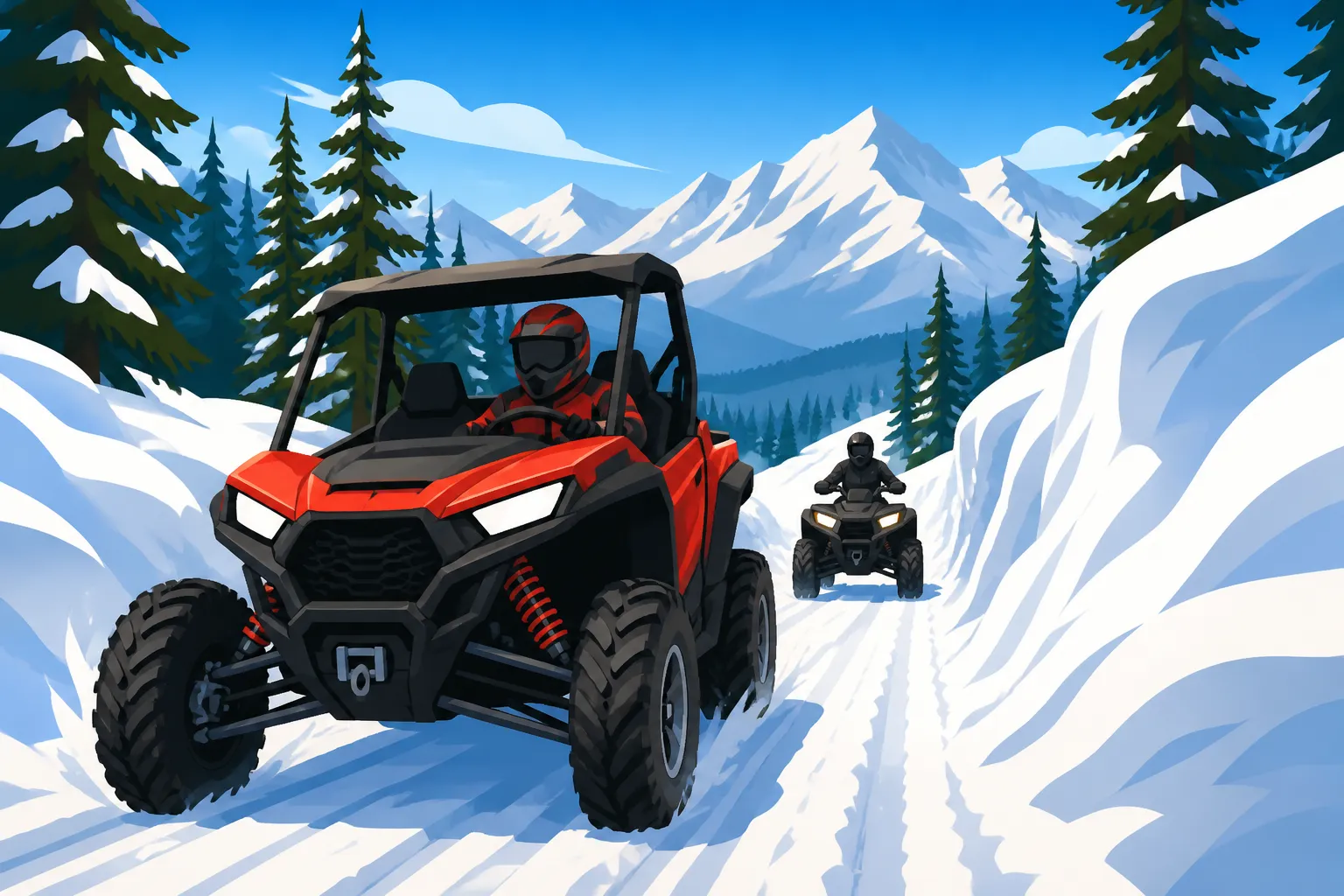
A snowdrift is not simply a patch of winter snow that has not melted yet. Wind moves snow from exposed areas and piles it into sheltered places, so the road may be bare across an open slope but blocked in a cut, at a bend, or behind a ridge. A drift can also have a firm, crusted surface that hides softer snow underneath. From the driver’s seat, it may be hard to judge how deep or stable it is.
The road’s shape matters. A bank on the uphill side can limit where snow goes, while a narrow cut through a slope can collect it. Wind can also build a drift across the road at a high point, even when nearby ground looks mostly clear. On a machine, those changes can arrive quickly: clear gravel, a short snowy stretch, then a drift deep enough to stop forward progress.
Shade and elevation slow the melt
High forest roads often stay snowy after lower roads have cleared. North-facing slopes, dense timber, and deep road cuts receive less direct sunlight. Snow may melt during warm afternoons and refreeze overnight, leaving a hard surface in the morning and soft, wet snow later in the day. Meltwater can also run across the road and freeze in shaded sections.
That is why a report from town, a nearby highway, or even a lower trailhead may not tell you much about conditions farther up the mountain. Roads in the Snowy Range, Medicine Bow National Forest, and Bighorn National Forest can vary sharply with elevation and aspect. A route that is dry at the start may still have a stubborn drift higher up. For seasonal context, see [Snowy Range Trails Out of Laramie, Wyoming] and [Bighorn Roads Closed Until June].
How to assess a route before you ride
Check closures and maps, then confirm what they cannot tell you
Start by checking the land manager’s current travel information for the exact road or route you plan to use. A trail map can show which routes are designated, but it does not necessarily show whether a drift currently blocks a particular mile. Check for seasonal closures, gates, restrictions, and notices before leaving home, then look again before you unload. [Wyoming Trail Closures to Check First] and [Reading a Wyoming Travel Management Map] can help you think through those checks.
Digital mapping tools, including onX Offroad, can help you locate roads, see your position, and plan a route back to a known junction. They are useful for orientation, especially when snow obscures the road edge or covers familiar landmarks. But a mapped line is not proof that the route is open or passable today. Download maps for offline use before losing service, and compare them with official land-manager information and posted signs on the ground.
Read the snow and the road as you approach
Before committing to a drift, stop well short of it on stable ground. Look for clues: the drift’s width and depth, whether the road edge is visible, whether water is running beneath or across the snow, and whether there is room to turn around without driving onto fragile vegetation. If another machine has crossed, its tracks do not prove the route is safe. The snow may have softened since then, or the earlier rider may have had different equipment and experience.
Conditions can change during the day. A frozen surface early in the morning may become slushy and rutted after several hours of sun. Those ruts can trap tires or pull a machine toward the shoulder. If you are already seeing frequent snow patches, wet road sections, or deep wheel tracks, treat each new drift as a reason to reassess rather than assuming the next one will be manageable.
| What you see | What it may mean | Safer response |
|---|---|---|
| A shallow-looking drift with no visible road edges | Snow depth may be difficult to judge | Stop before it and assess from stable ground |
| Water flowing across or under the snow | A weak spot or concealed washout may be present | Avoid driving onto the drift |
| Deep ruts or a steep, soft approach | The machine may lose traction or become stuck | Turn around if there is no clear, safe passage |
| A gate, closure sign, or blocked road | The route may be closed regardless of snow conditions | Do not go around the barrier |
| Snow covering the road well beyond the drift | More obstacles may be ahead, with limited room to turn | Reconsider continuing before entering |
Riding safely when snow is still on the road
Decide in advance what will make you turn around
A useful plan is to set a turnaround point before the ride, while everyone is still warm, rested, and thinking clearly. That might be a particular junction, the first significant drift, or a point where the road becomes too narrow to turn around safely. Talk through the plan with passengers and other riders so no one feels pressured to push farther just because the group has already traveled a long way.
Be especially cautious if snow reaches the road edge on both sides, if the route slopes toward a ditch, or if you cannot see what lies beyond the drift. A machine’s four-wheel drive does not remove the risk of hidden rocks, logs, ice, or a soft shoulder. If the safe option is uncertain, backtrack while you still have room and daylight. [Wyoming Riding in Early Spring] offers additional seasonal planning context.
Avoid forcing a crossing or making a new route
Driving into a drift to “test” it can leave the machine high-centered or buried, and it may damage the road surface beneath the snow. Spinning tires can cut into wet soil, while driving around the snowbank can widen the road into vegetation or create a new track. Even a short detour can cause lasting damage when the ground is saturated from snowmelt.
Do not bypass a closed gate or sign because the road looks open beyond it. A closure may be in place for seasonal protection, road damage, wildlife, or another management reason—not simply because the surface is inconvenient. If you reach a barrier, follow it and choose a legal route elsewhere. Route information in [Medicine Bow Roads That Open Late] may help explain why some high-country roads remain unavailable after lower areas are rideable.
Preparing your machine and group for changing conditions
Pack for a delay, not just the planned ride
A short recreational ride can become a long wait if a machine gets stuck or the group has to turn back slowly. Bring warm layers, waterproof outerwear, gloves, food, water, a first-aid kit, and a charged phone or other communication device. Tell someone where you are going and when you expect to return. In areas with limited cell service, consider how you would contact help if the group cannot get back to the trailhead.
Carry recovery equipment appropriate for your machine and know how to use it before you need it. A tow strap, basic tools, and a tire repair kit may be useful, but recovery gear is not a reason to enter questionable snow. Keep passengers informed, and do not separate the group to scout a route unless there is a clear communication and safety plan. A cold passenger or a rider who is tired can make a difficult turnaround more complicated.
Match the plan to daylight, weather, and the machine
Check the forecast for the elevation and area you intend to ride, not only the nearest town. Mountain weather can change quickly, and a warm day below the forest may still mean cold temperatures, wind, or fresh snow higher up. Leave enough time to return before dark; wet gloves and fading light make it harder to spot ice, ruts, and road edges.
Be realistic about your machine’s clearance, tires, load, and passengers. A heavy side-by-side carrying several people may behave differently in soft snow than a lightly loaded quad. Do not assume a more capable machine makes every crossing safe. If the route is open and snow has melted enough for riding, conditions can still be slick or muddy. [Wyoming Riding in Midsummer] provides a useful contrast with the shoulder-season conditions that often complicate high-elevation travel.
Make the turnaround part of the trip
Turning around is not a failed ride. It is a decision that protects your group, your machine, and the road. If a drift blocks your route, take note of the location, turn around only where the surface is firm enough, and avoid making a wider track while maneuvering. Share useful condition information with the appropriate land manager when practical, especially if a closure or road hazard is not clearly marked.
A good Wyoming ride is not measured by how far you push into the mountains. It is measured by getting everyone back safely and leaving the route in good condition. Check the route again before your next trip; sun, wind, and overnight temperatures can change a road substantially. OnX Offroad can help you retrace your route or find a mapped junction, but pair it with official closure information and what you see on the ground. On high forest roads, a conservative turnaround often preserves the chance to enjoy the same area on a better day.
Disclaimer
This article is for general informational purposes only and does not constitute professional advice. Laws, prices and regulations vary by location and change over time. Consult a qualified professional for guidance on your specific situation.