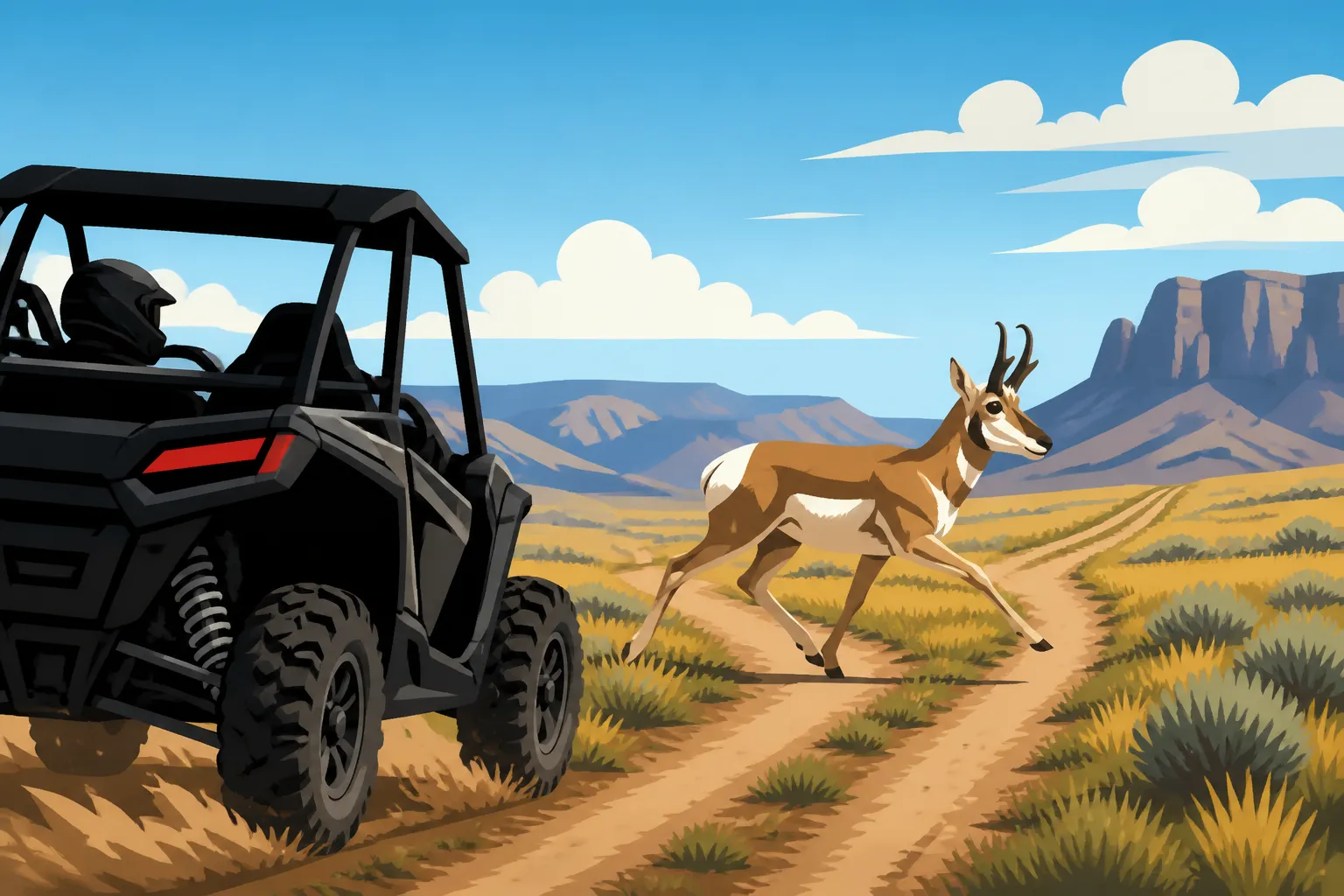
Pronghorn Crossing a Two-Track
A pronghorn can appear on a Wyoming two-track with almost no warning, especially where the road cuts across open sagebrush. The safest response is simple: slow down early, stop well short, give the animal room, and wait for it to move on its own. This guide explains how to handle a crossing, protect wildlife, and keep your ride on an authorized route.
What to do when a pronghorn crosses a two-track
Slow down before you reach the animal
Pronghorn are built for open country and can move quickly, but that does not mean they will react predictably to an ATV or UTV. An animal may stop, change direction, or run alongside the road before deciding where to go. If you approach at speed, you have less time to respond—and the animal has fewer safe options.
As soon as you spot a pronghorn, ease off the throttle and slow in a controlled way. Avoid a sudden swerve, hard acceleration, or revving the engine to make it move. If the animal is near the track or appears to be approaching it, come to a complete stop at a safe distance. Leave enough room that it can cross without feeling crowded.
If you are riding in a group, signal the riders behind you to slow or stop too. A pronghorn that has nearly cleared the trail may turn back if another machine suddenly approaches from the opposite direction. Keep the group quiet and stationary until the animal is well away from the route.
Give the animal space and a clear way out
Do not drive toward a pronghorn to encourage it to move. Do not follow it, circle around it, or position your machine to guide it across the road. Those actions can turn a brief crossing into a stressful encounter and may push the animal toward traffic, fencing, or uneven ground.
If a pronghorn is standing beside the track, wait. If it is already crossing, remain stopped until it has passed and has room to continue away. A single animal may be followed by others, so scan the surrounding sagebrush before pulling forward. Young animals can be difficult to spot in vegetation, and a group may cross in stages.
A useful rule is to let the wildlife choose the timing and direction. You can read more about broader wildlife etiquette in Wyoming Rules for Riding Near Livestock, though pronghorn are wild animals and should not be treated like livestock that can be guided along a road.
Avoid chasing, crowding, or trying to take a close-up photo
It can be tempting to follow a pronghorn for a better view, particularly when you are already stopped on a quiet two-track. Resist that urge. A machine moving behind an animal can keep it running longer than it otherwise would, and a close approach can create stress even if the animal does not visibly flee.
Take photographs only from where you are already stopped, using a zoom rather than moving closer. Keep voices low, avoid sudden movements, and do not use a horn or shout to make the animal look toward you. Once it has crossed and moved away, wait a moment to make sure it is not circling back before continuing at a cautious pace.
Why pronghorn crossings need extra care in Wyoming
Two-tracks often run through open wildlife habitat
Wyoming’s long stretches of sagebrush, grassland, and basin country can make it easy to see an animal in the distance—and easy to assume there is plenty of room to pass. But a two-track may cross a narrow opening between shrubs, a drainage, or a route the animal is already using. The road can be a small but important interruption in otherwise open habitat.
Pronghorn may be encountered in many parts of the state, including broad stretches of basin and prairie country. Conditions vary by place and season, so don’t assume a route is wildlife-free just because you rode it earlier in the day. Animals may be more visible at dawn and dusk, but a crossing can happen at any time.
This is also why the ground immediately beside a route matters. Don’t leave the two-track to go around an animal, even if the detour looks harmless. You may be entering sensitive habitat, damaging vegetation, or leaving an authorized route. Review Wyoming Rules for Riding a Two-Track and Wyoming Penalties for Leaving a Route before riding unfamiliar public land.
Fences, traffic, and other machines can change the situation
A pronghorn may hesitate at a fence, a road junction, a steep ditch, or a line of parked vehicles. If it seems unsure, give it time rather than trying to create a gap by driving closer. Don’t assume the animal will choose the direction that looks obvious to you.
On a wider road or near a public highway, be especially alert for other traffic. Stop where you can do so safely, and don’t block a travel lane or create a blind corner for approaching vehicles. If you are on a narrow two-track, pull aside only where the ground is firm and you can do so without driving off-route or into fragile vegetation.
A crossing can also become confusing when several riders react differently. If one person stops while another rolls forward, the animal may hesitate or change direction. Agree on a simple group signal before you ride: the first person to spot wildlife calls it out, everyone slows, and the group waits until the route is clear.
Young wildlife calls for even more patience
A small animal resting in grass or sagebrush may be difficult to identify from a machine. If you see a young pronghorn or an animal that seems separated from others, don’t approach to check on it or attempt to move it. Its mother may be nearby, and a person or vehicle close by can keep her from returning.
Do not pick up, feed, touch, or attempt to rescue wildlife. If an animal appears injured or trapped, keep your distance and contact the appropriate local wildlife agency or land manager for guidance. Avoid posting a precise location publicly if that could draw people toward the animal.
How to ride a Wyoming two-track responsibly
Confirm the route is open before you go
A visible track on the ground is not proof that the route is open to motorized use. Roads and trails can have different designations, seasonal closures, vehicle restrictions, and land-management rules. Check the relevant travel map and any current closure notices before your ride, then follow signs at the site.
A paper map, downloaded map, or agency map can help you stay oriented where cell service is unreliable. Tools such as onX Offroad can be useful for planning and seeing route information, but don’t treat any app as a substitute for land-manager maps, posted signs, or on-the-ground restrictions. If a digital map and a sign disagree, stop and follow the sign while you confirm the route with the responsible land manager. See Wyoming Trail Maps and MVUMs and When a Sign on the Ground Says Closed for more on checking route access.
Before setting out, identify a few practical details: where you can safely turn around, where the track meets a larger road, and whether the route is appropriate for your machine. Let someone know your general plan, especially if the ride takes you far from services or reliable phone coverage.
Stay on the established route
Keep all four wheels on the authorized road or trail. Don’t make a new bypass around mud, a gate, a wildlife group, or another obstacle. If you cannot continue without leaving the route, turn around where it is safe or wait for conditions to improve.
This can be frustrating when an obstacle seems minor or the detour appears to be only a few yards. But repeated off-route travel widens tracks and can damage vegetation. It may also lead into private land or a closed area without being obvious from the seat of your machine.
Use a map as a planning aid, not as permission to ride every visible line. onX Offroad may help you compare routes before leaving home, while official land-manager information and posted signs should guide your decisions on the ground. If you’re unsure whether a road is open, don’t guess; check with the managing agency or choose a route whose status is clear.
Prepare for changing conditions and seasonal restrictions
A route that is passable one day may be muddy, snow-covered, or closed when you arrive. Weather can change quickly in Wyoming, and a wet two-track may become slick or rutted. Don’t power through soft ground if doing so is likely to damage the route or force you off it. Turn back if conditions are unsafe or the road is closed.
Seasonal access can also vary with wildlife, fire danger, maintenance, or other management needs. Before riding, check notices for the particular area rather than relying on a past trip or a map screenshot saved months earlier. Wyoming Fire Season and Trail Access and Wyoming Rules for Riding During Hunting Season offer useful context for planning around changing conditions.
Carry enough water, warm layers, food, and basic recovery supplies for the route you plan to ride. In remote country, a small problem such as a flat tire can take much longer to resolve than expected. Make room in your plan for delays—especially when wildlife, weather, or a closure changes your route.
A practical response checklist for a pronghorn encounter
| Situation | What to do | What to avoid |
|---|---|---|
| You spot a pronghorn ahead | Slow gradually and scan for other animals | Accelerating to pass before it moves |
| The animal is crossing | Stop at a safe distance and wait until it clears the route | Driving behind it or blocking its path |
| The animal pauses near the track | Stay still and give it time to choose a direction | Honking, shouting, or moving closer |
| Riders are following you | Signal them to slow or stop | Letting the group bunch up near the animal |
| The route is blocked or unclear | Wait, turn around safely, or confirm access | Creating a bypass off the established route |
| You see a young or injured animal | Keep your distance and seek appropriate guidance if needed | Touching, feeding, moving, or photographing it at close range |
Before each ride, it can help to talk through this checklist with your group. A passenger can watch the shoulders and distant sagebrush while the driver focuses on the track. If someone spots wildlife, use a clear, calm call such as “pronghorn ahead” rather than shouting or making abrupt movements.
When you resume riding, do so slowly. Look again in both directions, check that no other animals are following, and continue at a pace that gives you time to react to another crossing. On a quiet two-track, that extra minute of patience is usually far less trouble than startling wildlife or creating a dangerous situation for another rider.
The goal is not to get as close as possible or to keep a schedule at all costs. It is to leave the animal space, protect the route, and let everyone in the group continue safely. Wyoming’s open country can make wildlife encounters feel casual, but a calm stop and a little distance are the most respectful response.
Disclaimer
This article is for general informational purposes only and does not constitute professional advice. Laws, prices and regulations vary by location and change over time. Consult a qualified professional for guidance on your specific situation.