Gates on a Grazing Allotment
A gate on a Wyoming grazing allotment can look like a simple pause in an otherwise open ride, but it may control livestock movement, mark a property boundary, or sit on a route that is not open to motorized use. This guide explains how to check your route, decide what to do with the gate, and avoid turning a quick ATV or UTV ride into a trespass or livestock problem.
What a gate on a grazing allotment means
An allotment is not automatically an open riding area
A grazing allotment is land managed for livestock grazing. It may be on public land, private land, or a mix of both, and a fence or gate can separate different ownerships or management areas. The fact that you can reach a gate from a public road does not, by itself, mean the track beyond it is open to ATV or UTV traffic.
Before you ride through, check whether the specific road or trail is authorized for motorized use. Look for current travel-management maps, route signs, and land-manager information. On federal land, the managing agency’s route designation matters. On private land, you generally need permission from the owner or someone authorized to grant access. A grazing lease does not give the public general permission to ride across the lease area.
This is why it helps to check route access before unloading at the trailhead, rather than trying to decide from the seat of your machine. [Wyoming Rules for Riding a Grazing Lease] explains the access issue in more detail, and Wyoming Landowner Permission Rules is useful when your route may cross private ground.
A gate is a livestock control, not a trail sign
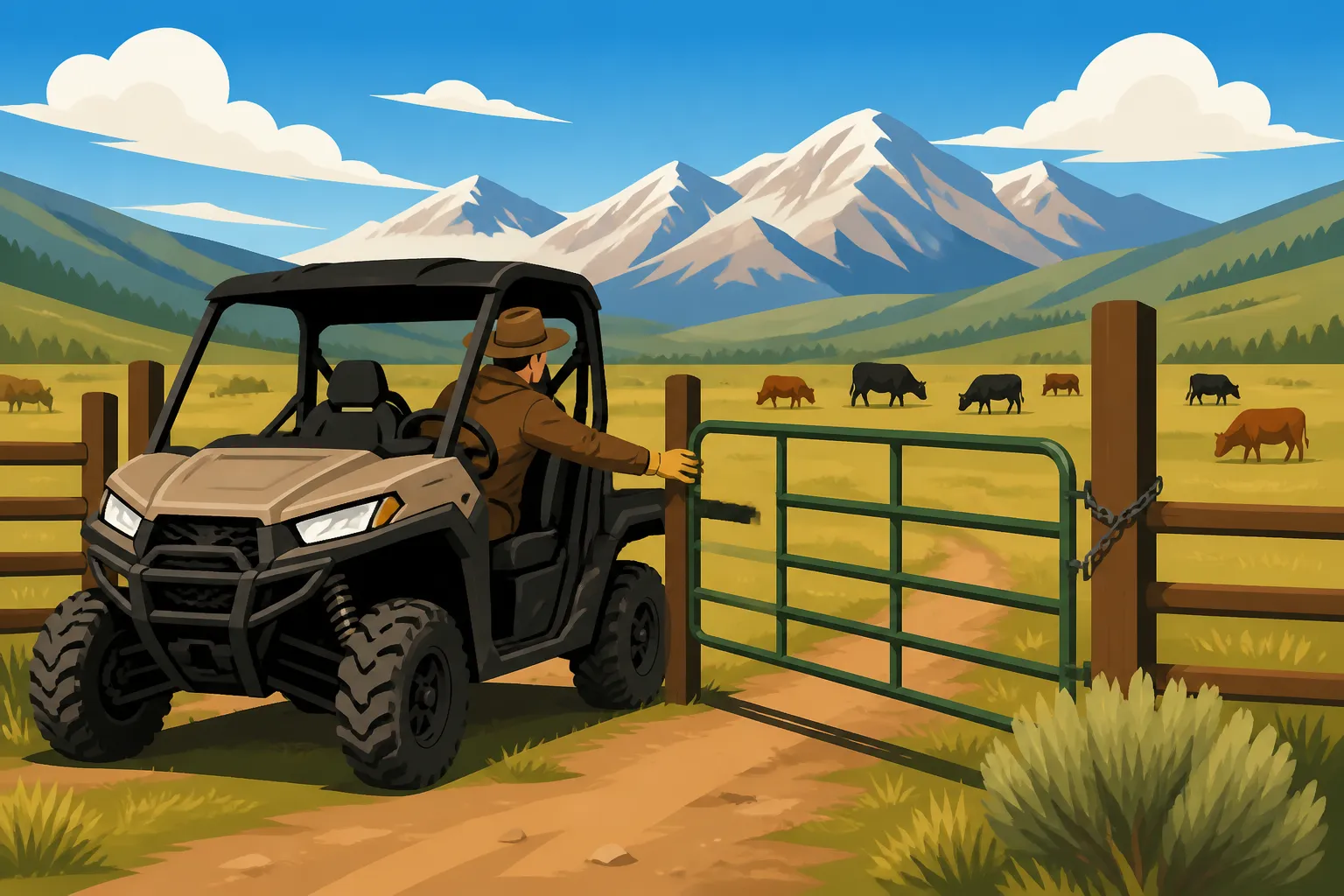
Gates are used to keep livestock in or out of a particular pasture, protect a grazing area, or separate one allotment from another. Their position can matter. A gate that is open when you arrive may be intentionally left open to allow animals to move between areas. Closing it could disrupt that movement. A gate that is closed may be there to keep animals from wandering onto a road or into a different pasture.
Do not assume that “open” means “go ahead” or that “closed” means “just open it and continue.” A gate can also mark a boundary or a change in access conditions. Check for signs on the gate, nearby posts, or at the route entrance. If signs prohibit motorized use or say the area is closed, do not ride through. If you cannot tell whether the route is open, stop and verify before proceeding.
A gate can also sit on a route that is open only seasonally, or on a road that has different rules for different vehicle types. Confirm that your ATV or UTV is allowed on that route, not merely that some kind of vehicle can use it. For route basics, see [Wyoming Rules for Riding a Designated Route].
The map and the ground both matter
A map is an important planning tool, but conditions on the ground can change. Gates may be added, moved, locked, or marked with temporary notices. A route may also be closed for livestock management, fire conditions, wildlife protection, or another reason. Use a current land-manager map where available, and pay attention to posted signs when you reach the route.
Navigation apps such as onX Offroad can help you orient yourself and compare your position with mapped roads and trails. They are most useful as one layer of your planning, not as permission to ride. Check the relevant agency or landowner information too, especially when an app’s route line appears to continue through a gate or across a pasture. If the map and the sign disagree, do not treat the map as a reason to ignore the sign. When a Map and a Sign Disagree and When a Sign on the Ground Says Closed cover the practical difference between mapped information and posted restrictions.
How to handle a gate during an ATV or UTV ride
Stop before the gate and look for instructions
When you reach a gate, bring your machine to a full stop before approaching it. Take a moment to read every sign and look for markings on the posts, fence, or nearby road. Check for clues that the gate is part of a livestock enclosure, such as cattle nearby, a water trough, fresh tracks, or a second gate farther along the route.
Do not ride around the gate, cut across a fence, or squeeze through a gap simply because the route looks passable. Those choices can damage fencing, disturb livestock, and take you off the authorized road. If a gate is locked or clearly marked closed, do not force it. A locked gate is a strong signal to stop and verify access rather than search for a way around.
If you are riding with a group, make sure everyone understands the plan before anyone opens the gate. It is easy for a following rider to assume the gate is being left open for them, then miss a sign or fail to notice livestock in the road. A quick hand signal and a clear “stop here” can prevent a small misunderstanding from becoming a much bigger one.
Leave the gate as directed, not as you guessed
There is no safe universal rule that every gate should always be left open or always be closed. Follow posted instructions and any specific guidance from the land manager or landowner. If the instructions say to leave it as found, note its position before opening it and return it to that position after the group passes. If there is a sign telling riders to close it, close it securely behind you.
When you do need to open a gate, keep control of your ATV or UTV and avoid letting the machine roll unattended. One rider can open and hold the gate while another passes, but the group should move deliberately rather than bunching up in the opening. Close and latch the gate carefully if required. A gate that looks shut but is not latched can swing open in wind or when livestock push against it.
If the gate is damaged, wired shut, difficult to operate, or impossible to close properly, do not improvise a repair or leave it in a different position without guidance. Contact the appropriate land manager or property contact when practical. If livestock are already on the road, wait for them to clear rather than rushing the group through. Which Gates You Are Required to Close is a helpful companion topic for working through the “leave it as found” question.
Keep the whole group and the livestock in mind
Opening a gate is not just a one-machine task. A group may need to pause long enough for every rider to pass, for the last person to close the gate, and for the group to confirm that no one was left behind. If the gate is on a slope or narrow track, choose a safe place to stop before the entrance so riders are not blocking the road or creeping forward while someone handles the latch.
Give animals space and time. Avoid revving the engine, honking, or driving close behind cattle. Livestock may react unpredictably to engine noise or to a vehicle trying to push through the herd. If animals are gathered near the gate, wait at a safe distance and let them move away on their own. A short delay is better than scattering a herd or forcing an animal against a fence.
The same care applies after the group passes through. Do not speed away immediately if the gate needs attention. Confirm that it is secured as directed, that the fence has not been snagged by a machine or trailer, and that the next riders know whether they should stop. Respectful behavior around working ranches and grazing areas helps protect continued access. Wyoming Trail Etiquette With Ranchers offers more guidance on sharing routes responsibly.
A practical decision guide at the gate
Check these things before proceeding
Use the following checklist when you reach a gate. If any answer leaves you uncertain, stop and verify access instead of treating the gate as a routine obstacle.
| What to check | What to do |
|---|---|
| Is the road or trail open to motorized use? | Confirm the route on an appropriate current map and look for signs at the entrance. |
| Is there a closure notice or restriction? | Follow the posted instruction. Do not go around a closed or locked gate. |
| Does the route cross private land? | Obtain permission from the owner or authorized contact before riding. |
| Are there instructions for the gate? | Follow them. If told to leave it as found, note its position and restore it after passing. |
| Are livestock near the gate or on the road? | Stop, give them room, and wait for them to clear. |
| Is the gate damaged or difficult to secure? | Do not force it or improvise. Contact the land manager or property contact when practical. |
| Is the map uncertain or inconsistent with signs? | Treat the ground-level closure notice as controlling and verify with the land manager. |
A navigation app can help you see where you are in relation to a mapped route, but an app cannot confirm every temporary closure or grant access across private property. If you use onX Offroad, check the route details before the ride and pair that information with agency maps and signs. When route status remains unclear, make a different plan rather than testing the gate.
Know when to turn around
Turning around is the right choice if the route is clearly closed, the gate is locked, the road crosses property you do not have permission to enter, or you cannot confirm that motorized travel is allowed. It may feel frustrating after you have driven a long way to the trailhead, especially when a mapped road seems to continue beyond the gate. But a gate is not an invitation to find a workaround.
A route that is open to one type of vehicle may not be open to your ATV or UTV. Likewise, a public road can lead to a private driveway, a restricted pasture, or a segment managed under different rules. If the route changes status at a boundary, the signs and management information for that segment matter. For more on staying on authorized paths, see [Wyoming Rules for Crossing Private Ground] and Riding a Two-Track Across a Pasture.
You may be able to continue your ride by returning to a known open route or choosing another trail in the area. It is worth marking the gate’s location and checking with the land manager later, especially if the sign is missing or the route status is unclear. That way, you can plan more confidently next time without guessing at the trailhead.
Avoid relying on one clue
A gate’s appearance is only one piece of information. An open gate does not prove that the public may ride through, and tire tracks beyond it do not prove that the route is currently open. Someone may have access for ranch work, agency operations, or another authorized purpose that does not apply to general riders.
Likewise, an older map line does not override a new closure sign. If you use more than one source, compare them before your trip and watch for differences in route names, boundaries, and vehicle restrictions. onX Offroad may help you locate a trail, while a land-manager map or direct confirmation can help establish whether that route is open for your machine. Treat signs and clearly marked closures seriously when you arrive.
If you are planning a longer ride through a network of forest roads, allotments, and private parcels, build in time for detours. Save a legal alternative route in advance, carry the map information you need offline if cell service may be limited, and tell your group what to do if a gate blocks the planned route. The more remote the ride, the more valuable that preparation becomes.
Plan a gate-aware Wyoming ride
Before you leave the trailhead
Before loading your machine, identify the roads and trails you intend to use and check whether motorized travel is allowed on each segment. Look for seasonal closures, width limits, and route-specific restrictions. If the route crosses public and private land, check the boundaries and access requirements rather than assuming that a road remains public all the way through.
Save a map for areas where cell service may be unreliable, and carry the information in a way you can access without a connection. onX Offroad can be useful for orientation and route planning, but compare its mapped route with the applicable land-manager information. Make sure every rider in the group knows that a gate is a place to pause, read signs, and follow instructions—not a challenge to overcome.
If you are unsure who manages a road, contact the relevant agency office or landowner before the trip. Share the road name or location, your vehicle type, and the dates you plan to ride. A clear question such as “Is this route open to an ATV or UTV, and how should riders handle the gate?” is more useful than asking whether an area is generally open.
During the ride
Approach gates slowly, watch for other users, and leave room for livestock. Keep the group together without crowding the entrance. One rider should take responsibility for checking the gate instructions and confirming that the gate is returned to the required position after everyone passes.
Stay on the designated route beyond the gate. Do not widen the track to get around a muddy section, drive beside the road to avoid a closure, or cut across a pasture. Those short detours can damage vegetation, disturb livestock, and lead riders onto land where access has not been granted. If you encounter a closure, use a lawful alternative or turn back.
If you find an unexpected lock, a missing sign, a damaged gate, or a route that appears unsafe, document the location and report it to the appropriate land manager when you can do so safely. Avoid moving signs or altering fences. The goal is to leave the area in the condition you found it—or better—so that the next rider and the people managing the land are not left with a new problem.
A final gate check
Before you ride through, confirm that the route is open to your vehicle and that you have permission where needed. At the gate, follow posted directions, protect livestock, and make sure the gate is secured as required after the group passes. If access or instructions are unclear, stop and verify rather than guessing.
That simple routine protects your ride, ranch operations, and the access opportunities that make Wyoming’s riding areas worth exploring. For related route and access guidance, see [Wyoming Rules for Riding a Designated Route], Wyoming Landowner Permission Rules, and Which Gates You Are Required to Close.
Disclaimer
This article is for general informational purposes only and does not constitute professional advice. Laws, prices and regulations vary by location and change over time. Consult a qualified professional for guidance on your specific situation.