Moose on a Willow Bottom Trail
A moose standing in willows can turn a relaxed Wyoming ATV ride into a tense stop in seconds. These encounters are especially challenging on narrow trails, where brush limits visibility and there may be little room to turn around. This guide explains how to recognize likely moose habitat, respond calmly if you meet one, and plan a ride that gives wildlife room.
Why Moose Use Willow Bottoms
Willows offer food and cover
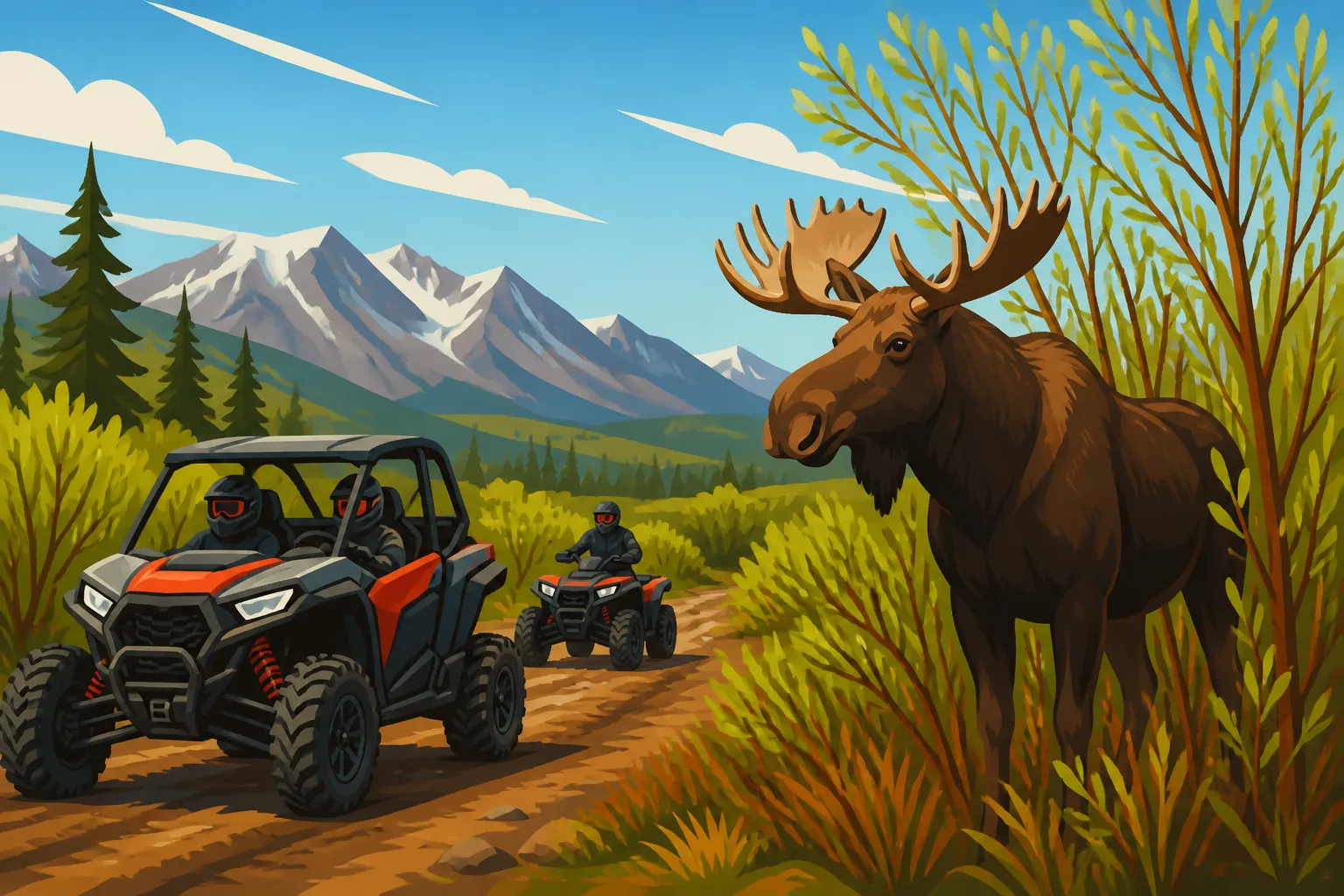
Moose browse on woody plants, including willow, and often use wet areas where that vegetation grows. A trail that dips beside a creek, crosses a marshy flat, or follows a willow-choked drainage may bring riders close to places moose feed or rest. The animal may be hard to see until you are nearby because its dark body can blend into brush and shadows.
That does not mean every willow bottom has a moose in it. It does mean visibility can change quickly. On a more open route, you might spot wildlife from a distance; in dense brush, a moose could be just beyond the next bend. Ease off the throttle in tight vegetation, keep enough room to stop, and pay attention to movement, fresh tracks, or branches shifting ahead.
Moose also move between feeding and resting areas, so an empty trail on the way out may not be empty on the return. Keep your attention on the route rather than assuming wildlife will stay put. If you are exploring an unfamiliar area, read Wyoming Trail Maps and MVUMs before setting out and check the applicable land manager’s route information for closures and access rules.
A moose may feel crowded even if you mean no harm
A moose is not likely to interpret a close ATV approach as a friendly visit. If it is surprised, guarding a calf, or has no clear way to leave, it may become defensive. A narrow trail with brush on both sides can make an encounter feel more confined for both the rider and the animal.
Calves deserve particular caution. A cow moose may be nearby even when the calf is the only animal you can see. Do not ride closer to identify the situation, and do not assume a young animal is abandoned. If a calf is near the trail, give it space and leave the area without trying to find its mother.
Avoid treating a moose sighting as a photo opportunity. A quiet approach is still an approach, and revving the engine, honking, or moving closer can add pressure. If the animal is in your path, the safest choice may be to wait at a generous distance or turn back rather than insist on passing.
What to Do When You See a Moose
Stop early and give it an escape route
As soon as you notice a moose, slow down and stop well before reaching it. Keep the machine under control and leave the animal room to move away. Do not ride toward it to get a better view, and do not position yourself between an adult and a calf.
If the moose is standing on the trail, wait quietly to see whether it leaves on its own. If it begins moving toward you, increase the distance carefully and use the terrain or your machine as a barrier if you can do so without getting closer. Do not try to squeeze past through brush or push it off the route. If there is no safe way through, backtrack when you can do so without provoking the animal.
The general rule is simple: make space, avoid sudden movements, and do not block the animal’s path. On a group ride, tell other riders to stop as well. A second ATV arriving quickly can make a tense encounter worse, especially if the first rider has stopped in a narrow passage.
Know the signs that mean “back away”
An agitated moose may hold its ears back, raise the hair on its shoulders, lower its head, or make a short forward movement. Those signs should be treated as a warning, not as an invitation to wait closer. Move away calmly and put as much distance or sturdy cover between yourself and the animal as the situation allows.
If a moose charges, do not try to race it on the trail or provoke it into changing direction. Get behind a substantial tree, boulder, or other solid barrier if one is immediately available. A vehicle may provide some protection, but do not count on outrunning a moose or assume an ATV is a shield in every situation. Once the animal has moved off, wait until the area is clearly safe before leaving.
| What you encounter | Safer response | Avoid |
|---|---|---|
| Moose far ahead on the trail | Stop and let it move away | Riding closer for a photo |
| Moose standing across the route | Wait at a distance or turn back | Squeezing past through brush |
| Calf near the trail | Leave the area calmly | Approaching or separating the calf from its mother |
| Moose walking toward you | Create distance and use cover if available | Revving, honking, or trying to outrun it |
| A group approaching the same spot | Alert riders behind you and keep everyone stopped | Letting the next machine roll forward |
Plan a Ride Through Wildlife Habitat
Choose routes with visibility and a sensible turnaround
Before leaving the trailhead, look at the route’s terrain and think through where you could safely stop or turn around. Willow bottoms, stream corridors, and brushy draws can have poor sightlines, so ride at a speed that lets you react to an animal or obstacle around the next curve. If the route narrows, slow down before entering rather than waiting until you are already close to something.
Maps can help you understand the route, but they cannot tell you whether a moose is standing around the next bend. Use an app such as onX Offroad to review your planned route and identify places where you may be able to turn around or leave a tight section safely. Confirm that the route is open with the relevant land manager; a line shown on a map is not, by itself, permission to ride it.
Carry a current travel management map where required and pay attention to signs on the ground. If a posted closure or temporary restriction conflicts with what you expected, follow the posted direction and check with the managing agency. For more on the access rules that shape a ride, see [Wyoming Rules for Riding a National Forest] and Wyoming’s Enrolled Roads and Trails.
Keep the group quiet, spaced, and prepared
Groups often make more noise and occupy more trail than a single machine. Keep a reasonable gap between ATVs and UTVs so riders have room to stop when someone spots wildlife. Agree on a simple signal for “stop” before you leave, and make sure everyone knows not to continue toward an animal just because the rider ahead has paused.
A practical group plan includes a turnaround point, a way to contact one another, and enough time to backtrack without rushing. If you are riding far from a trailhead, tell someone where you are going and when you expect to return. Cell service can be unreliable in remote areas, so do not make a phone your only plan for communication or navigation. onX Offroad can help you keep track of your intended route, but it does not replace checking official access information or watching the trail itself.
Give ranch operations and other trail users room too. Wildlife habitat may overlap with working land, gates, livestock, and shared routes. Follow Wyoming Trail Etiquette With Ranchers, close gates you open, and avoid leaving the designated route to get around an animal.
After the Encounter
Leave the area without turning back for another look
Once the moose has moved away and you have a safe path, continue cautiously or choose another route. Do not circle back to look for it, and do not stop a short distance away to take pictures. A moose may remain nearby in cover, and the animal could return to the trail after you pass.
If you cannot tell whether the route is clear, wait farther back or turn around. On a narrow trail, a retreat can feel inconvenient, especially after a long ride in, but pushing through is not worth cornering wildlife or putting riders at risk. Let the group know why you are changing plans so nobody tries to take a different line through the brush.
If the encounter involves an injured animal, an apparent collision, or a public safety concern, report it to the appropriate wildlife or land-management agency when it is safe to do so. Keep your report factual: note the general location, time, and what happened. Do not approach an injured moose or attempt to move it.
Make a few adjustments for the next ride
After returning, think about what made the encounter difficult. Was the trail too fast for the visibility? Did the group have a clear stop signal? Was there room to turn around? A small adjustment—such as reducing speed in brush, spacing machines farther apart, or choosing a more open route—can make the next ride calmer.
If you ride the same area again, check for updated closures and route conditions before leaving. Wildlife moves, and seasonal access rules can change. Keep Wyoming Trail Closures to Check First handy as part of your planning, and review Wyoming Riding Areas Good for Kids if younger riders are coming along. Explain that seeing a moose is a reason to stop and give it space, not a reason to get closer.
A moose in a willow bottom is a reminder that Wyoming trails pass through living habitat, not just scenic terrain. Ride slowly where you cannot see far, leave wildlife a clear way out, and be willing to turn back. Those habits protect both the animal and the people who came out to enjoy the ride.
Disclaimer
This article is for general informational purposes only and does not constitute professional advice. Laws, prices and regulations vary by location and change over time. Consult a qualified professional for guidance on your specific situation.