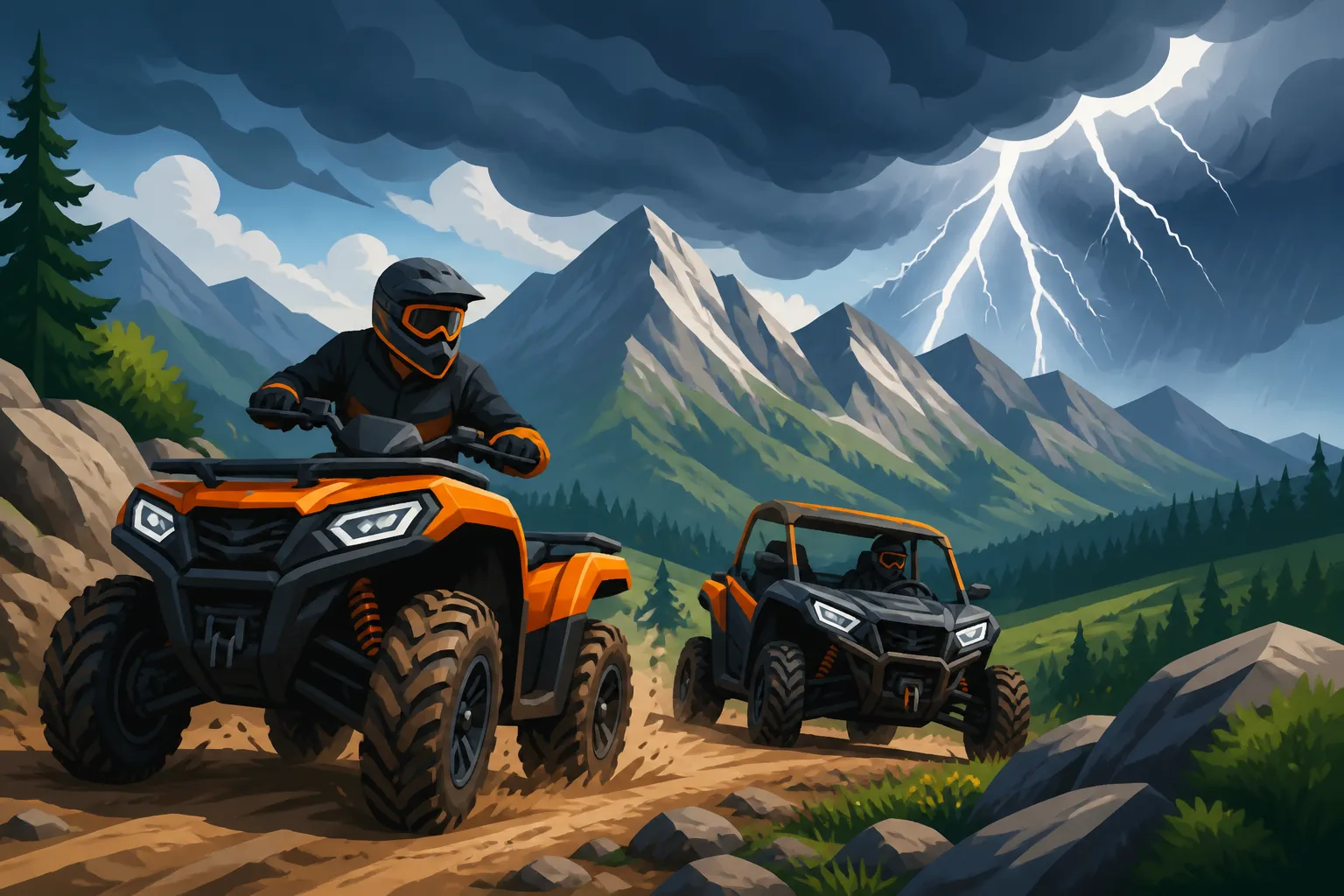
Afternoon Thunderstorms in the High Country
Afternoon thunderstorms can turn a beautiful Wyoming ATV or UTV ride into a risky trip surprisingly quickly. In the high country, a sunny start does not guarantee a clear afternoon: rain, lightning, hail, cold wind, and poor visibility can arrive while you’re far from your trailer. This guide explains how to plan around changing weather, what to do when storms build, and when to turn back.
Why Wyoming’s High-Country Storms Need Respect
Weather can change faster than your ride plan
A clear morning in the Snowy Range, the Bighorn Mountains, or another high-elevation riding area can feel reassuring. But conditions may change as the day warms. Clouds can build over ridgelines, wind can strengthen, and a shower that looked distant can move across the route while you’re still several miles from your starting point. The higher and more exposed your ride, the less wise it is to assume that a blue sky will last.
The challenge is not just getting wet. Thunderstorms can bring lightning, hail, sharp temperature drops, slick rocks, muddy ruts, and reduced visibility. A route that felt manageable in dry conditions may become difficult for a newer rider or a wide side-by-side once traction and sightlines worsen. On a narrow trail, there may be limited room to stop, turn around, or get away from exposed ground.
Altitude can make the weather feel more punishing, too. Even in summer, wet clothing and wind can leave riders chilled, especially after a long day on the machine. If you’re planning a high-elevation outing, build in extra time and keep the realities of Wyoming Riding at Altitude in mind. The safest plan is one that lets you head back early without feeling that you have to “get your money’s worth” from the day.
Learn the route and its exposure before you leave
Before starting, look at more than the trail’s distance. Ask whether the route climbs onto an open ridge, crosses a broad meadow, follows a creek, or enters a forested stretch where turning around might be awkward. Consider where you could stop, whether another route offers a shorter way back, and how far you’ll be from a substantial building or hard-topped vehicle if lightning develops.
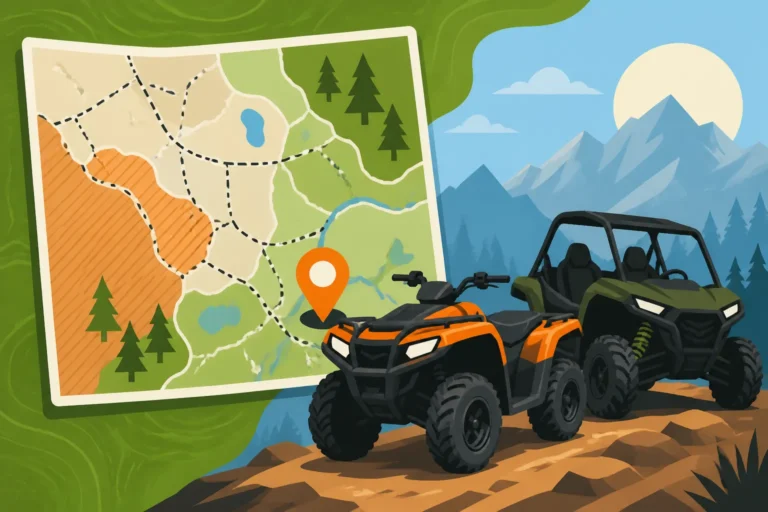
Use a current land-manager map to confirm which routes are open and where they lead. An app such as onX Offroad can help you review terrain and keep track of your position, but it should not replace official maps, posted signs, or local closure information. Download what you need before losing cell service, and make sure everyone in the group understands the planned route and turnaround points. Wyoming Trail Maps and MVUMs can help you think through the difference between seeing a line on a map and confirming that a route is actually designated for riding.
Conditions and access can change for reasons beyond weather, including seasonal restrictions, fire conditions, and land-management decisions. Check Wyoming Trail Closures to Check First before heading out, and pay attention to signs at the trailhead and along the route. If a storm or closure changes the safe options, the map on your phone cannot make a closed route open or a hazardous route safe.
Plan the Ride Around the Forecast
Start early and set a firm turnaround time
For a high-country ride, an early start is often more useful than trying to squeeze in one more trail after lunch. It gives your group more daylight and more flexibility if the route takes longer than expected. A slow climb, a stuck machine, a navigation mistake, or a long break can all push a ride into the part of the day when storms are more likely to become a concern.
Before you unload, agree on a turnaround time. Make it specific rather than saying, “We’ll head back if it looks bad.” For example, decide that the group will begin returning at a set time even if everyone is enjoying the ride. Choose that time based on the route, forecast, terrain, group experience, and how long it takes to get back—not on the most optimistic estimate.
A turnaround rule also helps with the social pressure that can creep into group rides. One rider may want to reach a viewpoint, while another is watching dark clouds collect over the ridge. If the group has already agreed that safety comes first, it is easier to turn around without an argument. Loading Up Before an Afternoon Storm is a useful way to think about the practical choices that can make an early departure or quick return easier.
Check more than one weather clue
Check the forecast before leaving and again before unloading, especially if you’re driving from a lower-elevation town to a mountain trailhead. A forecast for the nearest community may not describe conditions on a high ridge several miles away. Look for the expected timing of showers or thunderstorms, wind, temperature changes, and any severe-weather alerts. If the forecast suggests storms could affect your riding area, choose a shorter route or postpone the exposed ride.
Once you’re out, keep looking around rather than relying only on a forecast. Growing dark clouds, distant thunder, gusty wind, falling temperatures, or rain curtains across the mountains are reasons to reassess. A weather app can be helpful when you have a signal, but mountain reception can be unreliable. Don’t wait for a phone alert if the sky is already telling you to change plans.
Some riders use onX Offroad to keep their route visible while checking terrain and nearby roads. That can support decision-making, but it does not provide a reliable substitute for observing the weather or knowing where the route goes. Keep an offline map available, and tell someone at home where you plan to ride and when you expect to return. If you’re riding in a group, make sure every machine has a way to navigate back if the group becomes separated.
| Before the ride | What to check | Why it matters |
|---|---|---|
| At home | Forecast, storm timing, wind, and temperature | Helps you choose a suitable day and start time |
| At the trailhead | Updated conditions, signs, and route access | Conditions and closures may differ from what you expected |
| During the ride | Clouds, thunder, wind, rain, and visibility | Gives you a chance to turn back before conditions worsen |
| Before committing to a longer route | Distance back, exposure, and exit options | Helps you avoid becoming trapped far from shelter |
What to Do When a Storm Builds
Turn back before lightning is close
If you hear thunder, treat lightning as a real and immediate hazard. Don’t continue toward a ridge, summit, open meadow, or viewpoint because it seems only a few minutes away. Head toward safer shelter as soon as you can do so without taking a more exposed route. A substantial building or an enclosed, hard-topped vehicle is the safest option. An ATV or UTV does not offer the same protection as an enclosed vehicle, even if it has a roof.
If you cannot reach proper shelter, get away from exposed high points, isolated trees, water, and open areas where you may be the tallest object. Avoid bunching together in one spot. No outdoor position makes you safe from lightning, so keep moving toward appropriate shelter when it is reasonable to do so. Don’t shelter beneath a lone tree simply because it blocks the rain; lightning can strike the tree or travel through the ground nearby.
Wait at least 30 minutes after the last thunder before resuming outdoor activity. If thunder continues or storms keep building, extend the wait or end the ride. That may mean loading up while the rain is still falling or choosing not to return to a favorite section. It is frustrating to leave early, particularly after a long drive, but being back at the trailhead is better than trying to outrun lightning on an exposed route.
Slow down when rain, hail, or poor visibility arrives
Rain can quickly change how your machine handles. Reduce speed, increase following distance, and avoid sudden braking or sharp turns on slick surfaces. Mud can hide rocks, ruts, and washouts; water running across a trail may conceal the depth of a dip or the stability of the ground beneath it. If the route becomes difficult to read, stop somewhere safe and reassess rather than pressing ahead just to stay on schedule.
Never assume that a small stream or a shallow-looking crossing is harmless after heavy rain. Water can rise, move debris, and undermine banks. If you cannot clearly judge a crossing, do not ride into it. Turn back if you can, or wait for conditions to improve from a safe location. Don’t attempt to cross moving water merely because another rider has done so or because the route appears on a map.
Hail and cold rain can make it hard to see, steer, or keep your hands warm. Pull over only where the group is visible and safely off the riding line, and avoid stopping in a place where other machines could come around a blind corner into you. If the storm is severe, prioritize reaching shelter or a safe trailhead over continuing the planned loop. Wyoming Fire Season and Trail Access is also worth checking when dry, windy conditions are part of the day’s outlook, since fire-related restrictions can affect where and when you can ride.
Prepare for a Safe Return
Carry gear for cold, wet, and delayed conditions
Pack as though the ride might last longer than planned. A waterproof outer layer, warm insulating layer, gloves, eye protection, and a way to keep essential items dry can make a major difference when the temperature drops. Bring water and food, a first-aid kit, basic repair supplies, and a charged phone. A satellite messenger can be useful in places without dependable cell service, but it should be treated as a backup—not a reason to take unnecessary risks.
Keep critical items accessible. If your rain gear is buried beneath luggage, it may not help when a shower starts on an exposed stretch. Store electronics, maps, and spare layers in waterproof bags. For group rides, confirm that each rider has what they need instead of assuming one machine carries enough supplies for everyone.
Pay attention to signs of cold stress, including persistent shivering, numb hands, unusual fatigue, confusion, or difficulty making decisions. Those symptoms can make riding less safe even before anyone realizes how cold they’ve become. Stop in a safe place, add dry layers, and seek help if someone is getting worse. Hypothermia on a Summer Ride covers why warm-season riding does not eliminate the risk of becoming dangerously cold.
Make a simple plan for breakdowns and delays
A thunderstorm is not the only reason a ride might run late. A flat tire, mechanical problem, injury, or wrong turn can leave your group out longer than expected. Tell someone your route, the vehicles you’re taking, and when you expect to check in. If your plans change, update that person when you have a signal. Agree on what they should do if they do not hear from you by the planned time.
If a machine breaks down, first move the group to a safe location away from traffic and other riders. Consider the weather, daylight, and distance to the trailhead before deciding whether to repair it, continue on another machine, or call for help. Avoid splitting up casually: riders who leave to seek assistance should know the route, have supplies, and tell the remaining group exactly what they plan to do.
Use onX Offroad or another navigation tool as one part of your preparation, and keep a paper or offline map as a backup. Confirm the route before the ride, not after you’re already turned around in poor weather. For more on staying prepared when a machine or plan fails, see Breaking Down Far From Help. If your route begins high in the Snowy Range or crosses remote sections of the Bighorns, make your turnaround plan especially conservative. Guides to Snowy Range Trails Out of Laramie, Wyoming and Riding the Bighorns From Buffalo can help you consider the different terrain and access points involved in those areas.
Know when the best decision is to cancel
Sometimes the safest ride is the one you postpone. If the forecast points to widespread thunderstorms, your group includes inexperienced riders, or the route offers few ways to leave exposed terrain, choose a lower-risk outing or stay off the trail. The same applies if you’re already behind schedule before unloading, lack suitable clothing, or cannot confirm that the route is open.
A change of plan does not have to ruin the day. You might choose a shorter route with an easy return, spend the time checking maps and preparing for a better weather window, or explore a different area whose terrain and access are more appropriate for the conditions. The important thing is to make that choice before pressure builds to keep riding.
In Wyoming’s high country, good judgment is part of the ride. Start early, watch the sky, know your exits, and treat thunder as a reason to seek shelter—not as a challenge to finish one more mile. Those habits help keep a memorable ATV or UTV outing from becoming an avoidable emergency.
Disclaimer
This article is for general informational purposes only and does not constitute professional advice. Laws, prices and regulations vary by location and change over time. Consult a qualified professional for guidance on your specific situation.