Staging at a Dispersed Camp
A dispersed campsite can put your Wyoming ATV or UTV trip close to the riding you came for, but it does not automatically make the surrounding roads or trails legal to ride. This guide explains how to choose a practical camp, confirm where you can drive, stage machines and trailers, and avoid common problems such as blocked routes, muddy access roads, and arriving without water or fuel.
Choose a camp that works as a riding base
Dispersed camping is camping outside developed campgrounds, often on public land where it is allowed under the land manager’s rules. It can be a useful base for a riding trip because you may be able to camp near the area you want to explore without relying on a developed campground. The tradeoff is that you are responsible for figuring out access, services, and site-specific restrictions before you settle in.
A camp that looks perfect on a map may be a poor staging spot in person. The road could be too narrow for a trailer, the ground could be soft, or the nearest route could be closed to motorized travel. Treat the campsite and the ride as two separate decisions: first confirm that you may camp there, then confirm that your machine may travel from there to the route you plan to ride.
Match the camp to the riding area
Start by identifying the riding area and its official access points. Then look for camping options that are both close enough to be useful and permitted under the applicable land-management rules. Around Wyoming, a trip near Killpecker Sand Dunes, the Medicine Bow National Forest, or the Bighorn National Forest can involve very different terrain, road conditions, and seasonal access. Proximity alone is not a reliable guide to what is open.
Check the map at more than one scale. A regional map may show a network of roads without telling you which ones allow motorized travel, while a detailed route map may not show whether a nearby pullout is suitable for a long trailer. Tools such as onX Offroad can help you explore route and land-management information, but use the relevant land manager’s maps and signs to confirm current access rules. A digital line on a screen should be a starting point for your research, not permission to ride.
If you are planning to ride designated forest routes, review Wyoming Trail Maps and MVUMs and Wyoming’s Enrolled Roads and Trails. Those resources help clarify the difference between a road or trail that appears on a map and a route that is open to the machine you are bringing. Before leaving, save the relevant maps for offline use; cell service can disappear quickly once you leave a town or paved highway.
Look beyond the campsite pin
A pin may land in a clearing that is too small to turn around in, or on a spur that ends at a locked gate. Consider the final approach as carefully as the destination. Is the road wide and firm enough for your tow vehicle and trailer? Can you turn around without backing a long distance? Is there enough room to park without blocking traffic, gates, or another site?
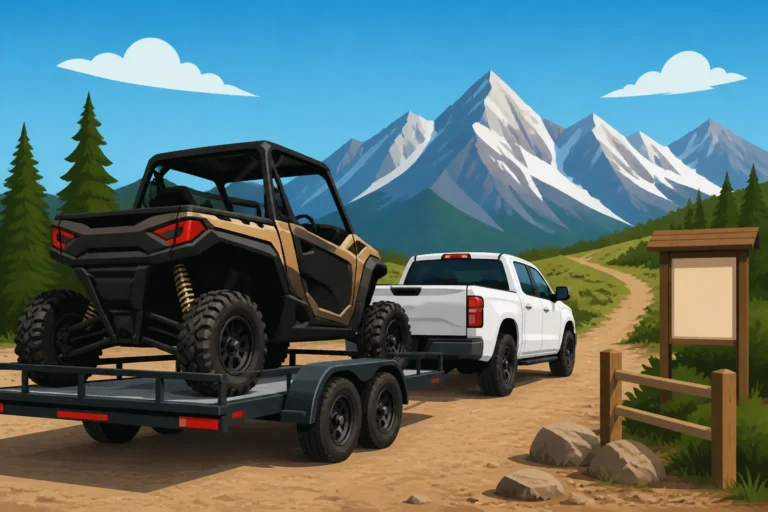
A compact car camping setup and a pickup towing a side-by-side trailer have different needs. If you are towing, do not assume a narrow two-track will have a safe turnaround just because a satellite image shows open ground nearby. When the route looks uncertain, scout it without the trailer or choose a more accessible location. Getting stuck or having to reverse a trailer down a rough road can turn the first evening of a trip into a stressful recovery job.
Keep the site low-impact. Use established disturbed areas where camping is allowed, avoid trampling vegetation to create a larger parking pad, and leave space for other visitors. If the best-looking spot requires driving across intact ground or around a closure sign, it is not a good staging site.
Confirm camping and riding access separately
Wyoming riding areas include land managed by different agencies, and access rules can change with location, season, wildlife concerns, fire conditions, or maintenance needs. A dispersed campsite near a route does not make that route open. Likewise, a road open to ordinary vehicles is not automatically open to every ATV or UTV.
Before departure, identify who manages the camping area and who manages the route. Review the applicable motor-vehicle-use map or travel-management map, read posted signs on the ground, and check for temporary closures. If a map and a sign appear to conflict, do not assume the more convenient interpretation is correct. Pause and contact the responsible land manager if you can.
Check the route from camp to the trail
Plan the connection between camp and the riding route as carefully as the ride itself. You may need to trailer the machine to a trailhead rather than ride directly from the campsite. In some areas, a road may allow travel to an access point but prohibit riding beyond it, or it may be open only to certain vehicle types or widths.
Use Riding an Enrolled Road to a Trail and Where an Enrolled Segment Ends as useful reminders to check where access begins and ends. A route can change status at a junction, gate, boundary, or signed transition. Do not count on a short stretch of road being legal just because it appears to connect camp to a trail on a phone map.
If you use onX Offroad to build a route, compare it with official maps before treating the route as ready. Pay close attention to route boundaries, machine-width restrictions, and the difference between a road and a trail. Then keep an offline copy of the official map with you as well. A map app can make planning easier, but it cannot replace signs, closures, or land-manager rules.
Check season, weather, and fire conditions
Wyoming’s riding conditions vary sharply with elevation and weather. A road that is dry in late summer may be muddy or snow-covered earlier in the season. High-country routes can remain inaccessible after lower-elevation roads have opened, and a sudden storm can make an unpaved approach difficult for a tow vehicle. Check the forecast for both the campsite and the riding area, not just the nearest town.
Fire restrictions may also affect where you can camp and whether you can use a campfire or stove. Confirm current restrictions before you leave and follow posted instructions at the site. Do not assume that a fire ring means a fire is permitted under present conditions.
| What to check | Why it matters | Practical next step |
|---|---|---|
| Camping permission | Public land is not automatically open to camping everywhere | Check the managing agency’s rules and posted notices |
| Route status | A nearby road may be closed or limited to certain vehicles | Review the official travel map and signs |
| Machine width | Some trails have width limits that exclude wider UTVs | Check route-specific restrictions before loading |
| Season and weather | Snow, mud, or storms can block access or make recovery difficult | Check conditions for the route and the approach road |
| Fire restrictions | Restrictions can change how you cook or camp | Confirm current rules and bring a no-fire cooking option |
| Trailer access | A campsite road may be unsuitable for a long rig | Look for a safe turnaround and firm parking surface |
Set up camp for safe staging
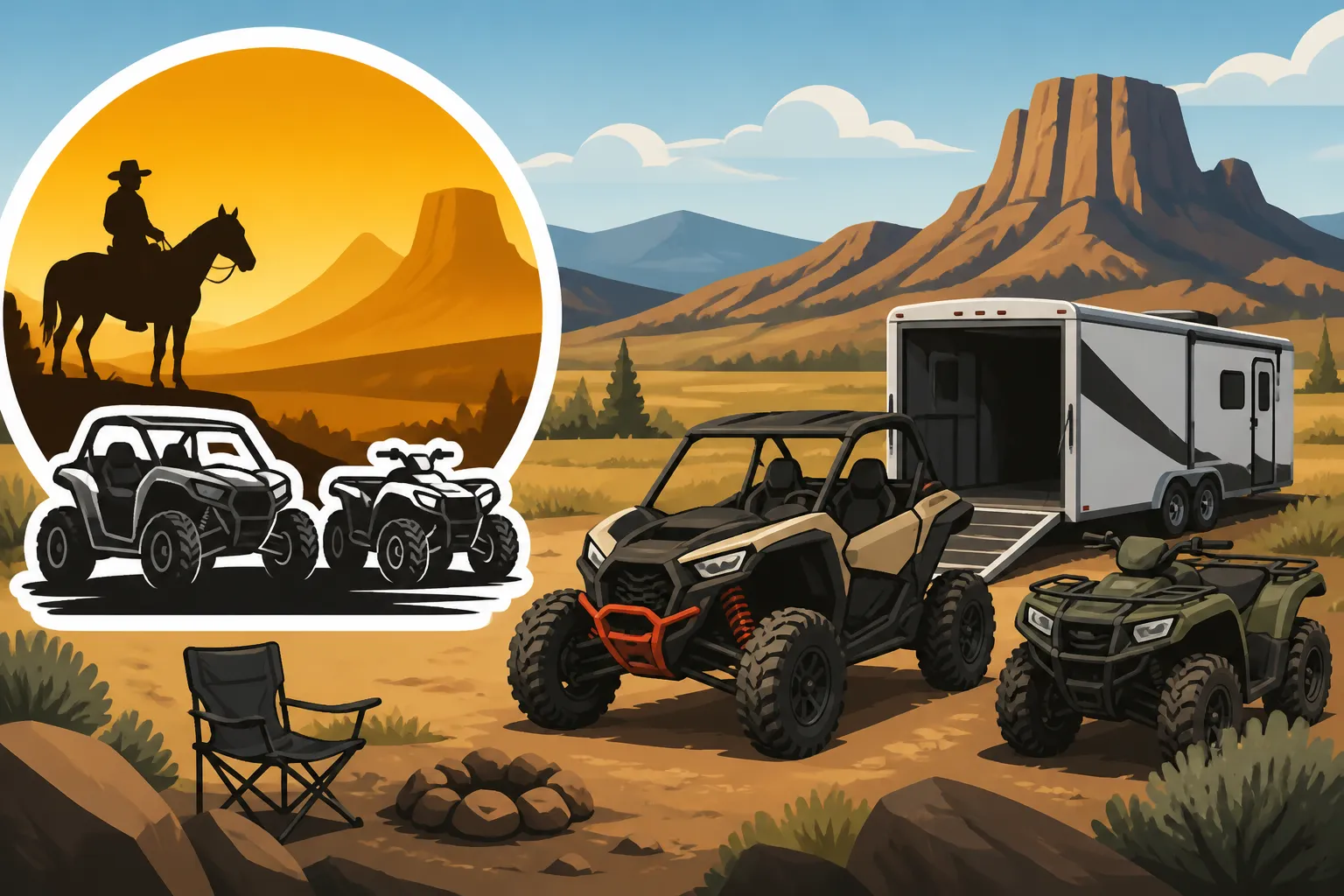
Once you have confirmed that camping is allowed, think through where the tow vehicle, trailer, ATV or UTV, and camping gear will go. A well-organized camp saves time in the morning and reduces the chance of leaving equipment behind. It also helps keep the site usable for other visitors.
Set up on durable ground and keep vehicles out of the route used by other campers or local traffic. Do not block a gate, narrow road, trail entrance, or pullout. If there is not enough room to park the trailer and still turn around safely, choose another site rather than improvising after you arrive.
Organize the machine and gear
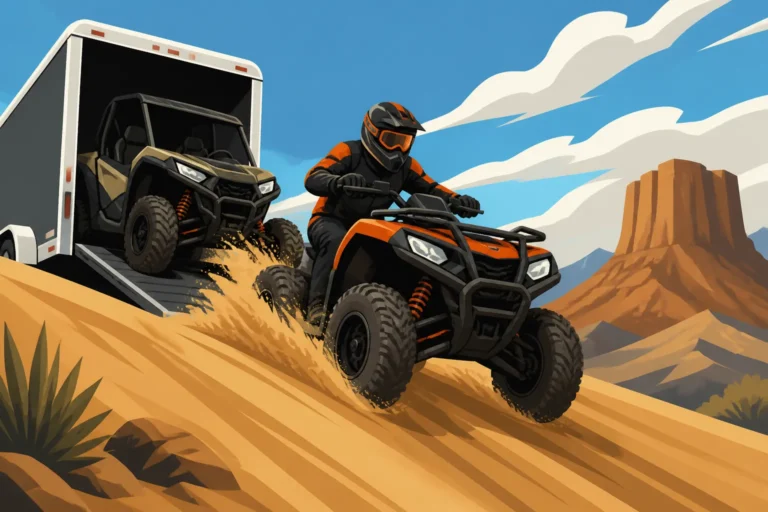
Unload on stable ground where the machine cannot roll toward a person, tent, or vehicle. Keep keys, helmets, gloves, maps, and basic repair supplies together so you are not searching through the trailer at dawn. Secure loose gear before riding; a tool bag or fuel container that shifts on a rough road can become a safety hazard.
Before each ride, check tires, brakes, lights, fuel, and basic controls. Carry a tire-repair kit and the tools suited to your machine, but do not assume a small kit can solve every breakdown. Think about what you would do if the machine stopped far from camp: who knows your route, how you would communicate, and whether you have enough water and warm clothing to wait for help.
If you are using a phone-based map such as onX Offroad, download the area before leaving reliable service and bring a backup power source. Keep your phone accessible but protected from dust, vibration, and weather. A paper map or another offline reference is a useful backup if a device fails or its battery runs down.
Keep the campsite comfortable and responsible
Dispersed sites usually do not provide the services of a developed campground. Plan to bring drinking water, food storage, rubbish bags, and a way to manage waste responsibly. Do not leave food or scented items exposed, and follow any local wildlife guidance. In remote areas, a quick trip back to town for forgotten supplies may take far longer than expected.
Pack out all rubbish, including small items such as zip ties, food wrappers, and broken equipment parts. Avoid washing vehicles or dumping grey water near streams, springs, or other water sources. Leave the site as you found it, or cleaner. Your goal is to camp without making the next visitor—or the land manager—deal with your leftovers.
For more planning detail, see Camping Near Wyoming Trailheads and Wyoming Dispersed Camping for Riders. These topics are especially relevant when you are deciding whether to camp beside the machine, use a more established campsite, or trailer to a designated staging area.
Make a practical trip plan before you go
A successful dispersed-camp ride is usually built around a few simple decisions made before departure: where you may camp, how you will reach the riding area, what route is open to your machine, and what you will do if conditions change. Write down the plan rather than relying on memory or a single app screen.
Share the route and expected return time with someone who is not on the ride. Include the campsite or trailhead, the route you intend to take, and a time to check in. If you change plans because of weather, a closure, or a mechanical problem, let that person know when possible.
Build a backup plan
Choose a second campsite or a safe place to regroup in case your first choice is occupied, inaccessible, or closed. Have an alternate ride that does not depend on crossing a questionable segment. If a route is muddy, washed out, or signed closed, turning around is often the safest and simplest decision.
For remote rides, carry more water and warm layers than you expect to need. Wyoming weather can change quickly, and a minor delay can become uncomfortable when you are exposed to wind or caught out after dark. Keep enough fuel for the planned route plus a reasonable reserve, especially if the ride passes through long stretches without services.
Use a final checklist
Before towing out, confirm that the machine is secured, the trailer connection and lights work, and essential gear is packed. At the last reliable service point, make sure your maps are available offline and that your phone or navigation device is charged. On arrival, check signs again: conditions on the ground take precedence over what you expected from the drive.
A simple final checklist can prevent the most common avoidable headaches:
- Confirm camping is allowed at the chosen location.
- Check official route maps and any machine-width or seasonal limits.
- Verify the access road is suitable for your tow vehicle and trailer.
- Save offline maps and identify a backup route or campsite.
- Pack water, food, weather layers, repair supplies, and waste bags.
- Tell someone your route and expected return time.
- Read signs at the campsite and route entrance before unloading or riding.
When those checks are done, dispersed camping can make a Wyoming ATV or UTV trip feel more flexible without requiring you to guess about access. Choose a site that fits your rig, treat camping and riding permission as separate questions, and be willing to change plans when the map, weather, or signs call for it.
Disclaimer
This article is for general informational purposes only and does not constitute professional advice. Laws, prices and regulations vary by location and change over time. Consult a qualified professional for guidance on your specific situation.