Why Wyoming Honors No Other State’s Registration
Wyoming does not treat an out-of-state ATV or UTV registration as a substitute for its own off-road permit. That can catch visitors off guard: your machine may be properly registered at home and still need a Wyoming decal before you ride where the state permit is required. Here’s why the rule works that way, what to buy, and what the permit does—and does not—allow.
The short answer: an out-of-state registration does not replace the Wyoming permit
If you bring an ATV, UTV, dirt bike, or other off-road machine into Wyoming, do not assume the registration or off-highway sticker from your home state will cover your ride here. Wyoming requires its own off-road permit for machines used in places where that permit is required. A home-state plate, registration card, or decal does not serve as a Wyoming permit.
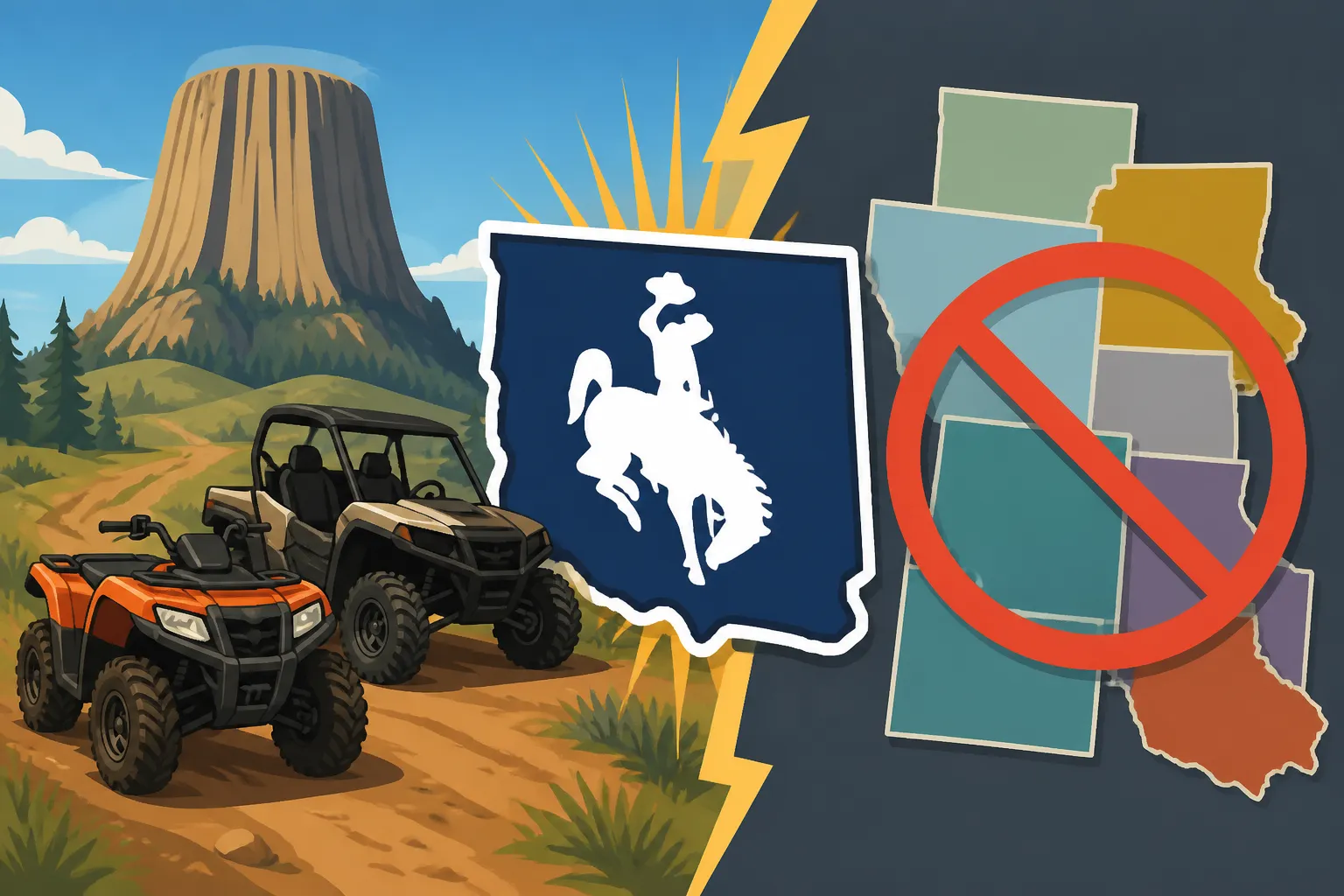
That is the central point of Wyoming’s no-reciprocity policy. “Reciprocity” would mean Wyoming accepts another state’s registration or permit as an equivalent. Wyoming generally does not do that for its off-road permit requirement. A visitor and a Wyoming resident need to follow the same basic permit rule when riding a qualifying machine in the applicable places.
This does not mean you should leave your home-state paperwork behind. It may still be important for identifying the machine, showing that it is lawfully registered where you live, or complying with rules that apply to your vehicle and its use. It simply does not replace Wyoming’s required decal.
The practical rule is straightforward:
- Bring your usual vehicle documents.
- Check whether your planned riding area requires a Wyoming off-road permit.
- If it does, get the Wyoming permit for each machine that needs one.
- Follow the route, land-access, equipment, and age rules that apply to your specific ride.
For a fuller overview of the system, see Wyoming ORV Permits Explained. If you are visiting from another state, Wyoming ORV Permit for Nonresidents focuses on the visitor’s side of the question.
Why Wyoming has a separate permit system
States do not all regulate off-road vehicles in the same way. One state may issue a registration card, another may use a sticker, and another may distinguish between a road-registered vehicle and a machine permitted for off-highway use. Even when two states use similar words, their documents may serve different purposes and apply to different places.
Wyoming’s off-road permit is a Wyoming-specific requirement. It is not simply a general proof that a machine has been registered somewhere. The state’s permit system is connected to use of qualifying machines on covered routes and riding areas, and its rules are set for Wyoming rather than automatically matching the system in a rider’s home state.
That is why a visitor can arrive with a current sticker from home and still need to purchase a Wyoming decal. The two documents are not interchangeable. Wyoming is not saying that the other state’s registration is invalid in the state that issued it; it is saying that the other state’s document does not satisfy Wyoming’s separate permit requirement.
The system also gives riders a consistent rule regardless of where they live. A visitor does not get a different Wyoming permit category just because their home state uses another kind of registration. The process is meant to be applied under Wyoming’s own terms, not negotiated state by state according to what each visitor carries.
Wyoming’s program is administered through its own channels, and permit revenue supports the state’s off-road trails system. The amount, sale locations, and current procedures are matters to confirm through the state’s official information before you travel. For the bigger picture on how permits fit into the state’s trails network, read Wyoming’s Enrolled Trail System.
A plate and an off-road permit are not the same thing
A plate can identify a vehicle for road use under the rules of the jurisdiction that issued it. An off-road permit is a separate authorization tied to off-highway use under the issuing jurisdiction’s rules. One document does not automatically satisfy every requirement associated with the other.
This distinction matters especially when a machine has a plate from another state. A plate may be relevant to whether it can travel on certain roads, but it does not automatically grant access to Wyoming trails or replace the state off-road decal. The reverse is also true: a Wyoming off-road permit is not a road license and does not, by itself, make a machine legal to drive on public streets.
If you are considering using a side-by-side on both trails and roads, treat the two questions separately. First ask whether the machine needs the Wyoming off-road permit for the places where you plan to ride. Then determine whether the machine and route meet the rules for road use. Why an ORV Permit Is Not a Road License explains that difference.
The permit follows the machine, not the rider’s home address
The no-reciprocity rule is not a penalty for being a nonresident. It is a requirement based on the machine and the intended use. A visitor should not expect to pay a special surcharge simply because they live elsewhere, nor should a resident assume a local registration document replaces the Wyoming permit.
A permit is generally associated with an individual machine rather than a person’s household. If you haul two machines, check the requirement for each one instead of assuming one decal covers all the machines you own or bring. If you are borrowing or renting, ask who is responsible for confirming the permit is in place before you ride. More on that distinction is available in Whose Decal Counts on a Borrowed Machine.
What your home-state paperwork does—and does not—prove
A common source of confusion is the word “registration.” Riders may use it to refer to a title, a vehicle registration card, a license plate, an off-highway sticker, or a local permit. Those documents can have different legal effects. When planning a Wyoming ride, identify exactly what you have and what it authorizes.
| Document or proof | What it may help establish | What it does not automatically do in Wyoming |
|---|---|---|
| Home-state off-highway decal | That you met a requirement in the state that issued it | Replace a Wyoming off-road permit |
| Home-state registration card | Registration status under the issuing state’s rules | Authorize every kind of off-road riding in Wyoming |
| License plate | Road registration status where the plate is recognized | Provide trail access or satisfy Wyoming’s off-road decal requirement |
| Title or bill of sale | Ownership or transfer information | Serve as an off-road permit |
| Wyoming permit decal | Compliance with the Wyoming permit requirement where it applies | Make a closed route open or grant permission to cross private land |
Keep your paperwork, but do not rely on a document just because it has a state seal, vehicle number, or sticker. The useful question is not “Is this official?” It is “Does this document meet the particular Wyoming requirement for the ride I plan to make?”
That distinction is useful when you are asked to show documents at a trailhead or during a contact with an enforcement officer. You may need to show the Wyoming decal for the permit question. Other paperwork may be relevant to ownership or vehicle status. A phone photo of a receipt might help you keep track of a purchase, but do not assume it replaces a decal that is required to be displayed on the machine. Check current instructions for what must be carried and what must be affixed.
Examples that often confuse visitors
“My quad has a current off-road sticker from my home state.”
That sticker may satisfy the home state’s rules, but it is not a Wyoming permit. If your Wyoming riding location requires the state permit, obtain the Wyoming decal as well.
“My side-by-side has a road plate.”
The plate may matter for road use under applicable rules. It does not, by itself, settle the off-road permit question. Check the permit requirement for the land and routes where you intend to ride.
“I’m only visiting for a weekend.”
A short trip does not automatically create an exemption. Verify whether the machine needs a Wyoming permit before you arrive at the trailhead. A brief visit can still involve a permit requirement.
“I’m renting the machine.”
Ask the rental business whether the machine already has the required Wyoming permit for the route or area you will use. Do not infer that it is covered simply because the company operates in Wyoming. Ask what the decal covers and whether there are route or land restrictions. Wyoming Rules for a Rented Machine covers related questions.
“I’m riding a machine owned by a friend.”
The owner’s address and your address are not the key questions. Confirm that the machine itself is properly permitted for the planned use. A friend’s home-state sticker does not automatically cover your Wyoming ride.
How to get the Wyoming permit before you ride
The easiest way to avoid a last-minute problem is to treat the permit as part of trip preparation, not something to figure out at the trailhead. Check the state’s current purchase options and permit instructions, then allow time to receive and attach the decal if you buy in advance.
A practical checklist
-
List every machine you plan to bring.
Note whether each is an ATV, UTV, dirt bike, youth machine, or another type. Different classifications can have different rules, so do not assume a policy for one machine automatically applies to another. -
Identify where you intend to ride.
Make a short list of the trail system, forest, public land, park, or road network you plan to use. A Wyoming permit does not tell you that every route in the area is open. -
Confirm whether each machine needs a Wyoming permit.
Use current state guidance for the machine type and intended use. If your situation is unusual—such as an imported, modified, homebuilt, or work-only machine—ask the relevant program or land manager before you travel. -
Choose an authorized way to purchase it.
Wyoming offers permit purchase options through official channels and authorized sellers. The current choices can change, so confirm the state’s instructions. For step-by-step online guidance, see Buying a Wyoming Permit Online. To find an in-person option, see Where to Buy a Wyoming ORV Permit. -
Check what information you need at checkout.
Be ready to identify the machine and provide the details requested by the seller or official system. Keep the purchase confirmation or receipt with your trip documents. -
Attach the decal as directed.
Follow Wyoming’s current placement instructions. Do not leave it in a glove box or assume that carrying a receipt is the same as displaying a required decal. Wyoming ORV Decal Placement covers placement considerations. -
Check the dates and renew when needed.
Wyoming’s permit system has its own validity period. Confirm when the permit starts and ends rather than assuming it follows your home-state registration year or the date you bought it. See When a Wyoming ORV Permit Expires.
For practical paperwork storage, a small waterproof document pouch can keep receipts and vehicle information together. If you shop on Amazon or another marketplace, choose a pouch that can be secured without blocking controls, labels, or required machine markings. The pouch is only for documents; it does not replace the decal or its required placement.
Do not wait until you are already at the trailhead
A permit may be available through more than one sales channel, but availability and processing times vary. An online order may involve delivery, while an in-person purchase depends on an authorized seller being open and having the needed permit available. Confirm the current options before setting out, especially if your trip begins early, takes you far from town, or depends on a specific trailhead.
If your decal arrives by mail, inspect it before loading the machine. Make sure you know which machine it belongs to and where it should go. If it is damaged, missing, or incorrectly attached, do not improvise by moving it to another vehicle. Check the official replacement or correction procedure.
A second Amazon purchase can be useful for the paperwork side of travel: a compact folder or document sleeve can hold the receipt, home-state registration, insurance information if relevant, and a printed map. Keep personal documents secure, and avoid putting paperwork where it can come loose or interfere with operating the machine.
The permit does not open every road, trail, or parcel of land
The Wyoming decal answers one question: whether you have met the state off-road permit requirement where it applies. It does not answer every question about where you may ride. A permitted machine can still be on a closed route, an unauthorized road, private land without permission, or terrain where that machine is not allowed.
This is the part visitors most often miss. They buy the correct decal, then assume they can ride any visible two-track or follow a route shown on a general map. The permit is not a universal access pass. Land managers and owners decide which routes are open, and the restrictions can vary by location, season, machine width, or other factors.
Before you unload, check the applicable travel map and current signs. A route’s appearance is not proof that it is open to motorized use. A track on a phone map may be a private road, a closed route, a route for a different class of vehicle, or an old line that is no longer authorized. [Wyoming Rules for Riding Federal Land] explains why land-specific rules matter, while [Wyoming Rules for Riding a Designated Route] focuses on staying on permitted routes.
Keep these permissions separate
- State permit: Whether the machine has the required Wyoming off-road decal.
- Route authorization: Whether the particular road or trail is open to your type of machine.
- Land access: Whether you have permission to cross or ride on the land.
- Road legality: Whether your machine may travel on a particular public road and meets the applicable equipment and licensing rules.
- Operating rules: Whether the rider meets age, supervision, helmet, safety, and other requirements.
Having one item does not automatically satisfy the others. For example, a permit does not grant permission to cross private property. A road plate does not mean an adjacent trail is open. And a route that is open to some machines may have limits that exclude a wider UTV.
If you are planning a multi-day trip across different land jurisdictions, check each segment rather than relying on one general map. The route can pass from one management area to another, and the rules can change at the boundary. Confirm that your intended connecting roads are open and that you understand where the authorized segment ends.
A map, a sign, and a permit all serve different purposes
Use a current travel management map to plan, then pay attention to signs on the ground. If a sign indicates a closure, do not treat your permit or an older map as permission to continue. If a map and a sign appear to conflict, stop and seek clarification from the responsible land manager instead of guessing.
A Wyoming permit does not certify that your machine meets every width or equipment rule. It does not guarantee that the trail is suitable for your vehicle, and it does not override temporary closures due to weather, fire danger, wildlife protection, maintenance, or seasonal conditions. Confirm conditions shortly before departure and again when you reach the area.
Common mistakes visitors make about reciprocity
The no-reciprocity rule is simple, but a few assumptions can make it easy to overlook. These are the mistakes worth catching before the trip.
Assuming a state-issued sticker must be accepted everywhere
A sticker can look official and still be limited to the state that issued it. Do not judge a document by its appearance or by the word “registration.” Check what the issuing state’s document does and what Wyoming requires separately.
Confusing a permit with a vehicle plate
A plate may be relevant to road use, while an off-road decal is tied to the Wyoming permit program. If your machine has both a plate and an off-road sticker, understand what each one covers. If it has only a plate, do not assume that settles the permit requirement.
Buying one permit for a group
A rider’s permit is not necessarily a household or group pass. If multiple machines are travelling together, verify the requirement for each machine. A convoy can include vehicles that differ in type or classification, and a permit associated with one machine should not be treated as transferable to another.
Treating a rental company’s location as proof the machine is permitted
A rental business may maintain its fleet paperwork, but you should ask directly whether the specific machine has the Wyoming permit required for your planned riding area. Ask whether the decal is already attached, whether it applies to the route you booked, and whether any restrictions apply. This is particularly important if you plan to leave the operator’s suggested route or use a different land system.
Assuming a permit makes the route legal
The permit is not a substitute for an open route. Riders can have a valid decal and still violate a closure, leave a designated trail, or enter land without authorization. Check maps and closures before the ride, not just the permit status.
Relying on a receipt as a substitute for the decal
A receipt can help show that you purchased a permit, but do not assume it takes the place of the physical decal if the state requires the decal to be displayed. Read the current instructions, attach it correctly, and keep the receipt as supporting paperwork rather than as a replacement.
Assuming a machine is exempt because it is used for work at home
A ranch, hunting, or utility use in another state does not automatically determine how Wyoming treats the machine when it is brought here. If the machine is used for work, kept on private land, operated on public routes, or used in a mixed way, describe the exact situation when checking the rules. The details of where and how the machine is operated can matter.
For easier document organization, some riders keep a simple machine-by-machine checklist with the VIN or serial information, permit confirmation, and route notes. You can make one on paper or use a folder, including a waterproof option found through Amazon. Keep the record private and secure, and do not post identifying machine details publicly.
A visitor’s trip-planning routine
A little preparation can prevent a permit issue from turning into a wasted drive. Use this sequence for each trip, whether you are bringing your own ATV from a neighboring state or towing a UTV from farther away.
Before you leave home
- Confirm the machine type and any special classification questions.
- Check the Wyoming permit requirement and purchase process.
- Buy the required decal through a current authorized channel.
- Read the instructions for displaying the decal.
- Make sure you have the purchase confirmation and your ordinary machine documents.
- Choose the exact riding area and identify the applicable land manager.
- Download or print the current travel map.
- Check route closures, seasonal restrictions, and machine-width limits.
- Confirm that any rental machine is already permitted for the planned use.
If you are crossing state lines with a plated machine, verify the requirements for the roads you will use as well as the off-road permit. Road registration and trail access are separate matters. Do not assume a vehicle’s status on highways tells you whether it can ride on a particular Wyoming route.
At the riding area
Before unloading, look for signs and confirm that you are at the intended access point. Check the decal on each machine, then compare the route ahead with your map. If you see a closure or are unsure whether the road is open to your vehicle type, stop and ask rather than proceeding based on what other riders are doing.
Carry the information you need in a place where it is accessible but protected from dust, water, and damage. A phone can be useful for storing purchase confirmations and maps, but cell service may be unreliable in remote areas. Save maps for offline use where possible, and keep a paper backup for the routes you plan to ride.
If you use a small case or pouch from Amazon for paperwork or a phone, make sure it is secured before riding and does not create a snag hazard. Gear choices are secondary; the important part is that you can access the route information and prove which machine has which permit if needed.
If plans change
A weather closure, fire restriction, trail condition, or access issue may force you to change routes. Do not assume the permit makes any alternative route acceptable. Re-check the map and restrictions for the new route. If your original trail crosses multiple land-management areas, the backup route may be under a different set of rules.
Likewise, if you swap machines, lend one to another rider, or add another ATV to the group, re-check the permit requirement for that machine. A decal assigned to one machine should not be moved to another without confirming the official process.
What to verify before the next Wyoming ride
Because sellers, purchase methods, dates, and operating requirements can change, confirm the current details with Wyoming’s official permit information before you travel. In particular, verify:
- Which of your machines needs a Wyoming permit.
- Whether a special machine type or use case has additional instructions.
- The current permit validity period and expiration date.
- Where you can buy the permit and whether an online purchase requires mailing time.
- How and where the decal must be displayed.
- Whether the specific road or trail is open to your machine.
- Any current seasonal, fire, wildlife, or weather-related closure.
- Whether your rental or borrowed machine already has the correct permit.
For a broad explanation of the annual permit, see Wyoming’s Annual ORV Permit. If you are comparing the permit requirement with another state’s registration, the clearest working assumption is that your home document does not replace Wyoming’s decal. Plan to meet Wyoming’s requirements separately, then confirm route access and all other rules for the place you intend to ride.
Disclaimer
This article is for general informational purposes only and does not constitute professional advice. Laws, prices and regulations vary by location and change over time. Consult a qualified professional for guidance on your specific situation.