Licensed Riders Over 15 on Wyoming Roads
It’s a common dream for many of us who love the wide-open spaces of Wyoming: being able to hop on our ATV or UTV right from our driveway and head straight to the nearest trail or even just down a county road to a friend's place. But when you’re a licensed rider over the age of 15, the rules about riding these machines on public roads in the Cowboy State can feel like navigating a maze blindfolded. This guide is here to untangle all those complex regulations, giving you a clear path forward for legally riding your ATV or UTV on Wyoming roads.
The Basics of Road Riding for Licensed Riders in Wyoming
When you're a seasoned rider who holds a driver's license, it’s natural to assume that gives you the green light for many things on the road. However, Wyoming has some very specific distinctions when it comes to off-road vehicles (ORVs) and on-road travel. It's not as simple as having a license and an ORV permit; there's a whole other layer of compliance that needs to be understood. This initial distinction is crucial, because misunderstanding it is where most riders get into trouble.
Why an ORV Permit Isn't Enough for Road Use
Many riders diligently get their annual Wyoming ORV permit, proudly displaying that vibrant decal on their machine, thinking they're all set for adventure. And for designated trails, you absolutely are! That permit signifies your contribution to the Wyoming Trails Program and allows you to explore thousands of miles of incredible backcountry. It's fantastic for carving through forest singletrack or navigating open BLM land.
However, that ORV permit is specifically for off-road recreational use. It does not, in any way, grant you permission to operate your ATV or UTV on paved state highways, county roads, or city streets unless those specific roads are explicitly "enrolled" in the state's ORV program and designated for such use. Thinking your ORV permit is a free pass for road riding is a common, but critical, mistake that can lead to fines and headaches. The state differentiates between a machine designed and permitted for dirt, and one that is street-legal. For a deeper dive, check out [Why an ORV Permit Is Not a Road License].
Your standard ATV or UTV, even with an ORV permit, is generally not considered street-legal for typical road use. It lacks the specific equipment and vehicle classification necessary for highway travel. Imagine trying to drive a dirt bike on I-80 without a license plate or brake lights – it's the same principle. The ORV permit is about access to trails, not about making your vehicle compliant with traffic laws. This distinction is paramount, especially for licensed riders who might mistakenly believe their general driving privileges extend to all vehicles they operate.
Understanding Wyoming's Multipurpose Vehicle MPV Class
So, if an ORV permit isn't the answer, what is? Enter Wyoming's "Multipurpose Vehicle" or MPV classification. This is the legal pathway for many ATVs and UTVs (especially side-by-sides) to become road-legal in the state. It's a special vehicle category designed to bridge the gap between purely off-road machines and traditional automobiles. To qualify as an MPV, your machine must meet a specific set of criteria outlined in Wyoming statutes, primarily W.S. 31-1-101. This includes requirements like having four or more wheels, a minimum curb weight of 300 pounds but not exceeding 3,000 pounds, and a seat height of at least 24 inches from the ground to the lowest point of the seat.
For many side-by-sides, meeting these physical requirements isn't a huge hurdle. Most modern UTVs naturally fall within the weight and seat height parameters. However, some smaller, lighter ATVs might not qualify, as they may fall below the 300-pound minimum or not meet the seat height. The MPV designation isn't just about the physical characteristics; it’s also about how the vehicle is registered and titled. You don't just declare it an MPV; you must go through the official titling and plating process, which we'll cover later. For more information on this, see [Wyoming's MPV Definition in W.S. 31-1-101].
Once your machine is correctly titled and registered as an MPV, and equipped with the necessary safety features, it unlocks the ability to ride on designated public roads. This is a game-changer for many who want to expand their riding horizons beyond just trails. It allows for convenient travel between trail systems, access to fuel and services in towns, and the sheer enjoyment of cruising some of Wyoming's scenic backroads. The MPV classification essentially transforms your off-road machine into a street-legal vehicle, albeit with certain restrictions on where it can operate. This path is your primary route to riding on Wyoming roads. Find out more about this process in [Wyoming's MPV Path to the Road].
Essential Requirements for Licensed Riders and Their MPVs
So you've got your eyes set on making your machine street legal and you already hold a driver's license. That's a great start! But being a licensed rider over 15 on Wyoming roads with an MPV involves more than just having a valid driver's license. There are specific endorsements you'll need, and your machine itself must be outfitted with particular equipment to ensure both your safety and compliance with state law. Cutting corners here isn't just risky, it's illegal.
Driver's License and Endorsement Necessities
If you're a licensed driver over the age of 15, you already possess a fundamental requirement: a valid driver's license. However, a standard Class C (passenger vehicle) license isn't enough to legally operate an MPV on Wyoming roads. The state requires an additional endorsement to specifically authorize you to drive these types of vehicles. This is similar to how you need a motorcycle endorsement to ride a street bike, even if you already have a car license.
Wyoming offers two primary endorsements that apply: the "M" endorsement (for motorcycles) or the "MR" endorsement (for motorcycle-related vehicles). For most MPV operators, the "MR" endorsement is the appropriate choice. This endorsement is specifically for multipurpose vehicles and doesn't require the same level of motorcycle riding skill as the "M" endorsement. To obtain an "MR" endorsement, you'll typically need to pass a written test covering motorcycle and MPV specific laws, and sometimes a skills test. It's always best to check with the Wyoming Department of Transportation (WYDOT) or your local driver services office for the most current requirements. Neglecting this endorsement means that even with a valid driver's license, you're technically driving without the proper authorization for your MPV, which could lead to a citation. For a comprehensive look at the rules surrounding this, consult [Wyoming Driver's License Rules for ORVs] and [The M or MR Endorsement Wyoming Asks For].
It's a step that often gets overlooked, but it's crucial for legal road use. Don't assume your existing license covers everything. The state wants to ensure that anyone operating these unique vehicles on public roads has at least a basic understanding of their operational differences and the specific traffic laws that apply to them. This ensures greater safety for everyone sharing the road.
Mandatory Equipment for Street-Legal MPVs
Once you've got your driver's license and the correct endorsement sorted, the next big hurdle is your machine itself. To be truly street-legal as an MPV in Wyoming, your ATV or UTV needs to be equipped with specific safety features, much like any other vehicle on the road. This isn't just about passing an inspection; it's about making your machine safe for higher speeds, traffic, and varying light conditions.
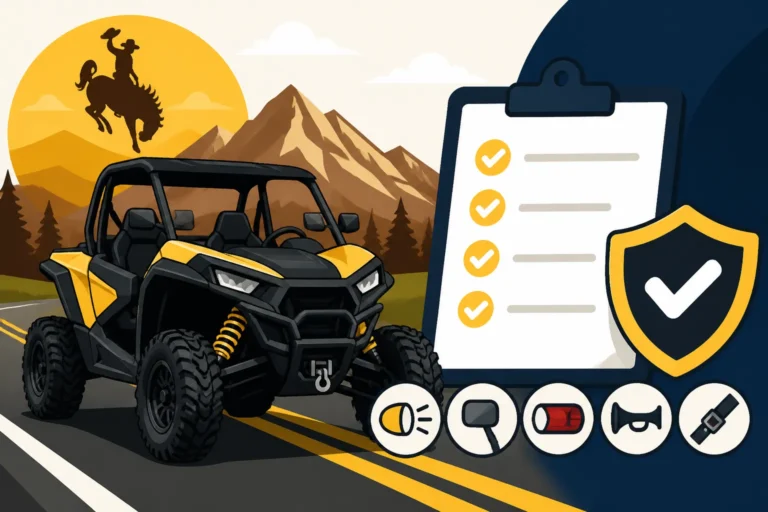
Key equipment includes working headlights, taillights, and stop lamps. Your headlights must be capable of illuminating the road a certain distance ahead, and your taillights and brake lights need to be clearly visible from the rear. You’ll also need at least one rear-view mirror mounted to provide a clear view of the road behind you. A horn is absolutely essential for signaling to other drivers or pedestrians. Depending on your MPV's configuration, you might also need turn signals if it's designed for such. You can find detailed requirements in [Wyoming Lighting Requirements for ORVs], [Wyoming Mirror Requirements for Road Use], and [Wyoming Horn Requirement on a Road Machine].
Beyond these core items, ensure your tires are in good condition and suitable for road use (some aggressive off-road treads wear quickly and can handle poorly on pavement). Your exhaust system must meet noise regulations and typically requires a spark arrester, even for road use, to prevent fires. Many riders turn to aftermarket solutions for these upgrades. Companies like SuperATV offer a wide range of street-legal kits and individual components – from mirrors and horns to turn signal kits – that can help transform a purely off-road machine into a compliant MPV. Investing in quality, compliant equipment is not just about meeting the letter of the law; it's about making your road adventures safer and more enjoyable. After all, what’s the point of being street legal if you can't be seen or heard? [Fitting a Horn to a Road-Legal Side-by-Side] is a good resource to ensure your machine is up to snuff.
Where Licensed Riders Can Operate Their MPVs on Wyoming Roads
So, your MPV is street-legal, and you're properly licensed and endorsed. Fantastic! Now comes the exciting part: hitting the road. But hold on a moment – not all roads are created equal when it comes to MPV access in Wyoming. The state has specific rules about where these vehicles can and cannot be operated, and understanding these distinctions is paramount to avoiding fines and ensuring a smooth ride.
Navigating "Designated" vs. "Undesignated" Roads
The biggest hurdle for MPV riders on Wyoming roads is the concept of "designated" versus "undesignated" routes. Unlike a standard passenger car that can drive on virtually any public road, MPVs are generally restricted to roads that have been specifically "enrolled" or "designated" for their use. This means a road isn't open just because it's a public thoroughfare; it needs official approval from the managing agency – whether that's the state, a county, the Forest Service, or the Bureau of Land Management (BLM).
You can't simply assume a road is open. Many state highways, for instance, have blanket prohibitions on MPVs, while others, particularly in rural areas, might be designated for use. County roads are often a mixed bag; some counties have explicitly opened many of their roads to MPVs, while others have not. It's a patchwork, and it requires diligence from the rider. The best way to know is to consult official maps provided by the managing agency. For example, the Forest Service issues Motor Vehicle Use Maps (MVUMs) that clearly show which roads and trails are open to which types of vehicles. The BLM also provides similar resources. Always look for signage indicating that a road is open to ORVs or MPVs, but don't rely solely on signs – maps are the definitive source. For a deeper understanding, explore [Wyoming's Designated ORV Roads].
Riding on an undesignated road can lead to tickets and potential impoundment of your vehicle, even if you are fully street-legal otherwise. This can be incredibly frustrating, especially for visitors or those new to an area, as the rules can change from one jurisdiction to the next. Always do your homework before heading out, especially if you plan to venture into unfamiliar territory. Getting caught off-guard on a closed road is a surefire way to spoil a perfectly good ride.
Specific Rules for Different Road Types County, Forest, BLM
While the "designated" rule applies across the board, the specific nuances and local considerations can vary depending on the type of road you're on. Licensed riders need to be aware of these distinctions to ensure they're always in compliance and respectful of other road users and landowners.
County Roads: Many Wyoming counties have embraced the MPV concept, opening numerous county roads to street-legal machines. However, it’s not uniform. Some counties have ordinances specifying which roads are open, while others may leave it up to individual commissioners or land managers. Speed limits on county roads are often posted, but even if they aren't, prudent speeds are always advisable, especially on gravel or dirt roads where visibility can be limited by dust. Watch out for potholes, washboards, and blind corners. Always yield to larger vehicles and be mindful of agricultural traffic. For more insights, refer to [Wyoming Rules for Riding a County Road].
Forest Service Roads: In the vast National Forests of Wyoming, many roads are designated for MPV use. These roads are typically identified on the Forest Service's MVUMs. When riding in a National Forest, remember that you're in a shared-use environment. You'll encounter campers, hikers, mountain bikers, and wildlife. Speed limits may be lower, and certain areas might have seasonal closures for wildlife protection or during periods of high fire danger. It's not uncommon to encounter cattle on Forest Service roads, especially in grazing allotments. Always approach livestock slowly and give them plenty of space. For more details, explore [Wyoming Rules for Riding a Forest Road].
BLM Roads: The Bureau of Land Management manages a massive amount of land in Wyoming, and like the Forest Service, they designate routes for MPV use. These are often vast networks of two-tracks and dirt roads crisscrossing sagebrush country. Again, carrying a current BLM map or having a GPS with updated route information is critical. BLM lands often have even fewer services than National Forests, so be prepared with extra fuel, water, and emergency supplies. Respect private property boundaries that may intersect BLM lands, and always close any gates you open. You can learn more about this in [Wyoming Rules for Riding a BLM Road]. In all cases, remember that you are sharing these routes with other users, so courteous and safe driving practices are always expected.
| Road Type | Designation Source | Typical Speed Limits | Common Restrictions | Important Considerations |
|---|---|---|---|---|
| County Roads | County Commissioners | Varies (often 35-55) | May be restricted by local ordinance | Watch for dust, agricultural traffic, private property |
| Forest Service | MVUMs (Forest Service) | Varies (often lower) | Seasonal closures, wildlife closures | Share with hikers/campers, watch for livestock, fire danger |
| BLM Roads | BLM Travel Management | Varies (often higher) | Wilderness boundaries, private land intersections | Limited services, remote areas, close gates |
| State Highways | WYDOT | Posted | Generally prohibited (unless specific designation) | High speed traffic, limited shoulder, specific crossings |
Insurance, Helmets, and Other Safety Considerations
Even as a licensed rider, operating an MPV on Wyoming roads means you're operating a motor vehicle subject to many of the same responsibilities as a car or truck. Beyond the obvious rules about licenses and equipment, there are crucial safety and legal requirements regarding insurance and personal protective gear. These aren't just suggestions; they're vital for your protection and to ensure you're compliant with Wyoming law.
Insurance and Proof of Financial Responsibility
Just like with any other vehicle you operate on public roads, your street-legal MPV must carry liability insurance in Wyoming. This isn't an option; it's a legal requirement to demonstrate financial responsibility. If you're involved in an accident and found to be at fault, this insurance helps cover the costs of damages or injuries to other parties. Without it, you could face severe financial penalties, including fines, suspension of your driver's license, and potential personal liability for all damages.
The minimum insurance requirements in Wyoming are similar to those for passenger cars. You'll need coverage for bodily injury per person, bodily injury per accident, and property damage. While these minimums protect you legally, many riders opt for higher coverage limits and additional types of insurance, such as collision or comprehensive, to protect their own machine in case of an accident, theft, or other damage. Because these machines can be quite valuable, it's wise to consider coverage beyond the basic liability. You can usually add your MPV to your existing auto insurance policy, or a separate policy can be obtained. Always carry proof of insurance with you when operating your MPV on public roads, either a physical card or digital proof on your phone. For more specific information, refer to [Wyoming ATV Insurance Requirement].
It’s tempting to think, "Oh, it's just a UTV, I'll be careful." But accidents happen, and having the right insurance coverage isn't just a legal formality; it's a crucial layer of protection for your finances and your peace of mind. Without it, a simple fender bender on a county road could turn into a catastrophic financial burden. Don't let a great day of riding turn into a nightmare due to a lack of proper coverage.
Helmet Laws and Passenger Rules for Licensed Riders
Wyoming's helmet laws for MPV riders are often a point of confusion, especially for licensed adults. For riders who are 18 years of age or older and operating an MPV (not a motorcycle), helmets are generally not legally required. This means if you're a licensed driver over 18 on a properly titled and registered MPV, you have the personal choice of whether or not to wear a helmet. However, while not legally mandated for adults, wearing a helmet is always a smart choice for safety, especially when traveling on paved roads with higher speeds and traffic.
The rules change, however, when it comes to passengers and younger riders. Any passenger under the age of 18 must wear an approved helmet when riding on an MPV on public roads. Similarly, if the operator is under 18, a helmet is required for them as well. This highlights Wyoming's commitment to protecting its younger riders. When carrying passengers, ensure your MPV is designed to safely accommodate them. Side-by-sides, with their multiple seats and seatbelts, are generally well-suited for passengers, but individual ATVs typically have stricter rules about carrying passengers, often prohibiting it unless specifically designed for two riders. Always ensure passengers are properly seated, secured with seatbelts (if available), and understand basic safety procedures. For detailed information, consult [Wyoming Helmet Law for ATV Riders], [Wyoming Helmet Law for Passengers], and [Wyoming Passenger Rules on an ATV].
Beyond helmets, other safety gear like eye protection (goggles or a face shield), gloves, and sturdy footwear are highly recommended for all riders, regardless of age or legal requirements. Riding on roads exposes you to dust, debris, and the potential for greater impact forces than off-road trails. Protecting yourself with appropriate gear is simply good practice, ensuring you can enjoy your ride safely and comfortably.
The Process of Making Your Machine Street Legal
Bringing your ATV or UTV up to MPV standards for road use in Wyoming is a multi-step process. It's not a single visit to one office; it involves paperwork, inspections, and potentially some mechanical upgrades. For a licensed rider eager to expand their riding territory, understanding this process is key to successfully hitting the pavement.
The Title and Registration Journey
The first crucial step in making your ATV or UTV street legal is to go through the titling process to get it recognized as an MPV. This begins at your local County Clerk's office. You'll need to present proof of ownership, such as a manufacturer's certificate of origin (MCO) if it's new, or a bill of sale and previous title (if available) if it's used. The County Clerk will verify that your machine meets the MPV criteria, including weight (between 300 and 3,000 pounds) and seat height (at least 24 inches from the ground). You may be required to fill out a specific MPV checklist form. Once the Clerk confirms your machine qualifies and all paperwork is in order, they will issue you a Wyoming MPV title. This title formally establishes your vehicle as an MPV in the eyes of the state. More information on this can be found in [Titling a Multipurpose Vehicle in Wyoming] and [Wyoming County Clerk Title Process].
After you have secured your MPV title from the County Clerk, the next stop is your County Treasurer's office to complete the registration and obtain your license plate. This is similar to registering a car. You'll pay applicable registration fees and sales tax (if not already paid). The Treasurer's office will then issue you a specific license plate for your MPV, which must be displayed on the rear of your machine. This plate, along with your valid title and the necessary equipment, officially makes your vehicle street-legal. Remember, both the title and the plate are essential components of road legality. You can't have one without the other for on-road use. Check out [Wyoming MPV Title Requirements] and [Wyoming MPV Plate Requirements] for specific details. The [Wyoming County Treasurer Plate Process] is the final step in getting your machine truly ready for public roads.
Equipping Your Machine for Road Legality
With the administrative hurdles of titling and registration out of the way, the focus shifts back to your machine itself: ensuring it has all the necessary equipment to be fully compliant and safe for road use. This isn't just a formality; these additions are critical for visibility, signaling, and overall safety when sharing roads with other vehicles. You'll need to install items like a horn, rearview mirrors, and appropriate lighting. If your machine doesn't have them integrated, you'll need headlights, taillights, and brake lights that are clearly visible and meet state requirements. A red rear reflector is also often a specific requirement.
For those riding side-by-sides, a turn signal kit is a highly recommended (and often legally required, depending on specific state statutes for MPVs) upgrade. Many aftermarket companies, including SuperATV, specialize in offering comprehensive street-legal kits that bundle all these necessary components, making the conversion process much easier. These kits typically include switches, wiring harnesses, lights, and instructions to integrate seamlessly with your machine. When choosing accessories, it’s vital to select products that are robust and designed to withstand the rigors of both off-road and on-road conditions.
Once all the equipment is installed, it’s a good idea to perform a thorough check of all functions. Test your lights, horn, and mirrors to ensure they are working correctly and properly adjusted for maximum visibility. While Wyoming doesn't typically require a formal vehicle inspection for MPVs like some other states, you are personally responsible for ensuring your machine meets all legal requirements. A proactive approach to equipping and inspecting your vehicle not only keeps you compliant with the law but also significantly enhances your safety and enjoyment on Wyoming's vast network of designated roads.
Disclaimer
This article is for general informational purposes only and does not constitute professional advice. Laws, prices and regulations vary by location and change over time. Consult a qualified professional for guidance on your specific situation.