Poison Spider’s 284 Acres
Poison Spider OHV Park offers a compact place to ride near Casper, but its 284 acres can be deceptively challenging: bentonite turns slick when wet, and routes vary in difficulty. This guide explains what to expect, how to prepare your ATV or UTV, and how to plan a safer visit without assuming every track is open or suitable for every machine.
Getting to Know Poison Spider OHV Park
What the 284-acre figure means for your ride
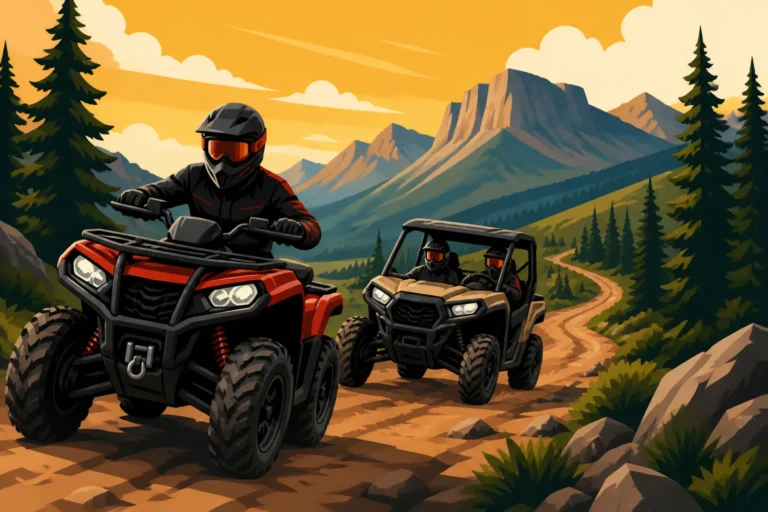
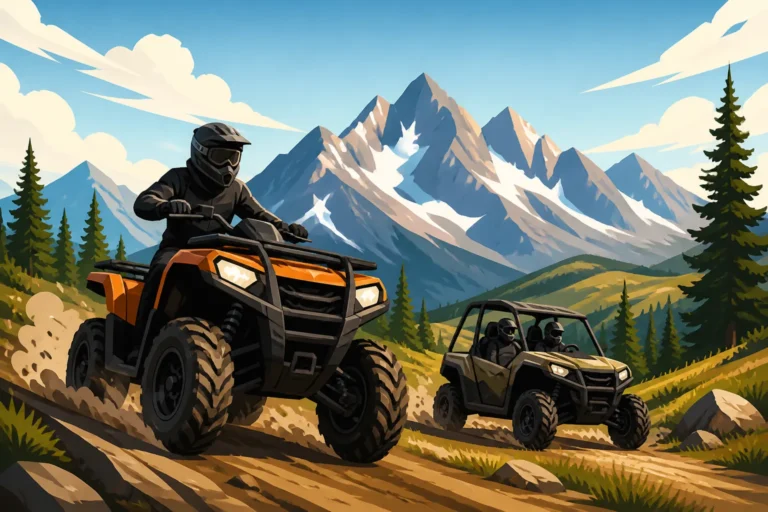
Poison Spider OHV Park is a designated off-highway riding area outside Casper, Wyoming. Its 284 acres make it a relatively compact destination compared with the broad public-land networks elsewhere in the state. That smaller footprint can be a benefit if you want a ride close to town, but it also means the park is not an endless backcountry route. Expect to spend time exploring the available trails, loops and terrain rather than covering a huge distance.
The acreage describes the size of the riding area, not a promise that all 284 acres are open for unrestricted riding. The routes you can use depend on the park’s boundaries, signs, closures and land-management rules. Stay on established routes and don’t assume an open-looking track is a permitted shortcut. A line across bare ground may be tempting, especially when another rider has driven it, but visible tire marks don’t necessarily mean the route is authorized.
The setting can make a short ride feel more involved than the mileage suggests. A UTV may move quickly across an easy section, then slow to a crawl on rougher terrain. An ATV rider may find the same distance tiring if the surface is uneven or the route requires frequent steering corrections. Plan by terrain and riding time, not simply by how many miles you expect to cover.
For an overview of the area and its setting, start with [Poison Spider OHV Park Outside Casper]. It also helps to understand the park’s mining history before riding: [How a Bentonite Mine Became Poison Spider Park] explains why the ground can behave differently from a conventional forest trail.
A former mine is not ordinary trail terrain
Poison Spider’s terrain reflects its past as a bentonite mining area. That history matters because the ground may be disturbed, exposed and highly changeable. Rather than assuming you’ll find a uniform dirt road, expect a mix of surfaces and formations that can include packed earth, loose material, ruts, slopes and uneven transitions. The exact feel of a route can change with weather, traffic and maintenance.
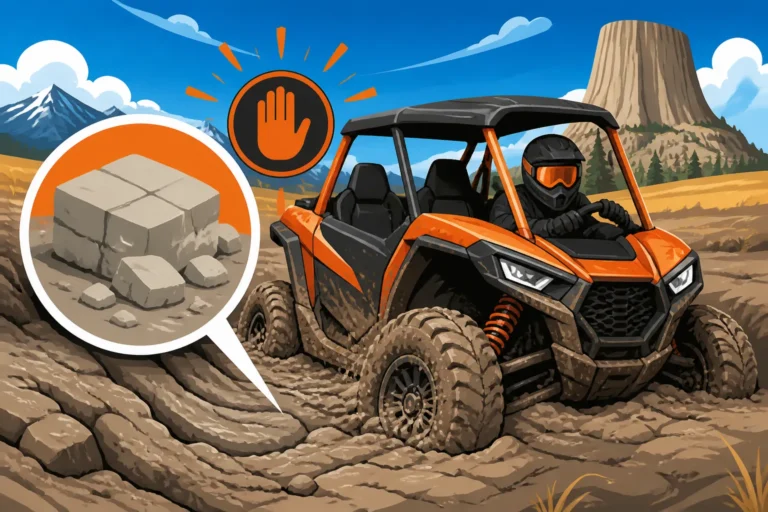
Bentonite is especially important to understand in wet conditions. When dry, a surface may look firm enough to cross. Once wet, clay-rich soil can become slick and sticky, making it harder to steer, brake or maintain traction. Mud can also pack into tires and chassis parts, while a wheelspin-heavy attempt to power through may deepen ruts or damage the surface. A route that felt manageable on a dry day may be a poor choice after rain.
This is one reason a local riding area still deserves backcountry-style preparation. Check weather before leaving, look at the ground near the parking or staging area, and be willing to turn around if conditions deteriorate. If the soil is already clinging heavily to your boots or tires, that is useful information—not a challenge to push farther. The article [Poison Spider After Rain] goes deeper into the way a wet forecast can change a ride, while [Bentonite Mud and Why It Stops You] focuses on the practical problems clay can create.
Choosing Routes and Matching Your Machine
Start with the least demanding terrain
If you have never ridden Poison Spider, begin conservatively. Use the easiest-looking established route that is clearly open, and take time to assess the surface before committing to a longer loop or steeper section. The goal is not to prove what your machine can climb. It is to learn how the terrain responds, how quickly conditions change and whether your group is comfortable with the route.
Riders often get into trouble by letting the most confident person set the pace. A friend who rides regularly may be comfortable with a narrow, uneven section that feels intimidating to a newer rider. If your group includes different experience levels, agree in advance that anyone can call for a stop or turn-around without being pressured. Keep the group close enough to communicate, but leave safe space between machines so a sudden stop does not become a collision.
Choose the route based on the least capable combination of rider and vehicle—not the strongest machine in the group. A compact ATV, a wide side-by-side and a youth machine do not handle every route the same way. Width, ground clearance, tire condition, rider skill and passenger load all affect what is sensible. A trail that looks easy from the driver’s seat may have a sharp edge, loose descent or tight turn that changes the risk.
Use a route comparison like this as a planning aid, not as a substitute for posted signs or current local guidance:
| Riding situation | What to consider | Sensible approach |
|---|---|---|
| First visit | Unfamiliar surface and route layout | Explore gradually and stay on clearly marked routes |
| Recent rain | Slick clay, mud and reduced traction | Delay the ride or turn around if the ground is soft |
| Wide UTV | Turning room and narrow or uneven sections | Confirm the route is suitable for the machine’s width |
| Mixed-experience group | Different comfort levels and speeds | Let the least experienced rider set the pace |
| Youth rider | Machine size, supervision and skill | Choose simple terrain and maintain close adult oversight |
ATV and UTV considerations
An ATV’s smaller footprint can make it easier to turn around in a tight space, but that does not make every steep or rutted section safe. Riders need to keep their weight balanced, look ahead and avoid sudden throttle or braking inputs on loose ground. If a route becomes uncomfortable, stop somewhere stable and reassess rather than trying to squeeze past a difficult spot simply because the group has already gone partway through.
A UTV brings a different set of trade-offs. Its seating, roll structure and carrying capacity can be useful, but its width and weight may limit where it can go. A wide machine can leave little room to correct a line on a narrow track, and a passenger can add weight that affects handling. Before following a track, consider whether the vehicle can turn around safely and whether there is enough room to pass without leaving the established route.
It is also worth checking your machine before the ride, rather than treating a nearby park as too close to need preparation. Inspect tires, brakes, steering, throttle return and basic fasteners. Bring water, a charged phone, a first-aid kit and tools suited to the machine. A phone mapping app such as onX Offroad can help you plan and understand your position, but it should support—not replace—posted signs, official land-management information and good judgment. For broader Wyoming route planning, see [Wyoming Trail Maps and MVUMs].
Planning a Safer Visit
Check the route, conditions and access
Before loading up, confirm where the park entrance and legal riding area begin, and review any available official directions or management information. The drive toward an OHV area can include public roads, private land or access roads with separate rules. Do not treat a route shown in an app as proof that every connecting road is open to motorized travel. The same caution applies to trail lines that appear on a general-purpose map.
A map is most useful when you compare it with signs and information from the land manager. onX Offroad can help you view your route and keep track of where you are, especially when several tracks look similar. Still, app layers may not communicate a temporary closure or a restriction posted at the entrance. If the map and a sign disagree, don’t use the app as permission to continue. Stop, read the sign and choose the route that follows the current on-the-ground direction.
Weather is another part of route planning, not just a comfort issue. A forecast that calls for rain or snow can affect traction, visibility and the likelihood of becoming stuck. Wind can make exposed riding unpleasant and can complicate communication between riders. Check the forecast before leaving and again before starting the ride, especially if you expect to be out for several hours. For advice on Wyoming-wide riding conditions, [Wyoming Trail Closures to Check First] is a useful companion read.
Build a simple ride plan
A good ride plan does not need to be complicated. Tell someone where you’re going, who is in your group and when you expect to check in. Set a turnaround time, even if you have not planned a specific mileage target. If the group spends longer than expected on a rough section, the time limit gives you a clear reason to shorten the ride rather than continuing until you are rushed or low on daylight.
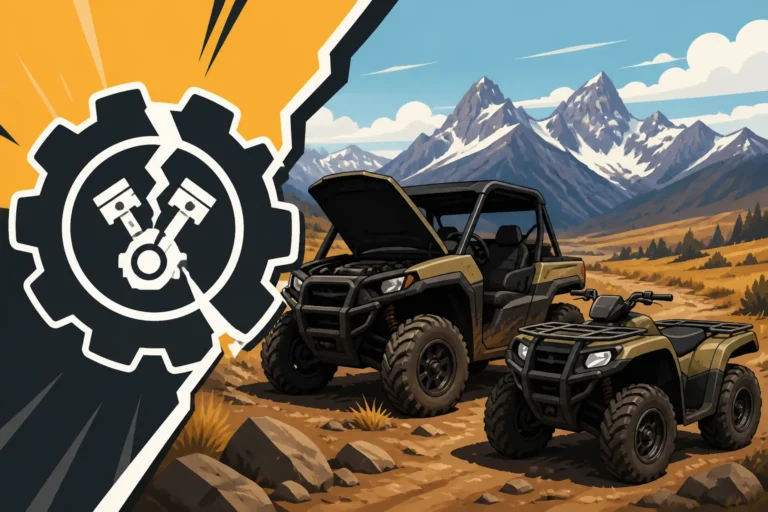
Pack for a breakdown even when the park is close to Casper. A machine can lose a tire, develop a mechanical problem or become stuck in a place where recovery takes longer than expected. Bring enough water for the group, weather-appropriate layers, a first-aid kit and basic recovery or repair equipment suited to your vehicle. Keep essential items secured so they do not bounce loose on rough terrain, and make sure everyone knows where the supplies are.
Agree on group habits before the engines start. Decide how riders will signal a stop, what to do if someone gets separated and who will stay with a disabled machine. Keep the group together at confusing junctions; don’t let the fastest rider disappear around a bend while newer riders guess which track to take. If someone is uncomfortable, stop somewhere safe and talk through the options. Turning around early is a reasonable riding decision, not a failed outing.
Riding Responsibly on a Small, Sensitive Area
Stay on permitted routes and respect closures
A compact riding area can show damage quickly when riders create new lines around obstacles or bypass wet sections. Riding off-route may widen the disturbed area, damage recovering ground or create conflicts with other users. Keep your tires on established, authorized routes, and avoid cutting corners, climbing closed slopes or making a new path to reach a viewpoint. If a route is blocked, use the marked alternative or turn back.
Signs and barriers matter even when a closure looks temporary or inconvenient. A closed section may be under repair, unsafe, environmentally sensitive or restricted for another reason. Do not move a barrier or assume that a closure is outdated just because you see tracks beyond it. If you are uncertain where a permitted route ends, stop and look for official information instead of exploring farther to find out.
Responsible riding also means giving other users room. Slow down when you approach people, parked vehicles or groups on foot. Avoid unnecessary revving and aggressive acceleration, especially near staging areas. If you encounter another rider on a narrow section, communicate clearly and pass only when there is a safe place to do so. For the larger context of designated access in Wyoming, read [Wyoming's Enrolled Roads and Trails] and [Wyoming Rules for Riding a Designated Route].
Protect the machine, the ground and the next visit
Riding through deep mud can be hard on both your vehicle and the terrain. Clay may clog tires, collect around moving parts and reduce traction. If you begin to lose control or the machine is digging in, stop before the wheels turn a difficult section into a deeper rut. A recovery attempt that involves spinning tires can make the situation worse and leave damage for other riders and land managers to deal with.
Clean your machine before hauling it to another riding area. Mud and plant material stuck to tires, fenders or undercarriage can be carried from one place to another. A basic post-ride check also catches damage while it is still easy to address: look for loose fasteners, tire cuts, damaged guards and anything that may have shifted during the ride. Remove trash and make sure gear is secured before driving away.
The park’s former industrial use does not make it a place to treat as disposable. Staying on approved routes, respecting closures and avoiding unnecessary wheelspin help protect the area’s continued use. These habits matter whether you are on an ATV for an afternoon or a UTV with a full group. A ride that leaves the place in good condition is more likely to remain enjoyable for the next person—and for you when you return.
Making Poison Spider Part of a Casper Trip
Allow enough time without overplanning
Poison Spider’s location near Casper makes it possible to include a ride in a broader visit, but avoid squeezing it into a schedule so tight that every delay becomes stressful. Loading, unloading, checking the machine and discussing the route take time. So do breaks, navigating junctions and helping a rider who needs extra practice. Build in a buffer rather than planning to finish at the last possible moment.
If you are driving from town, check your access directions before setting off. Route names, turnoffs and map labels can be easy to confuse when you are unfamiliar with the area. [Driving Poison Spider Road Out of Casper] can help you think through the approach, but always follow current signs and local directions when you arrive. Park only where permitted, keep access clear and avoid blocking other vehicles or equipment.
A shorter outing can be a better first visit than trying to ride every available route. Start with a manageable loop, notice how the terrain feels and leave time to return before fatigue sets in. If the surface is wet, the group is inexperienced or the machine is not handling well, adjust the plan. The park does not need to be conquered in one afternoon.
Understand permits and check local requirements
Wyoming’s off-road permit rules can apply to machines used on designated public riding areas, and a registration or sticker from another state may not automatically satisfy Wyoming requirements. The rules may depend on where and how you ride, so check the current requirements for your machine and intended route before unloading. Keep required documentation available and make sure any permit decal is displayed as directed.
Do not assume that a trip close to town is exempt from the rules that apply on public riding areas. At the same time, do not confuse an off-road permit with permission to ride on every road or every parcel of land. Access depends on the route’s designation and the land manager’s rules. The guides [Wyoming ORV Permits Explained] and [Why Wyoming Honors No Other State's Registration] can help clarify the permit questions visitors commonly have.
One lingering assumption is that a local riding spot must have the same access rules as a private track or a commercial recreation facility. Confirm the park’s current access, permit and operating information before your trip, and follow posted notices when you arrive. [Why Poison Spider Costs Nothing to Enter] discusses the entry-cost question, but no-cost access should never be mistaken for permission to ignore permits, closures or riding restrictions.
Disclaimer
This article is for general informational purposes only and does not constitute professional advice. Laws, prices and regulations vary by location and change over time. Consult a qualified professional for guidance on your specific situation.