Wyoming Horn Requirement on a Road Machine
Thinking about taking your ATV or UTV out on Wyoming's designated roads can feel like navigating a maze of rules. It’s easy to get caught up in the big stuff, like getting a title or a license plate, but often it’s the smaller, seemingly obvious requirements that trip people up. One of those critical, yet sometimes overlooked, components is the horn. You might think, "My off-road machine already has a horn for trail riding," but what Wyoming law specifies for road use is often a different ballgame. This guide is here to untangle the horn requirement, ensuring your machine is not only compliant but also safe for sharing the road with other traffic.
The Non-Negotiable Need for a Horn on Wyoming Roads
When you decide to transition your off-road machine from the dirt trails to paved or gravel county roads in Wyoming, you're stepping into a world with different expectations for vehicle equipment. It's not just about having fun; it's about safety and clear communication with everyone else around you. A horn isn't merely an accessory for announcing your presence; it's a vital safety device, a way to quickly and effectively communicate with other drivers, pedestrians, and even wildlife on the roadside.
Why Road Vehicles Need an Audible Warning Device
Imagine cruising down a two-lane highway on your side-by-side. You see a car ahead of you starting to drift into your lane, or perhaps a cyclist is unaware of your approach. In these moments, a quick, audible warning can be the difference between a close call and a serious accident. Unlike the quiet rustle of leaves or the hum of tires on dirt, road environments are often noisy, filled with engine sounds, wind, and ambient traffic noise. A horn cuts through that, grabbing attention instantly. It's an immediate, universal signal for "Heads up!" or "I'm here!" that every driver understands.
This need for an audible warning isn't just a suggestion; it's enshrined in traffic laws across the country, and Wyoming is no exception. These laws are designed to create a predictable and safer driving environment for all users. Without a proper horn, you're essentially driving blind in terms of audibility, relying solely on visual cues which can be easily missed in busy or challenging conditions. It leaves you, and everyone else, more vulnerable.
Wyoming's Expectation for Multipurpose Vehicles MPVs
Wyoming has a specific class of vehicles known as Multipurpose Vehicles (MPVs) that can be legally operated on certain public roads. This MPV classification is crucial because it bridges the gap between purely off-road machines and traditional street-legal vehicles. For your ATV or UTV to qualify as an MPV and gain that coveted road access, it must meet a distinct set of equipment standards, and a working horn is absolutely on that list. It's one of the foundational requirements that ensures your machine can integrate safely into the flow of traffic.
The state doesn't just wave a magic wand and declare your quad or side-by-side road-ready. There's a comprehensive checklist, and each item serves a specific purpose for public safety. Without a horn, your machine simply doesn't meet the baseline for an MPV that can navigate public thoroughfares. This means that even if you have all your other ducks in a row – the title, the plate, the lights – a missing or inadequate horn could halt your plans to hit the pavement. Think of it as a key piece of the puzzle that makes the [Wyoming's MPV Path to the Road] possible.
Decoding Wyoming's Horn Specifications for Road-Legal Machines
It’s one thing to know you need a horn, and another to understand what kind of horn Wyoming actually requires. This isn't about having a novelty air horn that plays a tune or a weak little "beep" that gets lost in the wind. The law is concerned with functionality, audibility, and ensuring the device contributes to safety rather than confusion. Your off-road machine might have come with a horn, but it’s vital to confirm if it measures up to road-legal standards.
What Constitutes a Legal Horn in Wyoming
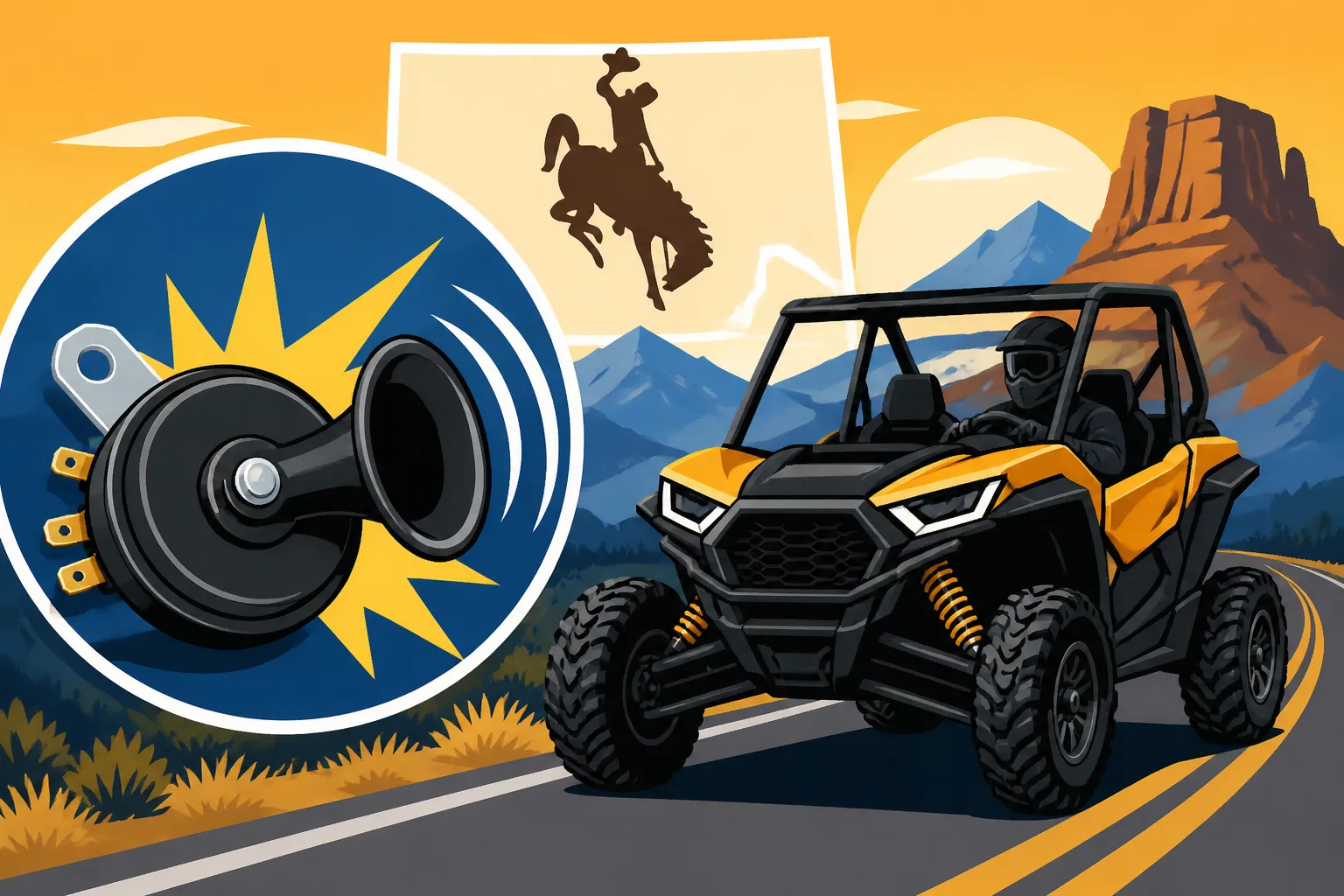
Generally, Wyoming statutes dictate that any vehicle operated on public roads must be equipped with a horn that is capable of emitting a sound audible under normal conditions from a certain distance – typically around 200 feet. This isn't an arbitrary number; it's the distance deemed necessary for another driver or pedestrian to reasonably react to your warning. The sound itself must be a single, constant tone. This means no sirens, whistles, or overly complex musical notes that could be mistaken for emergency vehicles or other non-standard signals. The idea is clarity and immediate recognition.
Furthermore, while it needs to be audible, the horn cannot be "unreasonably loud" or harsh, creating excessive noise pollution or startling drivers unnecessarily. There’s a balance to be struck between effective warning and public nuisance. This specification means that the small, often high-pitched or weak horn found on some recreational ATVs for trail use might not cut it. You'll want to test yours in a controlled environment to ensure it has the necessary volume and sustained tone to meet the state’s requirements. A horn that just barely squeaks might be ignored or unheard, defeating its entire purpose.
The Legal Framework and Its Intent
The legal framework for vehicle equipment in Wyoming, including the horn requirement, is designed with a singular goal: public safety. By mandating specific equipment like horns, headlights, and mirrors, the state aims to ensure that every vehicle sharing its roads can do so predictably and safely. The requirement for a specific type of horn isn't meant to be an obstacle; it's a safeguard. It ensures that when you press that button, everyone within a reasonable range knows your intent or is alerted to a potential hazard.
Consider a scenario where you're riding your side-by-side on a county road that suddenly curves, and a deer darts out from the trees. A robust, legal horn allows you to immediately warn the animal, or more importantly, alert any following traffic to your sudden braking. Without this standard, every vehicle could have a different, possibly ineffective, warning device, leading to chaos and confusion. Wyoming's commitment to these standards reflects a broader understanding that a consistent set of rules makes the roads safer for everyone, whether they're in a pickup truck, a sedan, or your newly road-legal MPV. These rules contribute to the comprehensive [Wyoming's Road Equipment Rules Come From] and ensure consistent expectations for all drivers.
Practical Steps to Install a Road-Legal Horn on Your ATV or UTV
So, you've decided your current horn isn't quite up to snuff, or maybe your machine didn't even come with one. Now it's time to get practical. Installing a new horn, or upgrading an existing one, for road legality in Wyoming is a common task for many ATV and UTV owners. It might seem daunting if you're not electrically inclined, but with the right approach and components, it's a manageable project that brings you one step closer to legal road access.
Choosing the Right Horn for Your Machine
The market offers a variety of horns suitable for off-road vehicles that need to become road-legal. Your primary choices typically fall between electric horns and air horns. Electric horns are generally compact, easy to install, and draw less power. They produce a consistent, often loud, tone that usually meets legal requirements. Air horns, on the other hand, are typically much louder and produce a deeper, more resonant sound, requiring an air compressor and reservoir, making them a bit more complex to install but undeniably effective. When making your choice, consider the space available on your machine, your comfort level with wiring, and of course, the sound output. You want something that's not only loud enough but also durable enough to withstand the elements and vibrations of off-road use.
Many riders turn to aftermarket suppliers for robust, purpose-built horn kits. Companies like SuperATV, for instance, offer horn kits specifically designed for the rugged demands of ATVs and UTVs, providing everything from the horn itself to the necessary wiring and switches. When selecting, look for kits that explicitly state they are designed for road legality or meet DOT (Department of Transportation) standards, which often align with state-specific requirements like Wyoming's. Consider factors like water resistance and vibration dampening, as your horn will be exposed to far more abuse than one in a passenger car.
Installation Considerations and Common Pitfalls
Installing a horn typically involves mounting the unit, running electrical wires, and connecting it to a power source and a switch. The first step is to find a suitable mounting location – somewhere protected from direct impact, but still able to project its sound effectively. Many riders choose to mount horns under the hood, behind the grill, or near the front bumper. Remember, the horn needs to be audible from 200 feet, so avoid burying it too deeply within the machine's bodywork.
Next comes the wiring. Most horn kits will come with a wiring harness, a relay, and a switch. The relay is crucial as it allows a low-current switch to activate a high-current device like a horn, protecting your machine's electrical system. You’ll typically need to connect to a 12-volt power source (often directly to the battery with an inline fuse for protection), ground the system, and run wires to the horn button on your handlebars or dash. Ensure all connections are secure, insulated, and protected from heat, water, and chafing. Overlooking these details can lead to shorts, blown fuses, or a non-functional horn when you need it most. If you're using a kit, such as one you might get from SuperATV, follow their instructions closely. This attention to detail is part of the process of [Fitting a Horn to a Road-Legal Side-by-Side], ensuring it works reliably when you're out on the road.
Comprehensive Road-Legal Equipment: More Than Just a Horn
While getting your horn compliant is a significant step, it's crucial to remember that it's just one piece of a larger puzzle when making your ATV or UTV road-legal in Wyoming. The state has a comprehensive set of requirements for Multipurpose Vehicles, all designed to ensure safety and visibility on public roads. Ignoring other essential equipment can quickly negate your efforts with the horn and still leave you liable for fines or unable to register your machine as an MPV.
Lights, Mirrors, and Reflectors: The Full Safety Package
Beyond the horn, your MPV will need a full complement of lighting. This includes functional headlights (which typically must be on at all times when operating on a public road, day or night), taillights, and brake lights that illuminate when you apply the brakes. Many aftermarket light kits are available that integrate seamlessly with your off-road machine's existing electrical system, and some even include turn signals, which, while not always explicitly required for all MPVs in Wyoming, are highly recommended for clear communication on the road. Remember, visibility is paramount, especially at dusk, dawn, or in adverse weather. [Wyoming Lighting Requirements for ORVs] are extensive and important to review.
Mirrors are another non-negotiable item. You'll need at least one rear-view mirror, mounted to provide a clear view of the road behind you for at least 200 feet. Two mirrors – one on each side – are even better for enhanced situational awareness. Many off-road machines don't come standard with street-legal mirrors, so this is another common upgrade. Lastly, reflectors are often overlooked but critical for passive visibility, especially if your lights fail or you're parked on the roadside. You'll need red reflectors on the rear and often amber reflectors on the sides. Taking the time to properly install and adjust items like your [Wyoming Mirror Requirements for Road Use], [Fitting a Stop Lamp], and [Fitting a Red Reflector to the Rear] will go a long way in preparing your machine for Wyoming's roads.
Documentation and Rider Preparedness
Having all the right physical equipment on your machine is only half the battle. You also need to ensure you, as the operator, and your machine itself are legally prepared. This means carrying your valid driver's license (which might require a motorcycle endorsement or an "MR" endorsement for MPVs depending on the machine's characteristics and your age, see [Wyoming Motorcycle Endorsement for an MPV]), proof of insurance (which is mandatory for road use, unlike purely off-road riding, as per [Wyoming ATV Insurance Requirement]), and your vehicle's registration and title documents.
Remember, simply having the equipment installed doesn't automatically make your machine street legal. You must go through the proper titling and registration process with the county clerk and treasurer to officially classify your machine as an MPV and receive a license plate. Being prepared means not just equipping your machine, but also having all your paperwork in order and readily accessible. A roadside stop by a Wyoming Highway Patrol trooper or a local sheriff will involve checking both your machine’s equipment and your documentation. Don't let a missing piece of paper spoil your adventure on Wyoming's beautiful enrolled roads.
Here's a quick checklist of essential equipment for your Wyoming MPV:
| Component | Requirement Description | Purpose |
|---|---|---|
| Horn | Audible from at least 200 feet, single constant tone | Warning, communication |
| Headlights | At least one, white or amber, visible from 500 feet, always on | Visibility for rider and to other traffic |
| Taillight | At least one, red, visible from 500 feet | Rear visibility to other traffic |
| Brake Light | Red, illuminates upon brake application | Signals braking intent |
| Rearview Mirror | At least one, providing 200 ft view to the rear | Situational awareness, monitoring traffic |
| Rear Reflectors | Red, mounted on rear | Passive rear visibility, especially at night |
| Front/Side Reflectors | Amber, if required by vehicle type/size | Passive side/front visibility |
| Tires | Safe condition, adequate tread | Traction, control |
| Seatbelts (UTV) | For all occupants, if equipped with a roll cage | Occupant safety, restraint |
| Muffler | Working, with spark arrester if off-road | Noise reduction, fire prevention |
| License Plate Light | Illuminates rear license plate | Ensures plate visibility at night |
| Turn Signals (Optional) | Highly recommended for clear communication on roads | Signalling turns or lane changes |
Disclaimer
This article is for general informational purposes only and does not constitute professional advice. Laws, prices and regulations vary by location and change over time. Consult a qualified professional for guidance on your specific situation.