Wyoming Rules for Crossing Private Ground
Crossing private ground can be the difference between a continuous Wyoming ATV or UTV route and an unauthorized shortcut. The key is to confirm that the route is legally open to you, not simply visible on a map or used by other riders. Here’s how to check access, ask for permission, and avoid mistaking a permit, road, or trail for a right to cross.
The basic rule: a riding permit is not permission to cross
A Wyoming ORV permit and permission from a landowner solve different problems. A permit may be required for riding on public routes or lands, but it does not give you the right to cross private property. Likewise, a landowner’s permission does not necessarily replace a permit or other requirements that apply once you reach a public route.
Think of the trip as a chain of separate access questions:
- Is the route open to the type of machine you are riding?
- Who controls the ground the route crosses?
- If it crosses private ground, do you have permission or another valid basis to use that route?
- Are there separate permit, seasonal, vehicle, or land-manager rules for the public segment?
A route can be legal for one part of the ride and off-limits for the next. For example, a rider may have permission to cross a ranch parcel but still need to follow the rules for the public trail beyond it. Or a route may appear to connect two public areas while passing through private land where access has not been granted.
A Wyoming ORV decal is not a general access pass, and a decal from another state does not establish private-land access either. For the separate permit question, see Wyoming ORV Permits Explained. For the rules that apply when you are riding on private property itself, [Wyoming Rules for Riding Private Land] is also relevant.
The safest starting point is simple: do not enter or cross ground that may be private unless you have confirmed that the route is open to the public or obtained permission from the person or entity with authority to grant it. Do not treat a gate standing open, tire tracks, or a route appearing on an online map as proof of permission.
Confirm the route and who controls it
Before setting out, check the full route rather than only the trailhead and destination. A public trail can end at a property boundary, and a public road can lead to a private road or driveway. A route may also pass through a patchwork of public and private parcels, with different access conditions along the way.
A line on a map is a lead, not a guarantee
Maps are useful for planning, but a line on a map does not always tell you whether the public may ride it. A map may show a road or trail without clearly explaining whether it is public, whether it is open to motorized use, which machines are allowed, or whether it crosses private property.
Use maps to identify questions to verify, not to settle every question. Check the map’s date and purpose, and look for information about route designations, seasonal restrictions, and machine limits. A route that is open to hikers or horseback riders is not automatically open to ATVs or UTVs.
For routes on public land, consult the relevant land manager’s current travel information. A Forest Service map or a Bureau of Land Management map may help identify routes and restrictions, but you still need to follow signs and closures on the ground. Which Travel Map You Must Carry in Wyoming explains why route information matters, while [Wyoming Rules for Riding a Designated Route] covers the difference between a route and permission to travel wherever you choose.
Check parcel boundaries and access rights separately
A parcel map can help show whether land is privately owned, but it usually does not answer every access question. Public access may exist through a recorded easement, a right-of-way, or a route specifically open to the public. Conversely, a visible road across a private parcel may be private even if it is well traveled.
If the route crosses a private parcel, verify the public access status with a reliable source before riding. Depending on the location, that may mean checking with the relevant land manager, county office, or landowner. If you cannot confirm that the corridor is open to public motorized use, choose another route or get permission.
Be especially careful with routes that follow property lines, cross ranchland, or connect public parcels through a narrow strip. A boundary shown on a map does not automatically create a public riding corridor. Nor does being able to see public land on the other side give you permission to cross the private parcel in between.
Distinguish a public road from a private road
A route can look like a road without being a public road. A ranch access road, driveway, logging road, or two-track may be maintained and used regularly but still be private. A public road may also cross private land, but the public right to use it depends on the road’s status and the scope of its right-of-way.
Do not assume that a route is public because it has a road name, appears on a navigation app, or connects to a county road. If access depends on a particular road or easement, confirm that it is open to motorized travel and that your vehicle is allowed. A public right-of-way may have limits, and a route may be closed to motorized use even if it remains available for other purposes.
Maps and signs can also appear to conflict. If a map suggests a route is open but a sign on the ground says it is closed, do not ride through just because the map is more convenient. When a Map and a Sign Disagree offers a useful way to think through that situation; when uncertainty remains, stop and verify rather than guessing.
Get permission that covers the route you intend to ride
If a private parcel is part of your route and public access is not established, ask the landowner or authorized manager before entering. Permission should be clear enough that both sides understand what is allowed. A casual “sure, you can ride” may leave important details unresolved if the planned trip involves several machines, passengers, repeated crossings, or a route that passes close to livestock or buildings.
Be specific when you ask
Explain the practical details, not just that you want to “cross the property.” Tell the owner or manager:
- Where you plan to enter and exit.
- Which route you intend to follow.
- Whether you will ride an ATV, UTV, or more than one machine.
- How many people and machines are in the group.
- When you expect to ride and whether you may return later.
- Whether you are asking to cross once or use the route repeatedly.
- Whether you need to open or close any gates.
If the property is part of a larger ranch or managed operation, confirm that the person you are speaking with can authorize the access you are requesting. A neighbor, tenant, employee, or other rider may know the land but may not have authority to grant permission.
For a one-time trip, a clear written message can prevent a later misunderstanding. It does not need to be complicated: record the agreed route, date or time period, number of machines, and any conditions. Keep the confirmation accessible while riding, but do not assume that a text message creates a permanent access right. Permission may be limited or withdrawn, and the landowner’s terms matter.
Wyoming Landowner Permission Rules and Wyoming Trespass Law and Off-Road Riders provide related context. The practical point is that permission is about the specific property and use, not a general invitation to ride anywhere nearby.
Respect the limits of the permission
If permission is granted for a particular crossing, stay on the route the owner approved. Do not widen it into a loop, explore a side track, or ride onto another parcel because it looks connected. Permission for one machine or one trip should not be treated as permission for a larger group or a later visit.
Clarify whether the owner expects riders to avoid certain areas, such as livestock pens, hay fields, homes, water sources, or equipment yards. Ask about seasonal conditions. A route that is usable when the ground is dry may be damaging when wet, and a landowner may restrict travel during calving, hunting, fire, or other sensitive periods.
If you arrive and the agreed route is blocked, newly signed, or visibly unsafe, do not create a new route around the obstacle. Contact the landowner or manager, or turn back. Permission to cross one route does not authorize you to find your own alternative across the property.
Do not treat silence or past use as consent
Other riders using a two-track does not prove that you may use it. A neighbor’s permission may not apply to you, and a route used in the past may have since been closed. Likewise, not seeing a fence, sign, or person at the property line does not mean the land is open to motorized travel.
If you cannot identify who controls the land, do not rely on a guess. Find a route with confirmed access or postpone the ride until you can verify the crossing. That is especially important when a route appears to be the only way to reach public land. There is no general right to cross private property simply because it blocks the shortest route.
Gates, fences, grazing leases, and other common trouble spots
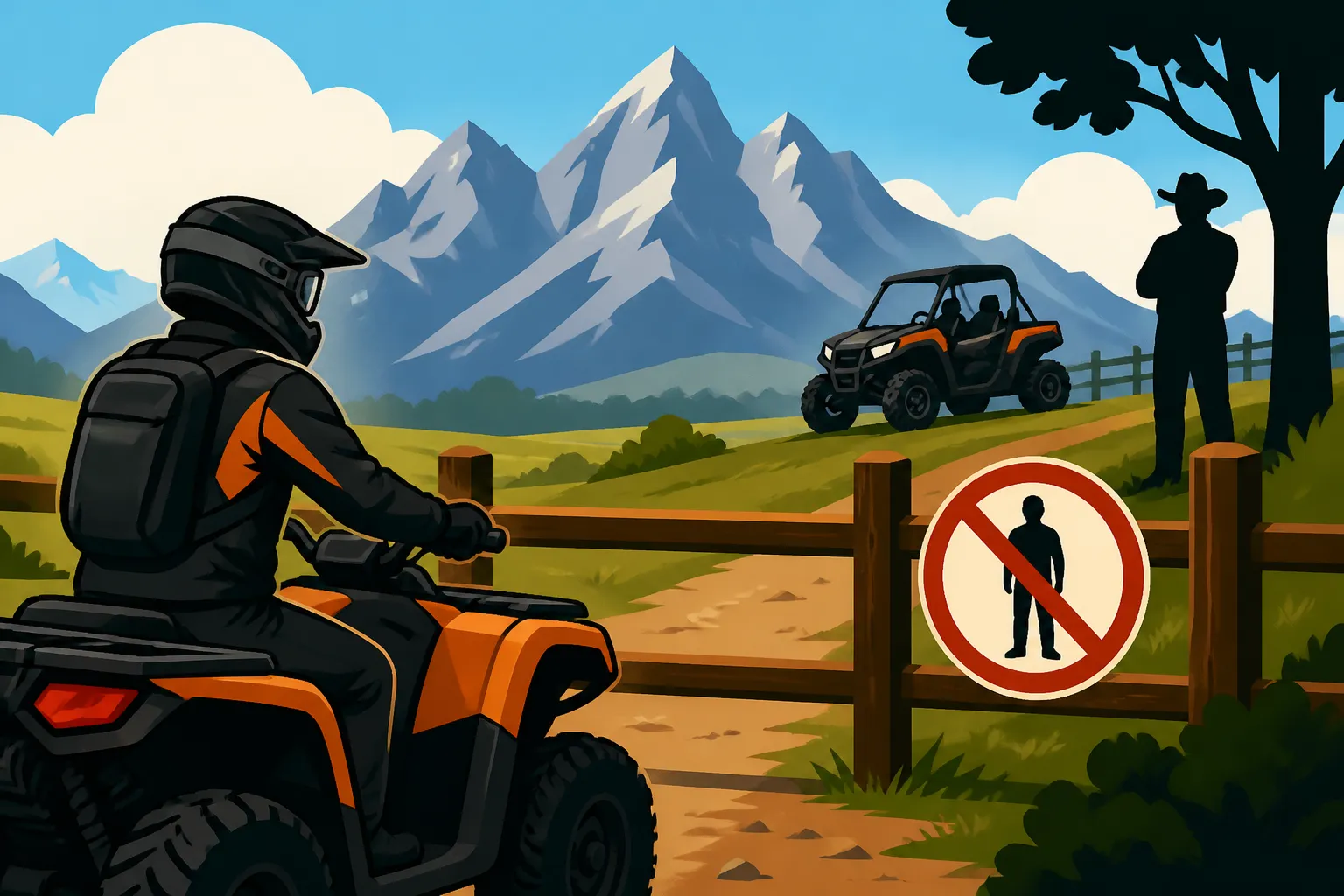
A fence or gate is a boundary feature, not an invitation to ride through. Some gates control access to private land; others sit on a route where travel is allowed but users are expected to manage the gate responsibly. The correct action depends on the route’s status and any posted instructions.
Follow the gate instructions and leave the property as found
If you have permission or are traveling on a confirmed public route, follow posted directions about the gate. When instructions are absent, ask the landowner or manager what they expect. Do not assume that leaving a gate open is harmless, and do not assume that closing it is always correct if a sign or direct instruction says otherwise.
If you open a gate, pass through carefully and make sure it is secured in the agreed position. A gate left open can allow livestock to leave an enclosure or enter a road. A gate closed when the owner expects it to remain open can also interfere with operations. If a gate is locked, chained, or marked as closed, do not bypass it or ride around it across the fence or field.
Never cut, lift, push, or drive through a fence to continue a route. If the fence appears damaged, report it to the landowner or the appropriate manager rather than making repairs without permission. Keep machines and passengers clear of livestock and avoid revving, chasing, or crowding animals.
Do not assume a grazing lease gives public access
Public land can be leased for grazing, but that does not make every route across the lease open to public riders. A grazing lease and the underlying land ownership are separate questions, and riding access depends on the applicable rules, route status, and any required permission.
The same caution applies to a two-track that crosses a grazing allotment or land used for ranch operations. Do not assume that a public-land boundary means every road within it is open to motorized use. Check the land manager’s route designation and any posted restrictions. [Wyoming Rules for Riding a Grazing Lease] explains why a grazing lease should not be treated as a blanket access permission.
Even when a route is open, ride in a way that does not interfere with livestock or ranch work. Slow down near animals, give them space, and avoid splitting a herd. If cattle or other livestock are on the route, wait for a safe opportunity to pass or turn back if doing so would cause stress or create a hazard.
Treat public-land access and private crossings as separate permissions
A trail may cross public land for most of its length and still require a private-land crossing at one point. In that situation, permission to ride the public section does not automatically cover the private gap. The reverse is also true: a landowner’s permission to cross a parcel does not make a closed public trail beyond it legal to ride.
This matters when planning access to national forests, BLM land, or other public areas. Confirm that the route is open on the public side, and separately confirm that any private segment is open to you. [Wyoming Rules for Riding a National Forest] can help with public-land route rules, but it cannot substitute for permission across a private parcel.
If a trail or road ends at a private boundary, stop there unless you have confirmed a public right-of-way or obtained permission. Do not ride around the end of a fence, cut across a field, or follow a neighboring track to get around a closure. A detour that appears short on a screen can still cross land where you have no access.
A practical check before you ride
A few minutes of preparation can prevent a long ride from ending at a locked gate or an uncertain property line. Use this checklist when a route may cross private ground:
- Trace the whole route. Look for private parcels, road crossings, trail endpoints, gates, and possible access gaps between public areas.
- Check the route designation. Confirm that the road or trail is open to motorized use and suitable for your machine. Check for seasonal closures or width restrictions.
- Verify private access. Determine whether the route has confirmed public access. If not, contact the owner or authorized manager and get permission for the specific crossing.
- Confirm the conditions. Ask about dates, group size, gates, livestock, route boundaries, and areas to avoid.
- Carry useful details. Keep the route information and any permission confirmation available. Do not rely on a phone signal being present at the property line.
- Follow signs and instructions. If the ground conditions or posted notices differ from what you expected, stop and reassess.
- Turn around when access is unclear. Do not treat an open gate, tire tracks, or a route shown in an app as permission.
Your Wyoming permit, route map, and landowner permission are not interchangeable documents. Keep each one focused on the question it answers: whether the machine is properly permitted for the relevant riding, whether the route is open, and whether you may cross the private ground.
If access is denied, choose another route. Do not argue at the gate, ride around a closure, or pressure someone to grant access. A respectful request and a willingness to turn back help protect future access for everyone.
Frequently Asked Questions
Can I cross private land if the road is shown on my map?
Not necessarily. A map may show a road without establishing that it is public or open to ATVs and UTVs. Verify the route’s status and get permission if public access is not confirmed.
Does a Wyoming ORV permit let me cross private property?
No. A permit does not grant permission to enter private land. You need a confirmed public access route or authorization from someone with authority over the property.
Can I ride around a closed gate if the trail continues on the other side?
No. Do not bypass a gate or fence. The route may be closed, the gate may control livestock, or the detour may cross private ground. Stop and verify access or turn back.
Does permission to cross a ranch parcel let me ride anywhere on the ranch?
No. Follow the route and conditions the owner or manager approved. Permission for one crossing does not automatically extend to side trails, other parcels, additional trips, or a larger group.
Disclaimer
This article is for general informational purposes only and does not constitute professional advice. Laws, prices and regulations vary by location and change over time. Consult a qualified professional for guidance on your specific situation.