9 Miles Out From Casper
When you want a quick ride close to Casper, Poison Spider OHV Park is an appealing option—but a short drive from town does not mean the terrain is easy or that every visible track is open. This guide explains what to expect about the area, how to prepare your ATV or UTV, and how to make a safer, less frustrating day of riding.
What to Expect at Poison Spider OHV Park
A riding area close to Casper
Poison Spider OHV Park sits west of Casper, reached by Poison Spider Road. Its proximity makes it practical for a half-day outing, a first ride in the area, or a quick trip when you do not want to tow a machine far from town. The short distance can also create a misleading impression: this is still an off-road area, not a groomed neighborhood trail.
For a broader overview of local riding options, see [Wyoming ATV Trails Near Casper]. Poison Spider is one option to consider, but the best choice depends on your machine, experience, weather, and what kind of terrain you enjoy. Before heading out, check where the designated riding area begins and ends rather than assuming that every track branching from the access road is part of the park.
The name is familiar to many riders, but the ground itself can be a surprise if you have only seen it from a vehicle. The park is associated with former bentonite mining, and its varied, disturbed terrain is part of what makes the ride distinctive. [How a Bentonite Mine Became Poison Spider Park] offers useful context for why the landscape looks different from a forest trail.
An unusual mix of terrain
Expect an open, rugged setting rather than a single, smooth trail winding through trees. Depending on the route and conditions, riders may encounter uneven ground, loose or rocky sections, slopes, and old mine features. A route that looks straightforward from the parking area can feel quite different when you meet a steep pitch, a loose turn, or a surface that has changed after rain.
That variety can be enjoyable for experienced riders, but it calls for a realistic assessment of your machine and your group. A wide side-by-side may need more room to turn than a smaller ATV, and a novice rider may be more comfortable choosing an easier line instead of following faster or more confident riders into challenging ground. Keep enough space between machines to see the terrain and react without eating someone else’s dust.
The area is often described as a relatively compact riding destination. [Poison Spider's 284 Acres] gives a sense of its scale, but don’t treat acreage as a measure of how long a visit will take. Route choices, breaks, mechanical issues, and the pace of a mixed-skill group can stretch a short outing. If you want a low-pressure first visit, agree on a turnaround time and regrouping point before leaving the staging area.
Think of it as an OHV park, not an open invitation
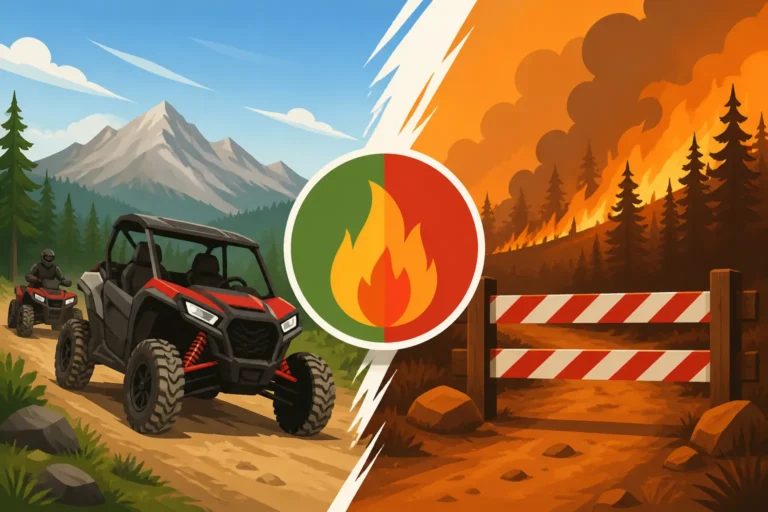
Seeing tire tracks does not automatically mean a route is open to the public. Stay within the designated riding area and use posted signs and current land-management information to guide your decisions. Boundaries and closures matter, especially near disturbed land, private property, or routes that lead away from the park.
A travel map can help you understand the area before you arrive. Resources such as [Wyoming Trail Maps and MVUMs] can help riders get oriented, and onX Offroad can be useful for checking your position and comparing route options. Treat digital mapping as a planning aid, not permission to ride: a line on a screen does not override a closure sign or establish that a route is open.
Planning a Ride From Casper
Getting there and choosing your timing
The access drive is part of the outing, so plan it as carefully as the ride itself. [Driving Poison Spider Road Out of Casper] is a helpful topic to review when working out your approach. Allow time to locate the staging area, unload, check your machines, and get everyone ready before setting off. If you are meeting friends, choose a clear meeting point rather than assuming cell service or easy communication once you spread out.
Weather can change the experience quickly. Wind can make an exposed ride tiring, while rain can transform certain surfaces into a sticky, slippery mess. Check the forecast for the riding area, not just the temperature in town, and think about whether your group has the clothing and equipment to handle a shift in conditions. Start earlier when possible so you are not rushing to finish as daylight fades.
A useful planning checklist:
- Confirm that the riding area is open and identify any posted restrictions.
- Check the forecast and recent precipitation.
- Make sure every rider knows the meeting and regrouping points.
- Carry water, basic tools, a first-aid kit, and a way to contact help.
- Set a turnaround time and let someone outside the group know your plan.
- Leave enough time to load up before dark or worsening weather.
Prepare for Wyoming’s permit and route rules
Before riding, make sure your machine has the required Wyoming ORV permit for the kind of public riding you plan to do. The rules can surprise visitors who assume their home-state registration or decal is enough. Review [Wyoming ORV Permits Explained] before the trip, and confirm the current requirements and purchasing options before you leave home.
A permit is not the same thing as permission to ride any road or track. Routes may have separate restrictions, and a designated route can have rules that differ from an off-highway riding area. [Wyoming Rules for Riding a Designated Route] is a useful starting point for understanding why it matters to follow the route designation rather than simply choosing the most convenient-looking track.
Keep your permit visible as required and bring any useful documentation with you. Before unloading, check posted signs at the access point. Once riding, obey closure notices even if a digital map, an older screenshot, or another rider suggests the route was open on a previous visit. When information conflicts, stop and verify the restriction instead of riding ahead and sorting it out later.
Choose routes for the least-experienced rider
A group ride is only fun if the pace works for everyone. Before leaving, ask about each rider’s experience, comfort on slopes and loose surfaces, and ability to handle the machine they brought. Make the least-experienced rider part of the route decision; don’t make them feel pressured to follow a line they would not choose on their own.
For a first outing, agree that anyone can call for a pause or a turn back without needing to justify it. More experienced riders can help by riding where they can see the group, stopping before difficult sections, and discussing an obstacle before attempting it. If a route looks beyond someone’s skill or equipment, choose another line or head back. A short ride that ends without an injury or breakdown is better than a long ride that turns into a recovery job.
Conditions, Gear, and Safety
Rain can change the ground dramatically
One of the most important things to check before riding is whether the area has had recent rain. Some bentonite-rich ground can become extremely slick and cling to tires, fenders, and undercarriages. Mud may build up until tires struggle to turn freely, and a machine that handled the same route comfortably in dry weather may suddenly have trouble climbing or steering.
Read [Poison Spider After Rain] and [Bentonite Mud and Why It Stops You] before deciding whether conditions are suitable. If the ground is saturated, postponing the ride is often the sensible choice. Pushing through can damage the machine, leave deep ruts, create a difficult recovery, or make a small problem much harder to manage.
Bring a plan for cleaning and checking machines after the ride, especially if conditions are damp or muddy. Caked material can hide damage and put extra strain on moving parts. Avoid driving onto a fragile surface just to see whether it is passable; if you cannot confidently ride through without getting stuck or leaving damage, turn around.
Match your equipment to the ride
You do not need an elaborate expedition setup for a nearby outing, but basic preparation matters. Check tires, brakes, steering, throttle operation, fuel, and any fluid leaks before unloading. Make sure the machine is appropriate for the terrain and that the driver understands its limits. A passenger should be briefed on how to sit, hold on, and communicate before the vehicle moves.
| Preparation item | Why it matters at Poison Spider | Practical check |
|---|---|---|
| Helmet and protective gear | Uneven ground and unexpected turns can lead to falls or impacts | Fit gear before riding, not after reaching the trail |
| Water and weather layers | Exposed terrain can feel hot, windy, or cold as conditions shift | Carry more than you expect to need |
| Tire and recovery equipment | Loose ground and mud can make a machine difficult to move | Bring tools and recovery gear suited to your machine |
| Phone or navigation device | Helps with orientation, but may not have dependable service | Download useful maps before leaving town |
| First-aid supplies | A minor injury is harder to manage when the group is spread out | Keep the kit accessible and tell the group where it is |
| Permit and route information | Permit compliance does not make every route open | Check requirements and posted restrictions before riding |
onX Offroad can help with pre-trip orientation and locating your position, but download or save what you need before leaving Casper in case you lose service. Carry a backup plan for navigation, such as a paper map or a clearly agreed route, and do not rely on a phone screen while driving. Stop somewhere safe to check directions.
Ride with a recovery plan
Even a short trip can become complicated if a machine has a flat, overheats, gets stuck, or develops a mechanical problem. Keep the group together, and make sure someone knows where you are headed. If a machine becomes disabled, do not leave its rider alone while everyone else continues exploring.
Before attempting a recovery, look at the slope, ground, attachment points, and position of nearby people. Improvised pulls can cause injuries or damage. If the machine is stuck in wet bentonite or on a difficult incline, repeated throttle may dig it in farther. Take a moment to assess the safest option, and use suitable recovery equipment only if someone in the group knows how to use it.
Navigation apps, including onX Offroad, may help you retrace your route or identify your location, but they are not a substitute for communication planning. Cell coverage can be unreliable in remote or uneven terrain. A charged phone, a written itinerary left with someone, and a firm check-in plan can make a real difference if your return is delayed.
Making the Most of a Short Visit
Keep the first ride simple
If it is your first time at Poison Spider, resist the urge to cover every visible track in one visit. Spend a few minutes at the staging area reviewing the map and posted information. Decide what kind of ride the group wants—a relaxed look around, a technical challenge, or a short practice outing—and choose routes that fit that goal.
A rider new to the park may enjoy a cautious first loop more than an ambitious ride that turns into a series of stressful obstacles. Pause often enough to check how everyone is doing, especially if someone is unfamiliar with the machine, the terrain, or Wyoming’s elevation and weather. If the group is having fun, you can always plan a longer outing another day.
Keep your machine under control and give other riders room. Avoid spinning tires unnecessarily, making abrupt turns near other people, or riding faster than you can see and react. Leave the area as you found it, pack out trash, and do not create new tracks around obstacles or closures.
Know when to turn back
Turning around is a riding skill, not a failure. Change plans if the weather worsens, the ground is too wet, a rider is uncomfortable, or your machine is showing signs of trouble. It is also sensible to stop when you are unsure whether a route is open. A quick check can prevent a much bigger problem than having to backtrack.
Make the return part of the plan rather than an afterthought. Keep enough fuel and daylight for the ride back to the staging area, and regroup before the group gets spread out. If you are running behind, skip the extra loop. The fact that Casper is nearby does not mean every situation is easy to handle once you have left the access point.
For a nearby outing, Poison Spider can be a convenient way to get out on the machines without committing to a long drive. The best visit is not necessarily the one that covers the most ground; it is the one where you choose suitable conditions, stay on authorized routes, and return with every rider and machine in good shape.
Disclaimer
This article is for general informational purposes only and does not constitute professional advice. Laws, prices and regulations vary by location and change over time. Consult a qualified professional for guidance on your specific situation.