Yielding to Horses on a Wyoming Trail
Sharing a Wyoming trail with horses calls for more than slowing down at the last moment. A horse may react to engine noise, movement, or an unexpected pass, putting both riders at risk. The safest approach is to spot horses early, stop in a predictable place, communicate calmly, and wait for clear direction before moving again.
Why horses need extra space on a motorized trail
Horses are large, powerful animals, but even a calm, trained horse can startle when something approaches quickly or makes an unfamiliar sound. A startled horse may shy sideways, turn suddenly, bolt, or kick. Its rider can be thrown, and a horse that moves into a narrow trail can put an ATV or UTV operator in a difficult position.
The risk is not limited to a direct collision. A horse might react to a machine that revs, to a rider moving suddenly, or to tires crunching over loose ground. The person riding the horse may be trying to control the animal while also judging whether there is enough room for everyone to pass. Giving them time and space helps them manage that situation.
On a trail, the safest choice is usually to make your machine predictable. Slow down well before you reach the horse, stop where you have room, and wait. Don’t assume that a horse is relaxed just because it is standing still, or that its rider has seen you. A rider may be focused on the animal, uneven terrain, a narrow turn, or other horses in the group.
It also helps to remember that a person on horseback may not know how your machine will behave. From their perspective, an approaching ATV or UTV may be loud, unfamiliar, and difficult to predict. A short conversation from a safe distance is more useful than a wave, a horn, or a sudden attempt to squeeze past.
Yielding is a trail-sharing practice, not a substitute for checking whether motorized travel is allowed on that route. Before a ride, confirm that the route is open to your machine and current for the season. A permit does not by itself authorize travel on every road or trail. For a broader overview of route access, see [Wyoming Rules for Riding a Designated Route] and [Wyoming Rules for Riding a National Forest].
How to approach, stop, and pass horses
The safest interaction begins before you reach the horse. Scan ahead around bends, over rises, and through wooded sections, where a group may be hard to see until you are close. Keep your speed low enough to stop within the distance you can see and control.
Use this sequence when you encounter horses:
- Slow down early. Reduce speed smoothly and avoid sudden braking, acceleration, or steering. If you are riding with others, signal the group to slow down too.
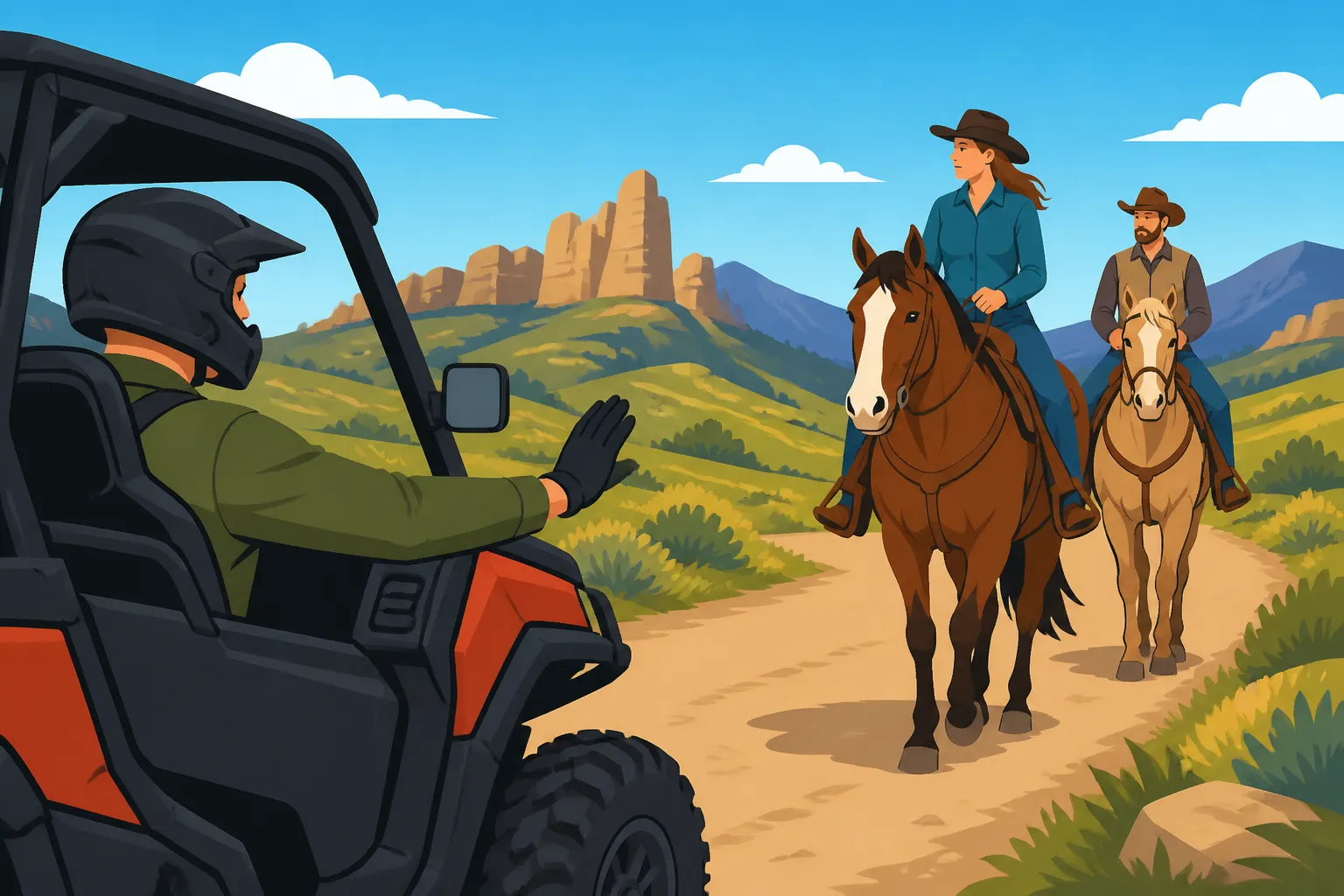
- Stop well short of the horse. Choose a visible spot with room for the horse and rider to pass. Avoid stopping on a blind bend, at a narrow pinch point, or where another rider might run into you.
- Make your presence known calmly. Speak in a normal voice from your machine. A simple greeting lets the rider know where you are without startling the horse. Avoid shouting, honking, or calling from behind the animal.
- Wait for the rider’s instructions. Ask whether they want you to stay put, move to a particular side, or proceed. Don’t assume you can tell what the horse will tolerate.
- Make no sudden movements. Keep your hands on the controls, stay seated if possible, and avoid waving objects or walking toward the horse. Keep children and passengers quiet and still.
- Pass only when the rider says it is safe. Move at a slow, steady pace, leaving as much room as the terrain allows. Avoid revving, spinning tires, or accelerating away as you pass.
- Wait until the group is clear. Horses may be traveling together, and the last animal may be some distance behind the first. Don’t restart or move off while another horse is approaching or passing.
There is no single distance that works on every trail. A wide, level road gives people more options than a steep, narrow path with a drop-off. Stop far enough away that you are not crowding the animal, then let the rider judge whether the gap is sufficient. If they ask you to move farther back, do so only if it is safe and you can move without making a sudden noise or creating a new hazard.
Where to wait
Choose a spot where the horse can see you and pass without being squeezed between your machine and a steep edge, bank, brush, or other obstacle. Avoid blocking an escape route or forcing the rider toward loose footing. If you can safely move off the traveled surface, do that only when it does not put you on unstable ground or require a sudden maneuver.
You may have heard the advice to stand on a particular side of a trail, such as the downhill side. That can be a useful convention in some settings, but it is not a safe rule for every slope or trail. The ground may be soft, steep, rocky, or too narrow to step onto. Follow the rider’s direction and use the safest available spot rather than treating a general tip as an absolute requirement.
If there is nowhere safe to pull aside, remain stopped and tell the rider what you can see. Don’t try to make space by edging toward a drop-off, into brush, or onto fragile ground. The rider can decide whether to lead the horse through, turn around, or wait for a better place to pass.
Engine and machine noise
Quiet, steady behavior matters more than a dramatic gesture. Let off the throttle early, avoid repeated revving, and don’t use a horn to hurry the horse or rider. If you can safely reduce engine noise further, do so. Whether you should shut the engine off depends on the circumstances: a sudden shutdown may itself be startling, and restarting can be loud. Follow the rider’s request when it is safe, and wait to restart until the horse has cleared the machine.
On a UTV, keep passengers from leaning out, waving, or making sudden movements. On an ATV, stay balanced and avoid shifting position abruptly. If you are wearing a helmet, speak clearly enough for the rider to hear you, but don’t shout.
Read the trail and the group before moving
A horse encounter is not always a simple one-at-a-time pass. You might meet a group of horses, a rider leading another animal, or a party approaching from the opposite direction. Some horses may be calm while others are nervous. Give the group time to make a plan rather than assuming the first rider’s position tells you what to do.
A helpful question is, “Where would you like me to wait?” Keep it brief and give the rider time to answer. If the rider asks you to move, repeat the instruction if needed so you both understand it. If there is a language or hearing barrier, use a clear gesture only after you have made your presence known; avoid waving your arms or moving closer to the horse.
Pay attention to the trail surface, visibility, and other traffic. A stopped machine can still create a hazard if it blocks the route around a blind corner. If you are first in a group, stop where the riders behind you can see you and have room to stop too. Communicate the situation to your group before anyone starts forward.
When several machines are traveling together, avoid bunching up around the horses. Keep the group quiet and spaced out. One rider should communicate with the horseback rider; multiple people calling out at once can make the situation confusing. Wait for all the horses to pass before signaling the group to continue.
| Trail situation | Safer response | Avoid |
|---|---|---|
| Horses are approaching on a wide trail | Slow early, stop in a visible spot, and ask the rider where to wait | Continuing at speed because there appears to be room |
| Horses appear around a blind turn | Stop and give the group time to pass; alert riders behind you | Honking or accelerating to clear the turn |
| The trail is narrow or steep | Stay stopped and let the rider choose the safest passing plan | Forcing your machine onto unstable ground |
| A group of horses is passing | Wait until the last horse is clear and the rider signals | Moving off when only the first horse has passed |
| The rider asks you to shut off the machine | Do so if it is safe, then wait to restart until the group is clear | Restarting while horses are still beside you |
| You are unsure whether the trail permits your machine | Check current route information before continuing | Treating an ORV permit as permission to use any trail |
Keep the horse’s rider in view if practical, but don’t stare in a way that distracts you from your machine or the trail. Watch for clear signals, and don’t interpret a rider’s silence as permission to proceed. If the rider seems occupied or the horse is unsettled, wait.
If a horse becomes nervous, do not try to manage it yourself. Stay still, give the rider room, and follow instructions. Don’t approach to offer help, touch the animal, or try to catch it if it gets loose. The rider or another person familiar with the horse is best placed to respond.
Wyoming trails and roads vary by land manager, route designation, season, and machine type. Use current maps and signs to confirm where motorized travel is permitted, and follow closures even if a route looks passable. Wyoming Trail Maps and MVUMs explains why maps and on-the-ground signs matter; [Wyoming Rules for Riding BLM Land] covers another common setting for motorized travel.
Permits, route access, and responsible riding
A Wyoming ORV permit and permission to ride a specific route answer different questions. A permit may be required for an off-road machine on applicable public routes, but it does not make a closed route open, change a route’s vehicle limits, or grant access across private land. Confirm the route’s status and rules before you ride, especially when your trip crosses different land jurisdictions.
Visitors should not assume that a registration, decal, or permit from another state replaces Wyoming’s requirements. Check the current rules that apply to your machine and the place you intend to ride. Wyoming ORV Reciprocity Rules explains the permit question for out-of-state riders, while [Wyoming Rules for Riding a Designated Route] addresses why route status matters separately.
This distinction is important when planning a ride that includes equestrian use. A horse-friendly trail can still be closed to motorized vehicles, and a motorized route can still be used by horses. Being legally permitted to operate your machine does not remove the responsibility to slow down and yield safely.
Route information can also change by season or because of temporary closures. Check the land manager’s current notices before setting out, and obey signs at the trailhead and along the route. If a map and a sign seem to disagree, don’t guess that the route is open. Pause and seek clarification from the responsible land manager before continuing.
Sound and equipment rules are separate from yielding etiquette, but they affect how an encounter goes. A properly maintained muffler and spark arrester help reduce noise and address public-land requirements. They do not make it safe to pass a horse without stopping or asking. For more on this topic, see Wyoming Spark Arresters and Sound Rules.
When riding with a group, brief everyone before departure. Agree on a hand signal or spoken cue for slowing and stopping, keep enough distance to avoid chain reactions, and identify who will talk with other trail users. The same preparation helps when you meet horseback riders, hikers, or other machines. [Wyoming Rules for a Group Ride] has more on organizing a ride responsibly.
Common mistakes and how to prevent them
Many risky encounters happen because a rider makes a reasonable-sounding assumption: the horse has seen the machine, the rider will move aside, or there is enough room to pass. Those assumptions can be wrong. A deliberate stop and short conversation usually take less time than dealing with a startled animal or a blocked trail.
Passing because the trail looks wide enough
A wide section may look comfortable to the machine operator but still feel tight to a horse rider. The horse may shy toward the machine, or the rider may need extra room to keep the animal steady. Stop, ask, and let the rider decide whether and where to pass. Do not creep forward while waiting for an answer.
Revving to signal or hurry the group
An engine rev is loud and sudden, and it can increase the horse’s stress. Signal your group with a hand signal or calm words rather than using the throttle. If your machine is already noisy, reduce speed early and avoid adding more sound.
Moving before the last horse is clear
A group can extend farther down a trail than it first appears. Wait for every horse to pass and for the rider to indicate that you can move. Starting too soon may surprise an animal that is still approaching or passing behind another horse.
Assuming the rider will move out of the way
A horseback rider may be managing a nervous animal, other horses, or difficult footing. They may have limited options for moving aside. Give them time to choose a safe path. If you are blocking the route, ask before changing position.
Stopping where nobody can see you
A stop on a blind bend, just over a rise, or in a narrow section can create a second hazard for riders coming up behind. If you can, move to a visible place before stopping. Alert your group and make sure following machines know what is happening.
Treating a permit as a pass to ride anywhere
A permit and route access are not interchangeable. Check that the route is open and suitable for your machine, then respect other users. If you discover an equestrian-only route or a posted closure, turn back rather than riding through because your machine carries a valid decal. Wyoming ORV Reciprocity Rules can help clarify the permit side of the question, but route access still needs to be checked independently.
Letting passengers add to the noise
Passengers may not realize how much sudden movement or shouting can affect a horse. Ask everyone to stay seated, keep voices low, and avoid pointing or waving. Children should be told before the ride what to do if the group encounters horses: stay calm, hold still, and follow the driver’s instructions.
Before the trip, make a simple plan. Check route access, review the machine’s noise and safety equipment, and agree on how your group will signal a stop. During the ride, scan ahead, slow early, and give other trail users time to respond. If you’re choosing an area for a first ride, Where to Ride an ATV in Wyoming is a useful starting point for thinking about routes and riding conditions.
Frequently Asked Questions
Do ATV and UTV riders have to stop for horses in Wyoming?
The safest practice is to slow down and stop when horses are approaching or when you reach them from behind. Follow the horseback rider’s instructions and wait for a clear signal before passing. Check the rules for the specific route and land manager, since access requirements can differ.
Should I turn off my ATV or UTV engine?
Reduce noise as much as you safely can. If the rider asks you to shut the engine off, do so when safe, then wait until the horses are clear before restarting. Avoid an abrupt shutdown or restart if it could startle the animal.
Which side of the trail should I wait on?
There is no side that is safe in every situation. Choose stable ground that gives the horse room, and follow the rider’s directions. Don’t step or drive onto a steep, loose, or fragile edge just to follow a general rule.
Does a Wyoming ORV permit allow me to use an equestrian trail?
No permit should be treated as permission to use every trail. Confirm that your route is open to your machine and obey posted signs and closures. A permit requirement and a route-access rule are separate questions.
Disclaimer
This article is for general informational purposes only and does not constitute professional advice. Laws, prices and regulations vary by location and change over time. Consult a qualified professional for guidance on your specific situation.