Wyoming Rules for Retrieving Game
Wyoming Rules for Retrieving Game
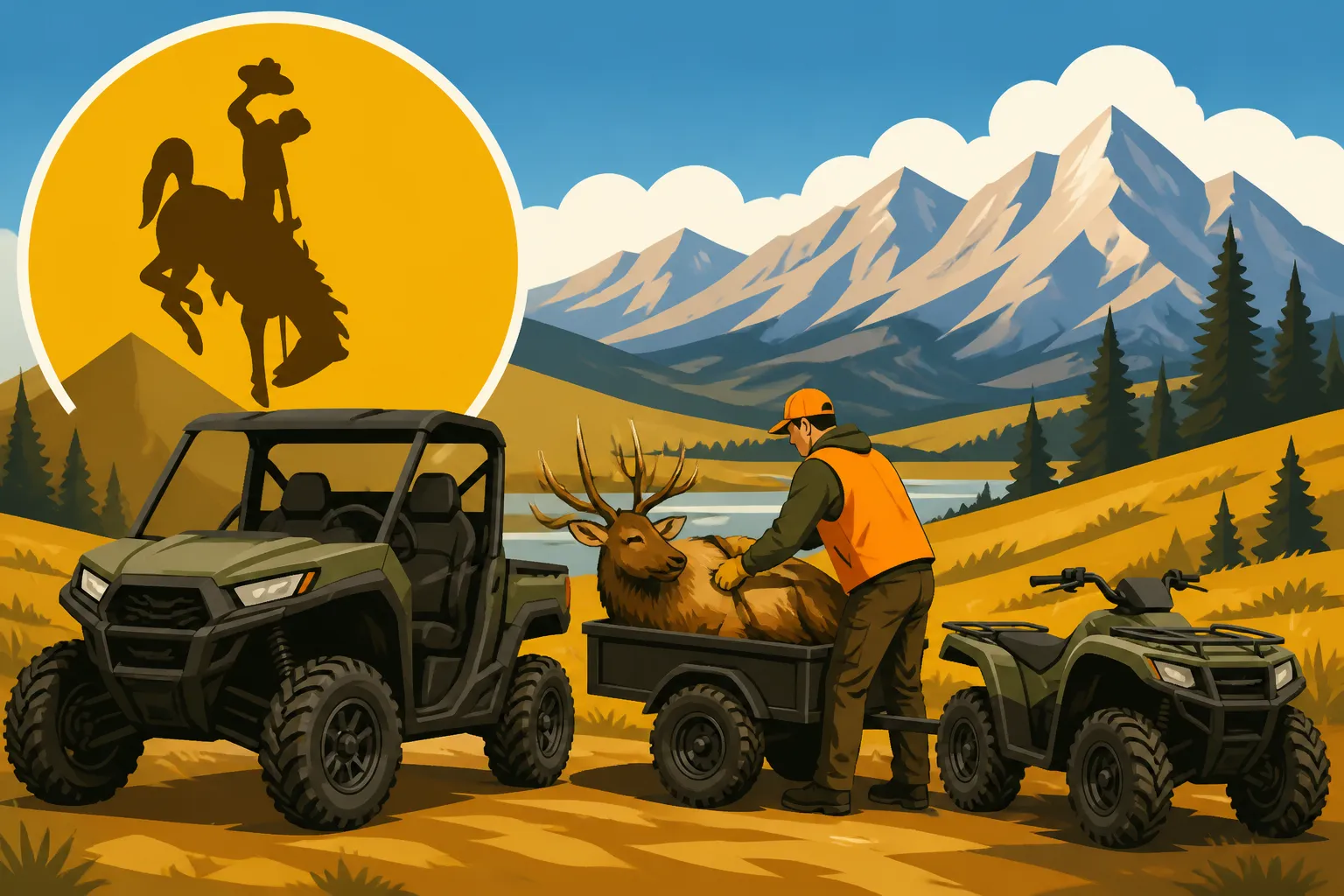
An ATV or UTV can make a long pack-out easier, but it does not automatically let you drive to a downed animal. In Wyoming, the route and land-use rules still apply after a harvest: a hunting license or off-road permit is not permission to leave an authorized route. Plan the recovery around where you can legally ride, then pack the animal out from there.
The key rule: a harvest does not open a route
The safest way to think about game retrieval is that it has two separate rule sets. Hunting regulations govern the harvest and handling of wildlife. Land-access rules govern where your machine may travel. A lawful harvest does not, by itself, create an exception to a motorized travel restriction.
That distinction matters most when the animal is away from a road or trail. It may be tempting to ride across open ground for a shorter recovery, follow a faint two-track, or push past a gate because the animal is just beyond it. But a route that looks passable is not necessarily open to motorized use. Nor does the need to retrieve game automatically make an unauthorized route legal.
On public land, use the route the land manager has opened to your type of machine, and follow signs and seasonal restrictions. On private land, get permission for the particular access you need; permission to hunt does not necessarily include permission to drive an ATV across the property. On either kind of land, stop if you are unsure rather than assuming that a hunting situation overrides a closure.
Wyoming’s ORV permit and route access are also separate issues. A permit may be required for a machine on certain public routes, but having one does not give you permission to ride every road, trail, or open-looking patch of ground. For the permit side, see Wyoming Rules for Hunting From a Machine and Wyoming Rules for Packing Out Game. For route access, start with [Wyoming Rules for Riding a Designated Route].
The same principle applies when the animal is close to a route but not on it. An ATV can be used to travel on a route that allows it, then parked in a lawful place while you retrieve the animal by foot or use another permitted method. That may take longer, but it avoids turning a difficult pack-out into an access violation or resource-damaging ride.
Before heading out, confirm the hunting rules that apply to your species, hunt area, and season with the Wyoming Game and Fish Department. Separately, check the travel rules for the land where you will ride. Where public land is involved, the responsible land manager’s map, signs, and current closure information matter. A map can help you plan, but a closure sign on the ground should not be ignored just because a route appears open on an older map.
Check the land, route, and machine before the hunt
A useful retrieval plan begins before a shot is taken. Identify the likely legal riding routes, where you can park, and how you will move an animal from the harvest site to your machine without crossing a closed area. If you are hunting across more than one land type, check the rules for each part of the route. The path out may be subject to different restrictions from the place where you hunted.
| Situation | What to check | Safer planning approach |
|---|---|---|
| National forest land | The forest’s current motor-vehicle map, route designations, and seasonal closures | Ride only routes open to your machine and use foot travel for the off-route portion |
| BLM land | The current travel map, signs, and any area or seasonal restrictions | Confirm that the specific route is open; do not treat unmarked ground as an invitation to ride |
| Private property | The owner’s permission and any limits on where or when you may drive | Ask about retrieval access before hunting, including gates, roads, and parking |
| State trust land | The applicable access authorization and motorized-use rules | Confirm access separately; do not assume a state land access permit allows off-route travel |
| Enrolled road or trail | Whether that segment is open to your machine and whether the season or other limits apply | Check the segment itself and where it ends before relying on it for a pack-out |
For detailed land-type considerations, use [Wyoming Rules for Riding a National Forest], [Wyoming Rules for Riding BLM Land], and [Wyoming Rules for Riding a Grazing Lease]. A grazing lease or a two-track across ranch country does not automatically make a route open to public ATV use. Permission and public access are not interchangeable.
Confirm access for the whole recovery route
It is easy to check only the route that gets you to a hunting area and forget the route you will need afterward. Before the hunt, trace the likely return trip from the legal riding route to a place where you can load and secure the animal. Consider whether the recovery could cross a boundary, private parcel, seasonal closure, or route that is open only to certain vehicles.
Use current information where possible. Seasonal closures can affect wildlife habitat, road conditions, or the timing of motorized access. A route that was open on a prior trip may be closed now. If a map and a sign appear to conflict, follow the more restrictive information until you can confirm the situation with the responsible land manager. When a Map and a Sign Disagree covers that kind of uncertainty.
If you cannot confirm the route, plan to keep the machine on a route you know is open and carry the animal to it. Do not rely on an informal claim that “people always ride in there.” Local custom is not a substitute for authorization, and other riders’ tracks do not prove a route is legal.
Check the permit and machine limits
A Wyoming ORV permit, if required for the route you plan to use, is not a road license and does not replace route permission. Check that the machine has the required permit or registration for the places where it will be ridden, and confirm whether any separate rules apply to your ATV, UTV, or trailer. See Wyoming ORV Permits Explained for permit basics.
Also think about whether the machine can safely carry the load. Check the manufacturer’s load guidance, cargo-rack limits, towing limits, and the way the load affects handling. A legal route is not automatically a safe route for a heavily loaded machine. Mud, steep grades, loose rock, water crossings, and changing weather can all make a recovery more difficult than the ride in.
Plan the recovery without riding off-route
A practical plan has a clear stopping point: the machine stays on a route where it is allowed, and the animal comes to the machine. That plan may involve more than one person, multiple trips, or an alternate pack-out method. The key is to decide that before you are tired, short on daylight, or under pressure to get meat out quickly.
- Mark the harvest location. Record a reliable location in a way your group can find again, and keep track of the route from the harvest site to the legal riding route. A phone may help, but do not depend on it as your only navigation tool in an area with limited service.
- Confirm where the machine can stop. Choose a place on an authorized route where the ATV or UTV can be parked without blocking traffic, damaging vegetation, or creating a hazard. If access depends on a gate or private road, confirm that arrangement in advance.
- Move the animal to the machine by a permitted method. Depending on distance, terrain, and the animal, this may mean quartering, carrying, dragging by hand where appropriate, or making several trips. Keep the machine out of closed ground even if the recovery would be shorter by riding directly to the animal.
- Keep loads manageable. A heavy or uneven load can destabilize an ATV, affect steering, and make braking or turning harder. Secure each piece so it cannot shift, drag, or catch on vegetation. Follow the machine maker’s guidance rather than guessing at its capacity.
- Use more than one trip when needed. A series of smaller, stable loads is often more controlled than overloading the machine for a single trip. Build in time for the return trip and for unexpected delays.
- Recheck the route on the way out. Conditions, signs, or closures may be different from what you expected. Do not continue past a closure or assume a route is open because you used it earlier in the day.
A winch or cargo system can help with some tasks, but it does not change where the ATV may travel. Do not use a winch to pull the machine off-route or into a place it cannot legally enter. Likewise, a tow strap is not a solution for crossing a closed route. If the terrain or load makes a legal pack-out unsafe, pause and choose another method rather than risking a rollover or injury.
Set roles before anyone leaves the harvest site
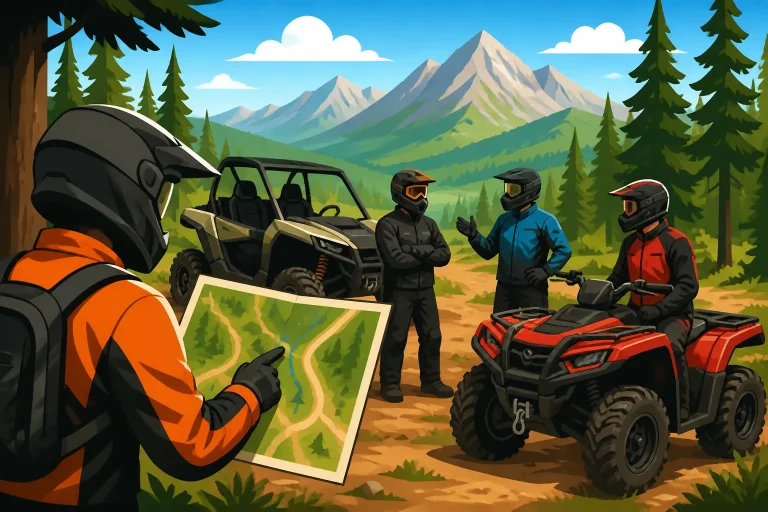
If you are with a partner, decide who stays with the animal, who moves the machine, and who is responsible for checking the route. This can prevent confusion when visibility drops or a group is spread out. Keep a way to communicate, but plan for the possibility that phones or radios will not work everywhere.
A group should also agree on a clear turnaround point. If the route is blocked, a gate is locked, or the load cannot be moved safely, do not split up without a plan. Avoid leaving a machine unattended in a place where it could block a route or be exposed to avoidable damage. Tell someone outside the hunting party where you are going and when you expect to return.
If recovery could require access across private land, arrange that access before the hunt. Ask specifically whether the owner allows a machine on the property, where it may travel, and whether the permission covers a harvested animal. A general invitation to hunt may not answer those questions. See Wyoming Rules for Crossing Private Land for more on treating land boundaries and permission carefully.
Protect the meat and the machine on the way out
A legal pack-out is only part of the job. The animal must also be handled so it can be transported as safely and cleanly as possible. Field care depends on the animal, weather, distance, and the hunting rules that apply. Follow the Wyoming Game and Fish Department’s current instructions for your species and hunt, and prioritize a prompt, sanitary recovery.
Keep meat and equipment separated where practical. Use clean game bags or other appropriate coverings, and avoid placing meat where it can contact fuel, oil, mud, or dirty cargo surfaces. Keep straps and other hardware away from exposed meat. If you carry meat on a rack or trailer, secure it so it cannot slide, fall, or interfere with the machine’s controls, lights, or visibility.
Plan for the terrain and temperature. A load that seems manageable on level ground can become unstable on a side slope or rough track. Wet weather can make a trail slick, while heat can make delays more consequential for meat care. If conditions change, shorten the load, make more trips, or use another legal transport method. A rushed trip with an overloaded machine may put the rider and the harvest at risk.
Before departure, inspect the load from more than one angle. Check that straps are tight, knots or fasteners are secure, and nothing hangs low enough to catch. Make sure the rider can move freely and reach the controls. Recheck the load after the first short stretch, because cargo can settle as the machine moves.
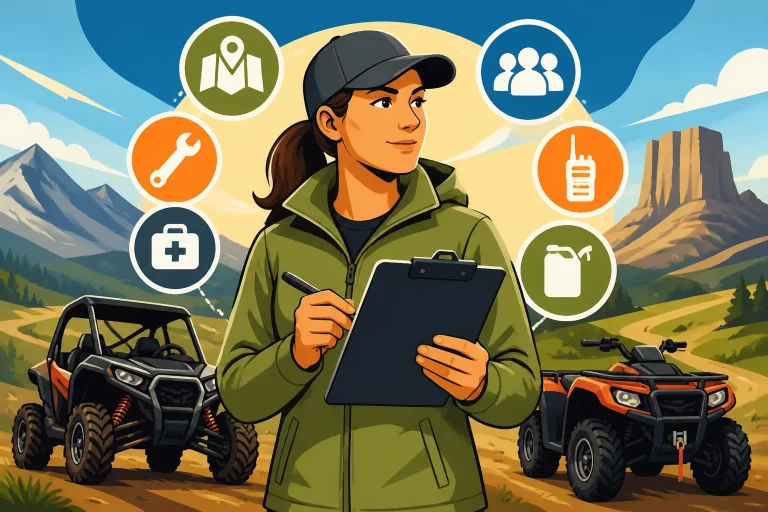
A basic recovery kit might include gloves, game bags, suitable straps, a small first-aid kit, a headlamp, water, and navigation tools. Choose gear for the machine and the terrain rather than assuming one setup fits every hunt. If you buy replacement straps or gear online, including through Amazon, check the product’s intended load and use; a convenient purchase is not proof that it is suitable for securing a heavy, irregular load on an ATV.
Do not assume that every animal can be carried whole or that every rack or trailer is suited to game. Check the machine’s capacity and keep the center of gravity as low and balanced as practical. If you are towing, account for braking, turning, and clearance on narrow routes. A trailer may make loading easier, but it does not authorize access to a route that is closed to motorized travel.
Common mistakes and what to do instead
The most common retrieval mistake is treating an urgent or inconvenient situation as permission to ride wherever the animal lies. The better response is to stop and reassess: Where is the nearest route open to this machine? Is the route still open today? Do you have permission for any private land crossing? Can the animal be moved to the route on foot, or should you use another lawful method?
Other mistakes often happen because riders confuse different kinds of permission:
- A hunting license is not route authorization. It authorizes hunting under its conditions; it does not automatically allow ATV travel across public or private land.
- An ORV permit is not permission to go cross-country. It does not cancel land-manager route restrictions. See Wyoming Fines for Riding Off a Route for why route violations should be taken seriously.
- A gate is not an invitation. An open gate does not necessarily mean the road is open to the public, and a closed gate should not be bypassed. Follow the instructions at the gate and confirm access if you are uncertain.
- Tracks are not proof of access. Tire marks may be old, unauthorized, or made by a different type of vehicle.
- A map is not a guarantee that conditions are unchanged. Check current closures and heed signs on the ground.
- A route open to one machine may not suit another. Width, route designation, and physical conditions can affect whether a specific ATV or UTV can use it safely and lawfully.
- A borrowed or rented machine does not change the rules. Confirm the route and permit requirements for the machine you are using. A rental company’s advice about suitable riding areas is useful, but the rider still needs to follow the current route restrictions.
- Being close to a road does not make off-route travel harmless. Even a short detour can damage vegetation, soil, or habitat and may violate a closure.
If you discover that a route is closed or access is uncertain during a recovery, do not press on in the hope that no one will notice. Return to a known legal route or contact the relevant land manager for direction. If an animal is in a location that cannot be reached legally or safely by machine, use a non-motorized recovery approach or seek appropriate assistance.
A little planning can prevent a serious problem. Before the hunt, save the relevant travel map, know the land boundaries, and identify a legal staging location. Carry enough supplies for a slow pack-out and enough time to complete it. If you hunt with a group, agree beforehand that no one will ride off-route to save time. That shared expectation makes it easier to choose the compliant option when the situation becomes stressful.
Frequently Asked Questions
Can I ride my ATV directly to a downed animal in Wyoming?
Only if the route and land rules allow your machine to travel there. A harvest does not automatically create permission to ride off-route. If you cannot confirm that access is authorized, leave the machine on a route that is open and move the animal to it by a permitted method.
Does a Wyoming ORV permit let me ride cross-country to retrieve game?
No. A permit does not replace route authorization or override a closure. Check the rules for the land and route you plan to use, as well as any permit requirements that apply to your machine.
Can I use a private road to pack out an animal?
Do not assume you can. Ask the landowner or other person with authority for permission, and clarify whether it covers the machine, the route, and game retrieval. Permission to hunt does not necessarily include permission to drive on the property.
What should I do if a map and a sign disagree?
Do not ride past a restrictive sign based only on a map. Stop, avoid the uncertain route, and check with the responsible land manager before proceeding. If you cannot confirm that the route is open, use a route you know is authorized.
Disclaimer
This article is for general informational purposes only and does not constitute professional advice. Laws, prices and regulations vary by location and change over time. Consult a qualified professional for guidance on your specific situation.