Wyoming Rules for Riding a Grazing Lease
A grazing lease can make a Wyoming route look like ranch land, public land, or both. For ATV and UTV riders, the key question is not simply who grazes cattle there, but who owns the ground and whether the route is open to motorized travel. Here’s how to check access, permits, closures, and gates before you ride.
A grazing lease does not automatically give you riding access
A grazing lease gives a rancher or livestock operator permission to use land for grazing under particular terms. It does not, by itself, establish that the public may ride an ATV or UTV there. Nor does a permit for riding elsewhere in Wyoming make every road or two-track open.
The first step is to identify what kind of land you’re dealing with. A grazing lease might involve private land, state trust land, or a grazing allotment on federal land. Those categories have different access rules, and a route can pass from one kind of land to another in a short distance.
| Land or route situation | What the grazing arrangement tells you | What to check before riding |
|---|---|---|
| Private ranch land | A landowner has allowed grazing under a private arrangement | Get permission from someone authorized to grant recreational access |
| State trust land | The state has authorized grazing or another use under a lease | Check current recreation access rules and whether a permit is required |
| Federal grazing allotment | A permittee or lessee is authorized to graze livestock on public land | Check the managing agency’s route rules, closures, and signs |
| Road crossing different ownerships | The route may cross several parcels or jurisdictions | Confirm that each part of the route is open and that access is legal |
A grazing lease is about grazing rights and duties, not a blanket public recreation easement. The person with grazing rights may have responsibilities involving livestock, fences, or water, but that does not automatically make that person the public’s access contact—or give them authority to open a road that a land manager has closed.
Likewise, seeing cattle, a ranch sign, a gate, or a two-track does not settle the question. A track may be used for ranch work without being open to public motorized travel. A route may be open on one section and closed on the next. Don’t infer permission from tire marks or from the fact that another vehicle has driven through.
If you’re trying to ride on private ground, get permission from the owner or someone the owner has authorized to grant it. For more on that distinction, see Wyoming Rules for Riding Private Land and Wyoming Rules for Crossing Private Ground. If the ground is state trust land, review Wyoming Trust Land and Its Own Permit and Buying a Recreational Use Permit before planning a ride.
Check the land manager and the route, not just the lease
On public land, access depends on the land manager’s rules and the status of the specific route. A grazing allotment on federal land remains subject to the relevant agency’s travel rules. The presence of a grazing permittee does not turn every ranch track into a public ATV route.
On Bureau of Land Management land, check the current travel information for the area and ride only where motorized use is allowed. On national forest land, use the forest’s travel management information and follow any seasonal or other restrictions. Routes can have different rules for different vehicle types, and a road open to one kind of traffic may not be open to your ATV or UTV. See Wyoming Rules for Riding BLM Land, Wyoming Rules for Riding a National Forest, and Wyoming’s Enrolled Roads and Trails for more on route access.
Verify the whole route
A mapped road is not automatically an open ATV route. Before leaving, trace the full ride, including access from the parking area and any connecting segments. Look for:
- The route’s current motorized-use designation
- Restrictions by vehicle type, width, or season
- Temporary closures and posted notices
- Boundaries between public, private, and state trust land
- Whether a road or trail is open through the date of your trip
- Where the authorized route ends and private or closed ground begins
A route shown on an older map may have changed. Check the current map or information from the agency responsible for that specific area. If a route crosses more than one management unit, verify the status with each relevant manager rather than assuming one map or office covers the entire ride.
On the ground, pay attention to signs and barriers. If a current sign says the route is closed, don’t treat a map or an old track as permission to continue. If a sign and a map seem to conflict, stop and confirm with the managing agency before riding farther. When a Sign on the Ground Says Closed explains why a posted closure should not be ignored.
Distinguish a public route from ranch access
Ranchers and grazing permittees may use roads and tracks to move livestock, check water, or reach working areas. Those uses don’t establish public access. Even if you see a ranch vehicle using a route, that doesn’t mean recreational vehicles may follow it.
The reverse can also be true: a route may be open to the public even though it crosses an area used for grazing. In that case, ride only on the authorized route and respect livestock, gates, and any posted restrictions. If you can’t determine whether a track is a public route or a private ranch road, don’t use it until you confirm.
Handle grazing land, livestock, and gates carefully
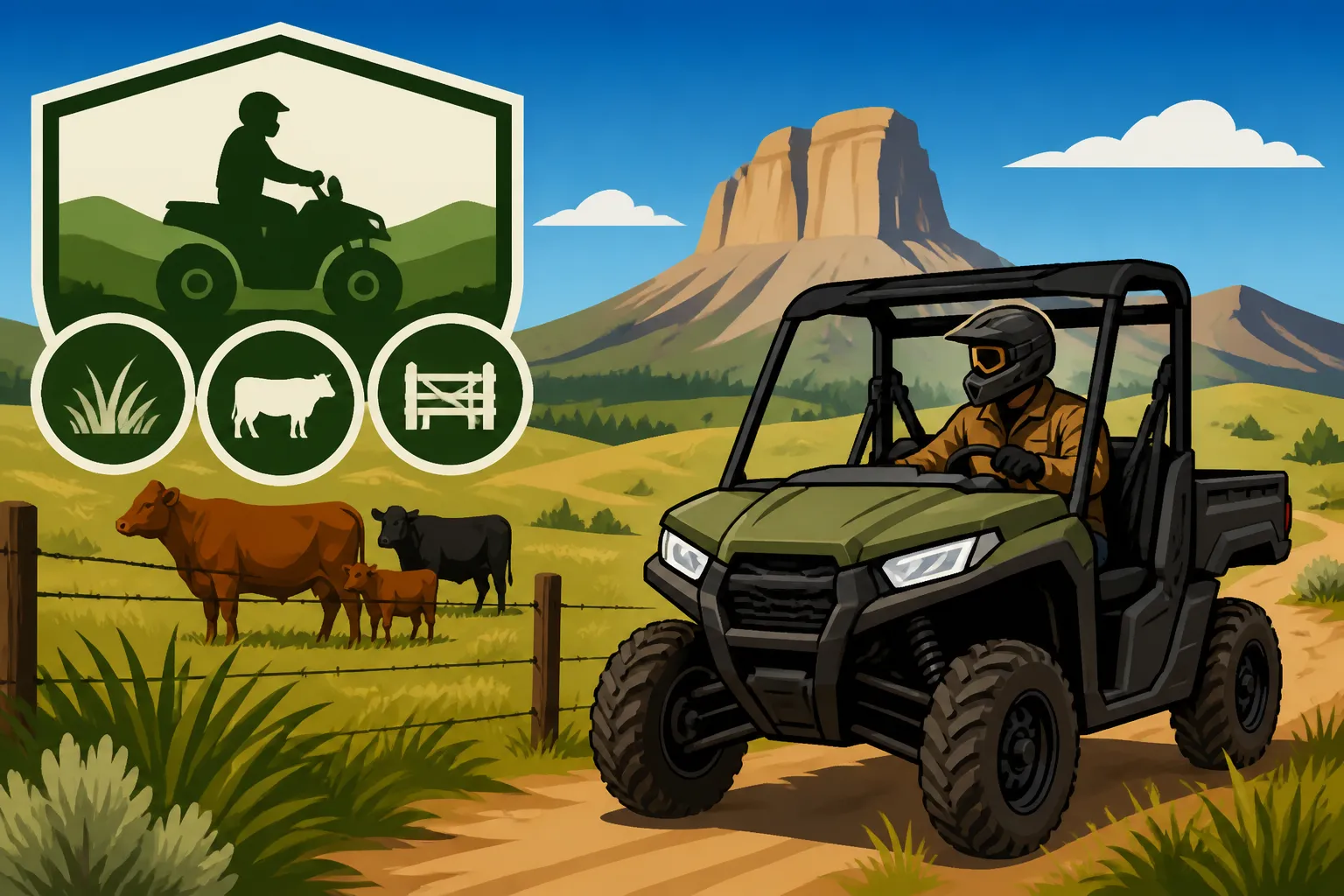
Riding through grazing country creates practical responsibilities even when the route is legally open. Cattle may be near the road, spread across a wide area, or hard to see around a bend. A group of animals can move unpredictably when startled by engine noise or a fast-moving machine.
Slow down when you see livestock, give animals room, and avoid driving toward or through a herd. Don’t chase, crowd, or try to separate cattle with an ATV or UTV. If animals block the route, wait for a safe opening or turn back rather than forcing a way through. Keep noise and speed under control around livestock and ranch operations.
Gates need special care because their position can help control where livestock move. Follow any sign or instruction at the gate. If there is no clear instruction, don’t guess based on what seems convenient: a gate’s position may be part of an active livestock plan. For practical guidance, see Which Gates You Are Required to Close.
A few habits help prevent trouble:
- Stop before a gate and check for signs, wires, livestock, or other hazards.
- Follow the posted instruction about whether to leave it open or closed.
- If you open a gate, pass through carefully and leave it in the required position.
- Make sure everyone in your group has passed through before moving on.
- Don’t cut, climb, or drive around a closed gate or barrier.
- If you can’t tell what the instruction is, contact the land manager or access provider rather than guessing.
Avoid damaging fences, water developments, or ranch equipment. Don’t drive around a muddy or blocked section to make a new track. Going around can damage vegetation, disturb livestock, or take you onto land where you have no access. If the authorized route is impassable, turn around and report the problem to the appropriate manager.
If you need permission to cross private ranch land, ask before the trip, not after arriving at a gate. A rancher may be able to tell you whether access is available, but don’t assume a grazing lease alone gives them authority to approve use of every nearby parcel or public road. Ask specifically about the route, dates, vehicle type, and any conditions such as staying on a particular track or avoiding livestock areas. Asking a Wyoming Rancher for Access offers more context for requesting permission.
Confirm permits, boundaries, and trip details before departure
A Wyoming ORV permit and permission to use a route are separate things. A permit does not grant access to private property, override a closure, or authorize riding off an open route. Conversely, having permission from a landowner does not necessarily satisfy permit requirements for riding on public routes. Check both.
Before a trip, confirm whether the machine needs a Wyoming permit for the places you plan to ride. The requirements can depend on where and how the machine will be used. If you’re unsure about the permit itself, see Wyoming ORV Permits Explained. Then verify the access rules for every route segment, including any connecting road used to reach the riding area.
A practical pre-ride check looks like this:
- Identify the land ownership along the entire route.
- Determine which agency or owner controls each section.
- Confirm that the route is open to your type of machine on your trip dates.
- Check for seasonal, emergency, or wildlife-related closures.
- Obtain permission before crossing private ground.
- Review any permit requirements that apply to your machine and riding area.
- Note gate instructions and plan to turn around if a route is closed or access is unclear.
- Carry current route information and a way to contact the relevant land manager.
If the ride depends on crossing state trust land, don’t assume a federal route map or ranch permission answers the trust-land question. Check the rules that apply to that parcel and obtain any required recreational authorization. If the route uses a federal road through a grazing allotment, follow the managing agency’s travel rules and any current closure notices.
It’s also worth planning for the possibility that access changes shortly before your ride. Weather, fire conditions, livestock work, road damage, and land-management decisions can affect whether a route is usable. Verify the status close to departure, and be ready to change plans. When in doubt, choose a route with clearly confirmed public access rather than relying on an informal track across grazing land.
Disclaimer
This article is for general informational purposes only and does not constitute professional advice. Laws, prices and regulations vary by location and change over time. Consult a qualified professional for guidance on your specific situation.