Wyoming Trespass Law and Off-Road Riders
Riding an ATV or UTV in Wyoming can take you across public land, private ranches, and routes with mixed ownership. The hard part is knowing when a road or trail is actually open to you. Here’s how to reduce trespass risk, check access, and handle gates, boundaries, and permission before you ride.
What trespass means for an off-road ride
For a rider, the practical issue is whether you have permission or another valid right to enter and travel across the land. A visible two-track, an open gate, or a worn trail does not by itself prove that the route is open to the public. A map line may also be misleading if it does not show who owns the land or what access rights apply.
Wyoming has a mix of public land, private ranchland, state trust land, and roads that cross more than one type of property. A route can start on public land, pass through private property, then return to public land. The fact that one end is publicly accessible does not automatically make every segment open.
Trespass concerns can arise when a rider enters private land without permission, ignores a closure, leaves an authorized route, or continues after being told to leave. The precise legal outcome depends on the facts and applicable law. For a specific dispute or citation, get advice from a qualified Wyoming attorney rather than relying on a map, another rider’s account, or assumptions about local custom.
A Wyoming ORV decal and permission to cross private property are separate things. A permit addresses the machine’s use under the applicable off-road permit system; it does not grant access to a ranch, create a public right-of-way, or override a land closure. For the permit side of the trip, see Wyoming Rules for Riding a Designated Route and Wyoming ORV Permits Explained. For land access, start with Wyoming Trespass Rules for Riders and Wyoming Landowner Permission Rules.
| Situation | What not to assume | Safer next step |
|---|---|---|
| A track appears on a phone map | That it is public or open to motorized use | Check the land manager’s current route information and ownership |
| A gate is open | That riders have permission to pass | Look for route signs and confirm access with the owner or manager |
| A road crosses private land | That the road is a public easement | Verify the route’s access status before using it |
| You hold a Wyoming ORV permit | That it allows entry anywhere | Treat the decal and land access as separate requirements |
| A ranch road crosses a grazing allotment | That a grazing lease gives you access | Confirm the route is open to public recreation |
| A route is marked open on an older map | That it remains open today | Check for current closures, seasonal restrictions, and signs on the ground |
Check the route before you ride
The safest time to resolve an access question is before unloading your machine. Check more than one source when a route crosses different land types. Official travel-management maps can show routes designated for motorized use, but maps may have scale limits, update delays, or details that are hard to interpret. Signs and closures on the ground matter too.
For National Forest or Bureau of Land Management land, consult the relevant agency’s current travel information. Public ownership does not mean every road or track is open to every vehicle. A route may be restricted by season, vehicle type, width, resource protection, or another management decision. Review Wyoming Rules for Riding a National Forest and Wyoming Rules for Riding BLM Land before heading out.
Pay particular attention to the boundary between public and private property. A route shown on a general-purpose map may not distinguish a public road from a private road, a public easement from a private access road, or a legal route from an informal track. If the route’s status is unclear, choose a confirmed alternative or contact the responsible land manager. Do not use the fact that a route is easy to follow as evidence that it is open.
When a road crosses private land
Some roads may have public access rights even though the surrounding land is privately owned; others may be private throughout. The existence and scope of any access right can be specific to that road. Avoid assuming that a county road, section line, ranch track, or route displayed on an app is open to public motorized travel without confirmation.
If you need to cross private land to reach a trail or public parcel, ask the owner for permission before riding. Be clear about the route, dates, number of machines, and whether you plan to stop or camp. Permission for one trip or one route should not be treated as blanket permission for future visits or for other riders.
A landowner may set conditions, such as staying on a particular track, closing a gate, or avoiding an area during a specific period. Follow those conditions. If permission is denied or the owner cannot be reached, use another route. Do not try to turn a convenient shortcut into an access right by riding it repeatedly.
For more on crossing property boundaries, read Wyoming Rules for Crossing Private Land. If you are approaching a ranch and want to ask directly, Asking a Wyoming Rancher for Access offers a useful starting point for making the request respectfully.
State trust land is not the same as open public land
State trust land has its own access rules. Do not treat it as though it were a National Forest, BLM parcel, or public road. Access may depend on the current recreational rules and any required authorization, and a route across trust land can have restrictions separate from those on adjacent property. Check the state’s current information before riding. See Riding Wyoming Trust Land With a Permit for more on this distinction.
Grazing leases also do not automatically create public riding access. A leaseholder’s authority to use land for grazing is different from a rider’s permission to travel across it. A familiar ranch road or a track used by livestock may still be closed to the public. Check [Wyoming Rules for Riding a Grazing Lease] rather than relying on the presence of cattle, fences, or vehicle tracks as signs of public access.
Gates, signs, and boundaries on the ground
A gate is part of the access picture, but it is not a permission slip. An open gate may have been left open for livestock or another authorized user. A closed gate may mark a boundary, protect livestock, or control access. Follow the posted direction and any instructions from the landowner or manager. If you cannot determine whether the route is open, stop and verify rather than riding through and sorting it out later.
When a route is clearly open and the instructions say to close the gate, close it behind you. If the gate is clearly meant to remain open, do not change its position. Never leave a gate in a different condition from the one in which you found it unless an authorized person directs you to do so. More guidance is available in Which Gates You Are Required to Close.
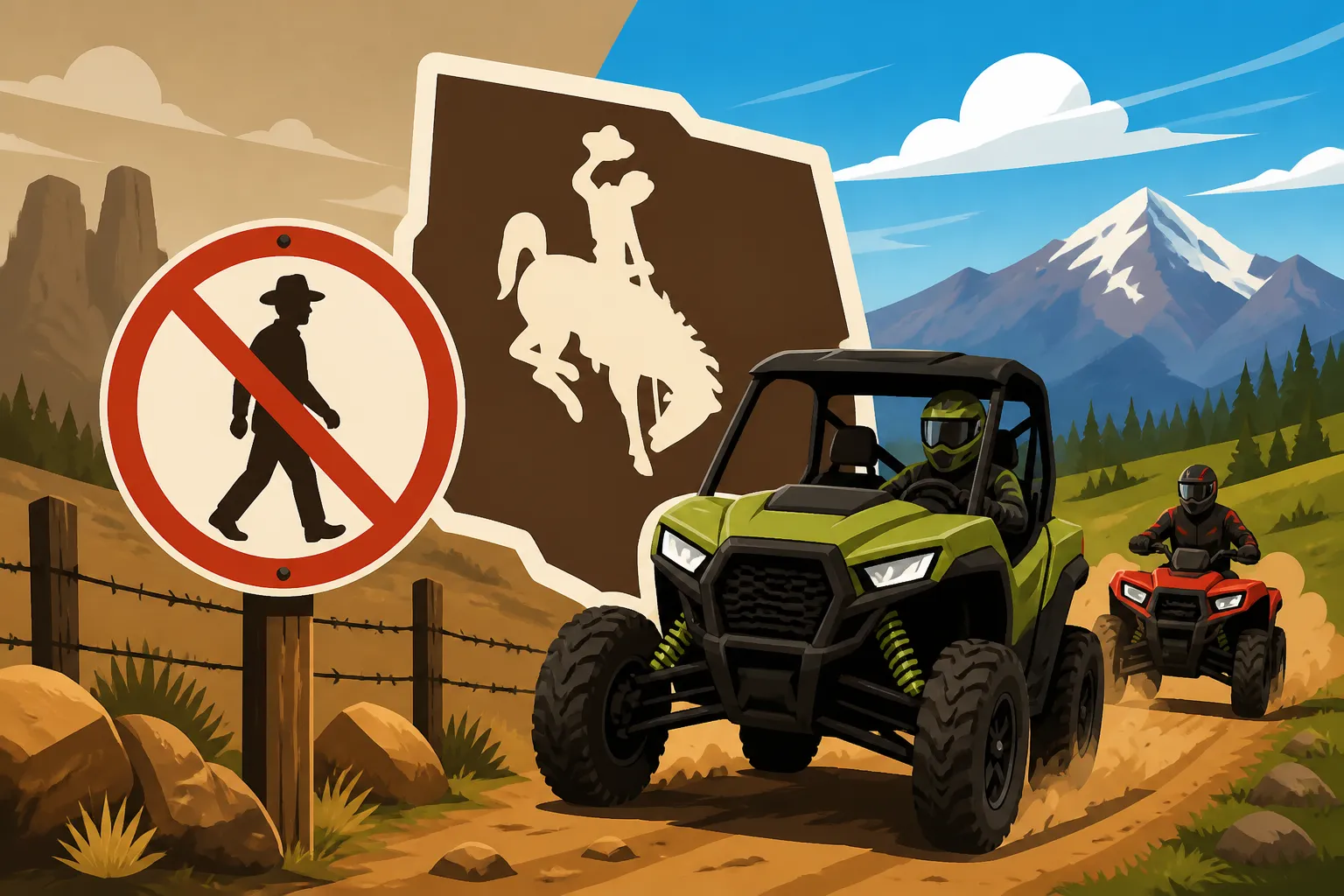
Signs can mark boundaries, seasonal restrictions, private property, or routes closed to motorized use. Take them seriously even if the route appears on a map. If a sign conflicts with your understanding of a map, stop and verify with the relevant land manager before proceeding. A route that was open on a previous trip may have changed status.
Stay on the established, authorized route. Riding around a closure, creating a bypass, or cutting across open ground can move you onto land where you lack access and may damage soil, vegetation, or ranch operations. The same applies to stopping: a route that allows travel through an area does not necessarily allow you to park, camp, hunt, or explore away from it.
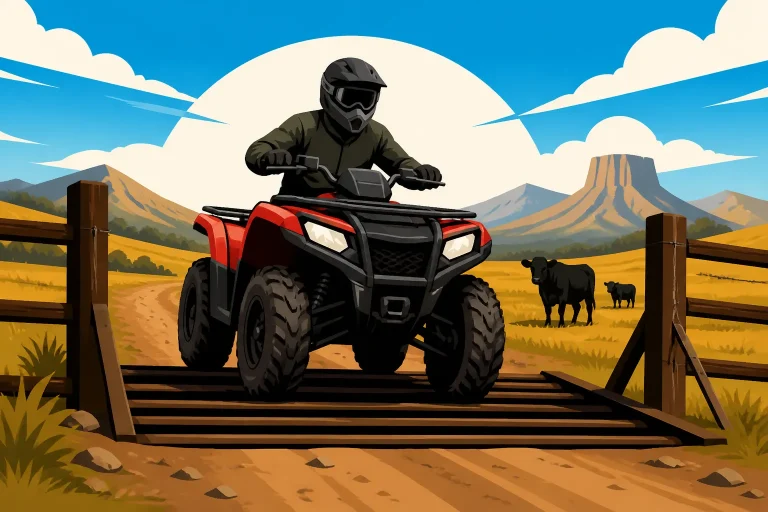
Do not treat fences, cattle guards, or property markers as obstacles to cross unless the route is specifically open and the crossing is permitted. A fence may not follow an obvious road boundary, and a track that crosses it may lead onto a separate parcel. If the route and boundary are unclear, turn back to a known legal route or contact the owner or agency.
A practical boundary check has four parts:
- Identify the land manager or owner for each segment of the planned route.
- Confirm that motorized travel is allowed on the specific road or trail, not just somewhere in the general area.
- Check for current closures, seasonal limits, and vehicle restrictions.
- Follow signs and instructions at the location, and stop if the route’s status is uncertain.
If access is challenged or you find a closure
If a landowner, manager, or enforcement officer tells you to stop or leave, stay calm and comply. Do not argue on the trail or continue riding while trying to resolve the question. If appropriate, ask politely who manages the route and where you can confirm its status. Make a note of the location and the route information you relied on, but do not take photos or collect details in a way that escalates the encounter.
If you discover a closure after starting a ride, turn around where it is safe and retrace your route. Do not ride around the sign or cross property to find a shortcut. If you cannot safely return the way you came, contact the relevant land manager or emergency services as appropriate rather than improvising a new route.
When planning, keep the land manager’s contact details and a map that works offline. A phone map can be useful, but it should not be your only access check. Carrying a current travel-management map and knowing which agency manages the area can help you avoid a confusing boundary decision with limited signal. For map-reading basics, see Wyoming Trail Maps and MVUMs.
If you believe a route has been incorrectly marked or you need permission for a specific crossing, contact the responsible agency or landowner before your next ride. Ask about the exact segment and the type of machine you plan to use. “Can I ride in this area?” may not be specific enough to resolve whether a particular road is open.
The simplest rule is to treat uncertain access as closed until you confirm otherwise. A short detour is usually less costly than a trespass dispute, a damaged relationship with a landowner, or a ride that ends with a citation. Verify the route, respect closures, and remember that a permit for the machine does not replace permission to use the land.
Disclaimer
This article is for general informational purposes only and does not constitute professional advice. Laws, prices and regulations vary by location and change over time. Consult a qualified professional for guidance on your specific situation.