Riding Over a Cattle Guard on a Two-Track
A cattle guard can make a two-track look like an established public route, but it does not tell you who owns the land or whether you may ride there. In Wyoming, the key questions are whether the route is open to your machine and whether you have permission to use it. Check those first, then cross slowly and keep livestock and other riders in mind.
Check the route before you reach the cattle guard
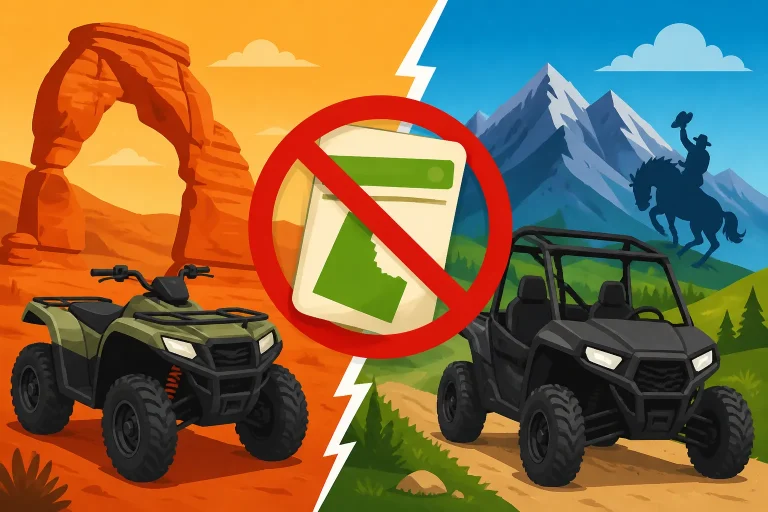
A cattle guard is a livestock-control feature, not a sign of public access. It may sit on a public road, an authorized route across public land, or a private track. Its presence alone does not make a route public, and a tire-worn two-track is not proof that off-road vehicles are allowed.
Before setting out, identify the land manager and check the route’s status. On National Forest or Bureau of Land Management land, use the current travel-management map or other official route information for that area. Public-land access is usually limited to routes designated for the type of vehicle you are riding. A track visible on a general map or satellite image may not be open to motorized use.
For more detail on route maps and designations, see Wyoming Trail Maps and MVUMs and When a Map Marks a Route Open. Pay attention to signs at the trailhead and along the route, too. If a sign says closed, do not assume an older map or visible tire tracks overrule it. When a map and sign seem to conflict, see When a Map and a Sign Disagree and confirm the route with the responsible land manager before riding.
Land ownership can change along a two-track. A route that starts on public land may cross private property, a grazing lease, or state trust land farther along. Each can have different access requirements. A route’s connection to a public road does not automatically authorize travel across every parcel it touches.
| What you encounter | What it tells you | What to check |
|---|---|---|
| Cattle guard on a two-track | The crossing is designed to help contain livestock | Whether the route is open to your vehicle and whether you have access |
| Open gate | The gate is not necessarily permission to enter | Land ownership, route designation, and any posted conditions |
| Closed or locked gate | Access may be restricted or managed | Do not bypass it; check with the landowner or land manager |
| Route shown on an official travel map | The route may be designated for certain uses | Vehicle type, seasonal restrictions, and signs on the ground |
| Tire tracks beyond the guard | Someone has traveled the route | Nothing conclusive about whether your ride is allowed |
On private land, get the owner’s permission before crossing. Do not assume that an unlatched gate, a cattle guard, or another rider’s tracks amount to consent. Wyoming’s rules for access across private property are covered in Wyoming Rules for Crossing Private Ground and Wyoming Landowner Permission Rules.
State trust land also has its own access requirements. A public road or nearby public-land route does not necessarily provide permission to ride on trust land. Check the relevant access rules before crossing or continuing. See Wyoming Riding on State Trust Land for more on this distinction.
If you cannot determine who manages the route or whether it is open, stop before entering the uncertain section. A short detour is better than trespassing, disturbing livestock, or riding into a closure. For help with a route on public land, contact the agency responsible for that area; for private land, ask the owner or an authorized representative.
Cross the guard slowly and squarely
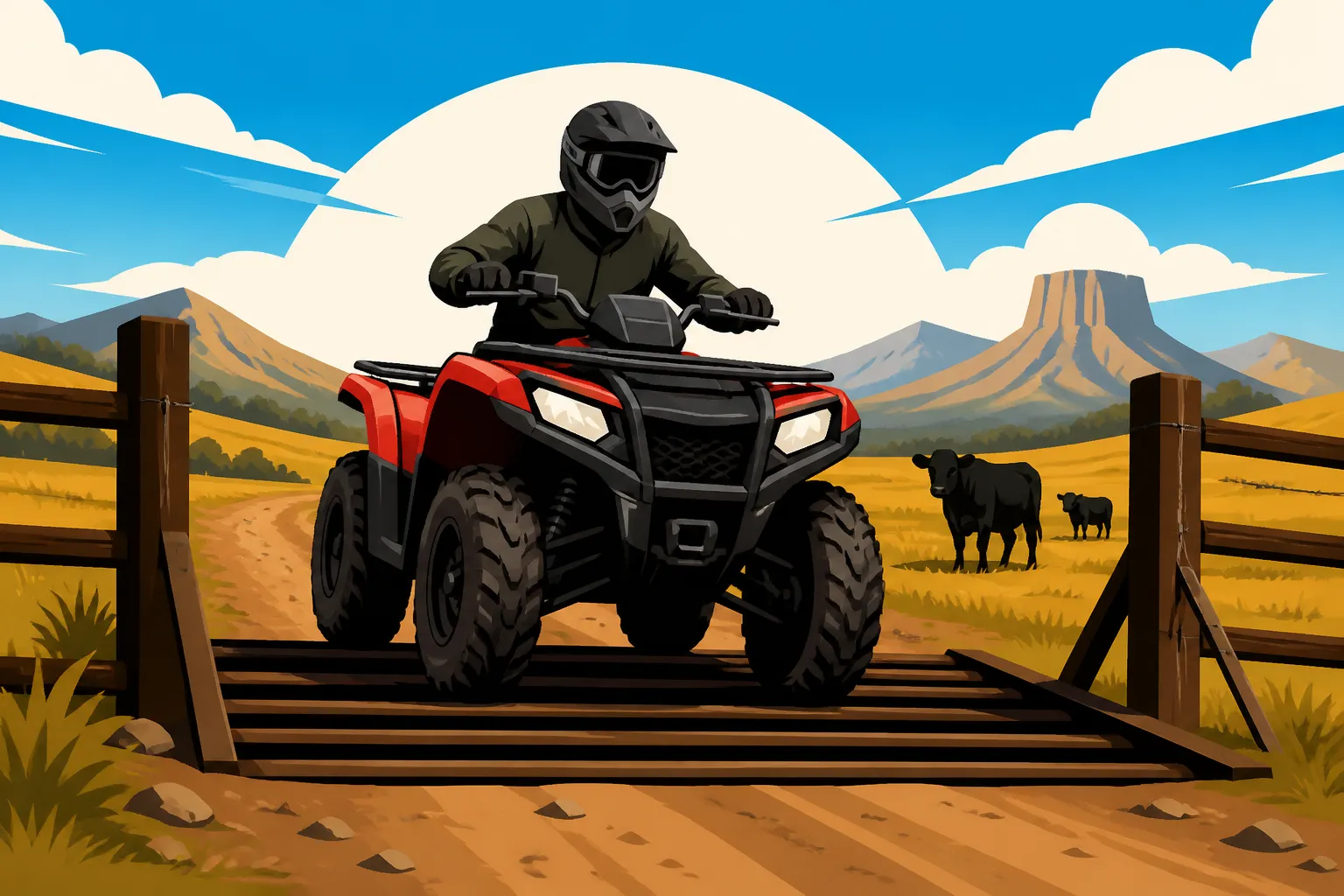
Once you have confirmed that you may use the route, approach the cattle guard at a controlled speed. The gaps between the bars can catch a tire, and a sudden turn or hard acceleration can make the crossing less stable. Slow down well before reaching the guard, keep the machine pointed straight, and cross in a steady line.
Avoid stopping on the bars unless an immediate hazard leaves you no safe alternative. Do not turn sharply while your tires are on the guard, and do not try to jump or ride across at speed. If you are unsure whether your machine can clear the crossing, stop on stable ground before it and assess the situation rather than approaching quickly.
A cattle guard may be uneven, muddy, icy, or damaged. Snow and dirt can conceal gaps, and loose gravel near the ends can reduce traction. Take extra care if you are riding a wide side-by-side, towing a trailer, or traveling with a passenger. Your machine’s tires, wheelbase, and ground clearance affect how it handles the crossing.
Before proceeding, look for:
- Missing, bent, loose, or visibly damaged bars
- Mud, snow, ice, or debris that could hide the surface or reduce traction
- A steep approach or drop-off at either end
- A narrow opening that may not safely accommodate your machine
- Livestock standing on or near the guard
- Riders, vehicles, or people approaching from the other side
If the crossing looks unsafe, do not force it. Turn around only if you can do so safely and legally, and use an authorized alternative route if one is available. Do not ride around the guard across the ground beside it: that can damage the fence, create a new track, or provide livestock with an escape path.
On a group ride, let riders cross one at a time. Leave enough room for the person ahead to clear the guard and continue before the next machine enters it. A spotter can help in poor visibility or on a difficult approach, but the rider still needs to make the crossing at a controlled pace. Keep passengers seated and avoid sudden movements.
The right speed depends on the surface and conditions; there is no useful single speed for every cattle guard. The practical aim is to approach slowly enough to inspect the crossing and maintain control throughout it. For more on riding a two-track across pastureland, see Riding a Two-Track Across a Pasture.
Leave gates and livestock as you found them
Some cattle guards are paired with gates, and a gate may be part of the landowner’s livestock-control plan. Follow signs and any instructions from the landowner or land manager. If you open a gate, close and secure it as directed. If it is already open, do not assume it should stay that way; follow posted instructions or ask the person who manages the property when possible.
This is especially important when multiple riders are traveling together. Make sure the last person knows whether a gate must be closed, and do not leave it unlatched because the next rider is still approaching. More guidance is available in Which Gates You Are Required to Close.
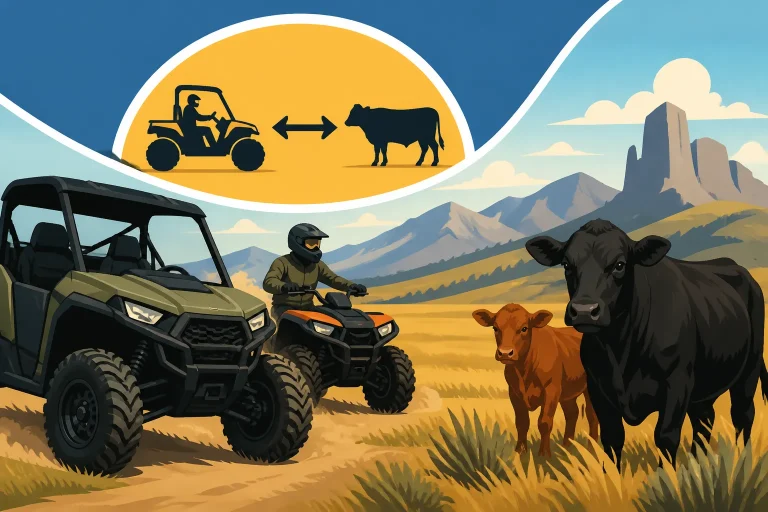
Give livestock room and do not use a machine to push animals off a cattle guard or out of your path. Sudden movement can injure an animal or rider, and a startled animal may run through a gate or onto a road. Wait at a safe distance for animals to clear the crossing. If the route is blocked, turn around or contact the land manager rather than driving through the herd.
Keep noise and speed down near livestock. Avoid revving the engine, honking, or making abrupt movements to hurry animals along. Do not stop so close that animals are crowded against a fence, and do not ride off the authorized route to go around them. Riding outside the route can damage vegetation, disturb grazing areas, or create a new path that other riders may follow.
A cattle guard is also a boundary feature: crossing it can take you into a different parcel or management area. If a sign, fence, gate, or map indicates a change in access conditions, treat that as a reason to pause and verify. Do not rely on the idea that a route must remain open because it was open earlier in the ride.
What to do when access or safety is uncertain
If you find a cattle guard on an unmarked or unclear route, do not treat the crossing as an invitation to continue. Stop somewhere safe before the guard, check your map and signs, and identify the land manager or owner. If you cannot confirm that the route is open, turn back rather than guessing.
Do not cross a closed route, bypass a barrier, or make a new track beside the cattle guard. Those actions can damage property and create problems for future access. If you are already on a route and encounter a closure sign, follow the closure rather than riding farther to see whether another route opens ahead. The practical considerations in Wyoming Rules for Riding a Grazing Lease and Wyoming Trespass Law and Off-Road Riders can help clarify why access status matters even when a track is easy to follow.
If the cattle guard is damaged or appears dangerous, avoid it if you can do so without leaving the authorized route. Report the problem to the landowner or the responsible agency, giving the location and a clear description. Do not attempt to repair or remove bars, wire, or fencing unless you have permission and the task is within your ability. Moving livestock-control equipment can create a hazard for animals and other riders.
A simple pre-ride routine can prevent most access and crossing mistakes:
- Check an official travel-management map and confirm that the route is open to your type of machine.
- Look for private-property boundaries, state trust land, closures, and seasonal restrictions.
- Follow signs and instructions at the route entrance and at the cattle guard.
- Approach slowly, inspect the surface, and cross straight without stopping or turning sharply on the bars.
- Close gates as directed, give livestock room, and stay on the authorized route.
- If access or crossing safety is uncertain, stop and verify or turn back.
The essential distinction is simple: the cattle guard controls livestock; it does not grant riding access. Confirm that the two-track is authorized before crossing, then handle the guard as a slow, controlled obstacle and leave the fence, gate, and animals undisturbed.
Disclaimer
This article is for general informational purposes only and does not constitute professional advice. Laws, prices and regulations vary by location and change over time. Consult a qualified professional for guidance on your specific situation.