Asking a Wyoming Rancher for Access
A route on a map may cross a ranch, follow a grazing allotment, or pass close to livestock, and it is not always obvious who can authorize access. Asking the right person—and being specific about where and when you plan to ride—can prevent a trespass problem and make it easier for a landowner to say yes or no.
First, Find Out Who Can Grant Access
A Wyoming rancher may own the land you want to cross, lease it, manage livestock on it, or use a public route nearby. Those situations are not interchangeable. Before asking for permission, work out what land you are dealing with and who has authority over it.
Permission from a private landowner is not the same as permission to use public land. Likewise, a rancher who holds a grazing lease may not be able to grant recreational access across the leased ground. The rules for riding private property differ from the rules for riding a grazing allotment or state trust land. For background, see Wyoming Rules for Riding Private Land, Wyoming Rules for Riding a Grazing Lease, and Wyoming Trust Land and Its Own Permit.
A public map can help you identify a possible route, but it may not tell you who owns every parcel or whether a particular track is open to motorized travel. Check the current land-management map and the signs on the ground. If a route crosses more than one type of property, you may need to confirm access with more than one landholder or agency. A rancher’s permission for one stretch does not authorize riding across neighboring private property or onto a closed public route.
| What you find | Who to ask or check with | What not to assume |
|---|---|---|
| Privately owned ranch land | The owner or someone authorized to grant access | That a visible two-track is open to the public |
| Land used under a grazing lease | The land manager and the agency responsible for the land | That the leaseholder can grant recreational access |
| State trust land | The responsible state land office and its recreational access requirements | That a nearby rancher can authorize your ride |
| A route shown on a public map | The agency or land manager responsible for the route | That the route is open to every vehicle or in every season |
| A route crossing several parcels | Each relevant owner or land manager | That one person’s permission covers the full route |
If you are unsure, pause and verify before riding. The practical details of Wyoming Landowner Permission Rules and Riding a Grazing Lease You Do Not Hold can help you identify why a verbal “it’s fine” from someone nearby may not settle the question.
Also separate land access from vehicle requirements. A Wyoming ORV permit does not give you permission to cross private land. Conversely, permission to cross private land does not necessarily meet permit or route requirements elsewhere on your ride. Check both sides of the question: are you allowed to be on the land, and is your machine allowed on that route?
Make a Clear, Respectful Request
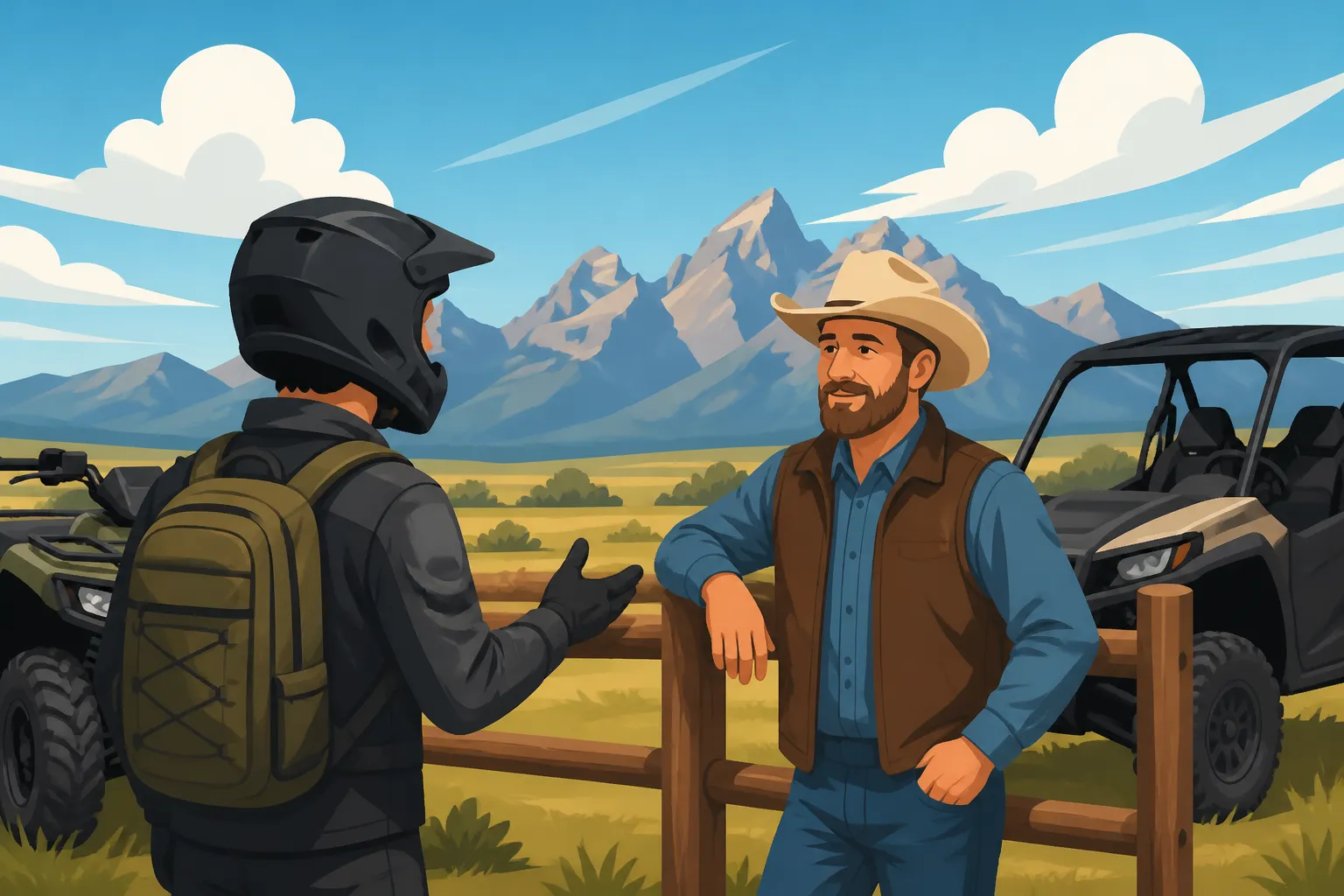
A useful access request is easy to assess. Give the rancher enough detail to understand the trip without making them do the work of planning it for you. Be concise, polite, and prepared to hear no.
When possible, ask well before your planned ride. Avoid showing up during a busy time, such as when livestock are being moved or work is underway. If you meet someone at a gate or while they are handling animals, ask whether there is a better time or way to contact them rather than trying to settle a complicated request on the spot.
Include these details:
- Your route: Identify the road, trail, or parcel you hope to cross. A map with your proposed line marked can make the request clearer.
- Your dates and timing: Give the intended day or date range and an approximate time of travel.
- Your group size: State how many riders and machines will be in the group.
- Your machine type: Say whether you will use ATVs, UTVs, or a mix, and mention any trailer or support vehicle if it will also enter the property.
- Your purpose: Explain whether you are asking to cross to reach another area, ride a specific route, or visit a particular place.
- Your plans for gates and livestock: Let the owner know you will follow their instructions and ask what they want you to do at gates or around animals.
- Your contact details: Provide a way to reach you if the rancher needs to change the arrangement or tell you a route is unavailable.
A request might sound like this:
“I’m planning a small ATV ride on Saturday and would like to ask whether we may cross the ranch on the road shown on this map between the north gate and the county road. We would have two machines, stay on that route, and be through by early afternoon. Is that land yours to authorize, and are there any gates, livestock, or other conditions we should know about?”
That wording leaves room for the rancher to clarify ownership or authority. It also avoids treating access as a right or assuming that a route is available just because it appears on a map.
If the answer is no, thank them and do not argue, enter anyway, or ask another person on the ranch to overrule the decision. If the rancher says the parcel is not theirs, ask whether they know which agency or owner you should contact, but do not treat a referral as permission.
Agree on the Route and Conditions
If the rancher agrees, make sure you understand exactly what has been approved. “You can ride through” may sound clear at first, but details matter when a route branches, a gate is locked, or livestock are in a different pasture than expected.
Confirm the basics before you leave:
- Where access begins and ends. Ask which entrance to use and where you are expected to leave the property.
- Which route to follow. Confirm that you should stay on a particular road or track. Do not add side trips or shortcuts without asking.
- When the permission applies. Access for one date or trip should not be treated as ongoing permission.
- How to handle gates. Ask whether each gate should be left as found, closed, or handled another way. Follow the owner’s specific direction.
- What to do around livestock. Ask whether certain pastures, water sources, or areas are off limits, and what to do if animals block the route.
- Whether the group may bring others. Do not assume permission for your group extends to friends who arrive separately or to a larger group.
- What to do if conditions change. Ask how to check for a closure, livestock movement, or other change before riding.
A written message, email, or text can help both sides remember the agreed route and conditions. It is not a substitute for understanding the landowner’s authority or following applicable rules. Keep the message and the map available during the ride, and contact the rancher if your plans change.
Permission is limited to what the owner or authorized person actually agreed to. It does not automatically cover camping, hunting, collecting items, bringing a trailer across the property, or returning on another day. If you want to do something beyond the original request, ask first.
Be especially careful with grazing leases. A person who runs cattle on land may not own the land or control recreational access. Confirm who has authority rather than relying on the fact that a gate, fence, or ranch operation is present. The distinction is important when considering Wyoming Trespass Law and Off-Road Riders.
Ride as Agreed and Leave the Ranch in Good Shape
Once access is granted, the most reliable way to preserve a good relationship is to do exactly what you agreed to do. Stay on the approved route, keep the group together, and ride at a speed that gives you time to respond to livestock, people, and changing conditions. A route that is acceptable for one small group may not be suitable for repeated use or a large gathering.
Gates deserve particular attention. A gate left open can let livestock move into the wrong pasture or onto a road; a gate closed when the owner expected it to remain open can also disrupt ranch work. Do not rely on a general rule when the owner has given a specific instruction. If you reach a gate you were not told about, or cannot tell what position it was in, stop and contact the rancher if possible. For more detail, see Which Gates You Are Required to Close.
Give animals plenty of room. Avoid chasing, crowding, or splitting a group of livestock. If cattle or other animals are on the road, slow down and wait for a safe opportunity to pass only if the rancher’s directions allow it. Do not honk or rev the machine to push them along. If you are uncertain about what is safe, wait and ask. Wyoming Rules for Riding Near Cattle and Wyoming Trail Etiquette With Ranchers offer related guidance.
Stay alert for posted signs and new closures. A landowner may need to change access because of livestock work, weather, fire conditions, or another concern. If a sign says the route is closed, do not assume your earlier permission overrides it; contact the person who granted access and clarify before continuing. Permission for one private crossing also does not mean you may leave the approved route to explore nearby public land.
At the end of the ride, leave gates as directed, pack out all trash, and report any problem you caused or encountered, such as a damaged fence or a gate that will not latch. Do not wait for the rancher to discover it. A prompt, factual message is more useful than silence, and it gives the owner a chance to address a problem before livestock or other riders are affected.
If you want to return, ask again rather than assuming the first approval remains valid. Access may depend on the season, the condition of the route, or current ranch operations. A courteous request, a clear plan, and careful riding cannot guarantee that permission will be granted, but they make the decision easier and help keep private access separate from public-route access.
Disclaimer
This article is for general informational purposes only and does not constitute professional advice. Laws, prices and regulations vary by location and change over time. Consult a qualified professional for guidance on your specific situation.